

Order Total (1 Item Items):
Shipping Destination:

Columbus Fernando (9 results)
Skip to main search results
Search filters
Product Type
- All Product Types
- Books (8)
- Magazines & Periodicals (No further results match this refinement)
- Comics (No further results match this refinement)
- Sheet Music (No further results match this refinement)
- Art, Prints & Posters (No further results match this refinement)
- Photographs (No further results match this refinement)
- Maps (No further results match this refinement)
- Manuscripts & Paper Collectibles (1)
Condition Learn more
- New (2)
- As New, Fine or Near Fine (No further results match this refinement)
- Very Good or Good (No further results match this refinement)
- Fair or Poor (No further results match this refinement)
- As Described (7)
Binding
- All Bindings
- Hardcover (3)
- Softcover (No further results match this refinement)
Collectible Attributes
- First Edition (3)
- Signed (No further results match this refinement)
- Dust Jacket (No further results match this refinement)
- Seller-Supplied Images (8)
- Not Print on Demand (7)
Language (1)
Free Shipping
Seller Location
Seller Rating
-

high voyage ppb1st 500th anniversary of columbus discovery of america , novel of diary of columbus son fernando , last 1504
Published by arling, 1992
First Edition
fair.
-

The Discovery of America. From the Life of Columbus by His Son
Published by Directors of the Old South Work ca. 1900], [Boston, 1900
Seller: Lorne Bair Rare Books, ABAA, Winchester, VA, U.S.A.
Association Member: ABAA ILAB IOBA
Seller rating 5 out of 5 stars

Small octavo (18cm.); pictorial staplebound self-wrappers; 16pp. Toning to extremities, tiny chips at spine ends, else Very Good and sound. Issued as Old South Leaflets, General Series, no. 29.
-

The Life of the Admiral Christopher Columbus by his son Ferdinand. Translated and annotated by Benjamin Keen. First Folio Society edition (this edition and translation was originally published: New Brunswick, Rutgers University Press, 1959).
Published by The Folio Society, London, 1960
Seller: AixLibris Antiquariat Klaus Schymiczek, Aachen, Germany
Association Member: BOEV
Seller rating 5 out of 5 stars
Gr.8° (25,1 x 15,7 cm). Erste Auflage, 271 S. OHalblederband mit Rückenblindprägung - Deckelbezüge mit blass-violettem Holzfurniermuster, OPappschuber. Sprache: Englisch, Mit 11 Tafeln nach alten Vorlagen (Holzschnitten und Kupferstichen), 8 teils ganzseitigen Karten im Text und 2 (wiederholten) Karten auf den Vorsätzen. Schuber etwas berieben und mit kleinen Anplatzungen an den Schuberkanten; Einband am Rücken etwas berieben und deutlicher beschabt (wie meist bei diesem empfindlichen, wildlederähnlichen Rücken); gering bestoßen; Schnitt etwas stockfleckig.
-
La vie de Cristofle Colomb, et la decouverte qu'il a faite des Indes occidentales, vulgairement appellées le Nouveau monde. Traduite en François. [par Charles Cotolendy].
Published by Paris: Claude Barbin et Christophe Ballard, 1681. 1681, 1681
Seller: JF LETENNEUR LIVRES RARES, Saint Briac sur mer, France
Association Member: ILAB
Seller rating 5 out of 5 stars
First Edition
2 parties reliées en 1 vol. in-12° (167 x 96 mm.) de: (12) ff. ; 262 pp. ; (1) f. bl. ; (12) ff., 260 pp. (Salissures, défauts d'usage, 2 ff. restaurés, divers ex-libris et cachets humides anciens sur les p. de titre). Pleine basanne 18 ème, dos lisse, titre de maroquin brun, tranche-fils de papier bleuté. (Dos discrétement restauré). Première édition française, traduite de l'original italien (1571, Venise) de cette biographie de Christophe Colomb par un de ses contemporains qui le connaissait le mieux : son fils Ferdinand. Henry Vignaud, critique sévère des origines de la soi-disant légende de Columbus, l'a jugé "la plus importante de nos sources d'information sur la vie du découvreur de l'Amérique", et Washington Irving l'a honoré comme "la pierre angulaire". de l'histoire du continent américain. " Un historien plus récent, Benjamin Keen, traducteur et éditeur de Historie de Ferdinand - publié sous le titre « The Life of Admiral Christopher Columbus by his sohn Ferdinand (1959) la considère comme «une uvre de grande autorité» et continue: « L'Histoire de Ferdinand est plus . qu'une source riche et fidèle d'informations sur Christophe Colomb, c'est aussi un document personnel émouvant qui recrée l'atmosphère morale et intellectuelle du monde de Colomb et les passions tourbillonnantes dont il était le centre ». « Pour le reste, le livre de Ferdinand a les vertus irrésistibles d'une histoire d'aventure splendide : c'est en grande partie un récit d'action direct . le moment haletant de découverte, naufrage, tempête, bataille avec des mutins ou Indiens, ou marronnage. » Ferdinand accompagna son père, Amiral de la Mer Océan, lors de son quatrième voyage en Amérique en 1502-1504, l'aventure la plus difficile et la plus désastreuse de toutes. Il écrit donc pour partie de son expérience, du récit de son père concernant les autres voyages et de l'accès unique à ses papiers. Que la première édition de l'Historie n'ait été publiée que plus de trente ans après la mort de son auteur, et en italien plutôt qu'en espagnol, est expliquée dans ce passage de la vie de Columbus par l'amiral Samuel Eliot Morison (1942) : «Ferdinand commença très tôt la biographie que nous ne connaissons pas, mais elle ne fut achevée que peu de temps avant sa mort: le manuscrit, disparu depuis, fut emmené par D. Luis Colon, petit-fils de l'amiral, en Italie en 1568 avant qu'une édition espagnole est pu été imprimée, et le seul texte qui subsiste est une traduction italienne d'Alfonso Ulloa imprimée à Venise en 1571. » Don Luis, fils de Diego, était le «petit-fils playboy du découvreur» (Keen), qui s'intéressait à des sujets plus vivants que les papiers de famille. Ainsi, il cédat le manuscrit de l'Histoire de Ferdinand à un riche médecin génois, Baliano de Formari, qui a assuré la traduction et la publication, et à qui l'ouvrage est dédié. A noter : au cours du siècle dernier, l'Américain Henry Harrisse a émis des doutes quant à la paternité de Ferdinand sur la base de preuves qui semblaient impressionnantes à l'époque. La découverte de preuves ultérieures tend à réfuter fortement la conclusion de Harrisse et démontre les pièges de la conjecture bibliographique, même quand faite par des experts.) Quand Ferdinand Columbus (né en 1488) était un jeune garçon il est devenu page auprès de l'héritier espagnol, le prince Juan, et plus tard de la mère du prince, la reine Isabelle. À treize ans, en 1602, il se rendit en Amérique avec son père, puis de nouveau, en 1609, avec son frère aîné, Diego, qui était gouverneur d'Hispaniola (St Domingue). Par la suite, il voyagea beaucoup en Europe, servit le gouvernement espagnol avec sa connaissance des colonies et de la géographie, et agit comme conseiller juridique de Diego dans ses différends avec la Couronne sur les droits des héritiers du Découvreur. Il est probable que son historique basé en partie sur des documents rassemblés pour servir sa défense en cas de litige. La part de Ferdinand dans la succession de son père comprenait les revenus du travail de 400 esclaves à Hispaniola, ce qui, avec plusieurs sinécures royales, en fit un homme riche. Une grande partie de son argent qu'il a dépensé pour les livres et les manuscrits et la collection est devenue sa dépense la plus importante. Sa bibliothèque de plus de 15 000 volumes a été léguée au chapitre de la cathédrale de Séville. En raison de siècles de négligence, la collection s'est réduite à environ 2.000 volumes, mais la « Bibliotheca Colombina », comme on l'appelle, reste néanmoins l'un des grands trésors des livres. 2 parts bound in 1 vol. in-12° (167 x 96 mm.) of: (12) ff.; 262 pp.; (1) bl. f.; (12) ff., 260 pp. (Soiling, defects of use, 2 restored ff., various bookplates and old damp stamps on the title pages). Comtemporary sheep. First French edition, translated from the original Italian (1571, Venise), of the first biography of Christopher Columbus, by one of his contemporaries who knew him best, his portside son, Ferdinand. Henry Vignaud, severe critic of the origins of the so-called Columbus Legend, judged it to be "the most important of our sources of information on the life of the discoverer of America," and Washington Irving honored it as "the corner-stone of the history of the American continent." A more recent historian, Benjamin Keen, translator and editor of Ferdinand's Historie - published as The Life of Admiral Christopher Columbus by His Son Ferdinand, New Brunswick, N. J. (Rutgers University Press), 1959 - calls it "a work of great authority," and continues: "Ferdinand's Historie is more than a rich and faithful source of information about Columbus. It is also a moving personal document that vividly re-creates the moral and intellectual atmosphere of Columbus's world and the swirling passions of which he was the center. . . ."."For the rest, Ferdinand's book has the irresistible virtues of a splendid adventure story. It is in large part a straightforward narrative of action . . . the breathless moment of discovery,
-
EL TESTAMENTO DE HERNANDO COLON [spine title].
Published by [Madrid: Testimonio Compañia Editorial, 1993]., 1993
Seller: William Reese Company, New York, NY, U.S.A.
Association Member: ABAA ESA ILAB SNEAB
Seller rating 4 out of 5 stars

A highly detailed and magnificently reproduced facsimile of the last will and testament of Fernando Columbus (or Hernán Colón, in his native Spanish), second son of the great explorer, originally created at Seville in 1539. Fernando accompanied his father on his fourth voyage to the New World in 1502, and is perhaps best known as the author of his father's first biography, considered one of the most important (and in many cases, the only) sources for the life of Columbus. Fernando was also a humanist and a great book collector, and much of the text of this testament concerns the distribution and care of his library (which included the books he inherited from his father). It is perhaps thanks to the detailed instructions in this document that nearly half of the 15,000-volume collection (including nearly 1200 incunables and hundreds of Dürer prints) survives today at the Institución Colombina, at the Cathedral of Seville. This testament gives precise rules for the ordering and storage of the books, names a full-time librarian (Juan Pérez), and provides rules for expanding the collection. This extremely faithful facsimile recreates the original document in color, extent, and size, and has been rendered at a level of detail down to edge wear, dampstaining, and even the cutting of precise worm trails. This copy is without the volume of commentary in Spanish which originally accompanied the facsimile. From an edition limited to 980 copies, this is number 172. Folio. Blindstamped calf, four small brass bosses on each board, spine gilt with raised bands. Modern bookplate on front pastedown. Fine.
-
Historie del S. D. Fernando Colombo; nelle quali s'ha particolare, & vera relatione della vita, & de' faiti dell' Ammiraglio D. Christoforo Colombo, suo padre
Published by Francesco de'Franceschi Sanese, Venice, 1571
Seller: James Cummins Bookseller, ABAA, New York, NY, U.S.A.
Seller rating 4 out of 5 stars
First Edition
First edition. First edition. a-b? c? A-2H?; [20], 247, [1] leaves. 12mo. The first edition of the life of Christopher Columbus, written by his illegitimate son, Fernando, and translated into Italian by Alfonso Ulloa from the original Spanish manuscript. Fernando accompanied his father on his fourth voyage to the New World in 1502, and was witness to many of the events described in the text. While the authenticity of this work was challenged by early commentators, modern researchers have increasingly found it an accurate source of information on many of the events of Christopher Columbus' life. It is now generally considered "the most important of our sources of information on the life of the discoverer of America" (Vignaud). "His work is an invaluable document, entitled to great faith, and is the cornerstone of the history of the American continent" (The English Catalogue, quoted in Sabin). "Still remains the only source of information upon many events in the life of Columbus" (Church). Church 114; European Americana 571/8; JCB (3) I:244; LeClerc 138; Rich 47; Sabin 14674; STC (Italian), p.190; Streeter Sale 22 Later crushed green morocco gilt, marbled endpapers, gilt edges. Housed in a morocco backed box. Provenance: Giovanni Pietro Pestalozzi (signature on rear blank) a-b? c? A-2H?; [20], 247, [1] leaves. 12mo.
-
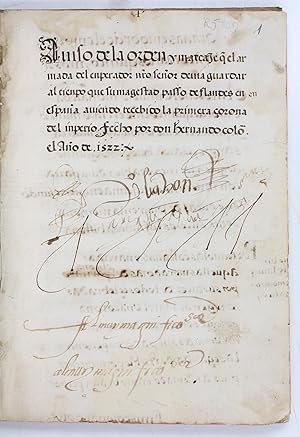
Aviso de la Orden y Mareaje a la Armada del Emperador Nro Señor Debia Guardar al Tiempo que su Majestad Paso de Flandes en España Habiendo Recibido la Primera Corona del Imperio Fecho 1522.
Published by [Seville, ca. 1522]., 1522
Seller: Antiquariat INLIBRIS Gilhofer Nfg. GmbH, Vienna, A, Austria
Association Member: ILAB VDA VDAO
Seller rating 5 out of 5 stars
Manuscript / Paper Collectible
4to. 79 pp. Contemporary manuscript. Paper watermarked with hand and star motif (Briquet, Les Filigranes 10772) dating it to ca. 1507 and from Konstanz, to the southwest of Worms. Contemporary limp vellum with remains of ribbon ties; reddened edges. Stored in custom-made blue half morocco solander box with gilt spine. Exceptional manuscript by Hernando Colón (Fernando Columbus), one of the first people to travel to America as early as 1502, and son of the most famous explorer of all times. - The present "Aviso de la Orden y Mareaje" was composed by Hernan Colón (1488-1539), one of the first Europeans to travel and explore the coasts of America, a renowned bibliophile and the son of Christopher Columbus, to provide the recently crowned Holy Roman Emperor, Charles V, with a set of guidelines for travelling by sea from Flanders to Spain in 1522. Hernando Colón formed part of Charles's retinue and accompanied him on this 1522 voyage. He based his advice on his own extensive knowledge of sea travel that dated from his sailing as a 13-year-old boy on Christopher Columbus's fourth and most dangerous voyage to the Americas (1502-04) when father and son, in the course of exploring the American mainland coast between Honduras and Panama, had been shipwrecked on Jamaica for almost a full year. - In this treatise, Hernando, who had been a member of the Spanish royal court from a young age, is surprisingly frank with Charles V about the practical measures he recommends for a safe journey. He notes that the dangers at sea "usually come from one of four reasons. The first is due to too much tempest. The second, lack of some necessary rigging [in this context, probably equipment]. The third, due to shoals, banks and reefs. The last, as a result of the opposition of enemies" ("suelen venir por una de quatro causas. La pr[i]mera por demasiada tormenta. La segu[n]da por falta de algun aparejo. La tercera por razon d[e] baxos y bancos y arracifes. La ultima por contrariedad d[e] enemigos", ff. 5v-6). Hernando then proceeds to explain the measures by which these dangers can best be offset, thereby discussing the numbers, types and sizes of ships which should compose the emperor's fleet; the manner in which each of these vessels is to be selected and inspected to ensure their seaworthiness; and the way in which each of these was to be fitted out, armed, manned and governed. - Hernando's advice is comprehensive when it comes to the organization of such a journey but even extends to the management of the emperor himself, including details of where on the "nao" Charles should have his quarters, his daily routine, the number of attendants he should have, and even on what he should eat. Here, Hernando notes that "it is also commonly held that anything sour, for being cold, is harmful, for which reason it is considered better to have meals such as stews, not phlegm-inducing foods, and warm preserves such as nutmegs and ginger, as well as good, sweet-smelling wines and those seasoned with spices such as hippocras or spiced white wine. Fruits, cheese and onions should be avoided. Above all, one should be well wrapped up, especially the stomach and the feet, and one should not occupy the mind with business or writing but only in leisure, going out to take fresh air regularly without looking too much at the sea. Some consider it very welcome to purge oneself lightly even before going on board and eating during the first days with some moderation" ("Tanbien [!] es comun opinion qu[e] toda cosa agria por ser fria es nociva por lo qual tienen por meior manjares exutos y asados y no flemosos y conservas calientes y oderiferas como nuezes moscadas y gengibre y buenos vinos odoriferos y algunos dellos adobados con especicas [!] como el hypocras, y la clarea, y devêse evitar las frutas, y el q[ue]so y las cebollas y sobre todo andar bien arropado especialmente el estomago y los pies y no ocupar el sentido mucho en negocios ni escrituras salvo en tomar plazer y salir do corte el ayre fresco sin mirar mucho la mar y aun algunos a[n]te del enbarcar [!] hallan muy saludable purgarse ligeramente comiendo los primeros dias con alguna regla", ff. 11v-12). - Despite its value for the history of travel and for an understanding of 16th century approaches to the transport by sea of high-status individuals such as Charles V, the "Aviso de la Orden y Mareaje" remains apparently unpublished and little known, most likely because it was written so relatively early in Hernando Columbus's career and due to the extreme rarity of surviving copies. Scholars have been aware of the Aviso's existence in part through a reference to it made by Columbus himself in 1524 in the "Declaracion del derecho que la Real corona de Castilla tiene ", where he noted that "I ventured to write to Your Majesty with that Treatise or order of navigation for the most high and happiest voyage of the Emperor, from Flanders to Spain" ("me atreví a escribir a V.M. con aquella Escritura o forma de navegación para el alto y felicísimo Viaje del Emperador, desde Flandes en España"; original version available online from the Real Biblioteca, II/652, and published in M. Salvá & P. Saínz de Baranda, Colección de Documentos Inéditos para la Historia de España, Madrid: La Viuda de Calero, 1850, XVI, document 3, pp. 382-420, at p. 383). - Juan Guillén Torralba has noted that "among the papers that Don Hernando kept until the end of his days and which were referred to by his executors, there appeared one that, almost certainly, is that of the voyage of Charles V, which has as a title: Aviso de la orden y mareaje del Emperador" ("Entre los papeles que conservó don Hernando hasta el final de susdías y de los que hicieron relación sus albaceas, apareció uno que, casi seguro , es este del viaje de Carlos V, que lleva como título: Aviso de la orden y mareaje . del Emperador", Guillén Torralba, Hernando Colón: humanismo y bibliofilia, Seville: Fundación José Manuel Lara, 2004, p. 101).
-
![Seller image for Nuevos auto?grafos de Cristo?bal Colo?n y relaciones de ultramar : los publica la duquesa de Berwick y de Alba, condesa de Siruela 1902 [LeatherBound] for sale by True World of Books](https://pictures.abebooks.com/inventory/md/md31533585629.jpg)
LeatherBound. Condition: New. BOOKS ARE EXEMPT FROM IMPORT DUTIES AND TARIFFS; NO EXTRA CHARGES APPLY. LeatherBound edition. Condition: New. Reprinted from 1902 edition. Leather Binding on Spine and Corners with Golden leaf printing on spine. NO changes have been made to the original text. This is NOT a retyped or an ocr'd reprint. Illustrations, Index, if any, are included in black and white. Each page is checked manually before printing. Pages: 328 As this print on demand book is reprinted from a very old book, there could be some missing or flawed pages, but we always try to make the book as complete as possible. Fold-outs, if any, are not part of the book. If the original book was published in multiple volumes then this reprint is of only one volume, not the whole set. Sewing binding for longer life, where the book block is actually sewn (smythe sewn/section sewn) with thread before binding which results in a more durable type of binding. Pages: 328 Language: Spanish.
-
Leather Bound. Condition: New. Language: Spanish. Language: Spanish, Castilian. Presenting an Exquisite Leather-Bound Edition, expertly crafted with Original Natural Leather that gracefully adorns the spine and corners. The allure continues with Golden Leaf Printing that adds a touch of elegance, while Hand Embossing on the rounded spine lends an artistic flair. This masterpiece has been meticulously reprinted in 2025, utilizing the invaluable guidance of the original edition published many years ago in 1902. The contents of this book are presented in classic black and white. Its durability is ensured through a meticulous sewing binding technique, enhancing its longevity. Imprinted on top-tier quality paper. A team of professionals has expertly processed each page, delicately preserving its content without alteration. Due to the vintage nature of these books, every page has been manually restored for legibility. However, in certain instances, occasional blurriness, missing segments, or faint black spots might persist. We sincerely hope for your understanding of the challenges we faced with these books. Recognizing their significance for readers seeking insight into our historical treasure, we've diligently restored and reissued them. Our intention is to offer this valuable resource once again. We eagerly await your feedback, hoping that you'll find it appealing and will generously share your thoughts and recommendations. Lang: - Spanish, Castilian, Pages:- 328, Print on Demand. If it is a multi-volume set, then it is only a single volume. We are specialised in Customisation of books, if you wish to opt different color leather binding, you may contact us. This service is chargeable. Product Disclaimer: Kindly be informed that, owing to the inherent nature of leather as a natural material, minor discolorations or textural variations may be perceptible. Explore the FOLIO EDITION (12x19 Inches): Available Upon Request. 328 328.


![Seller image for La vie de Cristofle Colomb, et la decouverte qu'il a faite des Indes occidentales, vulgairement appellées le Nouveau monde. Traduite en François. [par Charles Cotolendy]. for sale by JF LETENNEUR LIVRES RARES](https://pictures.abebooks.com/inventory/md/md22846645128.jpg)
![Seller image for EL TESTAMENTO DE HERNANDO COLON [spine title]. for sale by William Reese Company](https://pictures.abebooks.com/inventory/md/md32322628016.jpg)


![Seller image for Nuevos auto?grafos de Cristo?bal Colo?n y relaciones de ultramar : los publica la duquesa de Berwick y de Alba, condesa de Siruela 1902 [Leather Bound] for sale by Gyan Books Pvt. Ltd.](https://pictures.abebooks.com/inventory/md/md30264589798.jpg)