

Order Total (1 Item Items):
Shipping Destination:

De Morgan August (2 results)
Skip to main search results
Search filters
Product Type
- All Product Types
- Books (2)
- Magazines & Periodicals (No further results match this refinement)
- Comics (No further results match this refinement)
- Sheet Music (No further results match this refinement)
- Art, Prints & Posters (No further results match this refinement)
- Photographs (No further results match this refinement)
- Maps (No further results match this refinement)
- Manuscripts & Paper Collectibles (No further results match this refinement)
Condition Learn more
- New (No further results match this refinement)
- As New, Fine or Near Fine (No further results match this refinement)
- Very Good or Good (1)
- Fair or Poor (No further results match this refinement)
- As Described (1)
Binding
- All Bindings
- Hardcover (1)
- Softcover (No further results match this refinement)
Collectible Attributes
- First Edition (2)
- Signed (No further results match this refinement)
- Dust Jacket (No further results match this refinement)
- Seller-Supplied Images (1)
- Not Print on Demand (2)
Language (1)
Price
- Any Price
- Under US$ 25 (No further results match this refinement)
- US$ 25 to US$ 50
- Over US$ 50
Free Shipping
- Free Shipping to U.S.A. (No further results match this refinement)
Seller Location
Seller Rating
-

A Budget of Paradoxes: Reprinted with the Author's Additions, from the Athenaeum Vols. I & II
Published by The Open Court Publishing Co, 1915
First Edition
Hardcover. Condition: Good. No Jacket. Second Edition. The Open Court Publishing Co., 1915 Two volumes, viii, 401 pp - vol. I & 387 pp - vol. II. Ex-libe Columbia University School of Mathmatics. Texts are clean, tight and unmarked. Vol.I has front hinge cracked but holding. Red cloth boards are rubbed at extremities. Augustus De Morgan 1806-1871) was a British mathematician and logician. He formulated De Morgan's laws and introduced the term mathematical induction, making its idea rigorous. A Philosophical Society had been inaugurated at Cambridge; and to its Transactions De Morgan contributed four memoirs on the foundations of algebra, and an equal number on formal logic. The best presentation of his view of algebra is found in a volume, entitled Trigonometry and Double Algebra, published in 1849; and his earlier view of formal logic is found in a volume published in 1847. His most distinctive work is styled A Budget of Paradoxes; it originally appeared as letters in the columns of the Athenæum journal; it was revised and extended by De Morgan in the last years of his life, and was published posthumously by his widow. Second Edition. Hard Cover. Good/No Jacket. 8vo - over 7¾" - 9¾" tall. Ex-Library.
-
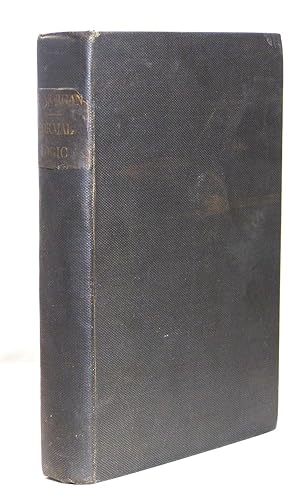
Formal Logic or, The Calculus of Inference, Necessary and Probable.
Published by Taylor and Walton, London, 1847
Seller: Athena Rare Books ABAA, Fairfield, CT, U.S.A.
Seller rating 3 out of 5 stars

First Edition
FIRST EDITION. TP + [iii]-vi = Preface + [vii]-xvi = Table of Contents + [1]-336 + [1]-8 = Publisher's ads. Octavo. First Edition. "De Morgan's work, which commenced in the 1840's, can be seen as the bridge between [the] older [Aristotelian] approach [to logic] and Boole's analytical formulation. Boole acknowledged his debt to De Morgan and Hamilton in the preface to his first logical work, 'The Mathematical Analysis of Logic' (1847)." (DSB under De Morgan). De Morgan's work, Formal Logic, published in 1847, is principally remarkable for his development of the numerically definite syllogism. The followers of Aristotle say that from two particular propositions such as Some M's are A's, and Some M's are B's nothing follows of necessity about the relation of the A's and B's. But they go further and say in order that any relation about the A's and B's may follow of necessity, the middle term must be taken universally in one of the premises. De Morgan pointed out that from Most M's are A's and Most M's are B's it follows of necessity that some A's are B's and he formulated the numerically formulated definite syllogism which puts this principle in an exact quantitative form. Suppose, for example, that the number of souls on board a steamer was 1000, that 500 were in the saloon, and 700 were lost. It follows of necessity, that at least 700 + 500 - 1000, that is, 200, saloon passengers were lost. This single principle suffices to prove the validity of all the Aristotelian moods. It is therefore a fundamental principle in necessary reasoning. Here then De Morgan had made a great advance by introducing quantification of the terms. Interestingly, the book is printed throughout using the "long s" (the eighth word in the book's title is, for instance, printed as Neceffary) - a practice that had been generally abandoned by British printers more than 50 years earlier. Publisher's later cloth binding (the six pages of ads present at the end of the book are dated November, 1853) with a printed spine label with faded gilt lettering. The terior is clean, tight and bright. ADDITIONAL PHOTOS AVAILABLE UPON REQUEST.


