
Drapentier (3 results)
 More images
Language: English
Published by Printed for N. Boddington, at the Golden Ball in Duck-lane; and H. Rhodes, at the Star, the corner of Bride-lane, Fleet-street 1698
- Hardcover
Seller: Lyppard Books, Worcester, , United KingdomLyppard Books
Contact seller5-star sellerCondition: Used - Very good
US$ 822.77
US$ 24.10 shippingShips from United Kingdom to U.S.A.Quantity: 1 available
Hardcover. Condition: Very Good. 12mo; [6], 150pp., complete with opening engraved frontispiece. Bound in late17th/early18th century full shagreen (fish skin) binding over five raised spine bands with working hand-made silver hasps and clasps, all page edges gilt and gauffered, original marbled endpapers, eighteenth century hera…ldic engraved ownership label (T. Bristowe) to front pastedown, and early ink inscription (Mary Fosbrooke her book) to opening blank. Title page in double-ruled frame, headlines printed in black letter, light spotting to opening and closing leaves, sporadic unobtrusive light paper browning, headlines very occasionally cropped, small creases to a few top page corners, boards slightly warped through pressure from closed clasps. Thomas Bristowe (1719-1814) of Beesthorpe Hall, Derbyshire married Mary Fosbrooke (b.1732) in 1765. This was clearly a valued devotional text given its binding, though with few signs of wear. A very attractive example in handsome original binding. A scarce edition; ESTC R177544, citing no institutional holdings in the US and just three in the UK (Hartlebury, Aberystwyth, Shrewsbury). . Drapentier, J. (active 1674-1713) (illustrator).
 More images
Published by Thomas Guy, Oxford, England 1684
- Hardcover
Seller: Ironwolf Rare Books, Litchfield Park, AZ, U.S.A.Ironwolf Rare Books
Contact seller5-star sellerCondition: Used - Very good
US$ 1,650.00
US$ 7.00 shippingShips within U.S.A.Quantity: 1 available
Hardcover. Condition: Very Good. Illustrated Edition. Ogilby editions are known for their striking illustrations and translations into a more accessible English. First Ogilby editions sell for as high as $20,000*** Overall Condition: antiquarian VG PROVENANCE From the Virgil Collection of Craig Kallendorf (1954 - 2023), who owne…d the largest private collection of Virgil works (1,150 editions, not including Incunable books) in the world. Only a handful of prominent institutions like the British Library had larger collections. 89 of the books in his collection were the only known surviving copies, 71 only had one other known copy. He worked closely with Princeton University in helping to assemble, supplement and catalog its Junius Spencer Morgan Virgil collection. Craig Kallendorf was Professor of English and Classics at Texas A&M University. He was the author or editor of 27 books and more than 170 articles, book chapters, and reference work entries. ABOUT THE BOOK Published in 1684 by Thomas Guy in Oxford, England. Fourth Ogilby edition. Text in English. The famous engravings by Jan Drapentier. Bound in modern 1/2 calf over marbled paper fine binding: board leather bordered in gilt; spine with five raised spine bands bordered in gilt with gilt title lettering and gilt emblems; all edges speckled. Octavo, 7 3/8" x 4 3/4", [2], 403 pages an original blank flyleaf both pre- and post-text. Thirty-two copper engraved plates plus an engraved title page. Head- and tail-pieces. Each page features extensive commentary, analysis and criticism by Ogilby in a small font bordering the main translated text. ABOUT THE TRANSLATOR John Ogilby (1600 - 1676) was a Scottish translator, impresario, publisher and cartographer. Ogilby's most-noted works include translations of the works of Virgil and Homer, and his version of the Fables of Aesop. Ogilby established Ireland's first theatre in Werburgh Street, Dublin, and following the Restoration, that country's first Theatre Royal. Ogilby played a significant part in arrangements for the coronation of King Charles II. Following the Great Fire of 1666, Ogilby's large-scale map of the City of London was founded on precise survey work, and his Britannia is the first road atlas of England and Wales to be based on surveys and measurements and drawn to scale. ABOUT THE PUBLISHER Thomas Guy (1644 - 1724) was an English merchant and politician who is best known for founding Guy's Hospital in London. In 1668 he opened a bookstore at the corner of Lombard Street and the Cornhill. At first, Guy illegally imported bibles printed in the Netherlands, as they were of higher quality than those printed in England. Amongst other classical works, he published both the third edition of John Ogilby's translation of Virgil (1675) and the fourth edition (1684). CONDITION REPORT VERY GOOD. With both an original front blank preceding and following the text. Refreshed endpapers. Exterior binding is in FINE condition. A little dust and a small spot of rubbing else LIKE NEW. Interior in VERY GOOD 17th century antiquarian condition. Multiple pages with small marginal tears. Several pages with a raggedy margin or margins. A few pages with pen-tip sized rust holes. Last quartile of book with a 1-2' long water dampening stain along fore-edge margin. Gently toned pages. Most of the text block and plates are clean and bright with sporadic to light foxing and signs of handling mostly along the margins - creasing, chips, smudging. Former owner signature in antiquarian ink on top margin of title page. FFEP with Kallendorf's ex libris sticker. All in all, a scarce complete copy of a desirable early Ogilby 17th century English translation of Virgil's works with the famous plates by Drapentier. Drapentier (illustrator).
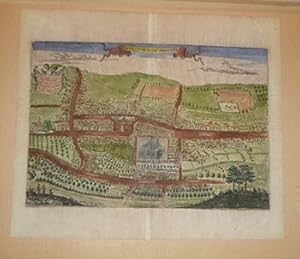
Published by [London : Published by Printed for Ben. Griffin et al] 1700
- Art Print
Seller: Wittenborn Art Books, San Francisco, CA, U.S.A.Wittenborn Art Books
Contact seller5-star sellerCondition: Used - Good
US$ 150.00
US$ 10.00 shippingShips within U.S.A.Quantity: 1 available
Condition: Good. Handcolored engraving. 37.3 x 44cm. sheet size. Reinforced veso on centerfold. Bird's-eye view engraving by J. Drapentier for Sir Henry Chauncy's History of Hertfordshire. In the foreground it is believed Drapentier has drawn himself making the view (seated figure).


