
Einstein Albert Stern (9 results)

Language: English
Published by Aspen Institute for Humanistic Studies, New York 1980
- Softcover
- First Edition
Seller: Saucony Book Shop, Kutztown, PA, U.S.A.Saucony Book Shop
Contact seller5-star sellerCondition: Used - Very good
US$ 65.00
US$ 6.00 shippingShips within U.S.A.Quantity: 1 available
Soft cover. Condition: VG+. First Edition. Stiff color illus. wrasp. Light shelf/handling wear, diagonal creases to bottom corners. Square, uncreased binding. vii,174 pp. Very scarce. Size: 4to - over 9¾" - 12" tall. Book.
Language: English
Published by Aspen Institute for Humanistic Studies, New York 1980
- Softcover
- First Edition
Seller: Saucony Book Shop, Kutztown, PA, U.S.A.Saucony Book Shop
Contact seller5-star sellerCondition: Used - Fine
US$ 75.00
US$ 6.00 shippingShips within U.S.A.Quantity: 1 available
Soft cover. Condition: Fine. First Edition. Stiff color illus. wrasp. Mere hints of handling wear, essentially as issued. Square, uncreased binding. vii,174 pp. Very scarce. Size: 4to - over 9¾" - 12" tall. Book.
- Softcover
Seller: SHIMEDIA, Brooklyn, NY, U.S.A.SHIMEDIA
Contact seller5-star sellerCondition: New
US$ 149.99
Free ShippingShips within U.S.A.Quantity: 1 available
Condition: New. Satisfaction Guaranteed or your money back.
 More images
Published by Science Et Litterature,, Paris, 1938
- Softcover
- First Edition
Seller: Burwood Books, Wickham Market, , United KingdomBurwood Books
Contact seller5-star sellerCondition: Used - Good
US$ 61.33
US$ 29.77 shippingShips from United Kingdom to U.S.A.Quantity: 1 available
Paperback. Condition: Good. First Edition. Wraps. Large 8vo. pp 168. Paperback. Original publisher's grey covers, lettered black. German expat academic magazine. Uncommon. Presentation on the title page, possibly from a contributor. Includes 'Physik und Realitat' by Albert Einstein. Text in German. Slight wear and tanning to cov…ers, otherwise close very good.

Published by Johann Ambrosius Barth, Leipzig 1913
- Hardcover
Seller: Jeremy Norman's historyofscience, Novato, CA, U.S.A.Jeremy Norman's historyofscience
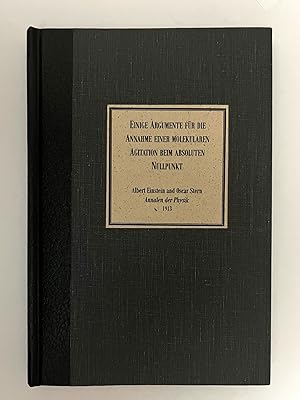
Contact seller2-star sellerEinstein, Albert (1879-1955). Einige argumente fur die annahme einer molekularen agitaation beim absoluten nullpunkt. In Annalen der Physik 40, pp.551-560. With: Otto Stern (1888-1969). Red cloth with gilt lettering on the spine. [Whole volume: 1056 pp. + 1 plate]. 210 x 130 mm. A very good copy. "Some arguments for the assumpti…on of molecular agitation at absolute zero." In this paper, Einstein and Stern show that the quantum theory of solids, to give the best agreement with experiments at normal temperatures, seems to demand that at absolute zero a residual energy would remain in the solids, which they term "zero-point energy." They thus introduced this important concept to physics." (p. 292. Calaprice, Kennefick & Shulmann. An Einstein Encyclopedia. 2015.) Otto Stern was a German-American physicist and Nobel Laureate in Physics. He was the second most nominated person for a Nobel Prize with 82 nominations in the years 1925-1945, ultimately winning in 1943 "for his contribution to the development of the molecular rat method and his discovery of the magnetic moment of the proton". In 1912 Stern did his doctoral dissertation in concentrated solutions. After receiving his Ph.D. degree, Stern took advantage of his economic independence to join Albert Einstein at Prague. Stern was with Einstein from the spring of 1912 until 1914. Weil's Bibliography, no. 53. .
 More images
Published by J.A. Barth 1913
- Hardcover
Seller: JF Ptak Science Books, Hendersonville, NC, U.S.A.JF Ptak Science Books
Contact seller5-star sellerCondition: Used - Fine
US$ 375.00
US$ 6.00 shippingShips within U.S.A.Quantity: 1 available
Hardcover. Condition: Fine. EINSTEIN, ALBERT and O. STERN. "Einige Argumente für die Annahme einer molekularen Agitation beim absoluten Nullpunkt" in Annalen der Physik, Berlin, Barth, 1913, volume 40, fourth seriesn number 3, pp (393)-698 with the Einstein and Stark on pp551-560. This is the entire issue 3, newly and expertly b…ound in calf-backed linen boards, with a paper cover label. Weil 53. (The term zero-point energy (ZPE) is a translation from the German Nullpunktsenergie.) [++] "(T)he idea of zero-point energy attracted the attention of Albert Einstein and his assistant Otto Stern. In 1913 they published a paper [the paper offered here] that attempted to prove the existence of zero-point energy by calculating the specific heat of hydrogen gas and compared it with the experimental data. However, after assuming they had succeeded, they retracted support for the idea shortly after publication because they found Planck's second theory may not apply to their example. In a letter to Paul Ehrenfest of the same year Einstein declared zero-point energy "dead as a doornail". Zero-point energy was also invoked by Peter Debye, who noted that zero-point energy of the atoms of a crystal lattice would cause a reduction in the intensity of the diffracted radiation in X-ray diffraction even as the temperature approached absolute zero. In 1916 Walther Nernst proposed that empty space was filled with zero-point electromagnetic radiation. With the development of general relativity Einstein found the energy density of the vacuum to contribute towards a cosmological constant in order to obtain static solutions to his field equations; the idea that empty space, or the vacuum, could have some intrinsic energy associated with it had returned."--Wikipedia.
 More images
Published by Johannes Barth and Verhandlungen der Deutschen Physikalischen Gesellschaft 1911
- Hardcover
Seller: JF Ptak Science Books, Hendersonville, NC, U.S.A.JF Ptak Science Books
Contact seller5-star sellerCondition: Used - Fine
US$ 1,500.00
US$ 6.00 shippingShips within U.S.A.Quantity: 1 available
Hardcover. Condition: Fine. PLANCK/EINSTEN/SternThree Papers. Two Important Papers by Max Planck and a key paper by Albert Einstein and Otto Stern on their Independent Development of "Zero Point Energy". Includes: Max PLANCK, "Eine neue Strahlungshypothese" AND PLANCK, "Über die Begründung des Gesetzes der schwarzen Strahlung" A…ND ALBERT EINSTEIN and Otto Stern, "Einige Argumente für die Annahme einer molekularen agitation beim absoluten Nullpunkt". Three papers: PLANCK, Max. "Eine neue Strahlungshypothese" extract from Verhandlungen der Deutschen Physikalischen Gesellschaft, 13, number 3, 15 Feb 1911, 119-148 in the issue, with Planck on pp 138-148. And: PLANCK, "Über die Begründung des Gesetzes der schwarzen Strahlung" also extracted from Verhandlungen der Deutschen Physikalischen Gesellschaft, 14 number 2, 30 January 1912, 43-136 in the issue, with Planck on 113-118. Both papers are bound in cloth-backed linen-covered boards with a paper front board label. The binding is brand new and the text is fresh. Very Fine copy. [++] And: EINSTEIN, ALBERT and O. STERN. "Einige Argumente für die Annahme einer molekularen Agitation beim absoluten Nullpunkt" in Annalen der Physik, Berlin, Barth, 1913, volume 40, fourth series, number 3, pp (393)-698 with the Einstein and Stark on pp 551-560. This is the entire issue 3, in the scarce original wrappers. Weil 53. The famously/infamously fragile wrappers are chipped around the edges and have a significant amount of loss on the spine. GOOD condition. $1500.00 [++] (The term zero-point energy (ZPE) is a translation from the German Nullpunktsenergie.) [++] "(T)he idea of zero-point energy attracted the attention of Albert Einstein and his assistant Otto Stern. In 1913 they published a paper [the paper offered here] that attempted to prove the existence of zero-point energy by calculating the specific heat of hydrogen gas and compared it with the experimental data."--Wikipedia [++] "The notion of a zero-point energy is a result of quantum theory and has no proper counterpart in classical physics. It was introduced by Planck in 1911, more than a decade before the emergence of modern quantum mechanics. Planck's so-called second quantum theory, on which the zero-point energy was based, was discussed for a brief period of time, but by 1920 at the latest it was abandoned by most physicists. On the other hand, although Planck's theory was dismissed, the idea of a zero-point energy lived on." Helge S. Kragh & James M. Overduin, "Planck's Second Quantum Theory" (SpringerLinks onine) [++] "Planck did not describe the implications of this finding until later, but Einstein and German physicist Otto Stern (18881969) did. In 1913, they suggested for the first time the existence of a residual energy at absolute zero, calling this residual energy "Nullpunktsenergie," translated as "zero-point energy." Einstein and Stern published their results in "Einige Argumente für die Annahme einer molekularen Agitation beim absoluten Nullpunkt". Wenner, History of Physics, the Wenner Collection.
Published by J. A. Barth, Leipzig 1913
- First Edition
Seller: By Books Alone, Woodstock, NY, U.S.A.By Books Alone
Contact seller5-star sellerCondition: Used - Very good
US$ 450.00
US$ 5.50 shippingShips within U.S.A.Quantity: 1 available
Condition: Very Good. First Edition. Contemporary three-quarter cloth, marbled boards. Minor abrasions on front cover.
- Hardcover
- First Edition
Seller: Herman H. J. Lynge & Søn ILAB-ABF, Copenhagen, , DenmarkHerman H. J. Lynge & Søn ILAB-ABF
Contact seller4-star sellerCondition: Used
US$ 450.60
US$ 48.20 shippingShips from Denmark to U.S.A.Quantity: 1 available
Berlin, J.A. Barth, 1913. Later full cloth. "Annalen der Physik. Vierte Folge. Band 40. Hrsg. von W. Wien und M. Planck.", VIII,1056 pp., 1 plate. Einstein paper: pp. 551-60. Internally fine and clean. The whole volume offered. First edition. In this paper "Some arguments for the existance of a molecular agitation at the absolut…e zero point" Einstein derives Planck's radiation law, without the usual discontinuity assumptions.The volume contains also papers by W. Pauli, Stark, Nordström and others. - Weil No 53.


