Order Total (1 Item Items):
Shipping Destination:

Fratellini Albert, Signed (2 results)
Skip to main search results
Search filters
Product Type
- All Product Types
- Books (1)
- Magazines & Periodicals (No further results match this refinement)
- Comics (No further results match this refinement)
- Sheet Music (No further results match this refinement)
- Art, Prints & Posters (No further results match this refinement)
- Photographs (No further results match this refinement)
- Maps (No further results match this refinement)
- Manuscripts & Paper Collectibles (1)
Condition Learn more
- New (No further results match this refinement)
- As New, Fine or Near Fine (No further results match this refinement)
- Very Good or Good (1)
- Fair or Poor (No further results match this refinement)
- As Described (1)
Binding
- All Bindings
- Hardcover (No further results match this refinement)
- Softcover (1)
Collectible Attributes
- First Edition (1)
- Signed (2)
- Dust Jacket (No further results match this refinement)
- Seller-Supplied Images (2)
- Not Print on Demand (2)
Language (1)
Price
- Any Price
- Under US$ 25 (No further results match this refinement)
- US$ 25 to US$ 50 (No further results match this refinement)
- Over US$ 50
Free Shipping
- Free Shipping to U.S.A. (No further results match this refinement)
Seller Location
Seller Rating
-
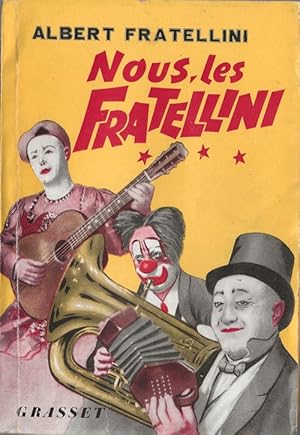
Editions Bernard Grasset 1955. In-8 broché de 265 pages au format 21 x 14,5 cm. Couvertures illustrées. Dos carré avec petite tache grise en haut. Plats et intérieur frais. Histoire des trois Clowns de la fratrie des Fratellini, racontée par Albert et accompagnée de 12 photographies et documents en noir, hors texte. Exemplaire du service de presse, signé par Albert Fratellini en page de faux titre. Edition originale en superbe état général.
-
Dated autographs of the four members of the the European circus family, known as The Fratellini Brothers from a Liber amicorum . Original autographs.
Published by Blois:. France 28 mars 1930, 1930
Seller: Wittenborn Art Books, San Francisco, CA, U.S.A.
Seller rating 5 out of 5 stars

Manuscript / Paper Collectible Signed
Condition: Good. Page from a Liber amicorum with greeting and autographs from visiting dignitaries. Possibly signed during a visit to the Château du Clos Lucé. Three signatures on one page with date and one (Victor ) on another page .The European circus family, known as The Fratellini Brothers, was a trio of clowns: Paul, François and Albert (1877-1940, 1879-1951, 1886-1961 respectively) who, with their grace and their brilliant performing techniques, were internationally admired and motivated a revival of interest in the circus world in Paris after World War I. Their father, Gustavo Fratellini (1842-1905), a Florentine follower of the Italian patriot Giuseppi Garibaldi, was a trapeze artist and acrobat, and the eldest brother, Louis (1867-1909) worked as a clown with Paul. François and Albert also began their careers as a couple. When Louis died in 1909, he left a family without a supporter and Paul without a partner.To solve both problems, the remaining brothers formed a single trio act: François retained his traditional role as the elegant, pompous, white-faced clown; Albert, as the hapless and disastrous Augusto, designed a grotesque new makeup of high black eyebrows, an exaggerated mouth, and a bulging red nose (a makeup style that has influenced countless later clowns); and Paul joined the trio with a new character, the notary, with minimal makeup and a comic style midway between his brothers'. The Fratellini toured Europe and Russia before joining the Cirque Medrano in Paris during World War I. By 1923, they had Paris at their mercy and were admired not only by the general public but also by intellectuals such as the screenwriters Raymond Radiguet and Jean Cocteau, who created characters based on the Fratellini in their plays. Many of the Fratellini children also became circus performers, including Victor (1901-1979), Paul's son, and Paul's daughter, Annie (born in 1932), who continued the family tradition as great clowns in France. Albert's memoirs, "Nous Les Fratellini," were published in 1955.Albert Fratellini (1886-1961) was born in Moscow to the Fratellini circus family. He and his brothers, Paul and François, trained in Russia under one of the Durov brothers. The Fratellini Brothers' entrance lasted 45 minutes. They performed at the Cirque Medrano, where they developed many routines now considered classics. A frequent visitor to the Fratellini dressing room was Pablo Picasso. Albert Fratellini was described as a "superb comic actor." He is considered the father of the American Augustus as we understand it today. His makeup style influenced many famous Augustus, most notably Louis Jacobs. His performances were extravagant and crazy. The Fratellini received honors from the President of France during their run at the Cirque Medrano, and Albert was one of the most famous clowns in French history.