
Goppelsroeder Freidrich (2 results)
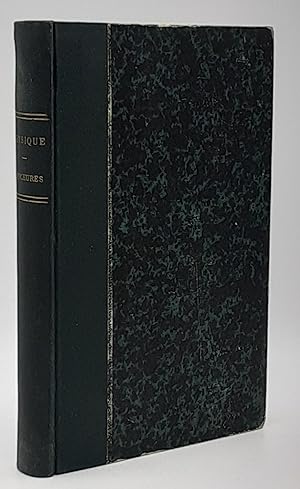 More images
Published by Circa 1880 1880
- Hardcover
- Signed
Seller: Zephyr Books LLC, Reno, NV, U.S.A.Zephyr Books LLC
Contact seller5-star sellerCondition: Used - Very good
US$ 2,475.00
US$ 6.45 shippingShips within U.S.A.Quantity: 1 available
Condition: Very Good. A collection of late 19th century scientific works. Notable for inclusion of the two pieces by Rosenstiehl on color. Inscribed and signed by Rosenstiehl, Lasne and Patein. weight: 2.0 lb. Very good. Illustrated with plates and tables, 9 color plates. 8vo.24x16 cm. 83: 83: 8: 8: 63: 53, 8: 65 pp. Contemporar…y quarter stippled cloth over marbled boards.
 More images
Ueber einige durch die Haarrohrchenanziehung des Papieres hervogebrachten Trennungswirkungen. Contained in: Verhandlungen der Naturforschenden Gesellschaft in Basel, Dritter theil, Zweiter heft, pp. 249-255, 1861.
GOPPELSROEDER, Freidrich (1837-1919) & Christian Friedrich SCHONBEIN (1799-1868).
Published by Schweghauseriche, 1861., Basel: 1861
- Softcover
- First Edition
Seller: Jeff Weber Rare Books, Neuchatel, NEUCH, SwitzerlandJeff Weber Rare Books
Contact seller4-star sellerCondition: Used
US$ 900.00
US$ 29.01 shippingShips from Switzerland to U.S.A.Quantity: 1 available
8vo. (218 x 139 mm) pp. [155]-295. Original printed yellow wrappers; covers lightly soiled. Bookplate of Andras Gedeon. Housed in a quarter tan calf clamshell box. Very good. FIRST PRINTING. This is an important work in the field of chromatography, describing the usefulness of color bands of different chemical reactions in porou…s materials for separation purposes, later of great use in clinical medicine. "In the 1860s, Christian Friedrich Schonbein and his student Friedrich Goppelsroeder published the first attempts to study the different rates at which different substances move through filter paper. Schonbein, who thought capillary action (rather than adsorption) was responsible for the movement, called the technique capillary analysis, and Goppelsroeder spent much of his career using capillary analysis to test the movement rates of a wide variety of substances. Unlike modern paper chromatography, capillary analysis used reservoirs of the substance being analyzed, creating overlapping zones of the solution components rather than separate points or bands." / Wikip. Friedrich Goppelsroder graduated from school in Basel, Switzerland, then the Les Auditore in Neuchatel, studying chemistry and physics with Prof. Charles Kopp. He studied with many leading figures of his time. He taught chemistry at Basel from 1861. Gedeon, Science and technology in medicine, p. 380.

