
Grade Chaim: Signed (3 results)

Published by Peretz Pub. Tel Aviv 1969
- Hardcover
- Signed
Seller: John Trotter Books, london, , United KingdomJohn Trotter Books
Contact seller5-star sellerCondition: Used
US$ 48.33
US$ 26.14 shippingShips from United Kingdom to U.S.A.Quantity: 1 available
Hardcover. Illustrated. Inscribed / Signed Copy. Covers Marked. No DustjacketGood.
Published by L.M. Stein, Chicago 1955
- Hardcover
- First Edition
- Signed
Seller: Dunaway Books, St. Louis, MO, U.S.A.Dunaway Books
Contact seller4-star sellerCondition: Used - Good
US$ 350.00
US$ 4.00 shippingShips within U.S.A.Quantity: 1 available
Hardcover. Condition: Good. First Edition. 8vo in dark green cloth, title and devices in gilt. Front cover has slight wear, including very light scratches and a few stains. Spine in great condition, but cracked hinge. Dated 1956, the signature is a dedication in Yiddish from the author to his friend. Signed By Author.
 More images
Language: Yiddish
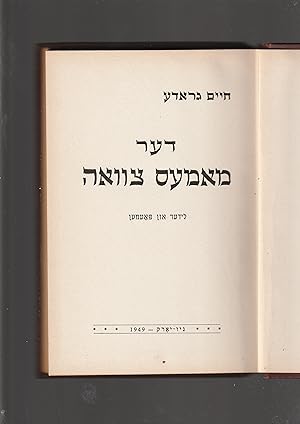
Published by Grenich Printing Corp., New York 1949
- Hardcover
- First Edition
- Signed
Seller: Meir Turner, New York, NY, U.S.A.Meir Turner
Contact seller5-star sellerCondition: Used - Very good
US$ 500.00
US$ 10.00 shippingShips within U.S.A.Quantity: 1 available
Hardcover. Condition: Very Good. No Jacket. 1st Edition. In Yiddish. 235 x 155 mm. 189 pages. Inscribed and dated by the author. Maroon cloth with gold lettering. The book won the 1950 prize from the World Congress of Jewish Culture. It includes some outstanding lyrics in Yiddish and is permeated with love and respect for his mo…ther, who perished during the Holocaust. Grade (1910-1982), a Yiddish poet and novelist was born in Vilna and became that city's most articulate literary interpreter. After his father's early death, his mother ran a market stall in order to provide him a traditional education. He attended several yeshivot, including seven years under the scholar-rabbi, the Hazon Ish. He was attracted to the Musar movement, made his literary debut in Dos Vort, and became a member of Yung Vilne. The group sought both to synthesize secular Yiddish culture with new currents in world literature, and to bring the impoverished Jewish home into contact with the progressive forces of contemporary society. Grade's poems appeared in leading Yiddish periodicals in Europe and the U. S. His first book, Yo, was acclaimed by critics for its stylistic elegance and its affirmation of faith in a synthesis of traditional and modern currents. His long poem "Ezekiel" demonstrated his understanding of the tragic nature of human and especially Jewish existence. Important in his early period was Geveyn fun Doyres, which treats the issues of Jewish identity and national history. His long poem "Musernikes", describes the spiritual struggles of yeshivah students torn between the Musar traditions and worldly temptations. During World War II, Grade found refuge in Russia and continued to write, his next collection of poems appearing in Moscow and followed Soviet directives. After the war he dedicated a series of poems, "Mit Dayn Guf af mayne Hent" to his wife who perished in the Holocaust. In his volumes Doyres, Pleytim, and Shayn fun Farloshene Shtern, he mourned the victims of the Holocaust and describes the survivors. With this attempt at confronting the national Jewish tragedy. Grade's return to Vilna in 1946 was traumatic, as described in "Af di Khurbes", and he left for Poland but after the Kielce pogrom moved to Paris, where he helped to revive Yiddish cultural life among the surviving Jews, leading the Yiddish literary club. Grade was a great interpreter of yeshiva life in modern Yiddish literature, recreating the daily life of the yeshiva student with great accuracy and affection, as in Tzemakh Atlas for instance. After that work he published two more collections of stories: Di Kloyz un di Gas and Der Shtumer Minyan, which again attempted to reconstruct the atmosphere of prewar Vilna. Grade's postwar poetry expressed, above all, the trauma of the Holocaust and focused on the question of his own survival, while his prose works continued to depict Jewish Vilna and the piety of Lithuanian Jewry. Signed Inscription By Author -.
