
Hampstead Bindery Phillips (1 results)
 More images
Published by John Lane 1900
Seller: Blackwell's Rare Books ABA ILAB BA, Oxford, United KingdomBlackwell's Rare Books ABA ILAB BA
Contact seller5-star sellerCondition: Used
US$ 9,637.17
US$ 59.41 shippingShips from United Kingdom to U.S.A.Quantity: 1 available
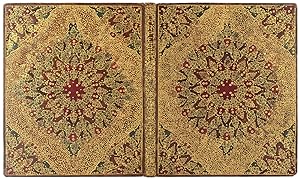
FIRST EDITION, wood-engraved frontispiece, 5 further plates, head-piece and tail-piece, all hand-coloured to a high standard, a few tiny nicks to page edges, title-page with presentation inscription in ink, 'E.S.W. from J.S.W. Santa Barbara Feb 14th 1909', pp. 48, small 4to, bound at the Hampstead Bindery (front free endpaper si…gned) in russet morocco, the boards with multiple onlays of dark green, fawn and chestnut-brown, with repeated tooled leaf motif arranged in central concentric circles punctuated with dots and paired small circles, on ground of massed gilt dots, board corner sections repeat the tools and onlays of the central design, richly gilt backstrip decorated with the same tools, the gilt title lettered vertically, green morocco doublures with spaced gilt small circle triads and crimson morocco onlaid small circles within border of gilt-tooled apricot and crimson convolvulus flowers linked by design of winding tendrils, with massed gilt dots at outer edges, corners of endpapers with small gilt-tooled hearts, gilt gauffered edges, doublure edges slightly faded, corners and joints a little rubbed, upper joint neatly repaired, very good. An exquisite binding, the onlay tones and leaf tool design characteristic of the Hampstead bindery's renowned 'finisher', Pietro A. Savoldelli, responsible for the much-copied 'firework' binding (no. 230, Foot, The Henry Davis Gift, II) and the purely concentric example in Maggs' catalogue 1212, p. 174. Savoldelli was among the original staff employed by Frank Karslake in 1898 when he established the bindery, was part of the cohort who helped to train members of the Guild of Women-Binders and was one of the last to leave the short-lived, but highly influential establishment, which closed in 1902. He was recognized as a particular expert in tooling, having worked in Italy and France, and learnt the practical techniques of the Parisien binders, notably in the brilliance and permanence of the tooled gilt. This example repays close examination: while the description above covers the main characteristics, there are unexpected details - the fawn leaves of the corner-pieces encroaching on the dotted ground, the board-edge green leaves cut in half, as if continuing beyond the board- - which lend a natural air to the symmetrical intensity of the composition. (Ainslie Waller, The Guild of Women-Binders, The Private Library, 3rd series, 6:3.).
