

Order Total (1 Item Items):
Shipping Destination:

Hyde Bruce Drew Kopp (18 results)
Skip to main search results
Search filters
Product Type
- All Product Types
- Books (18)
- Magazines & Periodicals (No further results match this refinement)
- Comics (No further results match this refinement)
- Sheet Music (No further results match this refinement)
- Art, Prints & Posters (No further results match this refinement)
- Photographs (No further results match this refinement)
- Maps (No further results match this refinement)
- Manuscripts & Paper Collectibles (No further results match this refinement)
Condition Learn more
- New (13)
- As New, Fine or Near Fine (2)
- Very Good or Good (1)
- Fair or Poor (2)
- As Described (No further results match this refinement)
Binding
- All Bindings
- Hardcover (No further results match this refinement)
- Softcover (18)
Collectible Attributes
- First Edition (No further results match this refinement)
- Signed (No further results match this refinement)
- Dust Jacket (1)
- Seller-Supplied Images (9)
- Not Print on Demand (18)
Language (1)
Free Shipping
Seller Location
Seller Rating
-
paperback. Condition: Acceptable. The item is showing use from the previous owner but works perfectly. Signs of previous ownership which could include: tears, scuffing, notes, excessive highlighting, gift inscriptions, slight water damage, a missing dust jacket, and library markings.
-

Condition: acceptable. Book is in acceptable condition and shows signs of wear. Book may also include underlining highlighting. The book can also include "From the library of" labels. May not contain miscellaneous items toys, dvds, etc. . We offer 100% money back guarantee and 24 7 customer service.
-
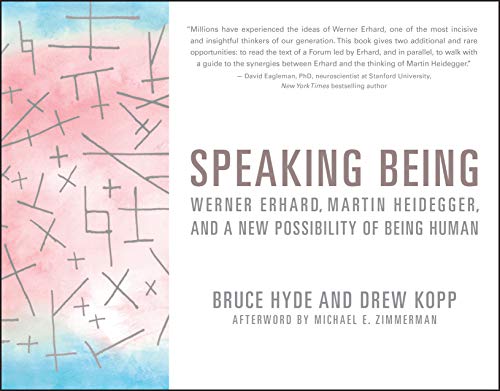
Speaking Being: Werner Erhard, Martin Heidegger, and a New Possibility of Being Human
Seller: Strand Book Store, ABAA, New York, NY, U.S.A.
Seller rating 4 out of 5 stars

Oversized Paperback. Condition: Good.
-

-

Condition: As New. Unread book in perfect condition.
-

Speaking Being
Language: English
Published by John Wiley and Sons Inc, US, 2019
ISBN 10: 1119549906 ISBN 13: 9781119549901
Paperback. Condition: New. Speaking Being: Werner Erhard, Martin Heidegger, and a New Possibility of Being Human is an unprecedented study of the ideas and methods developed by the thinker Werner Erhard. In this book, those ideas and methods are revealed by presenting in full an innovative program he developed in the 1980s called The Forum-available in this book as a transcript of an actual course led by Erhard in San Francisco in December of 1989. Since its inception, Erhard's work has impacted the lives of millions of people throughout the world. Central to this study is a comparative analysis of Erhard's rhetorical project, The Forum, and the philosophical project of Martin Heidegger. Through this comparative analysis, the authors demonstrate how each thinker's work sometimes parallels and often illuminates the other. The dialogue at work in The Forum functions to generate a language which speaks being. That is, The Forum is an instance of what the authors call ontological rhetoric: a technology of communicating what cannot be said in language. Nevertheless, what does get said allows those participating in the dialogue to discover previously unseen aspects of what it currently means to be human. As a primary outcome of such discovery, access to creating a new possibility of what it is to be human is made available. The purpose of this book is to show how communication of the unspoken realm of language-speaking being-is actually accomplished in The Forum, and to demonstrate how Erhard did it in 1989. Through placing Erhard's language use next to Heidegger's thinking-presented in a series of "Sidebars" and "Intervals" alongside The Forum transcript-the authors have made two contributions. They have illuminated the work of two thinkers, who independently developed similar forms of ontological rhetoric while working from very different times and places. Hyde and Kopp have also for the first time made Erhard's extraordinary form of ontological rhetoric available for a wide range of audiences, from scholars at work within a variety of academic disciplines to anyone interested in exploring the possibility of being for human beings. From the Afterword: I regard Speaking Being as an enormously important contribution to understanding Heidegger and Erhard. The latter has received far too little serious academic attention, and this book begins to make up for that lack. Moreover, the book's analysis of Heidegger's thought is among the best that I have ever read. I commend this book to all readers without reservation. Michael E. Zimmerman, Professor Emeritus, University of Colorado, Boulder.
-

Speaking Being
Language: English
Published by John Wiley and Sons Inc, US, 2019
ISBN 10: 1119549906 ISBN 13: 9781119549901
Seller: Rarewaves.com USA, London, LONDO, United Kingdom
Seller rating 5 out of 5 stars

Paperback. Condition: New. Speaking Being: Werner Erhard, Martin Heidegger, and a New Possibility of Being Human is an unprecedented study of the ideas and methods developed by the thinker Werner Erhard. In this book, those ideas and methods are revealed by presenting in full an innovative program he developed in the 1980s called The Forum-available in this book as a transcript of an actual course led by Erhard in San Francisco in December of 1989. Since its inception, Erhard's work has impacted the lives of millions of people throughout the world. Central to this study is a comparative analysis of Erhard's rhetorical project, The Forum, and the philosophical project of Martin Heidegger. Through this comparative analysis, the authors demonstrate how each thinker's work sometimes parallels and often illuminates the other. The dialogue at work in The Forum functions to generate a language which speaks being. That is, The Forum is an instance of what the authors call ontological rhetoric: a technology of communicating what cannot be said in language. Nevertheless, what does get said allows those participating in the dialogue to discover previously unseen aspects of what it currently means to be human. As a primary outcome of such discovery, access to creating a new possibility of what it is to be human is made available. The purpose of this book is to show how communication of the unspoken realm of language-speaking being-is actually accomplished in The Forum, and to demonstrate how Erhard did it in 1989. Through placing Erhard's language use next to Heidegger's thinking-presented in a series of "Sidebars" and "Intervals" alongside The Forum transcript-the authors have made two contributions. They have illuminated the work of two thinkers, who independently developed similar forms of ontological rhetoric while working from very different times and places. Hyde and Kopp have also for the first time made Erhard's extraordinary form of ontological rhetoric available for a wide range of audiences, from scholars at work within a variety of academic disciplines to anyone interested in exploring the possibility of being for human beings. From the Afterword: I regard Speaking Being as an enormously important contribution to understanding Heidegger and Erhard. The latter has received far too little serious academic attention, and this book begins to make up for that lack. Moreover, the book's analysis of Heidegger's thought is among the best that I have ever read. I commend this book to all readers without reservation. Michael E. Zimmerman, Professor Emeritus, University of Colorado, Boulder.
-
-

Speaking Being : Werner Erhard, Martin Heidegger, and a New Possibility of Being Human
Seller: GreatBookPricesUK, Woodford Green, United Kingdom
Seller rating 5 out of 5 stars
US$ 34.34
US$ 20.34 shipping
Ships from United Kingdom to U.S.A.Quantity: Over 20 available
Add to basketCondition: New.
-
Speaking Being: Werner Erhard, Martin Heidegger, and a New Possibility of Being Human
Seller: Ria Christie Collections, Uxbridge, United Kingdom
Seller rating 5 out of 5 stars
US$ 40.06
US$ 16.24 shipping
Ships from United Kingdom to U.S.A.Quantity: 2 available
Add to basketCondition: New. In.
-

Speaking Being : Werner Erhard, Martin Heidegger, and a New Possibility of Being Human
Seller: GreatBookPricesUK, Woodford Green, United Kingdom
Seller rating 5 out of 5 stars
US$ 37.43
US$ 20.34 shipping
Ships from United Kingdom to U.S.A.Quantity: Over 20 available
Add to basketCondition: As New. Unread book in perfect condition.
-
US$ 36.61
US$ 21.00 shipping
Ships from United Kingdom to U.S.A.Quantity: 2 available
Add to basketpaperback. Condition: New.
-
US$ 39.90
US$ 21.00 shipping
Ships from United Kingdom to U.S.A.Quantity: 17 available
Add to basketpaperback. Condition: New.
-
Speaking Being: Werner Erhard, Martin Heidegger, and a New Possibility for Being Human
Language: English
Published by John Wiley & Sons Inc, 2019
ISBN 10: 1119549906 ISBN 13: 9781119549901
US$ 48.27
US$ 20.34 shipping
Ships from United Kingdom to U.S.A.Quantity: 2 available
Add to basketPaperback. Condition: Brand New. 564 pages. 8.50x11.00x1.25 inches. In Stock.
-
-
Condition: New. Brand new! Please provide a physical shipping address.
-

Speaking Being
Language: English
Published by John Wiley and Sons Inc, US, 2019
ISBN 10: 1119549906 ISBN 13: 9781119549901
Paperback. Condition: New. Speaking Being: Werner Erhard, Martin Heidegger, and a New Possibility of Being Human is an unprecedented study of the ideas and methods developed by the thinker Werner Erhard. In this book, those ideas and methods are revealed by presenting in full an innovative program he developed in the 1980s called The Forum-available in this book as a transcript of an actual course led by Erhard in San Francisco in December of 1989. Since its inception, Erhard's work has impacted the lives of millions of people throughout the world. Central to this study is a comparative analysis of Erhard's rhetorical project, The Forum, and the philosophical project of Martin Heidegger. Through this comparative analysis, the authors demonstrate how each thinker's work sometimes parallels and often illuminates the other. The dialogue at work in The Forum functions to generate a language which speaks being. That is, The Forum is an instance of what the authors call ontological rhetoric: a technology of communicating what cannot be said in language. Nevertheless, what does get said allows those participating in the dialogue to discover previously unseen aspects of what it currently means to be human. As a primary outcome of such discovery, access to creating a new possibility of what it is to be human is made available. The purpose of this book is to show how communication of the unspoken realm of language-speaking being-is actually accomplished in The Forum, and to demonstrate how Erhard did it in 1989. Through placing Erhard's language use next to Heidegger's thinking-presented in a series of "Sidebars" and "Intervals" alongside The Forum transcript-the authors have made two contributions. They have illuminated the work of two thinkers, who independently developed similar forms of ontological rhetoric while working from very different times and places. Hyde and Kopp have also for the first time made Erhard's extraordinary form of ontological rhetoric available for a wide range of audiences, from scholars at work within a variety of academic disciplines to anyone interested in exploring the possibility of being for human beings. From the Afterword: I regard Speaking Being as an enormously important contribution to understanding Heidegger and Erhard. The latter has received far too little serious academic attention, and this book begins to make up for that lack. Moreover, the book's analysis of Heidegger's thought is among the best that I have ever read. I commend this book to all readers without reservation. Michael E. Zimmerman, Professor Emeritus, University of Colorado, Boulder.
-

Speaking Being
Language: English
Published by John Wiley and Sons Inc, US, 2019
ISBN 10: 1119549906 ISBN 13: 9781119549901
US$ 46.56
US$ 88.13 shipping
Ships from United Kingdom to U.S.A.Quantity: 7 available
Add to basketPaperback. Condition: New. Speaking Being: Werner Erhard, Martin Heidegger, and a New Possibility of Being Human is an unprecedented study of the ideas and methods developed by the thinker Werner Erhard. In this book, those ideas and methods are revealed by presenting in full an innovative program he developed in the 1980s called The Forum-available in this book as a transcript of an actual course led by Erhard in San Francisco in December of 1989. Since its inception, Erhard's work has impacted the lives of millions of people throughout the world. Central to this study is a comparative analysis of Erhard's rhetorical project, The Forum, and the philosophical project of Martin Heidegger. Through this comparative analysis, the authors demonstrate how each thinker's work sometimes parallels and often illuminates the other. The dialogue at work in The Forum functions to generate a language which speaks being. That is, The Forum is an instance of what the authors call ontological rhetoric: a technology of communicating what cannot be said in language. Nevertheless, what does get said allows those participating in the dialogue to discover previously unseen aspects of what it currently means to be human. As a primary outcome of such discovery, access to creating a new possibility of what it is to be human is made available. The purpose of this book is to show how communication of the unspoken realm of language-speaking being-is actually accomplished in The Forum, and to demonstrate how Erhard did it in 1989. Through placing Erhard's language use next to Heidegger's thinking-presented in a series of "Sidebars" and "Intervals" alongside The Forum transcript-the authors have made two contributions. They have illuminated the work of two thinkers, who independently developed similar forms of ontological rhetoric while working from very different times and places. Hyde and Kopp have also for the first time made Erhard's extraordinary form of ontological rhetoric available for a wide range of audiences, from scholars at work within a variety of academic disciplines to anyone interested in exploring the possibility of being for human beings. From the Afterword: I regard Speaking Being as an enormously important contribution to understanding Heidegger and Erhard. The latter has received far too little serious academic attention, and this book begins to make up for that lack. Moreover, the book's analysis of Heidegger's thought is among the best that I have ever read. I commend this book to all readers without reservation. Michael E. Zimmerman, Professor Emeritus, University of Colorado, Boulder.

