

Order Total (1 Item Items):
Shipping Destination:

Ian Eagles (21 results)
Skip to main search results
Search filters
Product Type
- All Product Types
- Books (21)
- Magazines & Periodicals (No further results match this refinement)
- Comics (No further results match this refinement)
- Sheet Music (No further results match this refinement)
- Art, Prints & Posters (No further results match this refinement)
- Photographs (No further results match this refinement)
- Maps (No further results match this refinement)
- Manuscripts & Paper Collectibles (No further results match this refinement)
Condition Learn more
- New (9)
- As New, Fine or Near Fine (6)
- Very Good or Good (4)
- Fair or Poor (No further results match this refinement)
- As Described (2)
Binding
- All Bindings
- Hardcover (No further results match this refinement)
- Softcover (21)
Collectible Attributes
- First Edition (No further results match this refinement)
- Signed (No further results match this refinement)
- Dust Jacket (No further results match this refinement)
- Seller-Supplied Images (8)
- Not Print on Demand (15)
Language (2)
Free Shipping
Seller Location
Seller Rating
-

Soft cover. Condition: As New. Unread softcover book in As New condition. We ship promptly from the United States and in a box.
-
Soft cover. Condition: Fine. Softcover book in Fine condition. Pages are completely clean and contain no additional markings. NOT a former library book. We ship promptly from the United States and in a box!
-
Refusals to License Intellectual Property: Testing the Limits of Law and Economics
Language: English
Published by Hart Publishing Company, Oxford, 2011
ISBN 10: 1841138738 ISBN 13: 9781841138732
Paperback. Condition: Fine. 8vo ; 270 pages.
-
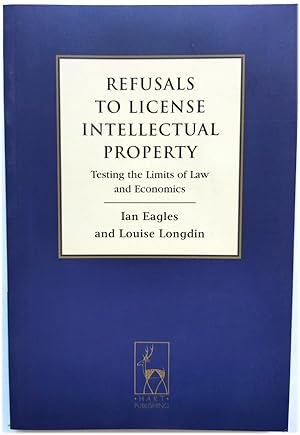
Refusals to License Intellectual Property: Testing the Limits of Law and Economics
Language: English
Published by Hart Publishing, Oxford, 2011
ISBN 10: 1841138738 ISBN 13: 9781841138732
Seller: PsychoBabel & Skoob Books, Didcot, United Kingdom
Seller rating 5 out of 5 stars

US$ 20.90
US$ 16.83 shipping
Ships from United Kingdom to U.S.A.Quantity: 1 available
Add to basketPaperback. Condition: Very Good. Paperback in excellent condition throughout, with no notable faults. TS. Used.
-

Legal Structures and Reasoning
Published by Palatine Press 1994, 1994
Seller: Hard to Find Books NZ (Internet) Ltd., Dunedin, OTAGO, New Zealand
Association Member: IOBA
Seller rating 5 out of 5 stars
Imperial octavo softcover (VG); all our specials have minimal description to keep listing them viable. They are at least reading copies, complete and in reasonable condition, but usually secondhand; frequently they are superior examples. Ordering more than one book will reduce your overall postage costs.
-
Legal Structures and Reasoning
Published by Auckland Uniservices Ltd 1993, 1993
Seller: Hard to Find Books NZ (Internet) Ltd., Dunedin, OTAGO, New Zealand
Association Member: IOBA
Seller rating 5 out of 5 stars
Imperial octavo softcover (VG-); all our specials have minimal description to keep listing them viable. They are at least reading copies, complete and in reasonable condition, but usually secondhand; frequently they are superior examples. Ordering more than one book will reduce your overall postage cost.
-

Law in Business and Government in New Zealand
Published by Palatine Press, 2001
ISBN 10: 0958341354 ISBN 13: 9780958341356
Paperback. Condition: Good. 796 pages. Cover worn.
-
Refusals to license intellectual property : testing the limits of law and economics.
Seller: Kloof Booksellers & Scientia Verlag, Amsterdam, Netherlands
Seller rating 4 out of 5 stars

Condition: as new. Oxford : Hart Publishing, 2011. Paperback. 298 pp. English text. Condition : as new. - Economic analysis rarely appears on the judicial horizon in intellectual property litigation. In competition cases, by contrast, economists are familiar figures in the courtroom and the language of economics is scattered throughout the judgments of even the highest courts. One might expect, therefore, that refusals to license intellectual property would generate the same fruitful symbiosis between law and economics when those refusals surface in competition proceedings. This, however, has not been how the law on this subject has developed in most jurisdictions. Courts and enforcement agencies faced with a unilateral refusal to license have instead tended to retreat into sketchily articulated black letter rules and presumptions, which then have to be fenced off from the rest of competition law by economically irrelevant qualifications and distinctions based on private law categorizations of, and rationales for, individual intellectual property rights. This bypassing of case-by-case analysis in favor of more traditional modes of legal reasoning is not entirely the fault of lawyers. Economists have contributed to this state of affairs by urging judges and regulators to convert empirically undernourished theories about the proper role of intellectual property in a market economy into rules of law and evidentiary presumptions intended to be binding in future cases. How this came about and what it means for the future of effective competition enforcement globally are the twin concerns of this book. Condition : as new copy. ISBN 9781841138732. Keywords : RECHT, Intellectual property.
-

Law in Business and Government in New Zealand. 4th edition
Language: English
Published by Palatine Press, Auckland, 2006
ISBN 10: 0958341370 ISBN 13: 9780958341370
Soft cover. Condition: Fine. 4th Edition. 842 pages.
-

Law in Business and Government in New Zealand (4th Edition)
Language: English
Published by Palantine Press, Auckland, New Zealand, 2006
ISBN 10: 0958341370 ISBN 13: 9780958341370
Soft cover. Condition: Good. 4th Edition. Heavy book - may require extra charge for shipping.
-

Law in business and government in New Zealand
Published by Palatine Press, New Zealand, 2006
ISBN 10: 0958341370 ISBN 13: 9780958341370
Paperback. Condition: Good. 842 pages. light stamp on foredge otherwise clean & tidy.
-
Refusals to License Intellectual Property: Testing the Limits of Law and Economics
Seller: Ria Christie Collections, Uxbridge, United Kingdom
Seller rating 5 out of 5 stars
US$ 200.52
US$ 16.13 shipping
Ships from United Kingdom to U.S.A.Quantity: Over 20 available
Add to basketCondition: New. In.
-
Refusals to License Intellectual Property (Paperback)
Language: English
Published by Bloomsbury Publishing PLC, Oxford, 2011
ISBN 10: 1841138738 ISBN 13: 9781841138732
Paperback. Condition: new. Paperback. Economic analysis rarely appears on the judicial horizon in intellectual property litigation. In competition cases, by contrast, economists are familiar figures in the courtroom and the language of economics is scattered throughout the judgments of even the highest courts. One might expect, therefore, that refusals to license intellectual property would generate the same fruitful symbiosis between law and economics when those refusals surface in competition proceedings. This however, has not been how the law on this subject has developed in most jurisdictions. Courts and enforcement agencies faced with a unilateral refusal to license have instead tended to retreat into sketchily articulated black letter rules and presumptions which then have to be fenced off from the rest of competition law by economically irrelevant qualifications and distinctions based on private law categorisations of, and rationales for, individual intellectual property rights. This bypassing of case-by-case analysis in favour of more traditional modes of legal reasoning is not entirely the fault of lawyers. Economists have contributed to this state of affairs by urging judges and regulators to convert empirically undernourished theories about the proper role of intellectual property in a market economy into rules of law and evidentiary presumptions intended to be binding in future cases. How this came about and what it means for the future of effective competition enforcement globally are the twin concerns of this book. Economic analysis rarely appears on the judicial horizon in intellectual property litigation. How this came about and what it means for the future of effective competition enforcement globally are the twin concerns of this book. Shipping may be from multiple locations in the US or from the UK, depending on stock availability.
-
US$ 256.49
US$ 33.65 shipping
Ships from United Kingdom to U.S.A.Quantity: 1 available
Add to basketPaperback. Condition: Like New. LIKE NEW. SHIPS FROM MULTIPLE LOCATIONS. book.
-
US$ 334.72
US$ 13.46 shipping
Ships from United Kingdom to U.S.A.Quantity: 2 available
Add to basketPaperback. Condition: Brand New. 270 pages. 8.75x6.00x0.50 inches. In Stock.
-
Refusals to License Intellectual Property
Language: English
Published by Bloomsbury Publishing (UK), 2011
ISBN 10: 1841138738 ISBN 13: 9781841138732
Seller: PBShop.store UK, Fairford, GLOS, United Kingdom
Seller rating 4 out of 5 stars
US$ 207.92
US$ 6.76 shipping
Ships from United Kingdom to U.S.A.Quantity: Over 20 available
Add to basketPAP. Condition: New. New Book. Delivered from our UK warehouse in 4 to 14 business days. THIS BOOK IS PRINTED ON DEMAND. Established seller since 2000.
-
Refusals to License Intellectual Property
Language: English
Published by Bloomsbury Publishing (UK), 2011
ISBN 10: 1841138738 ISBN 13: 9781841138732
PAP. Condition: New. New Book. Shipped from UK. THIS BOOK IS PRINTED ON DEMAND. Established seller since 2000.
-
Refusals to License Intellectual Property (Paperback)
Language: English
Published by Bloomsbury Publishing PLC, Oxford, 2011
ISBN 10: 1841138738 ISBN 13: 9781841138732
US$ 219.73
US$ 49.80 shipping
Ships from United Kingdom to U.S.A.Quantity: 1 available
Add to basketPaperback. Condition: new. Paperback. Economic analysis rarely appears on the judicial horizon in intellectual property litigation. In competition cases, by contrast, economists are familiar figures in the courtroom and the language of economics is scattered throughout the judgments of even the highest courts. One might expect, therefore, that refusals to license intellectual property would generate the same fruitful symbiosis between law and economics when those refusals surface in competition proceedings. This however, has not been how the law on this subject has developed in most jurisdictions. Courts and enforcement agencies faced with a unilateral refusal to license have instead tended to retreat into sketchily articulated black letter rules and presumptions which then have to be fenced off from the rest of competition law by economically irrelevant qualifications and distinctions based on private law categorisations of, and rationales for, individual intellectual property rights. This bypassing of case-by-case analysis in favour of more traditional modes of legal reasoning is not entirely the fault of lawyers. Economists have contributed to this state of affairs by urging judges and regulators to convert empirically undernourished theories about the proper role of intellectual property in a market economy into rules of law and evidentiary presumptions intended to be binding in future cases. How this came about and what it means for the future of effective competition enforcement globally are the twin concerns of this book. Economic analysis rarely appears on the judicial horizon in intellectual property litigation. How this came about and what it means for the future of effective competition enforcement globally are the twin concerns of this book. This item is printed on demand. Shipping may be from our UK warehouse or from our Australian or US warehouses, depending on stock availability.
-

US$ 243.25
US$ 57.66 shipping
Ships from Germany to U.S.A.Quantity: Over 20 available
Add to basketCondition: New. Dieser Artikel ist ein Print on Demand Artikel und wird nach Ihrer Bestellung fuer Sie gedruckt. Economic analysis rarely appears on the judicial horizon in intellectual property litigation. How this came about and what it means for the future of effective competition enforcement globally are the twin concerns of this book.Über den Autor.
-
Taschenbuch. Condition: Neu. Refusals to License Intellectual Property | Ian Eagles | Taschenbuch | Kartoniert / Broschiert | Englisch | 2011 | Bloomsbury 3PL | EAN 9781841138732 | Verantwortliche Person für die EU: Libri GmbH, Europaallee 1, 36244 Bad Hersfeld, gpsr[at]libri[dot]de | Anbieter: preigu Print on Demand.
-

Taschenbuch. Condition: Neu. nach der Bestellung gedruckt Neuware - Printed after ordering - Economic analysis rarely appears on the judicial horizon in intellectual property litigation. In competition cases, by contrast, economists are familiar figures in the courtroom and the language of economics is scattered throughout the judgments of even the highest courts. One might expect, therefore, that refusals to license intellectual property would generate the same fruitful symbiosis between law and economics when those refusals surface in competition proceedings. This however, has not been how the law on this subject has developed in most jurisdictions. Courts and enforcement agencies faced with a unilateral refusal to license have instead tended to retreat into sketchily articulated black letter rules and presumptions which then have to be fenced off from the rest of competition law by economically irrelevant qualifications and distinctions based on private law categorisations of, and rationales for, individual intellectual property rights. This bypassing of case-by-case analysis in favour of more traditional modes of legal reasoning is not entirely the fault of lawyers. Economists have contributed to this state of affairs by urging judges and regulators to convert empirically undernourished theories about the proper role of intellectual property in a market economy into rules of law and evidentiary presumptions intended to be binding in future cases. How this came about and what it means for the future of effective competition enforcement globally are the twin concerns of this book.


