
Jacob Clauser (3 results)
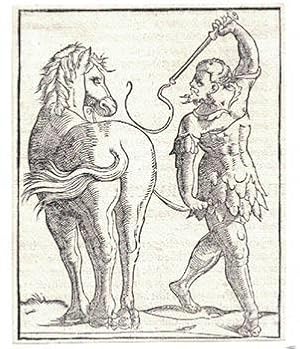
Man whipping the horse Bucephalus, from Liber V of Sebastian Münster, 'Cosmographia'. First edition.
Kandel, David (1520/25-1592/96); or Jacob Clauser (1520/25-1578/79)
Published by Basel: Sebastian Heinrich-Petri. 1552
- Art Print
Seller: Wittenborn Art Books, San Francisco, CA, U.S.A.Wittenborn Art Books
Contact seller5-star sellerCondition: Used - Good
US$ 200.00
US$ 10.00 shippingShips within U.S.A.Quantity: 1 available
Condition: Good. Woodcut with Latin text. 12 x 9 cm. Possibly clipped from: Sebastian Münster, 'Cosmographia', Basle: Heinrich Petri, 1550. c.1547-50Verso is text about Alexander the Great from Macedonia,Liber V. Bucephalus page 1071These leaves from Book V of one of the earliest editions of Cosmographia (the Latin edition from…the Basel printing house of Sebastian Heinrich-Petri, 1552) are devoted to Asia ("De terris Asiae maioris"), and more specifically to India. In his text, Münster clearly follows *Strabo*, relying heavily on his Geography (Book XV: On India).*PAGE 1071* and *PAGE 1072* are devoted to Bucephalus, the most famous horse of ancient times. Bucephalus, whose name means "ox-head," was called that because of his wide forehead and slightly "dished-shaped" face, marked by a white star. A black stallion only 15 hands high, he achieved fame carrying his master, Alexander the Great. The story is that Alexander met Bucephalus for the first time when he was only twelve years old. When Alexander's father, Philip, was looking at horses to buy, Bucephalus was brought out, but proved dangerously unruly. Alexander noticed that Bucephalus was frightened by his own shadow, so he turned the excited horse to face the sun, then vaulted onto the young stallion's back and rode him successfully. Alexander and Bucephalus rode thousands of miles and fought in many battles together, winning an enormous empire. Bucephalus finally died at the advanced age of 30, of wounds received in the battle against Porus on the Hydaspes in 326 BCE. Alexander honored him with a large, formal funeral, which he himself led, and named a city "Bucephala" in his honour.

Man whipping the horse Bucephalus, from Liber V of Sebastian Münster, 'Cosmographia'. First edition.
Kandel, David (1520/25-1592/96); or Jacob Clauser (1520/25-1578/79)
Published by Basel: Heinrich Petri. 1552
- Art Print
Seller: Wittenborn Art Books, San Francisco, CA, U.S.A.Wittenborn Art Books
Contact seller4-star sellerCondition: Used - Good
US$ 200.00
US$ 10.00 shippingShips within U.S.A.Quantity: 1 available
Condition: Good. Woodcut with Latin text. 12 x 9 cm. Possibly clipped from: Sebastian Münster, 'Cosmographia', Basle: Heinrich Petri, 1550. c.1547-50Verso is text about Colchis and Iberia.Liber V. Bucephalus page 1071These leaves from Book V of one of the earliest editions of Cosmographia (the Latin edition from the Basel printi…ng house of Sebastian Heinrich-Petri, 1552) are devoted to Asia ("De terris Asiae maioris"), and more specifically to India. In his text, Münster clearly follows *Strabo*, relying heavily on his Geography (Book XV: On India).*PAGE 1071* and *PAGE 1072* are devoted to Bucephalus, the most famous horse of ancient times. Bucephalus, whose name means "ox-head," was called that because of his wide forehead and slightly "dished-shaped" face, marked by a white star. A black stallion only 15 hands high, he achieved fame carrying his master, Alexander the Great. The story is that Alexander met Bucephalus for the first time when he was only twelve years old. When Alexander's father, Philip, was looking at horses to buy, Bucephalus was brought out, but proved dangerously unruly. Alexander noticed that Bucephalus was frightened by his own shadow, so he turned the excited horse to face the sun, then vaulted onto the young stallion's back and rode him successfully. Alexander and Bucephalus rode thousands of miles and fought in many battles together, winning an enormous empire. Bucephalus finally died at the advanced age of 30, of wounds received in the battle against Porus on the Hydaspes in 326 BCE. Alexander honored him with a large, formal funeral, which he himself led, and named a city "Bucephala" in his honour.

Siege of Acon or Ptolemais from Sebastian Münster, 'Cosmographia'. First edition.
Kandel, David (1520/25-1592/96); or Jacob Clauser (1520/25-1578/79)
Published by Basel: Sebastian Heinrich-Petri. 1552
- Art Print
Seller: Wittenborn Art Books, San Francisco, CA, U.S.A.Wittenborn Art Books
Contact seller5-star sellerCondition: Used - Good
US$ 200.00
US$ 10.00 shippingShips within U.S.A.Quantity: 1 available
Condition: Good. Woodcut with German text. 9.5 x 16.5 cm. Likely clipped from: Sebastian Münster, 'Cosmographia', Bael: Heinrich Petri, 1550. c.1547-50A maritime city of Galilee (Acts 21:7). It was originally called "Accho" , and received the name Ptolemais from Ptolemy Soter when he was in possession of Coele-Syria.


