

Order Total (1 Item Items):
Shipping Destination:

Jubulis Mark (3 results)
Skip to main search results
Search filters
Product Type
- All Product Types
- Books (3)
- Magazines & Periodicals (No further results match this refinement)
- Comics (No further results match this refinement)
- Sheet Music (No further results match this refinement)
- Art, Prints & Posters (No further results match this refinement)
- Photographs (No further results match this refinement)
- Maps (No further results match this refinement)
- Manuscripts & Paper Collectibles (No further results match this refinement)
Condition Learn more
- New (No further results match this refinement)
- As New, Fine or Near Fine (No further results match this refinement)
- Very Good or Good (3)
- Fair or Poor (No further results match this refinement)
- As Described (No further results match this refinement)
Binding
- All Bindings
- Hardcover (3)
- Softcover (No further results match this refinement)
Collectible Attributes
- First Edition (2)
- Signed (No further results match this refinement)
- Dust Jacket (No further results match this refinement)
- Seller-Supplied Images (2)
- Not Print on Demand (3)
Language (2)
Price
- Any Price
- Under US$ 25 (No further results match this refinement)
- US$ 25 to US$ 50 (No further results match this refinement)
- Over US$ 50
Free Shipping
- Free Shipping to U.S.A. (No further results match this refinement)
Seller Location
Seller Rating
-

Nationalism and Democratic Transition: the Politics of Citizenship and Language in Post-Soviet Latvia
Language: English
Published by University Press of America, Lanham, Maryland, 2001
ISBN 10: 0761819789 ISBN 13: 9780761819783
Seller: Literary Cat Books, Machynlleth, Powys, WALES, United Kingdom
Association Member: IOBA
Seller rating 4 out of 5 stars

First Edition
US$ 87.05
US$ 20.12 shipping
Ships from United Kingdom to U.S.A.Quantity: 1 available
Add to basketCondition: Very Good+. First Edition; First Impression. Original giltstamped black imitation leather cloth. Slight wear to spine, covers and corners. ; 23.3x15.5x2.6 cm; 416 pages Original black imitation leather cloth.
-
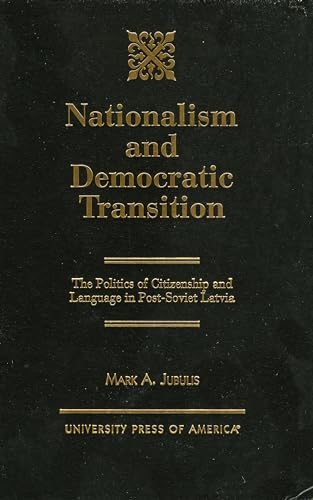
Nationalism and Democratic Transition: The Politics of Citizenship and Language in Post-Soviet Latvia
Language: English
Published by University Press of America, 2001
ISBN 10: 0761819789 ISBN 13: 9780761819783
US$ 124.36
US$ 21.47 shipping
Ships from United Kingdom to U.S.A.Quantity: 1 available
Add to baskethardcover. Condition: Very Good. Pages lightly tanned.
-

Nationalism and Democratic Transition. the Politics of Citizenship and Language in Post-Soviet Latvia
Published by University Press of America, Lanham, 2001
Seller: Literary Cat Books, Machynlleth, Powys, WALES, United Kingdom
Association Member: IOBA
Seller rating 4 out of 5 stars
First Edition
US$ 87.05
US$ 20.12 shipping
Ships from United Kingdom to U.S.A.Quantity: 1 available
Add to basketOriginal gilt-lettered boards. Condition: Very Good+. Dust Jacket Condition: No Dust Jacket. First Edition. Light soiling to text block edges. Slight soiling & light wear to covers, spine & corners. ; 23.5 x 15.5 x 2.9 cms; 416 pages; Nationalism and Democratic Transition: The Politics of Citizenship and Language in Post-Soviet Latvia by Mark A. Jubulis explores how Latvia's national identity and political structures were reshaped following the collapse of the Soviet Union. The book focuses on two core issues in the democratic transition: the redefinition of citizenship and the establishment of Latvian as the dominant national language. Jubulis challenges the idea that Latvia pursued a wholly exclusionary, ethnic form of nationalism. Instead, he argues that during the independence movement, Latvian nationalism was relatively moderate and aimed to unite diverse groupsâ"including non-Latviansâ"against Soviet rule. However, once independence was achieved, the national agenda turned toward strengthening Latvian cultural and political sovereignty. This shift involved redefining citizenship laws to prioritise ethnic Latvians. Citizenship was granted based on historical residence and Latvian language proficiency, leaving a significant portion of non-Latvian residentsâ"especially Russians, Ukrainians, and Belarusiansâ"outside the political process. Many of these individuals remained stateless or politically marginalised, forming their own parties with limited influence in national politics. Language policy was another central tool of nation-building. Latvian was declared the sole official language, and efforts were made to integrate it into education, administration, and public life. While these measures were intended to consolidate national identity and reduce Soviet-era Russification, they also created tensions over minority rights and cultural inclusion. The book presents a nuanced portrait of Latviaâs post-Soviet transformation. It shows how the country tried to reconcile democratic principles with the desire to restore ethnic Latvian dominance in public and political life. Jubulis highlights the delicate balance between building a cohesive nation-state and ensuring participation and rights for all residents in a multi-ethnic society.

