

Order Total (1 Item Items):
Shipping Destination:

Kuniteru (28 results)
Author:
kuniteru
Refine with Advanced Search
Skip to main search results
Search filters
Product Type
- All Product Types
- Books (23)
- Magazines & Periodicals (No further results match this refinement)
- Comics (No further results match this refinement)
- Sheet Music (No further results match this refinement)
- Art, Prints & Posters (4)
- Photographs (No further results match this refinement)
- Maps (1)
- Manuscripts & Paper Collectibles (No further results match this refinement)
Condition Learn more
- New (19)
- As New, Fine or Near Fine (4)
- Very Good or Good (4)
- Fair or Poor (No further results match this refinement)
- As Described (1)
Binding
- All Bindings
- Hardcover (No further results match this refinement)
- Softcover (No further results match this refinement)
Collectible Attributes
- First Edition (2)
- Signed (No further results match this refinement)
- Dust Jacket (No further results match this refinement)
- Seller-Supplied Images (9)
- Not Print on Demand (28)
Language (2)
Free Shipping
Seller Location
Seller Rating
-

Condition: Good. Kuniteru, Utagawa (illustrator). Connecting readers with great books since 1972! Used books may not include companion materials, and may have some shelf wear or limited writing. We ship orders daily and Customer Service is our top priority!
-
Condition: New. Kuniteru, Utagawa (illustrator). Brand New! Not Overstocks or Low Quality Book Club Editions! Direct From the Publisher! We're not a giant, faceless warehouse organization! We're a small town bookstore that loves books and loves it's customers! Buy from Lakeside Books!
-
Condition: New. Kuniteru, Utagawa (illustrator). Brand New! Not Overstocks or Low Quality Book Club Editions! Direct From the Publisher! We're not a giant, faceless warehouse organization! We're a small town bookstore that loves books and loves it's customers! Buy from Lakeside Books!
-
Condition: New. Kuniteru, Utagawa (illustrator).
-

Condition: New. Kuniteru, Utagawa (illustrator).
-

A Japanese Garden in Summertime - 1000 Piece Jigsaw Puzzle: A Scene from the Tale of Genji, Woodblock Print (Finished Size 24 in X 18 In) (Jigsaw)
Language: English
Published by Tuttle Publishing 4/13/2021, 2021
ISBN 10: 0804854157 ISBN 13: 9780804854153
Jigsaw. Condition: New. Kuniteru, Utagawa (illustrator). A Japanese Garden in Summertime - 1000 Piece Jigsaw Puzzle: A Scene from the Tale of Genji, Woodblock Print (Finished Size 24 in X 18 In). Other.
-
Condition: New. Kuniteru, Utagawa (illustrator).
-

Condition: As New. Kuniteru, Utagawa (illustrator). Unread book in perfect condition.
-
Condition: New. Kuniteru, Utagawa (illustrator).
-
A Japanese Garden in Summertime Jigsaw Puzzle - 1,000 pieces: A Scene from THE TALE OF GENJI, Woodblock Print (Finished Size 24 in X 18 in)
Seller: Kennys Bookshop and Art Galleries Ltd., Galway, GY, Ireland
Seller rating 5 out of 5 stars

Condition: New. Kuniteru, Utagawa (illustrator). 2021. Puzzle. . . . . .
-
A Japanese Garden in Summertime - 1000 Piece Jigsaw Puzzle
Seller: PBShop.store UK, Fairford, GLOS, United Kingdom
Seller rating 4 out of 5 stars

US$ 24.16
US$ 6.75 shipping
Ships from United Kingdom to U.S.A.Quantity: 10 available
Add to basketUNK. Condition: New. Kuniteru, Utagawa (illustrator). New Book. Shipped from UK. Established seller since 2000.
-
Condition: New. Kuniteru, Utagawa (illustrator). 2021. Puzzle. . . . . . Books ship from the US and Ireland.
-
Puzzle. Condition: New. Kuniteru, Utagawa (illustrator). Special order direct from the distributor.
-
A Japanese Garden in Summertime - 1000 Piece Jigsaw Puzzle: A Scene from The Tale of Genji, Woodblock Print (Finished Size 24 in X 18 in)
Seller: Ria Christie Collections, Uxbridge, United Kingdom
Seller rating 5 out of 5 stars
US$ 21.03
US$ 16.10 shipping
Ships from United Kingdom to U.S.A.Quantity: 6 available
Add to basketCondition: New. Kuniteru, Utagawa (illustrator). In.
-
Condition: As New. Unread copy in mint condition.
-
Condition: New. Brand New.
-
US$ 21.29
US$ 16.80 shipping
Ships from United Kingdom to U.S.A.Quantity: 2 available
Add to basketGeneral merchandise. Condition: Brand New. Kuniteru, Utagawa (illustrator). pzzl edition. 7.75x7.75x2.00 inches. In Stock.
-
Condition: New. Kuniteru, Utagawa (illustrator).
-
Puzzle. Condition: New. Kuniteru, Utagawa (illustrator). Special order item direct from the distributor.
-

Japanese Garden in Summertime - 1000 Piece Jigsaw Puzzle : A Scene from the Tale of Genji, Woodblock Print Finished Size 24 in X 18 in
Seller: GreatBookPricesUK, Woodford Green, United Kingdom
Seller rating 5 out of 5 stars
US$ 21.02
US$ 20.16 shipping
Ships from United Kingdom to U.S.A.Quantity: 7 available
Add to basketCondition: New. Kuniteru, Utagawa (illustrator).
-
US$ 24.97
US$ 16.80 shipping
Ships from United Kingdom to U.S.A.Quantity: 2 available
Add to basketGeneral merchandise. Condition: Brand New. Kuniteru, Utagawa (illustrator). pzzl edition. 7.75x7.75x2.00 inches. In Stock.
-
Condition: New. Kuniteru, Utagawa (illustrator).
-
Japanese Garden in Summertime - 1000 Piece Jigsaw Puzzle : A Scene from the Tale of Genji, Woodblock Print Finished Size 24 in X 18 in
Seller: GreatBookPricesUK, Woodford Green, United Kingdom
Seller rating 5 out of 5 stars
US$ 80.17
US$ 20.16 shipping
Ships from United Kingdom to U.S.A.Quantity: 7 available
Add to basketCondition: As New. Kuniteru, Utagawa (illustrator). Unread book in perfect condition.
-
Oshu Soma myoken matsuri
Published by Soma, Fukushima: Sojudo (publisher), [ca.1860s-1880s]., 1880
Seller: Kagerou Bunko (ABAJ, ILAB), Tokyo, Japan
Association Member: ILAB
Seller rating 2 out of 5 stars

Art / Print / Poster
No Binding. Condition: Fine. A scarce record of the Soma-Nomaoi festival, famous for its wild horse chase games, held annually from the 12th century. It is the largest horse festival in Japan. More than 500 horses and horse riders are gathered every May in Fukushima prefecture. The set consists of three splendid panoramas from a birds eye view of the most important events of the festival. The competitors are comparing riding skills: marching, chasing and racing. The original woodblock composition was made by Hiroshige I in the same unusually large size, but without colouration. Ichiyūsai KUNITERU II (1830?-1874), the author of this edition, was a famous pupil of Utagawa Toyokuni III, specialising in a wide range of ukiyo-e genres. Text in Japanese. 3 leaves, complete set. 33.3x46.5 each. Nishiki-e, woodblock print. Creasings, otherwise in fine condition. Comes with the original envelope.
-
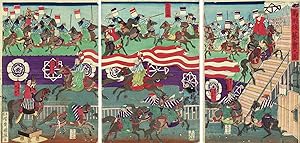
Bajutsu Gigeikai no Zu
Published by Edo [Tokyo] : Tsujiokaya Bunsuke, Meiji 6, 1873
Seller: Kagerou Bunko (ABAJ, ILAB), Tokyo, Japan
Association Member: ILAB
Seller rating 2 out of 5 stars
Art / Print / Poster First Edition
No Binding. Condition: Very Good. 1st Edition. A triptych nishiki-e (colour woodblock-printed illustration) by Kuniteru the Second, a pupil of Toyokuni the Third (Utagawa Kunisada). Five types of horsemanship including stair-climbing and 'dakyu' (a Japanese equestrian sport similar to polo) are depicted in the prints in vivid colour. Famous equestrian Kusakari Shogoro and a woman performing an equestrian trick can also be seen in the triptych. Three leaves, complete. Some bleeding to dyes. A few stains, ink marks, and wormholes to leftmost print. Overall very good. Each leaf measures 37.2 × 24.8 cm. Text in Japanese.
-
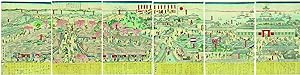
Tokyo Tsukiji Teppousu kei
Published by Tokyo: Daikokuya Kinjiro, Meiji 2 (1869), 1869
Seller: Kagerou Bunko (ABAJ, ILAB), Tokyo, Japan
Association Member: ILAB
Seller rating 2 out of 5 stars
Art / Print / Poster First Edition
No Binding. Condition: Very Good. 1st Edition. Polyptych ukiyo-e with the panorama of Tsukiji Tepposu, the first district for foreigners in Tokyo, which appeared after the treaty with the US. In the picture one can find the first foreign hotel in Tokyo, designed by an American architect (it later burned down in 1872). The British and Dutch residencies are also depicted. The flags of the US, Russia, Prussia, France and other countries fly over the hotel. The background shows a view of the harbor and port. The new red light district, Shin-Shimabara, is situated near the foreign district. The author, Utagawa Kuniteru II (1830-1874), was an apprentice of Toyokuni III and a master of depicting kabuki theater and also of westernized scenery. Very rare. Text in Japanese. Polyptych. 6 panels complete. 36.5 x 24.5 cm, each. Colour woodblock prints. Small holes, partly repaired. Some dirt. Very good condition.
-
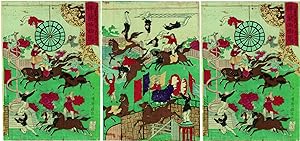
Asakusa Kan-non keidai ni Oite Kogyo Tsukamatsuri Soro: Furansu Kyokuba
Published by Tokyo: Tsujioka Bunsuke, Meiji 5, 1872
Seller: Kagerou Bunko (ABAJ, ILAB), Tokyo, Japan
Association Member: ILAB
Seller rating 2 out of 5 stars
Art / Print / Poster
No Binding. Condition: Very Good. vThis colour woodblock, a printed nishiki-e triptych, depicts one of the performances of the Soullier circus troupe. Louis Soullier (1813-1888) and his troupe visited Japan for three years from 1871 and enjoyed great success. The woodblocks were made after the first show that took place in October 1871 at Yasukuni shrine. For this later print, the title was changed to Asakusa shrine, as it became the main location for the circus performances in 1872. Text in Japanese. 34 x 24 each. Triptych, complete. Prints pasted together at extremities. Minor soiling. Good to very good.
-
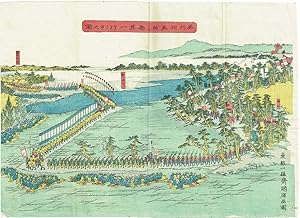
[Famous Places of Tokyo No. 1 View of the Prospering Nihonbashi Replacement Bridge].
Publication Date: 1873
Seller: Geographicus Rare Antique Maps, Brooklyn, NY, U.S.A.
Association Member: ABAA ESA ILAB
Seller rating 4 out of 5 stars
Map
Very good. Slight loss at bottom right quadrant. Light soiling. Size 13.75 x 27.75 Inches. An engaging 1873 Ukiyo-e triptych produced by Kuniteru II depicting the new Nihonbashi Bridge in Central Tokyo. The most culturally significant bridge in Japan, the historical terminus of the T?kaid? highway, the Edo-era arched bridge had been replaced by a Western-style flat bridge the year before this print's publication, both a practically and symbolically important change. A Closer Look Oriented towards the northeast, this view focuses on the historically significant Nihonbashi Bridge in central Tokyo. More specifically, it highlights the replacement of the preceding arched bridge with a Western-style flat bridge with balustrades, built to accommodate the increasing number of horse-drawn carriages and rickshaws, which are separated from pedestrians by a divider. The view presents a bustle of activity as people, carriages, and, on water, boats scurry in different directions. Although most figures retain traditional Japanese garments, including two samurai at right, others have partially incorporated elements of Western-style clothing or completely adopted the once-foreign vestments. Additional bridges (??? Edobashi and ??? Aramebashi) are labeled in the background. The building on the right is the telegraph office (???), with raised telegraph lines running parallel to the bridge. As it focuses on the new bridge and includes elements of changes in Tokyo brought by Western influence, this work could be considered part of the kaika-e subgenre of ukiyo-e . Nihonbashi (???) - Geographic and Cultural Center of Tokyo The Nihonbashi Bridge was originally built in 1603 during the Edo period. It served as a vital point in the Gokaid?, the five main roads connecting the capital, Edo (now Tokyo), with other parts of Japan. The bridge was the eastern terminus of the T?kaid?, the most important of these roads. All distances in Japan were once measured from this point, and it is still commonly used as a reference point for distances on roads and highways. The bridge gave its name to the surrounding district in central Tokyo, close to the imperial palace, which was a major commercial center in the Edo period. Due to its importance, Nihonbashi also took on a profound cultural significance, not quite to the level of Mt. Fuji, but still something that nearly all Japanese would recognize and associate with the capital. As a result, the bridge has been depicted in many works of art, including ukiyo-e prints by masters such as Hokusai and Hiroshige, and here by Kuniteru II. The original 1603 bridge was made of wood and it, along with several replacements, burned in various fires in the Edo period. As mentioned above, this view is significant because it highlights the replacement of the last Edo-era arched bridge with a flat Western-style bridge. In 1911, the bridge seen here was replaced by a stone and brass structure that still stands today. Kaika-e (???) Kaika-e is the Edo / Tokyo equivalent of the Yokohama-e (???) genre, depicting foreigners and foreign technologies in the wake of Japan's forcible opening to the world in the 1850s. The phrase 'kaika' is an abbreviation of bunmei-kaika (????), meaning?'civilization and enlightenment,' a slogan and guiding philosophy of the early Meiji period. Kaika-e became especially popular in the 1870s and were encouraged by the Meiji government as a way of advertising the modernization of the new regime's capital city. As with Yokohama-e , common themes included Western-style or hybrid architecture, clothing, and new modes of transportation, as well as scenes of Japanese and foreigners fraternizing amicably. Publication History and Census This view was prepared by Kuniteru II and published by Iseya Kanekichi in 1873. It is quite rare; we note examples held by the Tokyo Metropolitan Library, the National Institute of Japanese Literature, and the Japanese Postal Museum. It should not be confused with Hiroshige III's si.



![Seller image for [Famous Places of Tokyo No. 1 View of the Prospering Nihonbashi Replacement Bridge]. for sale by Geographicus Rare Antique Maps](https://pictures.abebooks.com/inventory/md/md32068510566.jpg)