
Lefman (18 results)
 More images
Language: English
Published by Garnier Freres, Libraires - Editeurs, Paris, 1889
- Hardcover
- First Edition
Seller: Lazarus Books Limited, Blackpool, LANCS, United KingdomLazarus Books Limited
Contact seller5-star sellerCondition: Used - Very good
US$ 31.82
US$ 32.17 shippingShips from United Kingdom to U.S.A.Quantity: 1 available
Add to basketDecorative Cloth. Condition: Very Good. First Edition. Not dated, c. 1889 Size quarto, 116 pages including index. Cloth covered boards decorated with repeat pattern of small flowers and in bronze gilt larger flowers and butterflies and dragonflied, black large titles, sage green end-papers. Condition very good, corners hinges an…d spine rubbed and slightly sunned, gift inscription to front paste-down, contents clean. Songs and rounds for children printed with the musical score for piano accompanyment. Illustrated throughout. Texts are in French. Henri Pille, Bourgeot, Lefman (illustrator).

Language: French
Published by Garnier Frères, Libraires-Editeurs, Paris
- Hardcover
Seller: Librairie Sheehy (Theologia Books), La Charite sur Loire, FranceLibrairie Sheehy (Theologia Books)
Contact seller4-star sellerCondition: Used - Good
US$ 21.16
US$ 41.10 shippingShips from France to U.S.A.Quantity: 1 available
Add to basketRelié. Condition: Bon État. Sans date. Exemplaire relié en bon état général. 116p. Henri Pille; J. Blass; Le Natur; L. Néhlig; Trimolet; Steinheil; Bourgeot & Lefman (illustrator).

- Softcover
Seller: Books Puddle, New York, NY, U.S.A.Books Puddle
Contact seller4-star sellerCondition: New
US$ 106.08
US$ 3.99 shippingShips within U.S.A.Quantity: 4 available
Condition: New.

- Softcover
Seller: preigu, Osnabrück, Germanypreigu
Contact seller5-star sellerCondition: New
US$ 59.97
US$ 79.91 shippingShips from Germany to U.S.A.Quantity: 5 available
Taschenbuch. Condition: Neu. Internationalisation of People Names | A study of human name structures around the world and a model to prevent identity loss within computer systems | Gary Lefman | Taschenbuch | 236 S. | Englisch | 2013 | Scholars' Press | EAN 9783639707090 | Verantwortliche Person für die EU: preigu GmbH & Co. KG,… Lengericher Landstr. 19, 49078 Osnabrück, mail[at]preigu[dot]de | Anbieter: preigu.
- Softcover
Seller: Revaluation Books, Exeter, United KingdomRevaluation Books
Contact seller5-star sellerCondition: New
US$ 132.33
US$ 13.43 shippingShips from United Kingdom to U.S.A.Quantity: 1 available
Paperback. Condition: Brand New. 236 pages. 8.66x5.91x0.54 inches. In Stock.
- Softcover
Seller: Revaluation Books, Exeter, United KingdomRevaluation Books
Contact seller5-star sellerCondition: New
US$ 138.05
US$ 13.43 shippingShips from United Kingdom to U.S.A.Quantity: 1 available
Paperback. Condition: Brand New. 236 pages. 8.66x5.91x0.54 inches. In Stock.
- Softcover
Seller: Mispah books, Redhill, SURRE, United KingdomMispah books
Contact seller4-star sellerCondition: New
US$ 231.03
US$ 33.58 shippingShips from United Kingdom to U.S.A.Quantity: 1 available
paperback. Condition: New. NEW. SHIPS FROM MULTIPLE LOCATIONS. book.

Published by società Editrice Libraria, Milano, 1900
- Hardcover
Seller: Il Salvalibro, Foligno, PG, ItalyIl Salvalibro
Contact seller5-star sellerCondition: Used - Good
US$ 58.79
US$ 39.96 shippingShips from Italy to U.S.A.Quantity: 1 available
Add to basketCondition: Good. Volume cartonato rigido di pagine 1078 con nmerose illustrazioni nel testo e fuori testo. Opera in buone condizioni. Spedizione in 24 ore dalla conferma dell'ordine. Book.
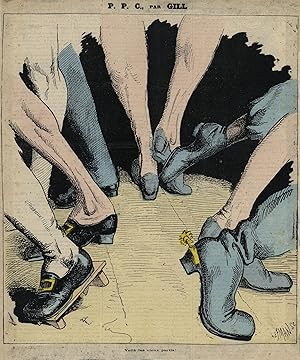
Published by L'Eclipse, Paris, 1872
Seller: Rob Zanger Rare Books LLC, Middletown, NY, U.S.A.Rob Zanger Rare Books LLC
Contact seller5-star sellerWoodcut with hand coloring in watercolor, 14 5/8 x 12 3/8 inches (370 x 312 mm), L'Eclipse publication page and masthead have been trimmed out, margins are narrow. Sheet laid down to bluish wove paper.

Published by [Paris: French Publisher, circa 1875]., 1875
- Art / Print / Poster
Seller: Wittenborn Art Books, San Francisco, CA, U.S.A.Wittenborn Art Books
Contact seller5-star sellerCondition: Used - Good
US$ 75.00
US$ 10.00 shippingShips within U.S.A.Quantity: 1 available
Add to basketCondition: Good. Hand-colored engraving. 24.5 x 32 cm (sheet). Very Good, some light foxing in the margins and image, water staining in lower right sheet corner.

Published by s. XIX, 1 . No Asignado
- Softcover
- Art / Print / Poster
Seller: Frame, Madrid, M, SpainFrame
Contact seller5-star sellerCondition: Used - Good
US$ 170.49
US$ 57.08 shippingShips from Spain to U.S.A.Quantity: 1 available
Add to basketCondition: ACEPTABLE. Journal des Artistes Formato (cm): 28x20.
 More images
Le Lampion de Berluron. Musicien de la Territoriale Orphéoniste de Tortequeue !
Pépin [Claude Guillaumin (1842-1927) illustrateur et rédacteur] / Pascal Lange [gérant] / Lefman [graveur]
- Softcover
- Magazine / Periodical
Seller: Albert bouquiniste, Paris, FranceAlbert bouquiniste
Contact seller1-star sellerCondition: Used - Near fine
US$ 2,469.22
US$ 55.94 shippingShips from France to U.S.A.Quantity: 1 available
Add to basketCouverture souple. Condition: Bon. Le Lampion de Berluron. Musicien de la Territoriale Orphéoniste de Tortequeue ! 10 centimes. Un numéro par semaine. Abonnement : un an 8 francs six mois, 4 francs. Paris - 53, Chaussée d'Antin - Paris. Paris, Imp. C. Murat, 1879- 1880-1881. Le dessin de la couverture est signé par le graveur Le…fman sc Le lampion fait probablement allusion à l'évènement historique parisien, le début des barricades de 1827 à Paris, où la foule des émeutiers pour obliger les occupants des appartements à se joindre à eux en illuminant, en scandant : Des lampions ! des lampions ! Le Berluron un mot d'argot, est celui qui a la berlue en voyant les choses de travers et déformant la réalité ou en percevant des choses imaginaires. Claude Guillaumin (1842-1927) signe ses caricatures anticléricales sous le pseudonyme de Pépin, [Ennui, avoir un pépin, ou allusion probablement à un personnage de vaudeville du XIXème, surgissant sur scène avec un énorme parapluie]. Berluron est le nom de plume de Claude Guillaumin. En 1875, au début de la Troisième République, apparaissent les dessins de Pépin dans le journal Le Grelot, [Journal républicain et anticlérical] dont il réalisa la plupart des couvertures entre 1876 et 1879. Dans la forme d'édition comme dans la ligne éditorial satirique, Le lampion de Berluron fera écho aux deux autres revues qui paraissaient à cette époque : La Lanterne d'Henri Rochefort (1831- 1913) [la brochure crée en 1868, a cessé de paraître en 1876] et La Lanterne de Boquillo de Pierre-François Humbert dit Albert (1835- 1886) [Revue fondée en 1868]. Le lampion de Berluron commença à paraître à partir de 1879 sous la direction de Pascal Lange du journal La Petite République, un journal socialiste proche de Léon Gambetta. Pépin collabore à la revue en fournissant des histoires tirées de l'actualité et des dessins de caricatures. Pépin est effectivement le principal rédacteur et illustrateur caricaturiste de la revue dès la parution du premier numéro en 1879. Il devint par la suite propriétaire et directeur de la revue satirique en décembre 1881, son nom Guillaumin apparait au n° 111 du 11 décembre 1881, avec la mention gérant. Par la suite la revue change de format, de in-12 elle passe au format in-octavo. Le dessin de la page de couverture représente un musicien de l'armée territorial [créée par la loi du 27 juillet 1872 instaurant les principes de la réserve militaire]. Le musicien de la caricature comme l'encadré sur la page de couverture l'indique, est affilié à l'orphéon du lieu-dit Tortequeue, dans la commune Le Vilhain, département de l'Allier. Il est représenté en tenue militaire avec une haute casquette à visière, sabre en bandoulière, musette sur l'épaule, soufflant dans un instrument à vent, un tuba devant un lampion en terre cuite dont la mèche est allumée provoquant de la fumée. Le papier des couvertures du Lampion de Berluron est de différentes couleurs par alternance d'un numéro à l'autre : vert foncé ou pale, rose foncé ou pale, jaune et bleu. Le texte central de 25 lignes est totalement calligraphié avec de nombreux petits dessins caricaturaux dans chacun des numéros de la revue. Le lampion de Berluron contient aussi des rebriques comme faits cléricaux, drôleries cléricales, méli-mélo cléricafard, des contes de la Fontaine, gazettes de campagnes, et des extraits de roman paraissant en feuilleton d'un numéro à l'autre. La revue est de format in-12, (12 cm. / 17 cm.) Au total 73 numéros du 21 décembre 1879 au 31 décembre 1881, broché au fil, chaque numéro contient 18 pages avec les pages de couvertures. Les versos des couvertures sont aussi imprimés contenant le plus souvent des extraits d'une nouvelle en feuilletant. Année 1879 : 2 numéros n°8, n°9. N° 8. 1er année 21 décembre 1879. Le fascicule à pour titre : Le roi de l'ile des canards. Signé Berluron orphéoniss et Le gérant Lange. Page 1 un dessin représentant le roi de l'Ile des canards gravé par Lefman sc. 4 dessins sous le titre « un ancien maire de l'ordre moral ».

- Softcover
- Print on Demand
Seller: BuchWeltWeit Ludwig Meier e.K., Bergisch Gladbach, GermanyBuchWeltWeit Ludwig Meier e.K.
Contact seller5-star sellerCondition: New
US$ 69.26
US$ 26.26 shippingShips from Germany to U.S.A.Quantity: 2 available
Taschenbuch. Condition: Neu. This item is printed on demand - it takes 3-4 days longer - Neuware -If a system does not possess the ability to capture, store, and retrieve people names, according to their cultural requirements, it is less likely to be accepted on the international market. Internationalisation of people names coul…d prevent a person s name being lost in a system, avoiding frustration, saving time, and possibly money. This is a study that attempts to determine the extent to which the human name can be internationalised, based upon published anthroponymic data for 148 locales, by categorising them into eleven distinctly autonomous parts. It attempts to provide an evaluation of the effectiveness of internationalising people names; examining the challenges of terminology conflicts, the impact of subjectivity whilst pigeonholing personyms, and the consequences of decisions made. The cultural variety of human names can be expressed with the Locale Data Mark-up Language for 74% of the world s countries. Spanning 1,919 anthroponymic syntactic structures, software developers, localisation engineers, and database administrators can benefit, through recognition of this problem, and understanding the potential gains from accurately handling people names within a system. 236 pp. Englisch.

- Softcover
- Print on Demand
Seller: moluna, Greven, Germanymoluna
Contact seller5-star sellerCondition: New
US$ 56.93
US$ 55.93 shippingShips from Germany to U.S.A.Quantity: Over 20 available
Condition: New. Dieser Artikel ist ein Print on Demand Artikel und wird nach Ihrer Bestellung fuer Sie gedruckt. Autor/Autorin: Lefman GaryGary is a PhD candidate at Trinity College Dublin with CNGL the Centre for Global Intelligent Content. He is Cisco s Internationalisation Architect, a Master of Science in Multilingual Comput…ing and Localisation at the Loc.
- Softcover
- Print on Demand
Seller: Majestic Books, Hounslow, United KingdomMajestic Books
Contact seller4-star sellerCondition: New
US$ 108.43
US$ 8.73 shippingShips from United Kingdom to U.S.A.Quantity: 4 available
Condition: New. Print on Demand.
- Softcover
- Print on Demand
Seller: Biblios, frankfurt am main, HESSE, GermanyBiblios
Contact seller4-star sellerCondition: New
US$ 115.24
US$ 11.36 shippingShips from Germany to U.S.A.Quantity: 4 available
Condition: New. PRINT ON DEMAND.

- Softcover
- Print on Demand
Seller: buchversandmimpf2000, Emtmannsberg, BAYE, Germanybuchversandmimpf2000
Contact seller5-star sellerCondition: New
US$ 69.26
US$ 68.49 shippingShips from Germany to U.S.A.Quantity: 1 available
Taschenbuch. Condition: Neu. This item is printed on demand - Print on Demand Titel. Neuware -If a system does not possess the ability to capture, store, and retrieve people names, according to their cultural requirements, it is less likely to be accepted on the international market. Internationalisation of people names could pr…event a person's name being lost in a system, avoiding frustration, saving time, and possibly money. This is a study that attempts to determine the extent to which the human name can be internationalised, based upon published anthroponymic data for 148 locales, by categorising them into eleven distinctly autonomous parts. It attempts to provide an evaluation of the effectiveness of internationalising people names; examining the challenges of terminology conflicts, the impact of subjectivity whilst pigeonholing personyms, and the consequences of decisions made. The cultural variety of human names can be expressed with the Locale Data Mark-up Language for 74% of the world's countries. Spanning 1,919 anthroponymic syntactic structures, software developers, localisation engineers, and database administrators can benefit, through recognition of this problem, and understanding the potential gains from accurately handling people names within a system.VDM Verlag, Dudweiler Landstraße 99, 66123 Saarbrücken 236 pp. Englisch.

- Softcover
- Print on Demand
Seller: AHA-BUCH GmbH, Einbeck, GermanyAHA-BUCH GmbH
Contact seller5-star sellerCondition: New
US$ 69.26
US$ 70.61 shippingShips from Germany to U.S.A.Quantity: 1 available
Taschenbuch. Condition: Neu. nach der Bestellung gedruckt Neuware - Printed after ordering - If a system does not possess the ability to capture, store, and retrieve people names, according to their cultural requirements, it is less likely to be accepted on the international market. Internationalisation of people names could pre…vent a person s name being lost in a system, avoiding frustration, saving time, and possibly money. This is a study that attempts to determine the extent to which the human name can be internationalised, based upon published anthroponymic data for 148 locales, by categorising them into eleven distinctly autonomous parts. It attempts to provide an evaluation of the effectiveness of internationalising people names; examining the challenges of terminology conflicts, the impact of subjectivity whilst pigeonholing personyms, and the consequences of decisions made. The cultural variety of human names can be expressed with the Locale Data Mark-up Language for 74% of the world s countries. Spanning 1,919 anthroponymic syntactic structures, software developers, localisation engineers, and database administrators can benefit, through recognition of this problem, and understanding the potential gains from accurately handling people names within a system.


