
Low Captain James (2 results)

The Legion Book.
Churchill, Winston S.; Aldousâ Huxley; Hilaireâ Belloc; Jacobâ Epstein; Ericâ Gill; Markâ Gertler; Davidâ Low; Johnâ Lavery; Rudyard Kipling; Lauraâ Knight; Williamâ Nicholson; Paulâ Nash; Charlesâ Ricketts; Edithâ Sitwell; Vitaâ Sackvilleâ'West; Stanleyâ Spencer; W.â Heathâ Robinson; W.â H.â Davies; Rebeccaâ West; P.â G.â Wodehouse et al. Edited by Captain James Humphrey Cotton Minchin
Published by Privately printed by The Curwen Press for H.R.H. The Prince of Wales, London 1929
- Hardcover
- First Edition
- Signed
Seller: Raptis Rare Books, Palm Beach, FL, U.S.A.Raptis Rare Books
Contact seller5-star sellerFirst and limited deluxe edition of the monumental Legion Book; one of only one hundred numbered copies printed for private distribution by the Prince of Wales and signed by a remarkable array of British writers and artists, as well as four prime ministers. Quarto, original publisher's full deluxe pigskin over boards elaborately… decorated in blind and gilt, top edge gilt, tissue-guarded color frontispiece, engraved title-page vignette, illustrated with 16 captioned tissued-guarded plates in various techniques (some signed by the artist) and 32 collotypes. One of one hundred numbered copies printed for private distribution by the Prince of Wales and with five pages signed by each of the 89 contributing writers and illustrators as well as four prime ministers (three British Prime Ministers: David Lloyd George, Stanley Baldwin, and Ramsay MacDonald, and French Prime Minister Georges Clemenceau) including: Winston Churchill (who was not yet a Prime Minister), Rudyard Kipling, P.G. Wodehouse, Eric Gill, Stanley Spencer, Charles Ricketts, W. Heath Robinson, Laura Knight, William Nicholson, Paul Nash, David Low, Rebecca West, John Lavery, Max Beerbohm, Vita Sackville-West, Hilaire Belloc, Mark Gertler, Edith Sitwell, Jacob Epstein, W.H. Davies, and Aldous Huxley among others. This is number 84. The Legion Book was created at the request of H.R.H. The Prince of Walesâ"who would later become King Edward VIII and, following his abdication, the Duke of Windsorâ"as a fundraising initiative for the British Legion. All profits from its sales were intended to support the organization. The book features contributions from 85 distinguished British writers and artists including Winston Churchill, Rudyard Kipling, P.G. Wodehouse, Aldous Huxley, Vita Sackville-West, G.K. Chesterton, Hilaire Belloc, Augustus John, Eric Kennington, and John Nash. It was compiled and edited by James Humphrey Cotton Minchin (1894â"1966), a veteran who served with the Cameronians and the Royal Flying Corps during the First World War. While the trade version saw several reprints, a special edition of 600 numbered copies was also produced. Of these, 500 bore the editorâs signature, but âthe first 100 were reserved for H.R.H. the Prince of Wales, sponsor of the volume, in his gift.â According to the note at the conclusion of the Table of Contents, âFive pages of contributorsâ signatures appear after the Dedication, with additional signed pages opposite Collotype No. 3 and Collotype No. 20.â Every contributor signed the book, with the sole exception of John Singer Sargent, who died in 1925, before the project was completed. In near fine condition with toning to the extremities of the front panel and front hinge. Housed in the original publisher's custom folding cloth clamshell box. An exceptional example of this rare signed limited edition. Formed in the aftermath of a war that had shattered a generation, the Royal British Legion emerged in May 1921 as a unified voice for the countless veterans left woundedâ"physically, mentally, and economicallyâ"by the First World War. The staggering cost of the conflict, with nearly 3.2 million British Empire casualties, exposed the inadequacy of postwar support. A fully disabled veteran received just 30 shillings a week, and any claim had to be made within seven years of discharge. In response to such injustice, several ex-servicemenâs groups came together to create the Legion, not merely as a charity, but as an advocate for those who had borne the brunt of industrialized warfare. From its inception, the Legion fought for fair pensions, better employment opportunities, and meaningful support for both former service members and their familiesâ"laying the groundwork for a broader movement of remembrance, welfare, and national responsibility that continues to this day.
 More images
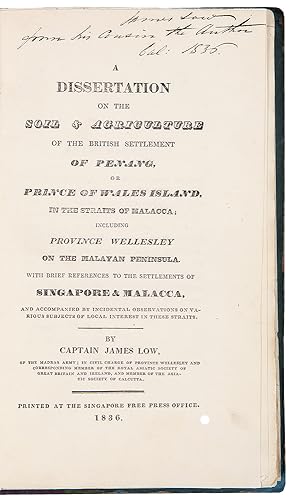
Published by Printed at the Singapore Free Press Office, Singapore 1836
- Softcover
- Signed
Seller: Donald A. Heald Rare Books (ABAA), New York, NY, U.S.A.Donald A. Heald Rare Books (ABAA)
Contact seller5-star sellerLarge octavo. (9 7/8 x 6 inches). v, 321, errata leaf. Two hand-colored folding lithographic plates printed in Calcutta by J.B. Tassin. Presentation copy. Original cloth backed. Blue paper boards. Rare Singapore imprint by the earliest serious Western scholar of the Thai language and a pioneering observer of Siam. Captain James…Low was a Madras Army officer posted to Penang from 1819 and the earliest sustained Western scholar of the Thai language and Siamese culture. Educated at Edinburgh, he learned Malay and Thai, served on missions along the Andaman coast (notably to the Raja of Ligor in 1824), compiled vocabularies, and amassed drawings and manuscripts. His Thai-facing publications laid the groundwork for nineteenth-century European study of Siam: A Grammar of the Thai or Siamese Language (Calcutta, 1828); "On Buddha and the Phrabát" (Transactions of the Royal Asiatic Society, 3, 1831); "Extracts from the Journal of a Political Mission to the Raja of Ligor in Siam" (Journal of the Asiatic Society of Bengal, July 1838); "On Siamese Literature" (Asiatic Researches, 20, 1839); and the collected treatise On the Government, the Literature, and the Mythology of the Siamese (London, 1839), followed by further philological and religious studies, including translations from the Phra Pathom, in JASB (1848-49). He also prepared early maps of Siam, Cambodia, and Laos. Published in Singapore in 1836, A Dissertation on the Soil & Agriculture of Penang is Captain James Low's practical survey of the island and its mainland Province Wellesley, written from the vantage of a resident East India Company officer. Low classifies soils and terrain, links them to climate and monsoon, and then moves crop by crop through the region's staples and plantations: coconut, areca, sugar-cane and garden produce around the coast; and the island's signature spices (nutmeg and clove). He touches on the working realities of agriculture: clearing and fallow, water management, pests and diseases, labour and land tenure, and the revenues and trade that follow. Beyond agronomy, Low devotes substantial space to social observation in Penang and the Straits. A long section on "Crime" treats policing, punishments, and the legal complexion of the settlement and later chapters range across a variety of ethnographic notes. The book's index and common-terms register point to further everyday topics such as "gaming," "police," "oath," and "superstition", as well as to his comparative references to Siam and the Siamese along the peninsula, consistent with Low's broader expertise in Thai language and culture. Together these sections make the volume a useful social portrait of Penang's multiethnic life in the 1830s as much as a handbook of crops and soils.

