
Macmonnies Frederick (4 results)

- Hardcover
Seller: BWS BKS, Ferndale, NY, U.S.A.BWS BKS
Contact seller4-star sellerCondition: Used - As new
US$ 2,725.48
US$ 3.00 shippingShips within U.S.A.Quantity: 2 available
Hardcover. Condition: As New.

Published by Sound View Press, Madison, CT 1996
- Hardcover
Seller: Strand Book Store, ABAA, New York, NY, U.S.A.Strand Book Store, ABAA
Contact seller4-star sellerCondition: Used - Very good
US$ 75.00
US$ 8.98 shippingShips within U.S.A.Quantity: 1 available
Oversized Hardcover. Condition: Very Good. Dust Jacket Condition: Very Good. (1996). 4to. Toning to edges of leaves, textblock, end papers, and pastedowns. Slight bumping with creasing to spine ends of barely rubbed boards with slightest wear to forecorners. Light toning to edges of dust jacket verso. Slight bumping and scraping… to edges, forecorners, and spine ends of rubbed, faintly scratched, and lightly soiled dust jacket. VG/VG.
 More images
Published by V.p. 1910
Seller: Auger Down Books, ABAA/ILAB, Marlboro, VT, U.S.A.Auger Down Books, ABAA/ILAB
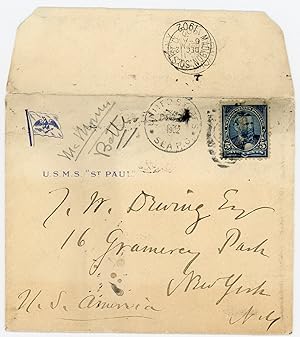
Contact seller5-star sellerCelebrated American Beaux-Arts sculptor Frederick MacMonnies (1863-1937) studied with Augustus Saint-Gaudens and many of his best commissions emerged from his relationships with Saint-Gaudens and the architect Stanford White. He lived primarily in France but traveled frequently to New York and was part of a circle of artists tha…t formed around White at Edwin Booth's Players Club in Gramercy Park and the Saint-Gaudens summer colony in New Hampshire. Artist Thomas Dewing was another Saint-Gaudens student and MacMonnies' close friend. Two of the three letters discuss an important commission for the Players Club: a memorial sculpture for famed actor Edwin Booth. The memorial became a flash point for changing American tastes and a harbinger of MacMonnies' declining fortunes. His original proposal was an elaborate and symbolic design at odds with the new fashion for modern and simplified ornament espoused by artists like Dewing. In a lengthy letter here MacMonnies provides a passionate defense for Beaux-Art symbolism in favor of the modernizing taste of many of his colleagues. In an earlier letter from January 1910, MacMonnies attests the commission has left him "nervous" and in "a collapsed state" but grateful for Dewing's "uplifting letter." Then, in May of the same year, MacMonnies provides his lengthy appeal to Dewing to be allowed to continue the commission and asks for help convincing the committee. "Simplicity, when it calls attention to itself, can be as offensive as any other form of pretension. Besides all this, the Theatre and Actors deal in rich costumes, fabulous scenery, richness and riot of color and form. What might naturally appear overloaded or overenriched or complicated in a preliminary sketch in sculpture, may in the finished production appear clear and simple. In making the model for the final work, I should naturally aim by every science of the art I may have acquired, to make the monument imposing, simple and impressive without losing the richness which should go with the subject." Though MacMonnies closes his letter, "I am desperately sickened at the thought of having it fall into the list of things not done," he eventually quit the project and artist Edmond Quinn's simplified Booth monument was chosen (including the actor's representation as Hamlet on a "Morris chair" lamented by MacMonnies in his letter). A well preserved collection in excellent condition. Ink on paper, each sheet approx. 9 x 7 in., 1-4 sheets each, variously paginated, one with orig. envelope.
 More images
Published by France 1910
- Manuscript
Seller: Auger Down Books, ABAA/ILAB, Marlboro, VT, U.S.A.Auger Down Books, ABAA/ILAB
Contact seller5-star sellerCondition: Overall excellent. Frederick MacMonnies (18631937) was an American expatriate sculptor and painter, known in the US for works including Nathan Hale and Bacchante and Infant Faun. In 1907, New York City's Player's Club commissioned MacMonnies to design and produce a monument to the club's founder, Edwin Booth. Offered…here are three letters from MacMonnies to Players Club member and fellow visual artist Thomas W. Dewing (18501938) following the commission. MacMonnies seemed to have been under extraordinary emotional stress, writing that he was returning to France as "New York had played on my nerves" (N.d.) and, later, that: "I have been in a collapsed state for about seven months, a sort of nervous prostration, and blue and desperate. You cannot imagine the pleasure your letter gave me, as one of the symptoms of the disease I have is in thinking nobody cares a [?] about you and an utter disbelief in any work you have ever done." (January 30, 1910) Later news from Dewing would not be so soothing to MacMonnies, as it reached the sculptor that the Players Club had some reservations about his design for the Booth memorial. MacMonnies' May letter is worth quoting at length, as he justifies his design choices and critiques trends in statuary: "I was sorry & very much surprised to hear you did not like my design for the Booth Memorial, for I have & always have had such implicit confidence & admiration for your taste that I thought there must be something wrong with me & a screw loose somewhere. "I had been highly elated over the design from the first after making about 75 sketches & going over thoroughly the usual statue & pendant figure on pedestal 'cliches', which I think has been the cause of many rotten monuments all over the world [.] really the Moliere Fountain in Paris is a good type of that sort of thing Moliere seated above & the tragedy & comedy neatly draped over the pedestal; having apparently walked or climbed up on the base & fitted their respective symbols into the mouldings still held in their hands with elbows uncomfortably resting on the base of the statue above. This 'cliche' has been used since in every ingeniously idiotic nouveaute in modern European monuments [.] "To avoid this sort of thing naturally was simple & easy, but to find something that would be refeshing, new & suggestive of the Theatre, and be an actors' monument, instead of a General's or Statesman's & be as appropriately suggestive of the Theatre as a General's monument should be of the battlefield. "I found great difficulty as I say in designing a new type of monument which would only be used in connection with an actor or playwright. [.] I tried to incorporate into my design the great point in the Medici Chapel tombs & of all good architectural figures, which is to inseparably connect the figures with the architecture, & to avoid the clock cliche, of figures appearing to have stopped in passing. [.] "No one knows more about this my dear Dewing than yourself your work has always had richness & simplicity, dignity, & all the rest, but they are never barren or bald [.] What might naturally appear overloaded or over enriched or complicated in a preliminary sketch in sculpture may in the finished production, appear clear & simple & yet be even more complex than the sketch [.] "The design I have made is in my friends' opinions here the best thing I have done (several distinguished architects & sculptors to whom I showed it warmly approved), & I am desperately sickened at the thought of having it fall into the list of things not done. I am hoping that in the hurly burly of New York life & your many interests you have not had the time to give the design much attention, and that my long explanation of what I have tried to do & hope to do with it may induce you to look into the matter again." (May 28, 1910) In 1913, MacMonnies would resign the commission, unable to come to an agreement with the Club over the design.[1] [1] "MacMonnies Quits Booth Memorial; Tells Frie.


