

Order Total (1 Item Items):
Shipping Destination:

Mclaughlin Jack Editor (3 results)
Skip to main search results
Search filters
Product Type
- All Product Types
- Books (3)
- Magazines & Periodicals (No further results match this refinement)
- Comics (No further results match this refinement)
- Sheet Music (No further results match this refinement)
- Art, Prints & Posters (No further results match this refinement)
- Photographs (No further results match this refinement)
- Maps (No further results match this refinement)
- Manuscripts & Paper Collectibles (No further results match this refinement)
Condition Learn more
- New (No further results match this refinement)
- As New, Fine or Near Fine (1)
- Very Good or Good (2)
- Fair or Poor (No further results match this refinement)
- As Described (No further results match this refinement)
Binding
- All Bindings
- Hardcover (3)
- Softcover (No further results match this refinement)
Collectible Attributes
- First Edition (3)
- Signed (No further results match this refinement)
- Dust Jacket (3)
- Seller-Supplied Images (No further results match this refinement)
- Not Print on Demand (3)
Language (2)
Price
- Any Price
- Under US$ 25
- US$ 25 to US$ 50
- Over US$ 50 (No further results match this refinement)
Free Shipping
- Free Shipping to U.S.A. (No further results match this refinement)
Seller Location
Seller Rating
-
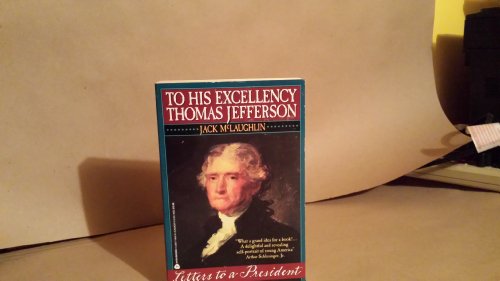
To His Excellency Thomas Jefferson: Letters to a President
Language: English
Published by W. W. Norton & Company, New York and London, 1991
ISBN 10: 0393030164 ISBN 13: 9780393030167
First Edition
Hard Cover. Condition: Very Good. Dust Jacket Condition: Very Good. 1st Ed. 344 pages. Thomas Jefferson.
-

To His Excellency Thomas Jefferson: Letters to a President
Published by W.W. Norton & Co., New York and London, 1991
Seller: Presidential Book Shop or James Carroll, Alexandria, VA, U.S.A.
Seller rating 5 out of 5 stars

First Edition
Cloth. Condition: Near Fine. Dust Jacket Condition: Near Fine. First Edition. xxxii, 344 p. Illustrated. A collection of letters - most previously unpublished - on a variety of subjects, penned by American citizens to their president. Size: 8vo - over 7¾" - 9¾" tall.
-
To His Excellency Thomas Jefferson; Letters to a President
Language: English
Published by W. W. Norton & Company, New York, 1991
ISBN 10: 0393030164 ISBN 13: 9780393030167
Seller: Ground Zero Books, Ltd., Silver Spring, MD, U.S.A.
Seller rating 4 out of 5 stars

First Edition
Hardcover. Condition: Very good. Dust Jacket Condition: Very good. xxxi, [1], 344, [6] pages. Footnotes. Illustrations. Sources. Notes. Index. Letters written to Thomas Jefferson while he was president, as well as his replies, offer insight into life in early nineteenth-century America. These letters, written to one of our most revered presidents and published to coincide with the 250th anniversary of his birth, provide a window into the life of a new nation and its people, offering vivid sketches of the writers, their families and the often precarious circumstances of their existence. Jefferson's careful filing of the letters that he received as President made possible this collection, which reveals something of the diverse beliefs and yearnings of his America. Jack McLaughlin is an Emeritus Professor of English at Clemson University, where he was head of the Humanities Division. He is the author of Jefferson and Monticello, about the life of Thomas Jefferson as seen through the prism of his fifty-year love affair with Monticello, which was nominated for a National Book Award in 1988. McLaughlin also wrote To His Excellency Thomas Jefferson, Letters to a President, and has contributed to such scholarly journals as Shakespeare Quarterly and Modern Drama. This collection of correspondence is a fascinating dialogue between one of the nation's most admired presidents, Thomas Jefferson, and the laboring-class Americans who elected him. The writers--most of whom would otherwise be unknown to history--provide us with striking sketches of themselves and their families, and the early America they were part of. In language sometimes crude, sometimes eloquent, these men and women pour out their needs and demands, praise and vituperation, with an urgency and immediacy not diminished by nearly 200 years. The letters--most of them never before published--are adoring, threatening, funny, passionately political, and begging. Jefferson, who was noted for being accessible to nearly every visitor who wanted to see him, answered as many of them as he could. His responses==sometimes by silence, by a single-word note, or by long, thoughtful letters--reveal his civility, graciousness, and generosity, but also at times his irritation and callousness. Most of the letters are from citizens who want something from the president: money, a job, release from debtor's prison, educational help. There are letters from Yankee tinkerers and craftsmen, from religious zealots, and from informers with secret information about assassination plots. Some writers sent gifts, pamphlets, or books; others offered honest advice about such issues as the settlement of western lands or the problem of slavery. All the letters are suffused with strong feeling. These letters are a valuable addition to the social social of the Jefferson era, providing new insights into the intellectual, technological, and cultural lives of a class of Americans forgotten by traditional political history. But above all they are a pleasure to read. They give us a portrait of Jefferson quite different from the public figure at Washington or the private Sage of Monticello. Here we find him alone at his writing desk, casting and retrieving lines of communications, weaving the myth that was to become Jeffersonian America. First Edition [Stated], First Printing [Stated].


