
Michelet Introduction (12 results)

Language: English
Published by University of Illinois Press, Urbana, Illinois, U. S. A. 1973
- Softcover
Seller: Granada Bookstore, IOBA, Woodlawn, IL, U.S.A.Granada Bookstore, IOBA
Contact seller5-star sellerCondition: Used - Very good
US$ 3.99
US$ 6.99 shippingShips within U.S.A.Quantity: 1 available
Soft cover. Condition: Very Good. No Edition Or Printing Stated. Includes Index. White Pictorial Wraps. Moderate Age Toning. The Spine Has Darkened And Has A Crease. Vertical Crease On The Front Cover.

Language: English
Published by Ann Arbor Paperbacks/The University of Michigan Press, Ann Arbor, MI 1967
- Softcover
Seller: gearbooks, The Bronx, NY, U.S.A.gearbooks
Contact seller5-star sellerCondition: Used - Very good
US$ 14.44
US$ 5.99 shippingShips within U.S.A.Quantity: 1 available
Trade Paperback. Condition: Very Good. 1st Edition: 1967. 132 pp. Stated first edition: 1967! Solidly bound copy with moderate external wear, crisp pages and clean text. Publisher's remainder mark on bottom edge. Synopsis: In the early 15th century, France was in turmoil. The country had been at war for years, and it had no king…. Out of the chaos came Joan of Arc. No one knows how Joan, a poor farm girl, was able to command armies and win battles, but she did all that and more. Some called Joan a heroine. Others called her a witch. But with her determination and unwavering faith, she would go down in history as Saint Joan of Arc. Quentin Fiore (Cover Design) (illustrator).
Published by Classiques Larousse 1935
- Softcover
Seller: Sperry Books, Rollinsford, NH, U.S.A.Sperry Books
Contact seller5-star sellerPaperback. Condition: Fair. Librairie Larousse 1935 mass market paperback, lightly rubbed and age-toned wrapper, smooth spine, tight binding, inked name inside, underlines Prompt, reliable service Prompt, reliable service, shipped next business day. Int'l mailed via first class or priority.
Language: English
Published by Salle Des Gens D'armes Du Palais, Paris, France 1971
- Softcover
Seller: gearbooks, The Bronx, NY, U.S.A.gearbooks
Contact seller5-star sellerCondition: Used - Very good
US$ 33.70
US$ 5.99 shippingShips within U.S.A.Quantity: 1 available
Soft Cover. Condition: Very Good. Janvier 1971 (January 1971). 131 pp. Solidly bound copy with moderate external wear, crisp pages and clean text. Text in French. Pencil mark on inside of back cover.

Lettres d'Abailard et d'Héloïse (French Edition)
De Jules Michelet. 61 Illustrations De J. Gigoux., Introduction
- Softcover
Seller: Gallix, Gif sur Yvette, FranceGallix
Contact seller5-star sellerCondition: New
US$ 30.70
US$ 19.71 shippingShips from France to U.S.A.Quantity: 1 available
Condition: Neuf.
Published by Little, Brown, and Company, Boston, MA 1867
- Hardcover
- First Edition
Seller: Shoemaker Booksellers, Gettysburg, PA, U.S.A.Shoemaker Booksellers
Contact seller5-star sellerCondition: Used - Good
US$ 37.00
US$ 7.50 shippingShips within U.S.A.Quantity: 1 available
Hardcover. Condition: Good to Very Good. No Dust Jacket. First U.S. Edition. 218 pp. Original green cloth covers w/ gilt title on spine. Binding lightly soiled. Ex-library w/ usual markings w/ evidence of card pockets removed from rear endpaper and rear paste-down. Previous owner's name in pencil on front blank endpaper. Very fa…int dampstain to top margin of several leaves in rear, not affecting any text.
 More images
Published by Harper & Brothers 82 Cliff-St., New York, N.Y 1843
- Hardcover
Seller: Meir Turner, New York, NY, U.S.A.Meir Turner
Contact seller5-star sellerCondition: Used - Good
US$ 45.00
US$ 10.00 shippingShips within U.S.A.Quantity: 1 available
Hardcover. Condition: Good. 435 pages. 155 x 100 mm.Number 170 in The Family Library. Damage to foot and head of spine. Signature of early owner on top blank margin of title page. Gilt lettering on spine. Jules Michelet, who went on in life to become a famous French historian, was born in Paris in August 1798 into a family which… had Huguenot traditions and where his father was precariously self-employed as a printer. As he grew to manhood Michelet was offered employment in the imperial printing office but his father, who had hopes for his evidently talented son, decided to keep him in school despite the relative poverty of his circumstances. The son fulfilled some of his father's expectations - he progressed from school to higher studies, in history. In 1821 he was appointed as a teacher of history. He married in 1824. Between 1825 and 1827 Michelet produced a number of sketches, chronological tables, etc., of modern history. His Introduction à l'histoire universelle, published in 1831, displayed the peculiar romantic and visionary qualities which make him one the most stimulating of all historians. It also featured his tendency to indulge in historical suggestions which, although associated with solid facts, are not always trustworthy. The Introduction à l'histoire universelle was in fact partly inspired by the anti-rationalist approach of the philosopher Vico who had proclaimed the triumph of the imagination over analysis. The events of 1830 which initiated the "liberal" monarchy of Louis Philippe unmuzzled Michelet as a liberal, anti-clerical and very patriotic historian and writer, and also put him in a better position for study by obtaining for him the position of head of the Historical Section of the National Archives and a deputy-professorship under Guizot in the literary faculty of the Sorbonne. Soon afterwards he began his chief and monumental work Histoire de France (History of France) in which he immersed himself in the narrative and stressed the development of France as a nation. It was in these years of his early thirties that Michelet seems to have begun to drift somewhat away from a previous acceptance of catholicism and royalism and towards more radical views. The completion of the Histoire de France was to involved intermittently sustained efforts over more than thirty years from 1833 but Michelet also produced other many works during these years. Some of the earlier of these other works included Oeuvres choisies de Vico, the Mémoires de Luther écrits par lui-même, and the Origines du droit française. In 1838 he was appointed professor at the Collège de France, where he held the chair of History and Ethics. He published, in 1839, his Histoire romaine. The results of his lectures appeared in the volumes Le Prêtre, la femme, et la famille (1843), and Le Peuple (1846). In his Le Peuple, Michelet describes the spirit and qualities of the French working class. It is widely considered to be his best single volume. On its initial day of publication it sold a thousand copies and was immediately translated into English. It discussed various economic and political transformations as France and Europe shifted from an agrarian to an industrial society and examined the condition of the social classes. According to Michelet, modernization and industrialization were heightening political and ideological conflict. He called for a love of one's country to solve many of France's problems and placed faith in the innate goodness of the masses, seeing "the people" as the source of progress in history. Le Peuple looks to the people to unify France and make her great. Michelet believed they were the true custodians of the spirit of Joan of Arc, and that their revolution had been a revelation of the inherent nobility of humankind. Michelet visualized himself throughout his life as a champion of the people .
Language: English
Published by Librairie Hachette, Paris, France 1900
- Hardcover
Seller: gearbooks, The Bronx, NY, U.S.A.gearbooks
Contact seller5-star sellerCondition: Used - Good
US$ 96.29
US$ 5.99 shippingShips within U.S.A.Quantity: 1 available
Decorative Hardcover. Condition: Good. No Jacket. Sixième Édition/ 6th Edition. 191 pp. Solidly bound copy with moderate use. Text in French. No dj. Slightly bumped cover board corners. Small tear on top of spine. Previous owner's name inscribed on front cover. Light foxing on page edges.
 More images
Language: English
Published by Gallimard, Paris 1959
- Hardcover
- First Edition
Seller: Dale Steffey Books, ABAA, ILAB, Bloomington, IN, U.S.A.Dale Steffey Books, ABAA, ILAB
Contact seller5-star sellerCondition: Used - Near fine
US$ 480.00
Free ShippingShips within U.S.A.Quantity: 1 available
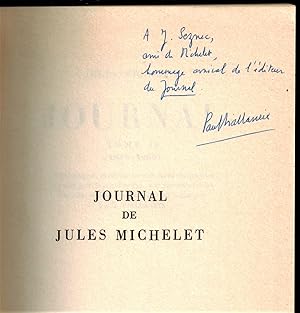
Cloth. Condition: Near Fine. First Edition. SIGNED AND INSCRIBED BY EDITOR Paul Viallaneix at the half-title of Vol. II- "A. J. Seznec, ami de Michelet. homage amicale de l'editeur du JOURNAL Paul Viallaneix". Jean J. Seznec (1905-1983) was a French historian and Renaissance scholar. Jules Michelet (1798-1874) is best known for…his monumental Histoire de France (1833-67). and for being the first historian to use and define the term Renaissance. Tome I Published 1959, Tome II, 1962. Two volumes bound in blue cloth, gilt backs, Near Fine, tidy marginal check marks, rear end page Vol. I with neat annotations in ink and pencil. Uncommon in hardcover and SIGNED AND INSCRIBED BY EDITOR. SIGNED AND INSCRIBED BY EDITOR.
 More images
Hommages à la Grèce.
Collectif - Introduction de Vassily Photiadès. Textes de Renan, Thibaudet, Maurras, Barrès, Michelet, Lacretelle, Ramuz:
Published by Lausanne, La Guilde du livre, 1942
- Hardcover
Seller: La Bergerie, Le Locle, SwitzerlandLa Bergerie
Contact seller5-star sellerCondition: Used - Fine
US$ 38.24
US$ 53.99 shippingShips from Switzerland to U.S.A.Quantity: 1 available
Couverture rigide. Condition: Très bon. Grand in-8, cartonnage bleu imprimé, dos ivoire. Cartonnage très légèrement défraichi, quelques petites taches sur tranches. Nom de possesseur sur garde. Illustré de 12 hors-textes photographiques en noir, contrecollés. Ce beau livre fut édité au seul profit de l'oeuvre de secours en faveu…r des enfants de Grèce: tous les auteurs, illustrateurs et artisans (imprimeur, photograveur et relieur)ayant renoncé à leurs droits. Tirage limité à 6330 exemplaires numérotés, celui-ci numéro 407.
Published by Editions L'Harmattan
Seller: BOOKIT!, Genève, , SwitzerlandBOOKIT!
Contact seller3-star sellerCondition: Used - As new
US$ 17.71
US$ 61.32 shippingShips from Switzerland to U.S.A.Quantity: 1 available
Condition: Used: Like New. Livre à l'état de neuf, très frais sans annotations ni défauts dissmulés.
 More images
Published by Famot
- Hardcover
- First Edition
Seller: Okmhistoire, St Rémy-des-Monts, SARTH, FranceOkmhistoire
Contact seller4-star sellerCondition: Used - As new
US$ 94.45
US$ 37.82 shippingShips from France to U.S.A.Quantity: 2 available
Couverture rigide. Condition: Comme neuf. Edition originale. Genève 1986. 1 Volume/1. -- Comme Neuf -- Reliure éditeur cartonnée skivertex décoré bleu royal émaillé de fleurs de lys dorées, portrait en medaillon . Format in-4°( 28,7 x 23 cm )( 1165 gr ). -------- 325 pages avec 19 illustrations pleine page N&B et couleurs dont 1… carte de l'itinéraire de Jeanne. ************************** '' C'est en 1841, dans le tome V de son Histoire de France, que paraît pour la première fois la Jeanne d'Arc de Michelet. En 1853, cette relation biographique fait l'objet d'une édition séparée, agrémentée d'une introduction, de notes et de quelques variantes. ************************* Extrait : « Ce qui fait de Jeanne une figure éminemment originale, ce qui la sépare de la foule des enthousiastes qui dans les âges d'ignorance entraînèrent les masses populaires, c'est que ceux-ci pour la plupart durent leur puissance à une force contagieuse de vertige. Elle, au contraire, eut action par la vive lumière qu'elle jeta sur une situation obscure, par une force singulière de bon sens et de bon coeur. » ***********************.


