
Pitt Theodore (10 results)

- Softcover
Seller: ThriftBooks-Atlanta, AUSTELL, GA, U.S.A.ThriftBooks-Atlanta
Contact seller5-star sellerCondition: Used - Fair
US$ 7.47
Free ShippingShips within U.S.A.Quantity: 1 available
Paperback. Condition: Fair. No Jacket. Readable copy. Pages may have considerable notes/highlighting. ~ ThriftBooks: Read More, Spend Less.
- Softcover
Seller: ThriftBooks-Atlanta, AUSTELL, GA, U.S.A.ThriftBooks-Atlanta
Contact seller5-star sellerCondition: Used - Very good
US$ 7.47
Free ShippingShips within U.S.A.Quantity: 1 available
Paperback. Condition: Very Good. No Jacket. May have limited writing in cover pages. Pages are unmarked. ~ ThriftBooks: Read More, Spend Less.
- Softcover
Seller: ThriftBooks-Atlanta, AUSTELL, GA, U.S.A.ThriftBooks-Atlanta
Contact seller5-star sellerCondition: Used - Good
US$ 7.47
Free ShippingShips within U.S.A.Quantity: 1 available
Paperback. Condition: Good. No Jacket. Pages can have notes/highlighting. Spine may show signs of wear. ~ ThriftBooks: Read More, Spend Less.
- Softcover
Seller: Better World Books: West, Reno, NV, U.S.A.Better World Books: West
Contact seller5-star sellerCondition: Used - Good
US$ 10.67
Free ShippingShips within U.S.A.Quantity: 1 available
Condition: Good. Former library copy. Pages intact with minimal writing/highlighting. The binding may be loose and creased. Dust jackets/supplements are not included. Includes library markings. Stock photo provided. Product includes identifying sticker. Better World Books: Buy Books. Do Good.
- Softcover
Seller: HPB-Emerald, Dallas, TX, U.S.A.HPB-Emerald
Contact seller5-star sellerCondition: Used - Very good
US$ 6.99
US$ 3.75 shippingShips within U.S.A.Quantity: 1 available
paperback. Condition: Very Good. Connecting readers with great books since 1972! Used books may not include companion materials, and may have some shelf wear or limited writing. We ship orders daily and Customer Service is our top priority.

Published by Sweet & Maxwell, Limited 1946
- Hardcover
Seller: Books for Libraries, Inc., Santa Clarita, CA, U.S.A.Books for Libraries, Inc.
Contact seller5-star sellerCondition: Used - Good
US$ 24.00
US$ 4.75 shippingShips within U.S.A.Quantity: 1 available
Hardcover. Condition: Good. 1946 Hardcover. Tenth Edition. No former owner's name or marks. Text is clean. Binding is strong. Dark blue cloth cover, stamped border, upper corners are bumped, spine has a faint light mark. **No shipping outside the United States available for this heavy book.

- Softcover
Seller: Revaluation Books, Exeter, , United KingdomRevaluation Books
Contact seller5-star sellerCondition: New
US$ 32.94
US$ 13.21 shippingShips from United Kingdom to U.S.A.Quantity: 1 available
Paperback. Condition: Brand New. 10.00x7.00x0.32 inches. In Stock.
Published by Sweet & Maxwell 1946
- Hardcover
Seller: Stephen White Books, Bradford, , United KingdomStephen White Books
Contact seller5-star sellerCondition: Used - Fair
US$ 56.96
US$ 43.91 shippingShips from United Kingdom to U.S.A.Quantity: 1 available
Hardcover. Condition: Acceptable. 1960 EDITION. No dust cover not an ex-library book. Well read with some wear but still very useable. Quick dispatch from UK seller.
 More images
Published by John Humphrey Noyes, Oneida, NY 1875
- First Edition
Seller: Aardvark Rare Books, EUGENE, OR, U.S.A.Aardvark Rare Books
Contact seller5-star sellerCondition: Used - Very good
US$ 248.00
Free ShippingShips within U.S.A.Quantity: 1 available
Newspapers. Condition: Very Good. First Edition. Eight-page newsprint editions, each 13.75 in. x 10 in., which show few flaws beyond routine signs of age, handling and transit. A bit of edge-wear; a bit of chipping; some toning of the paper, but not much; some splits to edges, but not many. They are still attractive to look at a…nd easy to read. The lot of 21 copies (17 unique) is comprised of the following issues: Mount Tom, Monday, April 25, 1864, Vol. I., No. 6. [Four inch closed tear to pages 1; split along the fold.] Mount Tom, Monday, March 6, 1865. Vol. I., No. 51 Oneida Community, August 16, 1869, Vol. VI, No. 22 Oneida Community, October 11, 1869. Vol. VI., No. 30 Oneida Community, February 28, 1870, Vol. VI, No. 50 (two copies) Oneida Community, March 21, 1870, Vol. VII, No. 1 (two copies) Oneida Community, April 25, 1870, Vol VII, No. 6 Oneida Community, September 5, 1870. Vol. VII, No. 25 (two copies) Oneida Community, January 23, 1871. Vol. VIII, No. 4 Oneida Community, February 6, 1871. Vol. VIII, No. 6 Oneida Community, May 15, 1871. Volume VIII, No. 20 (two copies) Oneida Community, July 17, 1871. Vol. VIII, No. 29 Oneida Community, September 18, 1871. Vol. VIII, No. 38 Oneida Community, April 15, 1872, Volume IX, No. 16 Oneida Community, August 31, 1874. Vol. XI, No. 36 Oneida Community, September 7, 1874. Volume XI, No. 31 Oneida Community, April 19, 1875. Vol. XII, No. 16 The item's masthead declaims: "Free to all. Those who wish to pay may sent two dollars a year." An early statement of the Law of Communism--from each, according to their abilities; to each, according to their needs--but from Christian, not Marxian standpoints. The founder of the Oneida Community in upstate New York, John Humphrey Noyes, was born on September 3, 1811 and lived until April 13, 1886. From his own personal socio-sexual entanglements and his theoretical proposition of the difference between propagative and amative love (one kind of sex is for love, the other kind of sex is for producing children) we get the term "complex marriage." Noyes graduated from Dartmouth College and then, eschewing a career in law, he pursued theological study at Andover Theological Seminary, and then Yale Theological Seminary. Noyes wanted to preach the Christian gospel but also to graft a growing political consciousness and activism onto his Christian idealism, including anti-slavery efforts. His (and other) preachings supported the uplift of women and girls as against putting the brakes on men's and boys' sexual and other privileges. He preached against biological enslavement of women in too-frequent pregnancy by slacking the rope of thoughtless monogamy. Some such intentional communities are marked by sexual liberalization in which "everyone was married to everyone else," but in an attempt to prevent a situation in which fecund females would be pregnant most of the time, Noyes developed an injunction against male ejaculation. At Oneida was preached and taught male continence, thus taking Onan's sin a step further, turning coitus interruptus into coitus reservatus so as not to deplete a man of his precious bodily fluids. The Oneida Community recorded a total of only 12 unplanned births from 1848-1868. Noyes et al. proposed that sexual instruction toward "amative" love should occur between young men and post-menopausal women and older men and girls and young women (Chmielewski, DeMaria). Noyes et al. also embarked upon a program of stirpiculture, predating the growth of scientific eugenics by at least three decades. At Oneida and other communities were enrolled 53 women and 38 men who, having engaged in coitus completis, produced 58 children (nine of whose were biologically Noyes's). From its original founding in 1848 with John Humphrey Noyes and his wife and 85 other members, the Oneida Community broadened to just over 300 members by 1878 before dissolving in 1881 and being replaced by the fine chinaware company, Oneida Limited, which thrives to this day . Satellite branches came into and went out of.
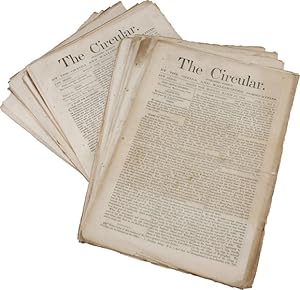
Published by Oneida and Wallingford Communities 1864-1865, Mount Tom 1864
Seller: Lorne Bair Rare Books, ABAA, Winchester, VA, U.S.A.Lorne Bair Rare Books, ABAA
Contact seller5-star sellerComplete run of vol. I. 52 issues (36cm), each 8pp. Some issues with sewing holes. Largely whole, rubbed at chipped at edges, occasional splits at folds, occasional moderate soil and browning: Good or better. The Circular suceeded the Free Church Circular as the newpsaper for the Oneida and Wallingford Communities, with its prin…ting works established in Wallingford, CT. While some Oneida periodicals were dense with theology, The Circular New Series included chatty editorials and community updates, as well as commentary on the Civil War, general information articles, book reviews, and correspondence from readers. WELLS (The Oneida Community Collection in the Syracuse University Library) p.24. DARE 1511.


