Order Total (1 Item Items):
Shipping Destination:

Pynchon Thomas, Signed (12 results)
Skip to main search results
Search filters
Product Type
- All Product Types
- Books (12)
- Magazines & Periodicals (No further results match this refinement)
- Comics (No further results match this refinement)
- Sheet Music (No further results match this refinement)
- Art, Prints & Posters (No further results match this refinement)
- Photographs (No further results match this refinement)
- Maps (No further results match this refinement)
- Manuscripts & Paper Collectibles (No further results match this refinement)
Condition Learn more
- New (No further results match this refinement)
- As New, Fine or Near Fine (5)
- Very Good or Good (1)
- Fair or Poor (No further results match this refinement)
- As Described (6)
Binding
Collectible Attributes
Language (2)
Price
- Any Price
- Under US$ 25 (No further results match this refinement)
- US$ 25 to US$ 50 (No further results match this refinement)
- Over US$ 50
Free Shipping
Seller Location
Seller Rating
-
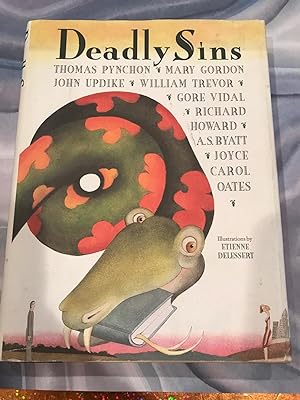
Deadly Sins
Seller: Uncommon Books, Glastonbury, CT, U.S.A.
Association Member: SNEAB
Seller rating 5 out of 5 stars

First Edition Signed
Hardcover. Condition: Near Fine. Dust Jacket Condition: Very Good. Etienne Delessert (illustrator). 1st Edition. Book has minor wear thus nearly fine. Dj has price clipped. Signed by A.S. Byatt, Mary Gordon and Joyce Carol Oates. Signed by Author(s). Book.
-
INHERENT VICE
Language: English
Published by The Penguin Press, New York, 2009
ISBN 10: 1594202249 ISBN 13: 9781594202247
Seller: Type Punch Matrix, Silver Spring, MD, U.S.A.
Seller rating 5 out of 5 stars
First Edition Signed
Condition: Near Fine. First edition. First printing of this manic Pynchon neo-noir, adapted for the screen into the film of the same name directed by Paul Thomas Anderson. 9'' x 6''. Original dark blue boards. In original unclipped ($27.95) color pictorial jacket designed by Tal Goretsky and Darren Haggar. [10], 370, [4] pages. Trace shelfwear here and there. Else bright, clean, and sharp. Near fine in a near fine jacket. Signed.
-

The Rainbow Quest of Thomas Pynchon
Language: English
Published by Borgo Press, 1980
First Edition Signed
Soft cover. Condition: Very Good. 1st Edition. Signed inscription by Douglas Mackey. A paperback original from Borgo Press. book shows some wear and light rubbing. Signed by Author(s).
-
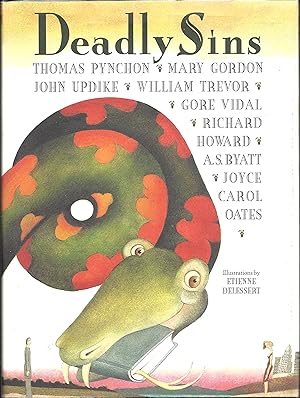
DEADLY SINS
First Edition Signed
Hardcover. Condition: NF. Dust Jacket Condition: NF. ETIENNE DELESSERT (illustrator). DEADLY SINS-By Thomas Pynchon-MAry Gordon-John Updike-William Trevor-Gore Vidal-Richard Howard-A.S.Byatt-Joyce Carol Oates- 1st ed Nf in NF DJ-SIGNED by the Illustrator ETIENNE DELESSERT.
-
Deadly Sins
Language: English
Published by William Morrow, New York, NY, 1993
ISBN 10: 0688136907 ISBN 13: 9780688136901
Seller: Fireproof Books, MINNETONKA, MN, U.S.A.
Association Member: MWABA
Seller rating 5 out of 5 stars
First Edition Signed
Hardcover. Condition: Fine. Dust Jacket Condition: Fine. 1st Edition. 125 pages. First edition, first printing. Illustrated by Etienne Delessert. Seven essays & one poem that appeared serially in The New York Book Review in the summer of 1993. Signed by Vidal on the title page. Also laid in is a "Certificate of Authenticity" from the book store in California that hosted Vidal's signing. Fine book in a fine dust jacket. A beautiful copy! Signed by Author(s).
-
![Stock image for MASON & DIXON. ['ADVANCE READING COPY'/ PROOF COPY] for sale by Burwood Books](https://pictures.abebooks.com/isbn/9780805037586-us-300.jpg)
MASON & DIXON. ['ADVANCE READING COPY'/ PROOF COPY]
Language: English
Published by Henty Holt & Co.,, New York,, 1999
ISBN 10: 0805037586 ISBN 13: 9780805037586
Seller: Burwood Books, Wickham Market, United Kingdom
Association Member: PBFA
Seller rating 5 out of 5 stars
First Edition Signed
US$ 553.01
US$ 30.20 shipping
Ships from United Kingdom to U.S.A.Quantity: 1 available
Add to basketPaperback. Condition: Fine. First Edition. Wraps. Fat 8vo.pp 773 'Advance Reading Copy'/ Proof copy. Large format paperback. . Original publishers beige (tan) thin card wraps, lettered dark brown at the spine and cover. This copy belonged to the senior editor at Cape ( Pynchon's English publisher) Dan Franklin with a typed signed note to him from Ray A Roberts senior editor at Holt. It is on Holt notepaper dated March 27th 1997 and reads: 'it was good to talk to you the other day and to hear of your progress on M and D. I'm sorry you won't be doing a bound galley, but for purely personal reasons. In the meantime I can offset your disappointment with the enclosed / It is good of you to pass the enclosed passage with Tom's copy onto him. / Cheers Ray.' ('Ray' is signed in ink, the reference to 'purely personal reasons' must relate to Roberts assiduous book collecting especially of Pynchon's work in proof and galley form.) Tom is presumably Thomas Pynchon (Roberts - his American editor referred to him as 'Tom' -- see ThomasPynchondotcom site 'Ray Roberts, editor and collector of Pynchon.') There is much there about the galleys of Mason and Dixon and the secrecy surrounding its pre-publication.There are known to be minor differences between the Advance Reading Copy and the published book, possibly editorial. Plot summary on rear, there were said to be 500 copies. Web (AI) says: Thomas Pynchon's editor at Henry Holt, who also worked with him at Little, Brown, was Ray Roberts, a well-known editor who handled Pynchon's later major novels like Mason & Dixon, and worked closely with the famously reclusive author on his transition to Holt and Viking.Ê About fine.
-

First edition, early printing of Pynchon's National Book Award-winning novel. Octavo, bound in full morocco by the Harcourt Bindery with gilt titles and ruling to the spine in six compartments within raised gilt bands, gilt ruling to the front and rear panels, gilt inner dentelles stamp-signed by the Harcourt Bindery, marbled endpapers, all edges gilt. Founded over a century ago in 1900, the Harcourt Bindery is the oldest and largest traditional bindery in America exclusively devoted to fine traditional leather bookbinding by hand. Harcourt Bindery uses 22 karat genuine gold leaf, top grades of Nigerian moroccos, and hand marbled papers from craftsmen representing seven countries. In fine condition. An exceptional presentation. âGravity's Rainbow is one of the few truly great novels of the century, and at the same time one of the most disappointing, disturbing, maddeningâ¦. One of the most original fictive styles to have been developed since Joyceâ (Contemporary Novelists, 1136). It is regarded by many scholars as the greatest American novel published after the end of the second world war, and is "often considered as the postmodern novel, redefining both postmodernism and the novel in general" (Pohllman). Time named it one of its "All-Time 100 Greatest Novels", a list of the best English-language novels from 1923 to 2005.
-
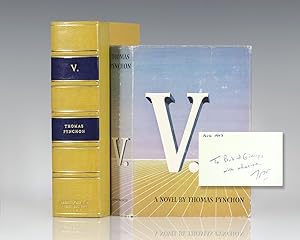
First edition of Pynchon's first book. Octavo, original cloth. Association copy, inscribed by the author on the verso of the front free endpaper in the month of publication, "Aug. 1963. To Bob & Ginny, with affection, Tom." The recipient was his Boeing colleague and close friend Bob Hillock and his wife Ginny. Fine in a near fine dust jacket. Jacket design by Ismar David. Housed in a custom half morocco clamshell box made by the Harcourt Bindery. Rare and desirable signed. "V may well stand as one of the very best works of the century" (Atlantic Review). It went on to win The Faulkner Foundation Award for Best First Novel of the Year.
-

VINELAND.
Published by Little, Brown and Company., Boston, 1990
ISBN 10: 0316724440 ISBN 13: 9780316724449
Seller: WAVERLEY BOOKS ABAA, Santa Monica, CA, U.S.A.
Seller rating 5 out of 5 stars
First Edition Signed
Hardcover. Condition: Fine. Dust Jacket Condition: Fine. First Edition; First Printing. First edition. SIGNED by Thomas Pynchon on title page. From the personal collection of noted small press publisher Herb Yellin with a letter attesting to the provenance laid-in. Fine in fine dust jacket. Books with authentic Pynchon signatures are rare. ; 8vo 8" - 9" tall; 385 pages.
-
GRAVITY'S RAINBOW - INSCRIBED TO CHRISTOPHER-ANN PRESS, WITH RELATED CORRESPONDENCE
Published by The Viking Press, New York, 1973
Seller: Captain Ahab's Rare Books, ABAA, Stephenson, VA, U.S.A.
Association Member: ABAA
Seller rating 4 out of 5 stars

First Edition Signed
First Edition. First Printing, hardcover issue, one of 4,000 copies. Octavo (22cm); rebound in a recent design binding in full orange crushed morocco, spine in five compartments, with four raised bands, gilt-stamped navy blue leather title labels, a concentric square motif tooled in gilt and navy blue within the compartments, and navy blue ruled border on covers; all edges gilt; [vi],[2],3-760,[2]pp. Inscribed by Pynchon in a contemporary hand on the front endpaper to his ex-girlfriend, Christopher-Ann Press: "For Christopher-Ann, who shares so much of this + with thankx for then, and love for now Tom." Some old dampstaining to endpapers, with mild waviness to a few preliminary and terminal leaves as a result; Near Fine, housed in a custom navy blue cloth slipcase, with the interior lined with marbled paper. Pynchon's third and best-known book, "a sprawling slipstream novel about a World War II psychological warfare unit full of weird characters, one of whom seems to be determining the pattern of V-2 rocket attacks by his sexual activities but refuses to submit to study and possible control" (Barron, Anatomy of Wonder II-885). One of the defining books of the 1970s, and a novel that redefined the postmodern novel. Winner of the National Book Award for Fiction in 1974, and selected by the Pulitzer Prize jury in 1973, though no award was given for fiction that year.An extraordinary copy, inscribed by Pynchon to Christopher-Ann Press (b.1950, who today goes by Zoë Christopher), who met Pynchon in 1967 when she was 17 and living with her mother and stepfather in Manhattan Beach, California. Pynchon lived in a duplex across the street, and he and her stepfather became friends over time. In an extended provenance statement she mentions her familiarity with him and the way their relationship came to be: "When Tom and I saw each other at the local neighborhood market or on the sidewalk, we'd strike up brief friendly conversations. On April 6, 1969, I went into labor, and opted for a natural birth. My stepfather, a physician, had offered to deliver my baby at home. I labored all day, and by early evening, we realized we'd neglected to include sutures in the "crash kit." My stepfather realized he'd have to speed to his office and back, and he wanted someone with him to watch for police. The only neighbor he trusted was Tom, and Tom agreed to go with him. When they returned, my stepfather invited Tom to come in and witness a natural birth. Tom and I had developed a nice friendship by then, and I was comfortable with him being present. It was toward the end of 1969 that my young son and I moved across the street and in with Tom. We'd become romantically involved and it was time to move away from a tense situation at home. I was nineteen. Tom and I discussed leaving the city as soon as he finished Gravity's Rainbow. We decided on Humboldt County. My best friend, Gail, who had become a good friend of Tom's, would be joining us. On October 7, 1970, we all loaded my truck and Gail's car. Tom would stay in Manhattan Beach to finish Gravity's Rainbow, while Gail and I went ahead to unpack and set up the house I had found for us in Eureka."The book is accompanied by three typed letters, signed, written from Pynchon to Press between November, 1970 and December, 1971. They chronicle, in great detail, the tumultuous nature of their relationship, his complicated feelings for her and her son, and his struggles with the manuscript for Gravity's Rainbow in the years between completion and publication. Contents are as follows:1. 3pp typed letter, dated 11 Nov, 1970, and written from Manhattan Beach, California. Single-spaced on two sheets of white graph paper (measuring 8.5" x 11"); 136 lines (1824 words), signed "LOVE, Tom" in pink felt-tipped pen at lower margin of p.3. Some old horizontal and vertical mailing folds smoothed out, light wear and handling, with some old dampstaining (not affecting legibility). Together with the original mailing envelope, a bit stained and roughly opened, franked, and postmarked Nov 12, 1970.2. 2pp typed letter, dated 30 Nov, 1970, and written from Manhattan Beach, California. Single-spaced on both sides of a single sheet of yellow graph paper (measuring 8.5" x 11"); 96 lines (1268 words), signed "lOVE, Tom" in orange marker at lower margin of p.2. Some old horizontal and vertical mailing folds smoothed out, light wear and handling, with three small, shallow, and very faint stains at right margin. Together with the original mailing envelope, faded, a bit foxed and roughly opened, franked, and postmarked Nov 30, 1970.3. 2pp typed letter, dated 10 Dec 1971, and written from Palm Desert, California. Single-spaced on both sides of a single sheet of yellow graph paper (measuring 8.5" x 11"); 91 lines (1159 words), signed "Love, Tom" in dark brown felt-tipped pen at lower margin of p.2. One minor holograph correction in Pynchon's hand on p.2, old horizontal and vertical mailing folds smoothed out, modest handling, with two surface abrasions resulting in two tiny holes toward right edge (not touching text). Further details available upon request.
-
EL ARCO IRIS DE GRAVEDAD (GRAVITY'S RAINBOW) - SIGNED
Published by Ediciones Grijalbo, S.A., Barcelona, 1978
Seller: Captain Ahab's Rare Books, ABAA, Stephenson, VA, U.S.A.
Association Member: ABAA
Seller rating 4 out of 5 stars
First Edition Signed
First Spanish Edition. First Impression, wrappered issue. Two octavo volumes (19cm); original pictorial card wrappers; [6],7-595,[1]; [v],596-1111,[3]pp. Each volume has been signed by Pynchon in black pen on the half-title page. Light wear to extremities, hint of sunning and some mild spotting to spines, with some light, scattered foxing to rear wrappers, inner covers, and text edges; Very Good+ or slightly better. Second translation into any language of Pynchon's third and best-known book, "a sprawling slipstream novel about a World War II psychological warfare unit full of weird characters, one of whom seems to be determining the pattern of V-2 rocket attacks by his sexual activities but refuses to submit to study and possible control" (Barron, Anatomy of Wonder II-885). One of the defining books of the 1970s, and a novel that redefined the postmodern novel. Winner of the National Book Award for Fiction in 1974, and selected by the Pulitzer Prize jury in 1973, though no award was given for fiction that year. Rare signed. Provenance: From the collection of Gail M. Sweeney (b.1951), Pynchon's friend and former housemate in both Manhattan Beach and Eureka, California between 1969-1971, with whom he maintained a lengthy correspondence between early 1972-2006. Mead D3b.
-
Slow Learner
Published by Little Brown, Boston, 1984
Seller: James Cummins Bookseller, ABAA, New York, NY, U.S.A.
Seller rating 5 out of 5 stars
Signed
193 pp. Tall 8vo. First trade paperback edition, advanced reading copy. 193 pp. Tall 8vo. A collection of Pynchon's early short stories, signed on the title page. No proof copies of this title were issued, only a few sets of unbound signatures laid into a proof dust jacket. Pynchon signatures remain as rare as sighting of the man. Mead A4c Stiff pictorial wrappers. Stamped NOT FOR RESALE on fore-edge First trade paperback edition, advanced reading copy. Signed.