
Remakrishnan (1 results)
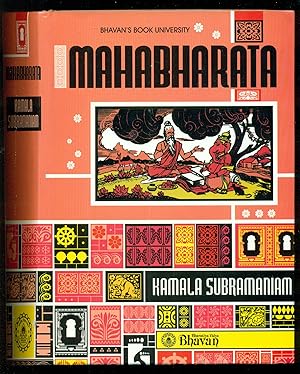
Published by Bhavan's Book University, Kulapati Munshi Marg, Mumbai 2001
- Hardcover
Seller: Don's Book Store, Albuquerque, NM, U.S.A.Don's Book Store
Contact seller5-star sellerCondition: Used - Very good
US$ 90.00
Free ShippingShips within U.S.A.Quantity: 1 available
Hard Back. Condition: Very Good. Dust Jacket Condition: Very Good. Eleventh Edition. 870 Pages.The front hinge is beginning to split however it will hold for a good long time as it is. Brown boards and endpapers. The Mahabharata is not a mere epic; it is a romance, telling the tale of heroic men and women and of some who were di…vine; it is a whole literature in itself, containing a code of life, a philosophy of social and ethical relations, and speculative thought on human problems that is hard to rival; but, above all, it has for its core with Gita, which is, as the world is beginning to find out, the noblest of scriptures and the grandest of sagas the climax of which is reached in the wondrous Apocalypse in the Eleventh Canto. Through such books alone, the harmonies underlying true culture, I am convinced, will one day reconcile the disorders of modern life. To an English reader, this volume will bring home the validity of the comment made by generations of Indian authors that "what is not there is nowhere to be found." Smt.Kamalan Subrakania was born on October 4, 1916 in Bangalore, Her father was the eminent Kannada poet and dramatist, Shri T. P. Kailasam. She studied under the distinguished scholar Prof. B. M. Srikantiah. She read avidly both classics and modem thrillers and her knowledge of English literature, especially of Shakespeare, was profound. She also loved philosophy and knew her Bible as well as she knew the Gita. In 1937, Smt. Kamala married Dr. S. Subramaniam, a renowned E.N.T. Surgeon of Madras. In spite of her family concerns, she pursued her literary interests and wrote a series of imaginary conversations on the model of Landor's for Triveni under the pen-name "Ketaki", Her love of literature, nursed over the years, expressed itself in her developing a fascination for the Epics and Puranas of India. In the late 60s Smt. Kamala underwent ano operation for cancel. which gave her a ten-year lease of life. Lesser mortals would have been un-nerved by this but for Smt. Kamala it came as a challenge and this period turned out to be the most productive literary period of her life. Her first labour of love was the retelling of the Mahabharata. In this masterly condensation, of India's great epic, Smt. Kamala captures with dramatic intensity the movement of the story. As the episodes unfold in Smt. Kamala's vivid narrative, one seems to hear Draupadi's wail of distress, Duryodhana's arrogant laughter, and even the twang of Arjuna's bow, the Gandiva. The Mahabharata, now in its 11th edition, won for Smt. Kamala a great reputation. She followed this up with condensations of Srimad Bhagavatam and Valmiki's Ramayana. Here is a trilogy of more than 2000 pages - a stupendous literary achievement. The epics and puranas epitomise our culture. The heroes and heroines set high standards of nobility, heroism, and chivalry. They have moulded the life and outlook of generations of Indians. Smt. Kamala Subramaniam has left a priceless Iegacy for the young and the old. The gifted author passed away on February 21, 1983. Smt. Kamala was so self-effacing that she would not even permit her photograph to .be printed on the jackets of her books. As a friend of hers wrote: As she wrote, she felt, as she felt, she lived in her invisible world and as she lived, her world grew rich and real for her and so it will grow for us when we read her books.
