
Robert Reisel (15 results)
 More images
Language: English
Published by Springer Verlag 1982
- Softcover
- First Edition
Seller: avelibro OHG, Dinkelscherben, , Germanyavelibro OHG
Contact seller5-star sellerCondition: Used - Very good
US$ 22.69
US$ 11.59 shippingShips from Germany to U.S.A.Quantity: 1 available
23,5 x 15,5 cm. Condition: Gut. 1. Auflage. 12 Seiten A Course in Constructing Mathematical Proofs. Innen sauberer, guter Zustand. Softcover, Broschur mit den üblichen Bibliotheks-Markierungen, Stempeln und Einträgen, innen wie außen, siehe Bilder. (Evtl. auch Kleber- und/oder Etikettenreste, sowie -abdrücke durch abgelöste Bibl…iotheksschilder). DC-10-3 Sprache: Englisch Gewicht in Gramm: 210.

Language: English
Published by Springer-Verlag Berlin and Heidelberg GmbH & Co. K 1982
- Softcover
Seller: Biblios, frankfurt am main, HESSE, GermanyBiblios
Contact seller4-star sellerCondition: New
US$ 64.47
US$ 11.53 shippingShips from Germany to U.S.A.Quantity: 1 available
Condition: New.

- Softcover
Seller: NEPO UG, Rüsselsheim am Main, , GermanyNEPO UG
Contact seller5-star sellerCondition: Used - Very good
US$ 72.58
US$ 27.82 shippingShips from Germany to U.S.A.Quantity: 1 available
Condition: Gut. 136 Seiten Exemplar aus einer wissenchaftlichen Bibliothek Sprache: Englisch Gewicht in Gramm: 206 2340004864,0 x 1560003200,0 x 90000176,0 cm, Taschenbuch.
- Softcover
Seller: Ria Christie Collections, Uxbridge, United KingdomRia Christie Collections
Contact seller5-star sellerCondition: New
US$ 96.47
US$ 16.07 shippingShips from United Kingdom to U.S.A.Quantity: Over 20 available
Condition: New. In.
- Softcover
Seller: Chiron Media, Wallingford, , United KingdomChiron Media
Contact seller5-star sellerCondition: New
US$ 94.37
US$ 20.78 shippingShips from United Kingdom to U.S.A.Quantity: 10 available
PF. Condition: New.
- Softcover
Seller: Books Puddle, New York, NY, U.S.A.Books Puddle
Contact seller4-star sellerCondition: New
US$ 122.06
US$ 3.99 shippingShips within U.S.A.Quantity: 4 available
Condition: New. pp. 136.
- Softcover
Seller: GoldBooks, Denver, CO, U.S.A.GoldBooks
Contact seller5-star sellerCondition: New
US$ 137.77
US$ 5.50 shippingShips within U.S.A.Quantity: 1 available
Paperback. Condition: new. New Copy. Customer Service Guaranteed.

- Softcover
Seller: AHA-BUCH GmbH, Einbeck, GermanyAHA-BUCH GmbH
Contact seller5-star sellerCondition: New
US$ 99.66
US$ 70.83 shippingShips from Germany to U.S.A.Quantity: 1 available
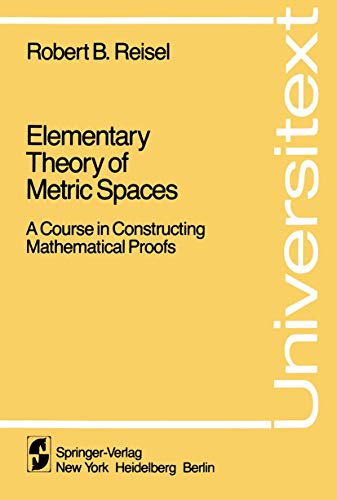
Taschenbuch. Condition: Neu. Druck auf Anfrage Neuware - Printed after ordering - Science students have to spend much of their time learning how to do laboratory work, even if they intend to become theoretical, rather than experimental, scientists. It is important that they understand how experiments are performed and what the r…esults mean. In science the validity of ideas is checked by experiments. If a new idea does not work in the laboratory, it must be discarded. If it does work, it is accepted, at least tentatively. In science, therefore, laboratory experiments are the touchstones for the acceptance or rejection of results. Mathematics is different. This is not to say that experiments are not part of the subject. Numerical calculations and the examina tion of special and simplified cases are important in leading mathematicians to make conjectures, but the acceptance of a conjecture as a theorem only comes when a proof has been constructed. In other words, proofs are to mathematics as laboratory experiments are to science. Mathematics students must, therefore, learn to know what constitute valid proofs and how to construct them. How is this done Like everything else, by doing. Mathematics students must try to prove results and then have their work criticized by experienced mathematicians. They must critically examine proofs, both correct and incorrect ones, and develop an appreciation of good style. They must, of course, start with easy proofs and build to more complicated ones.
- Softcover
Seller: Mispah books, Redhill, SURRE, United KingdomMispah books
Contact seller4-star sellerCondition: Used - As new
US$ 152.00
US$ 33.54 shippingShips from United Kingdom to U.S.A.Quantity: 1 available
Paperback. Condition: Like New. Like New. book.

- Softcover
- Print on Demand
Seller: BuchWeltWeit Ludwig Meier e.K., Bergisch Gladbach, , GermanyBuchWeltWeit Ludwig Meier e.K.
Contact seller5-star sellerCondition: New
US$ 102.15
US$ 26.66 shippingShips from Germany to U.S.A.Quantity: 2 available
Taschenbuch. Condition: Neu. This item is printed on demand - it takes 3-4 days longer - Neuware -Science students have to spend much of their time learning how to do laboratory work, even if they intend to become theoretical, rather than experimental, scientists. It is important that they understand how experiments are performe…d and what the results mean. In science the validity of ideas is checked by experiments. If a new idea does not work in the laboratory, it must be discarded. If it does work, it is accepted, at least tentatively. In science, therefore, laboratory experiments are the touchstones for the acceptance or rejection of results. Mathematics is different. This is not to say that experiments are not part of the subject. Numerical calculations and the examina tion of special and simplified cases are important in leading mathematicians to make conjectures, but the acceptance of a conjecture as a theorem only comes when a proof has been constructed. In other words, proofs are to mathematics as laboratory experiments are to science. Mathematics students must, therefore, learn to know what constitute valid proofs and how to construct them. How is this done Like everything else, by doing. Mathematics students must try to prove results and then have their work criticized by experienced mathematicians. They must critically examine proofs, both correct and incorrect ones, and develop an appreciation of good style. They must, of course, start with easy proofs and build to more complicated ones. 136 pp. Englisch.
- Softcover
- Print on Demand
Seller: THE SAINT BOOKSTORE, Southport, , United KingdomTHE SAINT BOOKSTORE
Contact seller5-star sellerCondition: New
US$ 114.45
US$ 17.36 shippingShips from United Kingdom to U.S.A.Quantity: Over 20 available
Paperback / softback. Condition: New. This item is printed on demand. New copy - Usually dispatched within 5-9 working days.
- Softcover
- Print on Demand
Seller: Majestic Books, Hounslow, , United KingdomMajestic Books
Contact seller4-star sellerCondition: New
US$ 126.47
US$ 8.72 shippingShips from United Kingdom to U.S.A.Quantity: 4 available
Condition: New. Print on Demand pp. 136 49:B&W 6.14 x 9.21 in or 234 x 156 mm (Royal 8vo) Perfect Bound on White w/Gloss Lam.

- Softcover
- Print on Demand
Seller: moluna, Greven, , Germanymoluna
Contact seller5-star sellerCondition: New
US$ 81.93
US$ 56.79 shippingShips from Germany to U.S.A.Quantity: Over 20 available
Condition: New. Dieser Artikel ist ein Print on Demand Artikel und wird nach Ihrer Bestellung fuer Sie gedruckt. Science students have to spend much of their time learning how to do laboratory work, even if they intend to become theoretical, rather than experimental, scientists. It is important that they understand how experimen…ts are performed and what the results me.
- Softcover
- Print on Demand
Seller: Biblios, frankfurt am main, HESSE, GermanyBiblios
Contact seller4-star sellerCondition: New
US$ 134.12
US$ 11.53 shippingShips from Germany to U.S.A.Quantity: 4 available
Condition: New. PRINT ON DEMAND pp. 136.

- Softcover
- Print on Demand
Seller: buchversandmimpf2000, Emtmannsberg, BAYE, Germanybuchversandmimpf2000
Contact seller5-star sellerCondition: New
US$ 95.81
US$ 69.55 shippingShips from Germany to U.S.A.Quantity: 1 available
Taschenbuch. Condition: Neu. This item is printed on demand - Print on Demand Titel. Neuware -Science students have to spend much of their time learning how to do laboratory work, even if they intend to become theoretical, rather than experimental, scientists. It is important that they understand how experiments are performed an…d what the results mean. In science the validity of ideas is checked by experiments. If a new idea does not work in the laboratory, it must be discarded. If it does work, it is accepted, at least tentatively. In science, therefore, laboratory experiments are the touchstones for the acceptance or rejection of results. Mathematics is different. This is not to say that experiments are not part of the subject. Numerical calculations and the examina tion of special and simplified cases are important in leading mathematicians to make conjectures, but the acceptance of a conjecture as a theorem only comes when a proof has been constructed. In other words, proofs are to mathematics as laboratory experiments are to science. Mathematics students must, therefore, learn to know what constitute valid proofs and how to construct them. How is this done Like everything else, by doing. Mathematics students must try to prove results and then have their work criticized by experienced mathematicians. They must critically examine proofs, both correct and incorrect ones, and develop an appreciation of good style. They must, of course, start with easy proofs and build to more complicated ones.Springer-Verlag KG, Sachsenplatz 4-6, 1201 Wien 136 pp. Englisch.


