
Rot Ter (3 results)
 More images
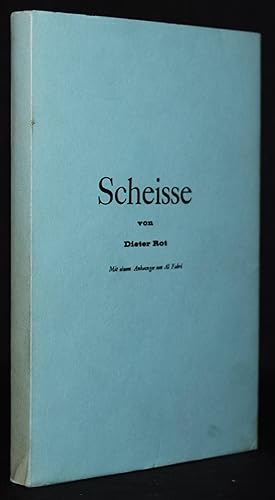
Published by Berlin, Rainer Verlag. 1982
- Softcover
- Signed
Seller: Antiquariat Haufe & Lutz, Karlsruhe, BW, GermanyAntiquariat Haufe & Lutz
Contact seller5-star sellerCondition: Used
US$ 334.64
US$ 55.68 shippingShips from Germany to U.S.A.Quantity: 1 available
Kl.-8°. 62 S., [3] Bl. OKart. mit OU. Mit eigenhändiger Widmung von D. Roth "für Frau Maurer zur Erinnerung an Dieter Roth Wien 23. 6. '83". - Schutzumschlag minimal fingerfleckig, sehr gutes Exemplar. Sprache: deutsch.

Published by (By the artist). (1958?64)., (Providence, Rhode Island?). 1958
- Softcover
Seller: Sims Reed Ltd ABA ILAB, London, , United KingdomSims Reed Ltd ABA ILAB
Contact seller5-star sellerCondition: Used
US$ 17,316.80
US$ 25.55 shippingShips from United Kingdom to U.S.A.Quantity: 1 available
Square folio. (424 x 428 mm). [26 leaves]. Initial green leaf with manuscript colophon / justification and dedication (see below), 24 leaves of alternating green and red each with 90 degree hand-cut slots, final blank red leaf; sheet size: 404 x 408 mm. Loose as issued in original publisher's black wrappers, original grey cloth…box. A very rare hand-cut 'slot book' by Di[e]ter Rot[h] with red and green sheets. From the proposed edition of 25 copies (although far fewer were issued, see The Dieter Roth Times quoted below) inscribed on the initial orange leaf in pencil: 'NR. 8 / 25 / DITER ROT / BOOK B / IDEA 1958 SC. 1964' and with the artist's thumbprint in black ink. Inscribed in blue ink 'fûr Kees Broos, Souvenir aus Basel / Marz 1987 / Dieter Roth.' This copy also includes an additional sheet of black paper with hand-cut slots, not called for, and presumably included in error. 'As of 1958, Roth created works that rest between print-making and books, the so-called 'slot books'. Using black, white or colored square sheets of paper, he cut out precise shapes in various sizes, most of them being rectangular, others more complex, resulting in loose stacked sheets with window-like images peering through layer after layer of pages. Rotating and reordering the sheets, the viewer can change the visual sequence and interact with the work . Roth worked on the idea of rearranging pages for some time. He would change the width of the slots, select different anglles for them, and alter the number of sheets and their colors . these early hand cut [sic] Roth books are considered important and rare 'incunabula' in the development of the artist's book.' (The Dieter Roth Times). 'Roth frequently referred to these books as 'concrete poetry' or 'Op-Art', but simultaneously underlined their intrinsic independence of such movements.' (Dirk Dobke). 'Roth identifies only 8 copies completed in his Collected Works volume 20.' (The Dieter Roth Times). According to the above quote, this would make the present copy to be the last of the edition. Kees Broos was an art historian.
 More images
- Softcover
Seller: Penka Rare Books and Archives, ILAB, Berlin, GermanyPenka Rare Books and Archives, ILAB
Contact seller5-star sellerCondition: Used
US$ 17,927.27
US$ 40.61 shippingShips from Germany to U.S.A.Quantity: 1 available
Reykjavík: forlag ed [the publishers are Einar Bragi and Dieter Roth], 1961. Square octavo (17.2 × 18.5 cm). Original limp cardboard binding with printed title label and handwritten signature and dedication; approx. 300 leaves. The handwritten dedication reads "eine hand hackt die andere ab (pestalozzi)" (one hand chops off the…other, pestalozzi). The binding is slightly toned; else very good. One of only about 50 copies actually manufactured; according to Dobke and Roth, the 200 copies noted by Roth on the title page were far from being reached. "Bok 3a" marks the beginning of a series of books in which Roth brings printed matter that usually circulates outside this medium into book form. In "bok 3a," Roth compiled pages from an Icelandic daily newspaper. He trimmed the pages to the appropriate size for the book, regardless of the text, and bound them together with adhesive binding. No two volumes are alike, as the pages that were available at the time were used for each volume. For the copy on offer here, he seems to have been provided with a stack of prints of a single gathering from the printer, so that the gathering repeats continuously. As in a music composition, certain structures, images, and themes reappear again and again as you leaf through the pages, only to disappear again into a sea of lead. Roth continued the series of accumulation books with bok 3b and bok 3d, which he filled with pages from children's comics and coloring books, punching holes of various sizes in them to create peepholes through which scenes from other pages can be seen. The series was completed with "bok 3c," which was made from makeready sheets used by printers to prepare and align the colors on the printing press before printing. For Roth, a happening and Fluxus artist, engaging with print media was no trivial matter. After graduating from high school, he began a four-year apprenticeship as a commercial artist and then took private lessons at the School of Arts and Crafts with Swiss graphic designer and typographer Eugen Jordi. Roth began his artistic work when he was unable to find employment as a graphic designer after completing his apprenticeship and earned his living as a laborer on construction sites. An influential encounter was that with Eugen Gomringer and Marcel Wyss, with whom he founded the magazine Spirale, which published nine issues between 1953 and 1964. At the same time, Roth met Daniel Spoeri and created his first food sculptures. When he moved to Iceland with his wife in 1957, he was rejected by the local graphic design association. Together with Einar Bragi, he founded the publishing house "forlag ed," where both published their respective artist books. In addition to his freelance artistic work, he also worked regularly as a commercial artist for companies. His interest not only in food scraps but also in printing scraps is evident not only in book format. In the same year as the book offered here, he also created his first "literature sausages", for which Roth processed finely chopped novels and daily newspapers together with spices and fat in sausage casings. (Cf. Ina Jessen, AKL XCIX, p. 482) Dobke p. 155; Roth/Mayer (books an graphics part 1) 11. As of September 2025, no copies located worldwide via KVK, OCLC; we know of only one copy in North American institutions.


