Order Total (1 Item Items):
Shipping Destination:

Solow Robert, Signed (30 results)
Skip to main search results
Search filters
Product Type
- All Product Types
- Books (24)
- Magazines & Periodicals (No further results match this refinement)
- Comics (No further results match this refinement)
- Sheet Music (No further results match this refinement)
- Art, Prints & Posters (No further results match this refinement)
- Photographs (No further results match this refinement)
- Maps (1)
- Manuscripts & Paper Collectibles (5)
Condition Learn more
- New (No further results match this refinement)
- As New, Fine or Near Fine (4)
- Very Good or Good (6)
- Fair or Poor (No further results match this refinement)
- As Described (20)
Binding
Collectible Attributes
Language (3)
Price
- Any Price
- Under US$ 25 (No further results match this refinement)
- US$ 25 to US$ 50
- Over US$ 50
Free Shipping
Seller Location
Seller Rating
-

Globalization and Economic Development in East Asia: Lecture Notes of Professor Henry Y. Wan Jr. (Modern Economic & Business Series, No. 3)
Published by Research Institute for Economics & Business Administration, Kobe University, 2007
Signed
Hardcover. Condition: Very Good. Dust Jacket Condition: Very Good. Signed and inscribed by author to previous owner. Hardbound with dust jacket; in Japanese and English. Text unmarked, limited modest wear. Signed by Author.
-

No Binding. Condition: Fine. 3" x 5" Card -- SIGNED by Dr. Robert M. Solow: "Go Red Sox - Robert Solow", winner of Nobel Prize in Econonics in 1987. SIGNED CARD.
-

No Binding. Condition: Near Fine. 4" x 5" B&W Portrait Image card -- SIGNED by Dr. Robert M. Solow, winner of Nobel Prize in Econonics in 1987 (signature only under image). SIGNED.
-

No Binding. Condition: Very Good. Small B&W photo w/Solow Quote- on 8 1/2" x 11" heavy bonded paper sheet- SIGNED (inscribed) by Dr. Robert M. Solow, winner of Nobel Prize in Econonics in 1987. sheet has two folds. Comes with original New York Times obituary for Dr. Solow. SIGNED PHOTO.
-

Kein Einband. Condition: Gut. Karte signiert mit Datum von dem amerikanischen Ökonomen und Nobelpreisträger Robert M. Solow (1924-2023) . card signed by Robert M. Solow. Vom Wissenschaftler signiert. Karte.
-
Inside Star Trek: The Real Story
Language: English
Published by Pocket Books, New York, 1996
ISBN 10: 0671896288 ISBN 13: 9780671896287
Seller: Jusara Book Shop IOBA, Canandaigua, NY, U.S.A.
Association Member: IOBA
Seller rating 3 out of 5 stars

First Edition Signed
Hardcover. Condition: Near Fine. Dust Jacket Condition: Near Fine-. First Printing. Inscribed, signed, and dated by Justman; additionally signed by Solow. Book in NF+ condition with just some light shelf wear and soiling. Jacket in NF- condition with general shelf and edge wear. According to Publishers Weekly, "As told by Solow, Star Trek's executive in charge of production, and Justman, Star Trek's co-producer, this is arguably the definitive history of the TV show.With plenty of behind-the-scenes material that will be of interest to Trek fans, this book puts a good deal of emphasis on the show's business side, elucidating production difficulties, cost overruns and the seemingly constant debate with NBC over the show's future." Although Solow is often credited with being the first to call Gene Roddenberry "The Great Bird of the Galaxy", drawn from one of George Takei's throwaway lines, as Mr Sulu, from the original series episode "The Man Trap", it was actually Robert Justman who coined the phrase. Stated first printing- June 1996. Full number line. Signed by Authors.
-
Briefbogen (1 S. 4° mit aufgezogenem Zeitungsartikel zur Nobelpreisverleihung an ihn), eigenhändig signiert mit persönlicher Widmung, Datum April, 20, 1988.
-
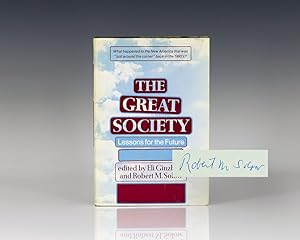
The Great Society: Lessons for the Future.
Published by Basic Books, New York, 1974
First Edition Signed
First edition of this collection of essays regarding The Great Society. Octavo, original cloth. Signed by Robert M. Solow on the title page. Review copy with the slip laid in. Fine in a near fine dust jacket. Robert Merton Solow is known for his work on the theory of economic growth that culminated in the exogenous growth model named after him. He was awarded the John Bates Clark Medal (in 1961), Nobel Memorial Prize in Economic Sciences (in 1987) and the 2014 Presidential Medal of Freedom. Solow, along with colleague Paul Samuelson were responsible for MIT becoming the top ranked economics department.The MIT economists were thus growthmen in two senses: in seeing growth as an absolutely central policy imperative and in seeing the theory of growth as a focus for economic research. What the MIT growthmen added was a distinctive style of analysis that made it easier to address the dominant policy concerns in tractable formal models. Solowâs (1956) model was the perfect exemplar of the MIT style. It provided the central framework for the subsequent developments in growth theory and secured MIT as the center of the universe in the golden age of growth theory in the 1960s (Boianovsky and Hoover 199-200).
-
Original Autogramm Robert Merton Solow (1924-2023) Nobel Prize Economic Sciences 1987 /// Autograph signiert signed signee
Language: English
Manuscript / Paper Collectible Signed
Karte. Condition: Gut. Blaue Blankokarte von Robert Merton Solow mit schwarzem Kuli signiert. /// Autogramm Autograph signiert signed signee /// Robert Merton Solow (* 23. August 1924 in New York; ? 21. Dezember 2023 in Lexington) war ein US-amerikanischer Ökonom. Er erhielt 1987 den Alfred-Nobel-Gedächtnispreis für Wirtschaftswissenschaften für seine Arbeiten über ökonomische Wachstumstheorien. Daneben war er auch Träger des Ordens Pour le Mérite für Wissenschaften und Künste (1995) und der Presidential Medal of Freedom (2014). Vier seiner Schüler, George Akerlof, Joseph Stiglitz, Peter Diamond und Paul Krugman, erhielten eigenständige Nobelpreise. Solow wurde 1924 im New Yorker Bezirk Brooklyn in einer jüdischen Familie geboren und wuchs dort auf. Sein 1940 begonnenes Studium wurde durch einen dreijährigen Kriegseinsatz unterbrochen. 1949 wurde er an der Harvard University zum Ph.D. promoviert. Sein wichtigster Lehrer war Wassily Leontief. Danach wechselte er an die Columbia University und schließlich als Assistant Professor zum Massachusetts Institute of Technology (MIT), wo er seit 1958 ordentlicher Professor war. 1956 wurde er in die American Academy of Arts and Sciences gewählt, 1972 in die National Academy of Sciences, 1975 in die British Academy[1] und 1980 in die American Philosophical Society.[2] Ab 1999 war er Ehrenmitglied der Royal Irish Academy.[3] Im Jahr 1979 stand Solow der American Economic Association als gewählter Präsident vor.[4] Er starb am 21. Dezember 2023 im Alter von 99 Jahren in Lexington, Massachusetts. [5] Forschung Robert Merton Solow erhält 1999 von Bill Clinton die National Medal of Science. Seinen wichtigsten Beitrag zur Wissenschaft erbrachte Solow schon 1956, als sein Aufsatz A Contribution to the Theory of Economic Growth erschien. Darin entwickelte er das Solow-Modell, das langfristiges Wirtschaftswachstum in einer Volkswirtschaft nur durch technischen Fortschritt erklärt. 1957 bestätigte er mit Hilfe von empirischen Belegen am Beispiel der USA seine Theorie. Er fand heraus, dass ein Großteil des amerikanischen Wirtschaftswachstums in der ersten Hälfte des 20. Jahrhunderts von technologischem Fortschritt vorangetrieben wurde (totale Faktorproduktivität) und nur ein sehr kleiner Teil durch den steigenden Einsatz von Arbeit und Kapital. Neben seinen Arbeiten zum Wirtschaftswachstum leistete Solow auch fundamentale Beiträge zur Arbeitsmarktökonomie, z. B. zur Lohnsetzung. Mehrere ökonomische Konzepte tragen seinen Namen, wie das Solow-Residuum (Wachstum), die Solow-Stiglitz-Effizienzbedingung (Ressourcenökonomik) und die Solow-Elastizität (Effizienzlohntheorie). /// Standort Wimregal GAD-0063 Sprache: Englisch Gewicht in Gramm: 10.
-
Original Autogramm Robert Merton Solow (1924-2023) Nobel Prize Economic Sciences 1987 /// Autograph signiert signed signee
Language: English
Manuscript / Paper Collectible Signed
Karte. Condition: Gut. Gelbe oder blaue Blankokarte von Robert Merton Solow mit schwarzem Kuli signiert mit eigenhändigem Zusatz "Go, Red Sox" /// (Mehrere Exemplare von diesem Motiv vorrätig) /// Autogramm Autograph signiert signed signee /// Robert Merton Solow (* 23. August 1924 in New York; ? 21. Dezember 2023 in Lexington) war ein US-amerikanischer Ökonom. Er erhielt 1987 den Alfred-Nobel-Gedächtnispreis für Wirtschaftswissenschaften für seine Arbeiten über ökonomische Wachstumstheorien. Daneben war er auch Träger des Ordens Pour le Mérite für Wissenschaften und Künste (1995) und der Presidential Medal of Freedom (2014). Vier seiner Schüler, George Akerlof, Joseph Stiglitz, Peter Diamond und Paul Krugman, erhielten eigenständige Nobelpreise. Solow wurde 1924 im New Yorker Bezirk Brooklyn in einer jüdischen Familie geboren und wuchs dort auf. Sein 1940 begonnenes Studium wurde durch einen dreijährigen Kriegseinsatz unterbrochen. 1949 wurde er an der Harvard University zum Ph.D. promoviert. Sein wichtigster Lehrer war Wassily Leontief. Danach wechselte er an die Columbia University und schließlich als Assistant Professor zum Massachusetts Institute of Technology (MIT), wo er seit 1958 ordentlicher Professor war. 1956 wurde er in die American Academy of Arts and Sciences gewählt, 1972 in die National Academy of Sciences, 1975 in die British Academy[1] und 1980 in die American Philosophical Society.[2] Ab 1999 war er Ehrenmitglied der Royal Irish Academy.[3] Im Jahr 1979 stand Solow der American Economic Association als gewählter Präsident vor.[4] Er starb am 21. Dezember 2023 im Alter von 99 Jahren in Lexington, Massachusetts. [5] Forschung Robert Merton Solow erhält 1999 von Bill Clinton die National Medal of Science. Seinen wichtigsten Beitrag zur Wissenschaft erbrachte Solow schon 1956, als sein Aufsatz A Contribution to the Theory of Economic Growth erschien. Darin entwickelte er das Solow-Modell, das langfristiges Wirtschaftswachstum in einer Volkswirtschaft nur durch technischen Fortschritt erklärt. 1957 bestätigte er mit Hilfe von empirischen Belegen am Beispiel der USA seine Theorie. Er fand heraus, dass ein Großteil des amerikanischen Wirtschaftswachstums in der ersten Hälfte des 20. Jahrhunderts von technologischem Fortschritt vorangetrieben wurde (totale Faktorproduktivität) und nur ein sehr kleiner Teil durch den steigenden Einsatz von Arbeit und Kapital. Neben seinen Arbeiten zum Wirtschaftswachstum leistete Solow auch fundamentale Beiträge zur Arbeitsmarktökonomie, z. B. zur Lohnsetzung. Mehrere ökonomische Konzepte tragen seinen Namen, wie das Solow-Residuum (Wachstum), die Solow-Stiglitz-Effizienzbedingung (Ressourcenökonomik) und die Solow-Elastizität (Effizienzlohntheorie). /// Standort Wimregal PKis-Box68-U024ua Sprache: Englisch Gewicht in Gramm: 10.
-

Learning from ?Learning by Doingâ: Lessons for Economic Growth (Kenneth J. Arrow Lectures).
Published by Stanford University Press, Stanford, CA, 1997
First Edition Signed
First edition of this work by the Nobel Prize-winning economist. Octavo, original cloth. Signed by Robert Solow on the title page. Fine in a fine dust jacket. Learning from âLearning by Doingâ: Lessons for Economic Growth is by Robert Solow, a Nobel laureate in economics. It begins with a brief exposition of Kenneth J. Arrow's classic paper "The Economic Implications of Learning by Doing" (1962). It shows how Arrow's idea fits into the modern theory of economic growth, and uses it as a springboard for a critical consideration of spectacular recent developments that have made growth theory a dynamic topic today. Solow then develops a new theory that combines learning by doing (identifying it with the concept of "continuous improvement") with a separate process of discrete "innovations." Learning by doing leads to a fairly smooth reduction in labor required per unit of output, tied to the rate of gross investment in new capital equipment. Innovations arrive at random; when one of them happens, the labor requirement takes a jump downward. This new model, simple as it is, does not lend itself to self-contained solution. The author accordingly presents the results of a series of computer simulations that exhibit the variety of paths the new model economy can follow, showing, among other things, that early good luck can have a persistent effect. The book concludes with some general reflections on policies for economic growth, drawn not from any one modeling exercise but from general experience with a variety of growth models.
-

Solow, Robert
Seller: Markus Brandes Autographs GmbH, Kesswil, TG, Switzerland
Association Member: PADA
Seller rating 3 out of 5 stars
Manuscript / Paper Collectible Signed
Signed card, 6 x 4 inch, signed and inscribed in black ballpoint ink "With best wishes to - Mainrad Diethelm - Robert Solow - May 6, 1988" - additionally inscribed by the collector to the lower edge, in very fine condition.
-
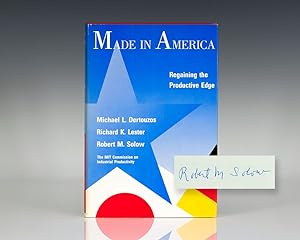
Made In America: Regaining the Productive Edge.
Published by The MIT Press, Cambridge, MA, 1989
First Edition Signed
First edition of the best-selling book in MIT Press' history. Octavo, original cloth. Signed by Robert M. Solow on the title page. Fine in a near fine dust jacket. The best-selling book in MIT history, Made in America is the definitive account of how America works. Based on interviews with hundreds of workers, this vivid portrait not only identifies weaknesses and problems in management and productivity, but offers workable solutions for making American business work well again.
-
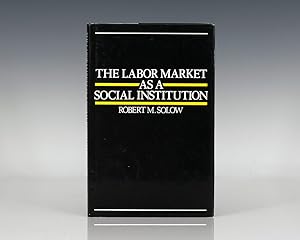
The Labor Market as a Social Institution.
Published by Blackwell Publishers, New York, 1990
First Edition Signed
First edition of this work by the Nobel Prize-winning economist. Octavo, original cloth. Signed by Robert Solow on the title page. Near fine in a fine dust jacket, small name to the front free endpaper.
-
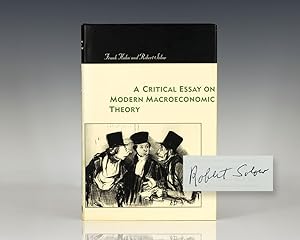
A Critical Essay on Modern Macroeconomic Theory.
Published by The MIT Press, Cambridge, MA, 1995
First Edition Signed
First edition of this work by the Nobel Prize-winning economist. Octavo, original cloth. Signed by Nobel Prize-winning economist Robert Solow on the title page. Fine in a fine dust jacket. "Like the great debate between Einstein and Bohr on quantum physics,the debate between Hahn-Solow and Lucas's rational expectationism is a must for all serious students of macro. This is how scientific progress should be doneâ"by sober analysis rather than clever rhetoric or frenzied ideology" (Paul A. Samuelson).
-
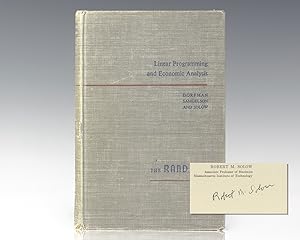
Linear Programming and Economic Analysis.
Published by McGraw-Hill Company, Inc, New York, 1958
First Edition Signed
First edition of this classic text. Octavo, original gray cloth. Signed by Robert M. Solow on the title page. In very good condition with notes and marginalia. Linear programming has been one of the most important postwar developments in economic theory, but until publication of the Linear Programming and Economic Analysis, no text offered a comprehensive treatment of the many facets of the relationship of linear programming to traditional economic theory. This book was the first to provide a wide-ranging survey of such important aspects of the topic as the interrelations between the celebrated von Neumann theory of games and linear programming, and the relationship between game theory and the traditional economic theories of duopoly and bilateral monopoly.
-
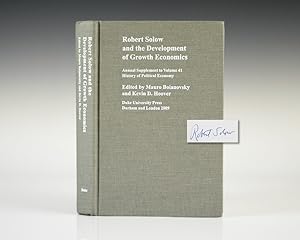
Robert Solow and the Development of Growth Economics.
Published by Duke University Press, Chapel Hill, NC, 2009
First Edition Signed
First edition of this work by the Nobel Prize-winning economist. Octavo, original cloth. Signed by Robert Solow on the title page. In fine condition, no dust jacket was issued for this volume. Robert Merton Solow is known for his work on the theory of economic growth that culminated in the exogenous growth model named after him. He was awarded the John Bates Clark Medal (in 1961), Nobel Memorial Prize in Economic Sciences (in 1987) and the 2014 Presidential Medal of Freedom. Solow, along with colleague Paul Samuelson were responsible for MIT becoming the top ranked economics department.The MIT economists were thus growthmen in two senses: in seeing growth as an absolutely central policy imperative and in seeing the theory of growth as a focus for economic research. What the MIT growthmen added was a distinctive style of analysis that made it easier to address the dominant policy concerns in tractable formal models. Solowâs (1956) model was the perfect exemplar of the MIT style. It provided the central framework for the subsequent developments in growth theory and secured MIT as the center of the universe in the golden age of growth theory in the 1960s (Boianovsky and Hoover 199-200).
-

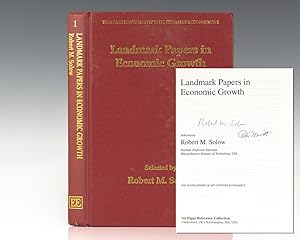
Landmark Papers in Economic Growth.
Published by Edward Elgar Publishing, Northampton, MA, 2001
First Edition Signed
First edition of this collection of writings by Nobel Prize-winning economist Robert M. Solow. Octavo, original cloth. Signed by Robert M. Solow on the title page. In fine condition, issued without a dust jacket. Robert Merton Solow is an American economist, particularly known for his work on the theory of economic growth that culminated in the exogenous growth model named after him. He was awarded the John Bates Clark Medal in 1961, the Nobel Memorial Prize in Economic Sciences in 1987, and the Presidential Medal of Freedom in 2014.
-

Price Expectations and the Behavior of the Price Level: Lectures Given in the University of Manchester.
Published by Manchester University Press, Manchester, 1969
First Edition Signed
First edition of this collection of lectures delivered by Solow in the University of Manchester. Octavo, original wrappers. Presentation copy, inscribed by the author on the title page, "For John Rogers with best wishes Robert Solow." In very good condition with residue to the front and rear panels. American economist Robert Solow's work on the theory of economic growth culminated in the exogenous growth model named after him. These lectures provide an econometric test of the concept of the 'trade-off' between the rate of inflation and the level of employment and economic activity using data from both the United States and United Kingdom. In the course of the test, Solow studies to the extent to which changes in the general price level are affected by changes in cost factors and in the pressure of demand, and by incomes policies or 'guideposts'.
-
Inside Star Trek; The Real Story
Published by Pocket Books, New York, 1996
Seller: Ground Zero Books, Ltd., Silver Spring, MD, U.S.A.
Seller rating 5 out of 5 stars

First Edition Signed
Hardcover. Condition: Very good. Dust Jacket Condition: Very good. John Knoll (Jacket illustration) (illustrator). First Printing [Stated]. The format is approximately 7.5 inches by 9.5 inches. xx, [2], 458 pages. Illustrations. Index. DJ has a couple of small dings. Inscription signed by both authors. Inscription reads 8/16/96 To David--"Live Long & Prosper!" Herbert Solow Bob Justman. Contents include Act One Genesis: The Two Pilots; Act Two The First Season: A Struggle for Life; Act Three Death and Transfiguration: The Second and Third Seasons; Act Four Rebirth: Star Trek Lives!, and Epilogue. A history of the classic television series follows the collaboration of Herb Solow, Gene Roddenberry, and Bob Justman and chronicles the personalities, production methods, and special effects that resulted in the show's phenomenal legacy. Herbert Franklin Solow (December 14, 1930 - November 19, 2020 was an American motion picture and television executive, screenwriter, producer, director and talent agent. In 1964, he joined Desilu Studios and oversaw the development and production of Star Trek, Mission: Impossible, and Mannix. Robert Harris "Bob" Justman (July 13, 1926 - May 28, 2008) was an American television producer, director, and production manager. He worked on many American TV series including Lassie, The Life of Riley, Adventures of Superman, The Outer Limits, Star Trek, Mission: Impossible, Search, and Then Came Bronson. Justman was one of the pioneers behind Star Trek, working both as an associate and supervising producer on Star Trek: The Original Series and Star Trek: The Next Generation. He was the assistant director of the first two Star Trek episodes: "The Cage" and "Where No Man Has Gone Before." Along with Robert H. Justman, he wrote Inside Star Trek: The Real Story, published by Pocket Books in 1996. According to Publishers Weekly, "As told by Solow, Star Trek's executive in charge of production, and Justman, Star Trek's co-producer, this is arguably the definitive history of the TV show . With plenty of behind-the-scenes material that will be of interest to Trek fans, this book puts a good deal of emphasis on the show's business side, elucidating production difficulties, cost overruns and the seemingly constant debate with NBC over the show's future." Although Solow is often credited with being the first to call Gene Roddenberry "The Great Bird of the Galaxy", drawn from one of George Takei's throwaway lines, as Mr. Sulu, from the original series episode "The Man Trap", it was actually Robert Justman who coined the phrase.
-
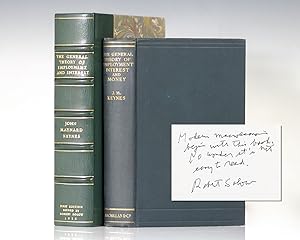
The General Theory of Employment, Interest and Money.
Published by Macmillan and Co., Limited, London, 1936
First Edition Signed
First edition of the economist's masterpiece, generally regarded as the most influential social science treatise of the twentieth century. Octavo, original cloth. Signed by Nobel Prize-winning economist, "Modern macroeconomics began with this book, no wonder it's not easy to read Robert Solow." In near fine condition. Housed in a custom half morocco clamshell box made by the Harcourt Bindery. A unique example. The General Theory ranks with Smith's Wealth of Nations as an intellectual event and with Malthus' Essay on Population as a guide for public policy. The London Review of Books has grouped The General Theory "among the glories of modern publishing, edited with exemplary authority and lack of fuss." Many innovations of The General Theory remain central to modern macroeconomics. It was placed on Time's 2001 top one-hundred non-fiction books written in English since 1923.
-
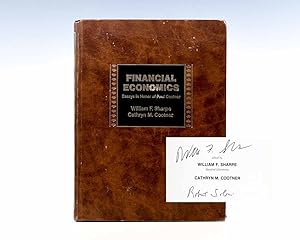
Financial Economics: Essays in Honor of Paul Cootner.
Published by Prentice-Hall, Inc, New York, 1982
First Edition Signed
First edition of this collection of essays in honor of the famed economist. Quarto, original boards. Boldly signed by Nobel Prize-winning economists William Sharpe and Robert Solow on the title page. In near fine condition.
-
Landmark Papers in Economic Growth.
Published by Edward Elgar Publishing, Northampton, MA, 2001
First Edition Signed
First edition of this collection of writings by Nobel Prize-winning economist Robert M. Solow. Octavo, original cloth. Signed by Nobel Prize-winning economists Robert M. Solow and Peter Howitt on the title page. Howitt contributed an essay in this volume. In near fine condition, issued without a dust jacket. Robert Merton Solow is an American economist, particularly known for his work on the theory of economic growth that culminated in the exogenous growth model named after him. He was awarded the John Bates Clark Medal in 1961, the Nobel Memorial Prize in Economic Sciences in 1987, and the Presidential Medal of Freedom in 2014.
-
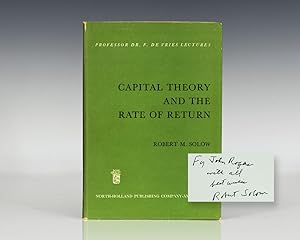
Capital Theory and the Rate of Return.
Published by North-Holland Publishing Company, Amsterdam, 1963
First Edition Signed
First edition of the Nobel prize-winning economist's De Vries Lectures on economics. Octavo, original wrappers. Presentation copy, inscribed by Robert Solow on the title page. In near fine condition, name on the front free endpaper. "These three lectures in the volume under review consolidate and extend Robert Solow's previous examination of the relationship between capital and economic growth. What is crucial is to know the social rate of return on investment; this is the principal theme, and a sound one. Readers of Solow's articles on capital and growth will surely wish to continue with this book. It is also a particularly good introduction to the discussion; prepared for oral delivery, the presentation seems easier to follow than his previous contributions. It would be an injustice, however, to imply that these lectures are merely one more contribution to the current debate over capital and growth; they are more than that. This review can scarcely suggest the breadth of the discussion or the elegance of the theoretical analysis and manipulation of simple models; suffice it to say that the whole volume is highly stimulating" (Denison, American Economic Review).
-
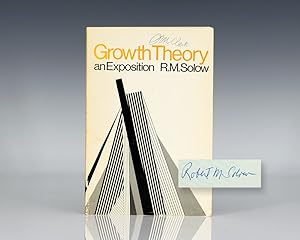
Growth Theory: An Exposition.
Published by Oxford University Press, New York, 1970
First Edition Signed
First edition of this classic work by the Nobel Prize-winning economist. Octavo, original wrappers. Signed by Robert M. Solow on the title page. In near fine condition, with a name to the front panel and front free endpaper. Robert M. Solow is known for his work on the theory of economic growth that culminated in the exogenous growth model named after him. He was awarded the John Bates Clark Medal in 1961, the Nobel Memorial Prize in Economic Sciences in 1987, and the Presidential Medal of Freedom in 2014.
-

Creating a Learning Society: A New Approach to Growth, Development, and Social Progress (Kenneth J. Arrow Lecture Series).
Published by Columbia University Press, New York, 2014
First Edition Signed
First edition of this classic economic text. Octavo, original cloth. Signed by authors Joseph Stiglitz and Bruce Greenwald on the title page, as well as Robert Solow, who contributed some commentary. Fine in a fine dust jacket. Includes commentaries from Philippe Aghion and Michael Woodford, as well as from Nobel Laureates Kenneth J. Arrow and Robert M. Solow. It has long been recognized that an improved standard of living results from advances in technology, not from the accumulation of capital. It has also become clear that what truly separates developed from less-developed countries is not just a gap in resources or output but a gap in knowledge. In fact, the pace at which developing countries grow is largely a function of the pace at which they close that gap. Thus, to understand how countries grow and develop, it is essential to know how they learn and become more productive and what government can do to promote learning. In Creating a Learning Society, Joseph E. Stiglitz and Bruce C. Greenwald cast light on the significance of this insight for economic theory and policy. Taking as a starting point Kenneth J. Arrow's 1962 paper "Learning by Doing," they explain why the production of knowledge differs from that of other goods and why market economies alone typically do not produce and transmit knowledge efficiently. Closing knowledge gaps and helping laggards learn are central to growth and development. But creating a learning society is equally crucial if we are to sustain improved living standards in advanced countries. Combining accessible prose with technical economic analysis, Stiglitz and Greenwald provide new models of "endogenous growth," up-ending thowhe thinking about both domestic and global policy and trade regimes. They show well-designed government trade and industrial policies can help create a learning society, and how poorly designed intellectual property regimes can retard learning. They also explain how virtually every government policy has effects, both positive and negative, on learning, a fact that policymakers must recognize. They demonstrate why many standard policy prescriptions, especially those associated with "neoliberal" doctrines focusing on static resource allocations, have impeded learning. Among the provocative implications are that free trade may lead to stagnation whereas broad-based industrial protection and exchange rate interventions may bring benefitsânot just to the industrial sector, but to the entire economy.
-
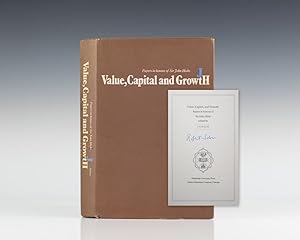
Value, Capital and Growth: Papers In Honour of Sir John Hicks.
Published by Edinburgh University Press, Edinburgh, 1968
First Edition Signed
First edition of this work in honor of John Hicks. Octavo, original cloth. Signed twice by Robert Solow, who contributed an article in this volume. Fine in a near fine dust jacket with light shelfwear. Edited by J.N. Wolfe. John R. Hicks's early work as a labour economist culminated in The Theory of Wages still considered standard in the field. He collaborated with R.G.D. Allen in two seminal papers on value theory published in 1934. His magnum opus is Value and Capital published in 1939. The book built on ordinal utility and mainstreamed the now-standard distinction between the substitution effect and the income effect for an individual in demand theory for the 2-good case. It generalized the analysis to the case of one good and a composite good, that is, all other goods. It aggregated individuals and businesses through demand and supply across the economy. It anticipated the aggregation problem, most acutely for the stock of capital goods. It introduced general equilibrium theory to an English-speaking audience, refined the theory for dynamic analysis, and for the first time attempted a rigorous statement of stability conditions for general equilibrium. In the course of analysis Hicks formalized comparative statics. In the same year, he also developed the famous "compensation" criterion called Kaldorâ"Hicks efficiency for welfare comparisons of alternative public policies or economic states. Hicks's most familiar contribution in macroeconomics was the Hicksâ"Hansen ISâ"LM model, which formalized an interpretation of the theory of John Maynard Keynes. The model describes the economy as a balance between three commodities: money, consumption and investment. Hicks himself did not embrace the theory as he interpreted it; and, in a paper published in 1980, Hicks asserted that it had omitted some crucial components of Keynes's arguments, especially those related to uncertainty.
-
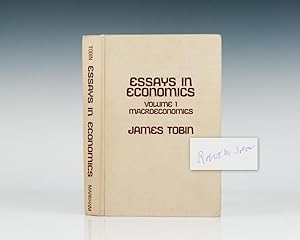
Essays in Economics: Volume 1 Macroeconomics.
Published by North-Holland Publishing Company, Amsterdam, 1971
First Edition Signed
First edition of this collection of essays. Octavo, original cloth. Signed by Nobel Prize-winning economist Robert M. Solow, who contributed an article in this volume. Name to the front free endpaper, in near fine condition.
-
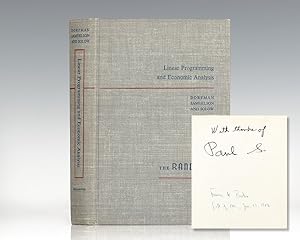
Linear Programming and Economic Analysis.
Published by McGraw-Hill Company, Inc, New York, 1958
First Edition Signed
First edition of this classic text. Octavo, original gray cloth. Presentation copy, inscribed Paul Samuelson to colleague and close friend Francis Bator on the front free endpaper, "With thanks of Paul S." With Francis M. Bator signature and note Gift of PAS, Jan. 17, 1958. Also laid in is a note, "With the Compliments of Paul A. Samuelson." The recipient, Francis M. Bator was Deputy National Security Advisor of the United States from 1965 to 1967. He was also a Special Assistant to President Lyndon B. Johnson. Bator was Lucius N. Littauer Professor of Political Economy in Harvard's Kennedy School of Government where he was founding chairman of the School's Public Policy Program, and director of studies in its Institute of Politics. Before coming to Harvard in 1967 he served as deputy national security advisor to President Lyndon Johnson covering U.S.-European relations and foreign economic policy. On the occasion of his departure from the White House, The Economist of London headed an article about his service "Europe's Assistant." Bator's 1958 article "The Anatomy of Market Failure," was recently described as "the standard reference" to the "approach [that] now forms the basis of â¦textbook expositions in the economics of the public sector." His 1960 book, The Question of Government Spending, was described in the Economic Journal "as a model of the sort of contribution which the economist can make to informed public discussion" and in the New York Times as one of seven books that influenced President Kennedy's approach to the presidency. In near fine condition. A nice association. Linear programming has been one of the most important postwar developments in economic theory, but until publication of the Linear Programming and Economic Analysis, no text offered a comprehensive treatment of the many facets of the relationship of linear programming to traditional economic theory. This book was the first to provide a wide-ranging survey of such important aspects of the topic as the interrelations between the celebrated von Neumann theory of games and linear programming, and the relationship between game theory and the traditional economic theories of duopoly and bilateral monopoly.
-
Robert Solow - Signed card + Photo - 1987
Language: French
Publication Date: 1987
Manuscript / Paper Collectible Signed
Pas de couverture. Condition: Bon. Authentic card signed in 1987. + Photo 23x15 cm (recent print). Size : 7.5x12.5 cm. Condition : see scans please. Certificate of Authenticity and lifetime guarantee. Signé par l'auteur.