Order Total (1 Item Items):
Shipping Destination:

Steury Editor Donald (20 results)
Skip to main search results
Search filters
Product Type
- All Product Types
- Books (20)
- Magazines & Periodicals (No further results match this refinement)
- Comics (No further results match this refinement)
- Sheet Music (No further results match this refinement)
- Art, Prints & Posters (No further results match this refinement)
- Photographs (No further results match this refinement)
- Maps (No further results match this refinement)
- Manuscripts & Paper Collectibles (No further results match this refinement)
Condition Learn more
- New (12)
- As New, Fine or Near Fine (4)
- Very Good or Good (4)
- Fair or Poor (No further results match this refinement)
- As Described (No further results match this refinement)
Binding
Collectible Attributes
- First Edition (4)
- Signed (No further results match this refinement)
- Dust Jacket (2)
- Seller-Supplied Images (11)
- Not Print on Demand (14)
Language (2)
Free Shipping
Seller Location
Seller Rating
-

Condition: As New. Unread book in perfect condition.
-

Condition: New.
-

Sherman Kent and the Board of National Estimates
Seller: Rarewaves.com USA, London, LONDO, United Kingdom
Seller rating 5 out of 5 stars

US$ 22.95
Free Shipping
Ships from United Kingdom to U.S.A.Quantity: Over 20 available
Add to basketPaperback. Condition: New.
-

US$ 17.90
US$ 20.77 shipping
Ships from United Kingdom to U.S.A.Quantity: 10 available
Add to basketPF. Condition: New.
-

Sherman Kent and the Board of National Estimates
Seller: GreatBookPricesUK, Woodford Green, United Kingdom
Seller rating 5 out of 5 stars
US$ 21.16
US$ 20.11 shipping
Ships from United Kingdom to U.S.A.Quantity: Over 20 available
Add to basketCondition: New.
-

Sherman Kent and the Board of National Estimates
Seller: GreatBookPricesUK, Woodford Green, United Kingdom
Seller rating 5 out of 5 stars
US$ 24.25
US$ 20.11 shipping
Ships from United Kingdom to U.S.A.Quantity: Over 20 available
Add to basketCondition: As New. Unread book in perfect condition.
-

Intentions and Capabilities: Estimates on Soviet Strategic Forces, 1950-1983
Published by Central Intelligence Agency
Seller: Wonder Book, Frederick, MD, U.S.A.
Seller rating 5 out of 5 stars
Condition: Good. Good condition. (russia, soviet union, cold war, military history) A copy that has been read but remains intact. May contain markings such as bookplates, stamps, limited notes and highlighting, or a few light stains. Bundled media such as CDs, DVDs, floppy disks or access codes may not be included. NOT AVAILABLE FOR SHIPMENT OUTSIDE OF THE UNITED STATES.
-
On the Front Lines of the Cold War: Documents on the Intelligence War in Berlin, 1946 to 1961
Published by CIA History Staff, Center for Study of Intelligence, 1999
Soft cover. Condition: Very Good. Over-sized soft cover book (634 pages)titled ON THE FRONT LINES OF THE COLD WAR: Documents on the Intelligence War in Berlin, 1945 to 1961. Edited by Donald P. Steury. Published in 1999 by CIA History Staff, Center for Study of Intelligence. Light rubbing to covers. International shipping may require additional charge. Bookseller since 1995 (LL-Base2-BS-10-bottom-R) rareviewbooks Language: eng.
-
The Intelligence War (World War II Chronicles Series)
Language: English
Published by Metro Books/Friedman/Fairfax, New York, NY, U.S.A., 2000
ISBN 10: 1567999581 ISBN 13: 9781567999587
Seller: RareNonFiction, IOBA, Ladysmith, BC, Canada
Association Member: IOBA
Seller rating 5 out of 5 stars
First Edition
Hardcover. Condition: Fine. Dust Jacket Condition: Fine. First Printing. 128 pages including index. Black and white illustrations throughout. From signals intelligence and code-cracking breakthroughs to the daring exploits of agents in the field, this work vividly chronicles the covert activities that comprised the secret war of 1939 through 1945. Written by intelligence expert Donald P. Steury, illustrated with full-color maps and period photographs, and featuring an introduction by series editor and respected WWII historian Lt. Col. Roger Cirillo, United States Army, Retired, this evocative history provides an insightful account of the significance of intelligence during World War II. Clean, bright and unmarked. Very light wear. Excellent copy.
-
On the Front Lines of the Cold War; Documents on the Intelligence War in Berlin, 1946 to 1961
Language: English
Published by CIA History Staff/Center for the Study of Intelligence, Washington, DC, 1999
Seller: Books by White/Walnut Valley Books, Winfield, KS, U.S.A.
Seller rating 5 out of 5 stars
First Edition
Hardcover. Condition: Fine. Dust Jacket Condition: Near Fine. 1st Edition. CIA History Staff/Center for the Study of Intelligence, Washington, DC. 1999. Hardcover. First Edition. Book is tight, square, and unmarked. Book Condition: Fine. DJ: Near Fine; light chipping at spine head. Maroon boards and spine with bright gilt lettering on spine and front board. 634 pp 4to. This book contains documents dealing with every aspect of the intelligence war in Berlin from 1945 until the building of the Berlin Wall in 1961. Each document illustrates an important facet of intelligence operations in Cold War Berlin. Taken together they represent a detailed picture of a side of the Cold War long withheld from the general public. A clean very presentable copy.
-
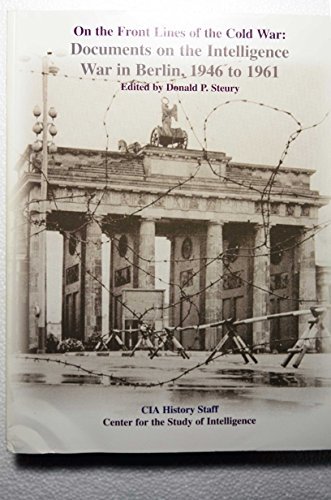
On the Front Lines of the Cold War; Documents on the Intelligence War in Berlin, 1946 to 1961
Language: English
Published by Central Intelligence Agency, Center for the Study of Intelligence, Washington, DC, 2000
ISBN 10: 1929667019 ISBN 13: 9781929667017
Seller: Ground Zero Books, Ltd., Silver Spring, MD, U.S.A.
Seller rating 4 out of 5 stars

First Edition
Trade paperback. Condition: Very good. xvi, 575, [1] pages. Oversized Book (measuring 10-3/4 inches by 8-1/2 inches). Minor black marks on bottom edge. Includes Preface, Introduction, Footnotes. Illustrations, and Index to documents. Topics covered include The Opening of the Intelligence War; The March Crisis and the Berlin Airlift; June 1953; Alltagsgeschichte: Day to Day in the Intelligence War; The Berlin Tunnel; The Berlin Crisis; The Wall; and a Glossary of Abbreviations. Donald P. Steury is a Historian for the National Declassification Center in the National Archives and Records Administration. In the summer of 1945, the Allied powers--the United States, Great Britain, France, and the Soviet Union--began what was to be a temporary, joint occupation of the city of Berlin. Despite an optimistic beginning, by 1948 Cold War pressures had created two separate cities, East Berlin and West Berlin. In 1948 the Soviet Union blockaded Berlin, cutting off deliveries of coal, food, and supplies. The Western Allies responded with the Berlin Airlift, in which Allied air crews flew 4,000 tons of supplies a day into the city. In May 1949 the blockade came to an end, as the Soviets permitted the Western Allies to resupply Berlin by land. Berlin, however, was to remain a divided city with two governments until the end of the Cold War. For nearly 50 years the German city of Berlin was the living symbol of the Cold War. The setting for innumerable films and novels about spies and Cold War espionage, Berlin was, in truth, at the heart of the intelligence war between the United States and the Soviet bloc. For the United States and its allies, Berlin was a base for strategic intelligence collection that provided unequaled access to Soviet-controlled territory. For the Soviet Union and the captive nations of the Warsaw Pact, the presence of Western intelligence services in occupied Berlin was a constant security threat, but also an opportunity to observe their opponents in action, and possibly to penetrate their operations. Perhaps nowhere else did the Soviet and Western intelligence services confront each other so directly, or so continuously. It thus seems appropriate to refer to this situation as an "Intelligence War"; not because the conflict between the opposing services regularly erupted into organized violence, but because it was a sustained, direct confrontation that otherwise had many of the characteristics of a war. For the early Cold War period at least, "Berlin Operations Base" may be said to have been one of the most active and productive postings for CIA intelligence officers in Europe. Its first Chief of Base was Allen W. Dulles. Richard Helms succeeded Dulles in October 1945. Following in the shoes of these two future Directors of Central Intelligence were some of the most successful intelligence officers in the Agency--most of whom must remain anonymous even today. CIA Berlin was never an independent entity, however, but always was subordinate to the Senior Agency Representative in Germany. Moreover, the CIA mission in Berlin was never more than a very small part of the much larger Allied presence. What follows is a sampling of CIA intelligence documents dealing with Cold War Berlin from the beginning of the Allied occupation in the summer of 1945 until the construction of the Berlin Wall in 1961. This might be regarded as the classical period of the intelligence war in Berlin, when the relatively unrestricted access permitted between the eastern and western halves of the city facilitated the intelligence operations of both sides. It was during this period that Berlin earned its reputation as a "den of espionage," a reputation that at least partly lived up to the romantic image created over the years by novelists and screenwriters. Second Edition [stated]. Presumed first printing thus.
-
Hardcover. Condition: New. In shrink wrap. Looks like an interesting title!
-
On the Front Lines of the Cold War; Documents on the Intelligence War in Berlin, 1946 to 1961
Language: English
Published by Central Intelligence Agency, Center for the Study of Intelligence, CIA History Staff, Washington, DC, 1999
ISBN 10: 1929667019 ISBN 13: 9781929667017
Seller: Ground Zero Books, Ltd., Silver Spring, MD, U.S.A.
Seller rating 4 out of 5 stars
First Edition
Trade paperback. Condition: Good. Presumed First Edition, First printing. x, [2], 634, [8] pages. Oversized Book (measuring 8.5 by 11 inches). Cover has some wear and soiling. Includes Preface, Introduction, Footnotes. Illustrations, and Index to documents. Topics covered include The Opening of the Intelligence War; The March Crisis and the Berlin Airlift; June 1953; Alltagsgeschichte: Day to Day in the Intelligence War; The Berlin Tunnel; The Berlin Crisis; The Wall. Donald P. Steury was a Historian for the National Declassification Center in the National Archives and Records Administration. Donald Steury edited a substantial number of highly influential works on intelligence during the Cold War. In the summer of 1945, the Allied powers--the United States, Great Britain, France, and the Soviet Union--began what was to be a temporary, joint occupation of the city of Berlin. Despite an optimistic beginning, by 1948 Cold War pressures had created two separate cities, East Berlin and West Berlin. In 1948 the Soviet Union blockaded Berlin, cutting off deliveries of coal, food, and supplies. The Western Allies responded with the Berlin Airlift, in which Allied air crews flew 4,000 tons of supplies a day into the city. In May 1949 the blockade came to an end, as the Soviets permitted the Western Allies to resupply Berlin by land. Berlin, however, was to remain a divided city with two governments until the end of the Cold War. For nearly 50 years the German city of Berlin was the living symbol of the Cold War. The setting for innumerable films and novels about spies and Cold War espionage, Berlin was, in truth, at the heart of the intelligence war between the United States and the Soviet bloc. For the United States and its allies, Berlin was a base for strategic intelligence collection that provided unequaled access to Soviet-controlled territory. For the Soviet Union and the captive nations of the Warsaw Pact, the presence of Western intelligence services in occupied Berlin was a constant security threat, but also an opportunity to observe their opponents in action, and possibly to penetrate their operations. Perhaps nowhere else did the Soviet and Western intelligence services confront each other so directly, or so continuously. It thus seems appropriate to refer to this situation as an "Intelligence War"; not because the conflict between the opposing services regularly erupted into organized violence, but because it was a sustained, direct confrontation that otherwise had many of the characteristics of a war. For the early Cold War period at least, "Berlin Operations Base" may be said to have been one of the most active and productive postings for CIA intelligence officers in Europe. Its first Chief of Base was Allen W. Dulles. Richard Helms succeeded Dulles in October 1945. Following in the shoes of these two future Directors of Central Intelligence were some of the most successful intelligence officers in the Agency--most of whom must remain anonymous even today. CIA Berlin was never an independent entity, however, but always was subordinate to the Senior Agency Representative in Germany. Moreover, the CIA mission in Berlin was never more than a very small part of the much larger Allied presence. What follows is a sampling of CIA intelligence documents dealing with Cold War Berlin from the beginning of the Allied occupation in the summer of 1945 until the construction of the Berlin Wall in 1961. This might be regarded as the classical period of the intelligence war in Berlin, when the relatively unrestricted access permitted between the eastern and western halves of the city facilitated the intelligence operations of both sides. It was during this period that Berlin earned its reputation as a "den of espionage," a reputation that at least partly lived up to the romantic image created over the years by novelists and screenwriters.
-

US$ 21.14
US$ 87.14 shipping
Ships from United Kingdom to U.S.A.Quantity: Over 20 available
Add to basketPaperback. Condition: New.
-
PAP. Condition: New. New Book. Shipped from UK. THIS BOOK IS PRINTED ON DEMAND. Established seller since 2000.
-
Sherman Kent and the Board of National Estimates
Seller: PBShop.store UK, Fairford, GLOS, United Kingdom
Seller rating 4 out of 5 stars
US$ 22.11
US$ 5.58 shipping
Ships from United Kingdom to U.S.A.Quantity: Over 20 available
Add to basketPAP. Condition: New. New Book. Delivered from our UK warehouse in 4 to 14 business days. THIS BOOK IS PRINTED ON DEMAND. Established seller since 2000.
-
Sherman Kent and the Board of National Estimates
Seller: THE SAINT BOOKSTORE, Southport, United Kingdom
Seller rating 5 out of 5 stars
US$ 25.19
US$ 21.46 shipping
Ships from United Kingdom to U.S.A.Quantity: Over 20 available
Add to basketPaperback / softback. Condition: New. This item is printed on demand. New copy - Usually dispatched within 5-9 working days.
-

Condition: New. Dieser Artikel ist ein Print on Demand Artikel und wird nach Ihrer Bestellung fuer Sie gedruckt. KlappentextrnrnThese collected essays by Sherman Kent were edited by Donald P. Steury and published in 1994 by the History Staff of the Center for the Study of Intelligence, Central Intelligence Agency, Washington D.C. Kent was chairman of the B.
-

Taschenbuch. Condition: Neu. nach der Bestellung gedruckt Neuware - Printed after ordering - These collected essays by Sherman Kent were edited by Donald P. Steury and published in 1994 by the History Staff of the Center for the Study of Intelligence, Central Intelligence Agency, Washington D.C. Kent was chairman of the Board of National Estimates from 1952 - 1967 and these declassified essays represent the essence of his thinking on estimate preparation as well as important historical background on the methodology used before and during his tenure. The foreword is by J. Kenneth McDonald, then (1994) chief of the CIA History Staff and the text includes some security-related redactions. This book, long out of print, is a foundational text in the study of intelligence analysis. For the general non-fiction reading public, Kent's illustrative anecdotes about De Gaulle, Bedell Smith, Dean Acheson, etc., offer color and interest, as does his 'lessons learned' essay on analysis failure in predicting Soviet missile deliveries to Cuba.
-
Taschenbuch. Condition: Neu. Sherman Kent and the Board of National Estimates | Editor Donald P. Steury | Taschenbuch | Kartoniert / Broschiert | Englisch | 2011 | [.] | EAN 9781257781898 | Verantwortliche Person für die EU: Libri GmbH, Europaallee 1, 36244 Bad Hersfeld, gpsr[at]libri[dot]de | Anbieter: preigu Print on Demand.