
Order Total (1 Item Items):
Shipping Destination:

Tolbert Samuel (6 results)
Skip to main search results
Search filters
Product Type
- All Product Types
- Books (6)
- Magazines & Periodicals (No further results match this refinement)
- Comics (No further results match this refinement)
- Sheet Music (No further results match this refinement)
- Art, Prints & Posters (No further results match this refinement)
- Photographs (No further results match this refinement)
- Maps (No further results match this refinement)
- Manuscripts & Paper Collectibles (No further results match this refinement)
Condition Learn more
- New (No further results match this refinement)
- As New, Fine or Near Fine (1)
- Very Good or Good (4)
- Fair or Poor (No further results match this refinement)
- As Described (1)
Binding
Collectible Attributes
- First Edition (No further results match this refinement)
- Signed (1)
- Dust Jacket (No further results match this refinement)
- Seller-Supplied Images (3)
- Not Print on Demand (6)
Language (2)
Free Shipping
Seller Location
Seller Rating
-

Loving a Fragile Woman
Seller: World of Books (was SecondSale), Montgomery, IL, U.S.A.
Seller rating 5 out of 5 stars

Condition: Very Good. Item in good condition. Textbooks may not include supplemental items i.e. CDs, access codes etc.
-
Loving a Fragile Woman
Seller: World of Books (was SecondSale), Montgomery, IL, U.S.A.
Seller rating 5 out of 5 stars
Condition: Good. Item in good condition. Textbooks may not include supplemental items i.e. CDs, access codes etc.
-

Research in the Sociology of Organizations, VOLUME 9.
Seller: books4less (Versandantiquariat Petra Gros GmbH & Co. KG), Welling, Germany
Seller rating 5 out of 5 stars
gebundene Ausgabe. Condition: Gut. 362 Seiten Der Erhaltungszustand des hier angebotenen Werks ist trotz seiner Bibliotheksnutzung sehr sauber und kann entsprechende Merkmale aufweisen (Rückenschild, Instituts-Stempel.). In ENGLISCHER Sprache. Sprache: Englisch Gewicht in Gramm: 780.
-

Hardcover. Condition: Fine.
-
Research in the Sociology of Organizations, VOLUME 10.
Seller: books4less (Versandantiquariat Petra Gros GmbH & Co. KG), Welling, Germany
Seller rating 5 out of 5 stars
gebundene Ausgabe. Condition: Gut. 220 Seiten Der Erhaltungszustand des hier angebotenen Werks ist trotz seiner Bibliotheksnutzung sehr sauber und kann entsprechende Merkmale aufweisen (Rückenschild, Instituts-Stempel.). In ENGLISCHER Sprache. Sprache: Englisch Gewicht in Gramm: 560.
-
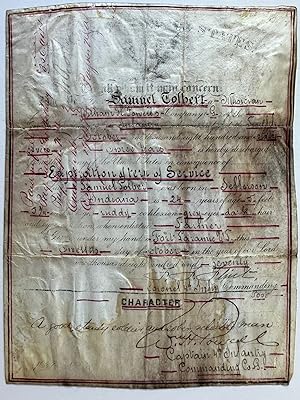
FORT LARAMIE, WYOMING TERRITORY DISCHARGE PAPER FOR SAMUEL TOLBERT, MUSICIAN, IN WILLIAM H. POWELL'S COMPANY G, 4TH INFANTRY, OCTOBER 12, 1870, UPON EXPIRATION OF TERM OF SERVICE
Published by Fort Laramie, W.T., 1870
Seller: Bartleby's Books, ABAA, Chevy Chase, MD, U.S.A.
Association Member: ABAA ESA ILAB IOBA
Seller rating 5 out of 5 stars
Signed
Partly printed, completed in manuscript. Text bordered by red and black lines, some of the hand-written sections underlined in red. Single sheet of thin vellum, 24 cm., wrinkled and stained, old fold lines, a printed header "Army of the United States," and vignette of the American Eagle are faded and rubbed. Signed in ink by Col. F.F. Flint, 4th Infantry, Commanding Post, and by Capt. Wm. H. Powell, 4th Infantry, Commanding Co. G. Discharge paper for Samuel Tolbert, born in Jefferson, Indiana, aged 24, 5 ft 5 3/4 in., described as a farmer, with a ruddy complexion, grey eyes and dark hair, who had enlisted on Oct. 12, 1867, for the period of three years. Capt. Powell appended a further note describing Tolbert's character: "A good, steady soldier, and sober, reliable man." Fort Laramie, originally named Fort William (and then Fort John) was erected as a private trading post in 1834. In 1849, the U.S. Army purchased the post, renaming it Fort Laramie, and began using it to protect settlers moving west along the Oregon Trail, Pony Express riders, and the Overland Stage. F[ranklin] F. Flint arrived in 1869 to take command of the post. In a deposition from April 1869 by William G. Bullock, an agent of S.E. Ward, the post trader, Flint is described as "an officer of the old school. an accomplished gentleman, and a superior soldier." [see: HR Ex. Doc. No. 152, 41st Congress, 2d Session, Letter from the Sec. of the Interior, relating to appropriations for goods furnished by S.E. Ward to Indians at Fort Laramie]. William H. Powell, born in Washington, DC in 1838, served in the Union Army during the Civil War, and in 1867 was ordered West, first to Nebraska and then Colorado. He was posted to Fort Laramie from June 1868 until March 1871, and later served in several other western posts, retiring from the army in 1899. [see: his biographical sketch in a book he authored, "Records of Living Officers of U.S. Army," (Phila.: 1890), pp. 474-6] Tolbert arrived at Fort Laramie in Wyoming Territory in the midst of Red Cloud's War. The Lakota, Northern Cheyenne, and Northern Arapaho people were fighting to protect their lands and way of life from encroachments by the wave of emigrants following the Bozeman Trail through the Powder River country to the gold fields of Montana, and from the increasing military presence in the area. A resolution of sorts was established by the Treaty of Fort Laramie, signed by the Native Americans and the U.S. government on April 29, 1868. [Capt. Wm. H. Powell signed as one of the witnesses]. In exchange for the cessation of hostilities, the Native Americans agreed to relocate to the Black Hills of South Dakota to a reservation set aside for them. History proved the peace to be momentary. Tolbert [spelled Talbert in some records] returned to his farm in Indiana, later becoming a minister of the Friends Church.

