

Order Total (1 Item Items):
Shipping Destination:

Trumbull John, Signed (4 results)
Skip to main search results
Search filters
Product Type
- All Product Types
- Books (4)
- Magazines & Periodicals (No further results match this refinement)
- Comics (No further results match this refinement)
- Sheet Music (No further results match this refinement)
- Art, Prints & Posters (No further results match this refinement)
- Photographs (No further results match this refinement)
- Maps (No further results match this refinement)
- Manuscripts & Paper Collectibles (No further results match this refinement)
Condition Learn more
- New (No further results match this refinement)
- As New, Fine or Near Fine (No further results match this refinement)
- Very Good or Good (1)
- Fair or Poor (No further results match this refinement)
- As Described (3)
Binding
Collectible Attributes
- First Edition (1)
- Signed (4)
- Dust Jacket (No further results match this refinement)
- Seller-Supplied Images (2)
- Not Print on Demand (4)
Language (2)
Free Shipping
- Free Shipping to U.S.A. (No further results match this refinement)
Seller Location
Seller Rating
-
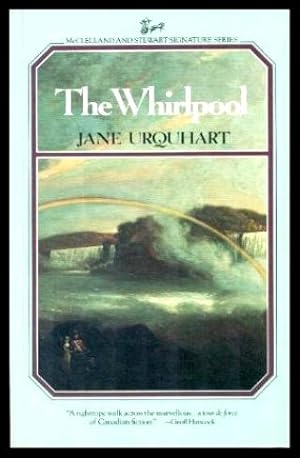
THE WHIRLPOOL
Language: English
Published by McClelland and Stewart, Toronto, 1986
ISBN 10: 0771086555 ISBN 13: 9780771086557
First Edition Signed
Soft cover. Condition: Very Good+. John Trumbull; (illustrator). First Printing - First Thus. 237 pp. Trade paperback format. Personalized inscription by Jane Urquhart on the title page. Light edge and corner wear with a flat uncreased spine; two holes from a staple in the front endpaper. The cover features a detail of Niagara Falls from Below the Great Cascade on the British Side, by John Trumball, circa 1809. Set in Niagara Falls in the summer of 1889, it is the season of reckless river stunts, a time when the undertaker's widow is busy with funerals, her days shadowed by her young son's curious silence. Across the street in Kick's Hotel, where Fleda and her husband, David McDougal, have temporary rooms, Fleda dreams of the place above the whirlpool where she first encountered the poet, a man who enters her life and, unwittingly, changes everything. As the summer progresses, the lives of these characters become entangled, and darker, more sinister currents gain momentum. Size: 8vo. Signed by Author(s). Book.
-

[AUTOGRAPH LETTER, SIGNED, TO ARTIST JOHN TRUMBULL FROM HIS DISTRIBUTOR, JOSEPH ANTHONY, REGARDING SALES FOR HIS PRINT OF The Sortie Made by the Garrison of Gibraltar].
Published by Philadelphia. May 9, 1803., 1803
Seller: William Reese Company, New York, NY, U.S.A.
Association Member: ABAA ESA ILAB SNEAB
Seller rating 5 out of 5 stars

Signed
An interesting letter written to John Trumbull, the "Painter of the Revolution," by his long-time friend and collaborator, Joseph Anthony. Anthony was a business owner in Philadelphia at the turn of the 19th century, and was the man largely responsible for collecting and remitting Trumbull's subscriptions as well as ultimately managing the delivery of the artist's prints to his customers. While little information about Anthony's life is available, he had considerable correspondence with foundational figures including George Washington, Thomas Jefferson, Timothy Pickering, and others regarding the sale of Trumbull's prints. The "Painter of the Revolution" didn't confine his artistic endeavors solely to North America. In this letter to Trumbull, who was then living in London after traveling there as secretary to John Jay during the Jay Treaty negotiations, Anthony acknowledges his receipt of the prints for The Sortie Made by the Garrison of Gibraltar, a 1789 painting commemorating an unsuccessful attempt by Spain to take control of that island while Britain was distracted with the Revolution. The European subject matter may not have proved as popular as Trumbull's other prints, however, as Anthony remarks that "the subscribers are very tardy in calling for their prints & I have sold very few, I have now in my hand about 300 Dollars which you are at liberty to draw for when you please." The rest of this brief letter deals with more personal matters, including an unidentified "Stewart" who was then impinging on Anthony's hospitality and the typical well wishes and remembrances. The letter is addressed to Trumbull on the fourth page, and docketed in Trumbull's hand, "Joseph Antony / Phila. May 9th, 1803 / Ans'd July 6th." Before becoming a painter, Trumbull fought in the Revolutionary War. He rose to the rank of colonel as a deputy adjutant-general, but he resigned the commission he finally received because it was dated three months late, a slight his honor could not tolerate. He refused to return to the law, finding it distasteful, and chose instead to pursue his true passion, art, against his family's wishes. Though he was never wealthy in this pursuit, he did achieve a certain amount of success in his own lifetime. An interesting and very well preserved piece of business involving one of America's most famous painters. [1]p. autograph letter, signed, on a folded folio sheet. Addressed for mailing on the fourth page, with two postmarks, and docketed in manuscript in Trumbull's hand. Old folds. Lightly tanned. Very good.
-
M'Fingal: A Modern Epic Poem, in Four Cantos
Publication Date: 1795
Seller: G.S. MacManus Co., ABAA, Bryn Mawr, PA, U.S.A.
Seller rating 5 out of 5 stars
Signed
TRUMBULL, John. M'Fingal: A Modern Epic Poem, in Four Cantos. Modern full polished calf, gilt-ruled spine, early red morocco spine label laid down, marbled endpapers, housed in custom cloth slipcase. New-York: Printed by John Buel, 1795. Evans 29659. BAL 20562. The first illustrated edition, containing portrait frontis and eight copper-engraved plates. Laid in is an accomplished warrant from the State of Connecticut, Hartford County, made out to :John Trumbull Esqr. State Attorney for Said County three pounds Sixteen Shillings" It is signed by Trumbull on the verso. John Trumbull (1750-1831) was a poet and lawyer, who gained fame as a poet while still an undergraduate at Yale. In 1773, Trumbull moved to Boston to continue his legal studies under John Adams, whose confidential friend he remained for years. "In the fall of 1775, at the suggestion of `some leading members of the first Congress,' Trumbull wrote the initial canto of M'Fingal. This was published early in 1776 with a 1775 imprint. After the war, he divided this part into two cantos and wrote two additional cantos. The whole work, containing approximately three thousand lines, was first published at Hartford in 1782. . The framework of the poem is a loosely unified narrative of the misfortunes of the Tory squire M'Fingal; but the poem virtually constitutes a comprehensive review of the blunders and cowardice of the British leaders throughout the Revolution. . [Trumbull] invested his poem with literary qualities which received their fullest recognition after the war, when, despite Puritan prejudice against satirical poetry, M'Fingal was accepted as an important contribution to belle-lettres. Its inexhaustible wit, its air of learning without pedantry, and its buoyant Hudibrastic couplets that fitted snugly in the memory made it a cherished possession of the American people in an era when good native poets were not plentiful. Reprinted more than thirty times between 1782 and 1840, it was the most popular American poem of its length before Longfellow's Evangeline"-DAB. Faint scattered foxing, else a very good or better copy with all plates. Signed.
-

LES ANTIQUITÉS D'HERCULANUM AVEC LEURS EXPLICATIONS EN FRANÇOIS.
Published by Paris: Chez David, 1780-1781., 1781
Seller: William Reese Company, New York, NY, U.S.A.
Association Member: ABAA ESA ILAB SNEAB
Seller rating 5 out of 5 stars
Signed
An absolutely phenomenal association copy of this influential study of the antiquities of the Italian city of Herculaneum, destroyed during an explosion of Mount Vesuvius in 79 A.D. This set of Les Antiquités D'Herculanum. was given by Thomas Jefferson to his young protégé, painter John Trumbull. Jefferson has inscribed it on the front fly leaf of the first volume: "Th. J. begs Mr. Trumbull will do him the favor to accept this copy of the Herculaneum." Jefferson was instrumental in furthering Trumbull's career at an early stage and in encouraging him to create his painting of the presentation of the Declaration of Independence. That painting is one of Trumbull's most important and iconic works, and in placing Jefferson at the center of that scene Trumbull helped to cement the Jefferson image in the American mind. Jefferson and Trumbull first met in London in early 1786, when Trumbull was thirty and Jefferson thirteen years his elder. At the time Trumbull was studying painting under Benjamin West, but was planning to visit Paris to study the artworks available there. Jefferson invited Trumbull to stay with him at his Paris residence, the Hotel de Langeac, and the two quickly became close. In fact, Trumbull joined William S. Smith and Jefferson's secretary, William Short, in the small group of people that Jefferson asked to perform tasks or "commissions" for him. Trumbull lived with Jefferson for five or six weeks at the Hotel de Langeac, and Jefferson encouraged Trumbull in his early historical paintings. Trumbull had brought with him to Paris two of his recent historical paintings, "Death of General Warren at Bunker's Hill" and "Death of General Montgomery at Quebec," which he wanted to have engraved. It was almost certainly at Jefferson's suggestion and encouragement that Trumbull added the Declaration of Independence to his series of American historical paintings. With Jefferson's assistance and recollection of the event, Trumbull began his painting of the signing of the Declaration of Independence. It was Trumbull's placing of Jefferson at the center of his painting, flanked by John Adams and Benjamin Franklin, that helped cement the centrality of Jefferson's role as author of the Declaration in the public consciousness. Merrill Peterson asserts: "In the panegyrics of the Fourth of July.the popularity of Trumbull's masterpiece of historical portraiture, 'The Signing of the Declaration' - Jefferson's authorship of the American birthright was his certain title to immortality." Jefferson espoused Trumbull's talents and introduced him to important people in Paris, and Trumbull repaid the favor in consequential ways. Jefferson's biographer, Dumas Malone, writes: "Jefferson was on the most intimate terms with Trumbull until the very end of his stay in France, and he always associated him in memory with what he called 'our charming coterie in Paris.'" That coterie included Maria Cosway, the beautiful and vivacious young wife of English portraitist Richard Cosway. Trumbull had already met the Cosways and introduced them to Jefferson in Paris in August 1786 at the Halle aux Bleds marketplace. The widowed Jefferson became enraptured with Maria Cosway and spent a great deal of time with her between August and October 1786. Trumbull was often with the pair, touring art galleries, attending concerts, walking around Paris and journeying into the countryside. On Oct. 12, 1786, on the occasion of the Cosways return to England, Jefferson wrote Maria Cosway an anguished letter in which he related a debate between "my head and my heart." It was to Trumbull that Jefferson entrusted the delivery of this confidential and revealing letter. Trumbull was also an intermediary for Jefferson's friendship with Angelica Schuyler Church, Alexander Hamilton's sister-in-law. Mrs. Church and Maria Cosway were good friends, referring to each other as "sisters." Jefferson, in fact, helped Mrs. Church secure a volume of the Herculanum in September 1788 (see Jefferson letter of Sept. 21, 1788, in Papers of Thomas Jefferson, Vol. 13, pp.623-24). It is possible the gift of this set to Trumbull took place at the same time. The friendship between Jefferson and Trumbull continued after Trumbull left Paris for London and the United States. In 1788, Jefferson commissioned from Trumbull a canvas containing life-size busts of Francis Bacon, John Locke, and Isaac Newton, whom Jefferson considered as "the three greatest men that have ever lived." Also in 1788, Trumbull painted a portrait of Jefferson, and would later make copies of that portrait for Maria Cosway, Angelica Church, and Jefferson's eldest daughter, Martha. In 1789, anticipating that William Short was about to move on to other endeavors, Jefferson offered John Trumbull the position of his personal secretary, an offer that Trumbull declined. Sometime after that Jefferson recommended Trumbull for the position of American Minister to the Barbary states, a post that Trumbull also declined. In 1793, Jefferson and Trumbull (a Federalist and a New England Congregationalist) had a falling out over questions of politics and religious faith, issues that came to a head at a dinner Jefferson hosted that also included the Virginia politician, William Branch Giles. Trumbull and Giles already had bad blood between them, and when Jefferson seemingly took Giles' side, Trumbull recalled that "from this time my acquaintance with Mr. Jefferson became cold and distant." Jefferson's gift to Trumbull of this set of Maréchal's Les Antiquités D'Herculanum is significant on several levels. Excavations at Herculaneum, destroyed by an eruption of Mount Vesuvius in 79 A.D., had begun in 1738. The publication of illustrated books such as those of Maréchal, showing the antiquities preserved and discovered at Herculaneum, had an important effect on the growing popularity of Neoclassical styles and themes in contemporary European and American art. Jefferson himself owned a set of Maréchal's work (altho.

