

Order Total (1 Item Items):
Shipping Destination:

Vajda E a (10 results)
Author:
vajda e a
Refine with Advanced Search
Skip to main search results
Search filters
Product Type
- All Product Types
- Books (10)
- Magazines & Periodicals (No further results match this refinement)
- Comics (No further results match this refinement)
- Sheet Music (No further results match this refinement)
- Art, Prints & Posters (No further results match this refinement)
- Photographs (No further results match this refinement)
- Maps (No further results match this refinement)
- Manuscripts & Paper Collectibles (No further results match this refinement)
Condition Learn more
Binding
- All Bindings
- Hardcover (No further results match this refinement)
- Softcover (8)
Collectible Attributes
- First Edition (1)
- Signed (No further results match this refinement)
- Dust Jacket (No further results match this refinement)
- Seller-Supplied Images (3)
- Not Print on Demand (10)
Language (2)
Free Shipping
Seller Location
Seller Rating
-

United States Naval History: A Bibliography (Naval History Bibliographies)
Language: English
Published by Naval Historical Center, 1993
ISBN 10: 0945274122 ISBN 13: 9780945274124
paperback. Condition: Very Good. Connecting readers with great books since 1972! Used books may not include companion materials, and may have some shelf wear or limited writing. We ship orders daily and Customer Service is our top priority!
-
United States Naval History: A Bibliography (Naval History Bibliographies)
Language: English
Published by Naval Historical Center, 1993
ISBN 10: 0945274122 ISBN 13: 9780945274124
Soft cover. Condition: Near Fine. 5th or later Edition. 7th Edition, Blue Cover.
-
United States Naval History A Bibliography
Language: English
Published by Naval Historical Center, Washington, 1993
ISBN 10: 0945274122 ISBN 13: 9780945274124
Seller: Dale A. Sorenson, Silver Spring, MD, U.S.A.
Association Member: IOBA
Seller rating 5 out of 5 stars

Softcover. Condition: Near Fine. Seventh Edition. Seventh Edition. Revised by Barbara A. Lynch and John E. Vajda. Washington: Naval Historical Center Dept. of Navy, 1993. 8vo. 173pp, Index. Softcover, near fine condition. Naval History Bibliographies, No. I. ISBN 0945274122; Naval History Bibliographies; 8vo 8" - 9" tall; 173 pages.
-
United States Naval History: A Bibliography
Language: English
Published by Naval Historical Center, Washington, DC, 1993
ISBN 10: 0945274122 ISBN 13: 9780945274124
Seller: Ground Zero Books, Ltd., Silver Spring, MD, U.S.A.
Seller rating 5 out of 5 stars
Condition: very good. Seventh Edition. 173, wraps, frontis illus., index, slight wear and soiling to covers. Naval History Bibliographies, No. 1.
-

Focus on epilepsy : proceedings of workshop held at the Austin Hospital, John Lindell Lecture Theatre Melbourne, Australia, November, 1987.
Published by Department of Neurology, The Austin Hospital, Abbotsford, 1987
Seller: Lost and Found Books, Healesville, VIC, Australia
Seller rating 5 out of 5 stars
soft cover. Condition: Very Good. No Jacket. 21 cm. 222 pages VG. Very good condition with light shelf wear to covers, owner stamp on flyleaf and reverse of last page.
-

Grey areas in epilepsy : proceedings of workshop held at the Austin Hospital, Melbourne, Australia, 22nd and 23rd November, 1985.
Published by Department of Neurology, The Austin Hospital, Abbotsford, 1985
Seller: Lost and Found Books, Healesville, VIC, Australia
Seller rating 5 out of 5 stars
soft cover. Condition: Very Good. No Jacket. 20.5 cm. 159 pages VG. Very good condition with light shelf wear to covers, owner stamp on flyleaf and reverse of last page.
-
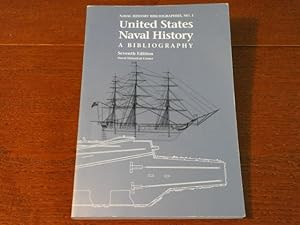
United States Naval History. A Bibliography.
Published by Washington (Naval Historical Center), 1993., 1993
Seller: Antiquariat Bebuquin (Alexander Zimmeck), Pegau OT Werben, Germany
Seller rating 4 out of 5 stars

7. Auflk. 173 S. mit Frontispiz. ill. OKart. Ordnungsgemäß aus Bundeswehrbeständen ausgesondertes Bibliotheksexemplar (Stempel). = Naval History Bibliographies, No 1. EA. Sprache: englisch.
-
United States Naval History: A Bibliography (Naval History Bibliographies)
Language: English
Published by Naval Historical Center, 1993
ISBN 10: 0945274122 ISBN 13: 9780945274124
Paperback. Condition: New. Seventh Edition, Blue cover. ~ New inside and Out! Clean & Crisp Pages. (Email for more info/pics).
-

United States Naval History; A Bibliography
Published by Department of the Navy, Naval Historical Center, Washington DC, 1993
Seller: Ground Zero Books, Ltd., Silver Spring, MD, U.S.A.
Seller rating 5 out of 5 stars
First Edition
Trade paperback. Condition: Very good. John Charles Roach (illustrator). Illustrated covers. Frontis illustration. viii, 173, [1] pages. This is Naval History Bibliographies, No. 1. This includes a Foreword. General Works, Chronologies, Pictorial Histories and Naval History by Period (15 major periods listed), Organizational Histories, Special Subjects (17 headings listed), Coast Guard, Biographies, Memoirs, Biographical Lists and Registers, Periodicals, Bibliographies and Research Aids, and an Index of Authors, Compilers, and Editors. Barbara Lynch was a staff member at the Naval History Division. John E. Vajda was an assistant librarian at the Navy Department Library in the Dudley Knox Center for Naval History. The illustrator, John Charles Roach, was a Navy artist whose training began with three years of study in Paris at the National Academy of Fine Arts and culminated in a Master's Degree from the American University. He served in Vietnam and the 7th Fleet as an official Navy Artist to document naval activities in-country and offshore. On active duty in the Naval Reserve he has completed artist assignments depicting the submarine force of the 1980s, Desert Shield and Storm, and Bosnia-Herzegovina. Among his private commissions, he designed and sculpted elements of the Navy Memorial in Washington, DC and completed a mural for USS Arizona Visitors Center in Honolulu, Hawaii. The history of the United States Navy divides into two major periods: the "Old Navy", a small but respected force of sailing ships that was notable for innovation in the use of ironclads during the American Civil War, and the "New Navy", the result of a modernization effort that began in the 1880s and made it the largest in the world by 1945. The United States Navy claims October 13, 1775 as the date of its official establishment, when the Second Continental Congress passed a resolution creating the Continental Navy. With the end of the American Revolutionary War, the Continental Navy was disbanded. Under first President George Washington, threats to American merchant shipping by Barbary pirates from four North African Muslim States in the Mediterranean led to the Naval Act of 1794, which created a permanent standing U.S. Navy. The original six frigates were authorized as part of the Act. Over the next 20 years, the Navy fought the French Republic Navy in the Quasi-War (1798-99), Barbary states in the First and Second Barbary Wars, and the British in the War of 1812. After the War of 1812, the U.S. Navy was at peace until the Mexican-American War in 1846, and served to combat piracy in the Mediterranean and Caribbean seas, as well as fighting the slave trade off the coast of West Africa. In 1845, the Naval Academy was founded at old Fort Severn at Annapolis, Maryland by the Chesapeake Bay. In 1861, the American Civil War began and the U.S. Navy fought the small Confederate States Navy with both sailing ships and new revolutionary ironclad ships while forming a blockade that shut down the Confederacy's civilian coastal shipping. After the Civil War, most of its ships were laid up in reserve, and by 1878, the Navy was just 6,000 men. In 1882, the U.S. Navy consisted of many outdated ship designs. Over the next decade, Congress approved building multiple modern steel-hulled armored cruisers and battleships, and by around the start of the 20th century had moved from twelfth place in 1870 to fifth place in terms of numbers of ships. Most sailors were foreigners. After winning two major battles during the 1898 Spanish-American War, the American Navy continued to build more ships, and by the end of World War I had more men and women in uniform than the British Royal Navy. The Washington Naval Conference of 1921 recognized the Navy as equal in capital ship size to the Royal Navy, and during the 1920s and 1930s, the Navy built several aircraft carriers and battleships. The Navy was drawn into World War II after the Japanese Attack on Pearl Harbor on December 7, 1941, and over the next four years fought many historic battles including.
-
UNITED STATES NAVAL HISTORY. A bibliography.
Published by Naval Historical Center Department of the Navy, Washington, 1993
Seller: studio bibliografico pera s.a.s., LUCCA, LU, Italy
Seller rating 5 out of 5 stars
Brossura. Condition: discrete. 7^ed. Testo inglese. Prefazione di D.C.Allard. 8°,pg.8,172. Collezione "Naval History Bibliographies", n°1. 318 gr.


