

Order Total (1 Item Items):
Shipping Destination:

Walker Burnham S (4 results)
Skip to main search results
Search filters
Product Type
- All Product Types
- Books (4)
- Magazines & Periodicals (No further results match this refinement)
- Comics (No further results match this refinement)
- Sheet Music (No further results match this refinement)
- Art, Prints & Posters (No further results match this refinement)
- Photographs (No further results match this refinement)
- Maps (No further results match this refinement)
- Manuscripts & Paper Collectibles (No further results match this refinement)
Condition Learn more
- New (No further results match this refinement)
- As New, Fine or Near Fine (1)
- Very Good or Good (1)
- Fair or Poor (1)
- As Described (1)
Binding
- All Bindings
- Hardcover (3)
- Softcover (No further results match this refinement)
Collectible Attributes
- First Edition (3)
- Signed (2)
- Dust Jacket (No further results match this refinement)
- Seller-Supplied Images (2)
- Not Print on Demand (4)
Language (1)
Price
- Any Price
- Under US$ 25 (No further results match this refinement)
- US$ 25 to US$ 50 (No further results match this refinement)
- Over US$ 50
Free Shipping
Seller Location
Seller Rating
-

Hardcover. Condition: Fair. No Jacket. Missing dust jacket; Readable copy. Pages may have considerable notes/highlighting. ~ ThriftBooks: Read More, Spend Less.
-
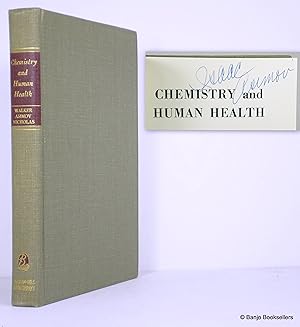
Chemistry and Human Health
Published by McGraw-Hill Blakiston Division, New York, 1956
Seller: Banjo Booksellers, IOBA, Andover, MA, U.S.A.
Association Member: IOBA
Seller rating 5 out of 5 stars

First Edition Signed
Hardcover. Condition: Fine. No Jacket. First Edition. Sixth printing. Signed by Asimov on the title page. 445 pp including index. A fine, unmarked copy in a square, tight binding. Size: 8vo - over 7¾" - 9¾" tall. Signed by Author(s).
-
Chemistry and Human Health (Signed and inscribed and dated by Isaac Asimov)
Published by The Blakiston Division / McGraw-Hill Book Company, New York, 1956
Seller: Brainerd Phillipson Rare Books, Holliston, MA, U.S.A.
Association Member: SNEAB
Seller rating 5 out of 5 stars
First Edition Signed
Hardcover. Sturdily bound in heavy gray linen cloth stamped brightly in red and gilt on the spine. Very clean and tight throughout and like any good textbook there are several pages of close underlining. with the exception of several pages of in the middle of the volume. This copy is inscribed by Asimov: "To David G. With all best wishes/ Isaac Asimov/ 8 Jan. 82" on the title page. Uncommon signed. Isaac Asimov(1920 1992) was an American writer and professor ofbiochemistryatBoston University. He was known for his works ofscience fictionandpopular science. Asimov was a prolific writer, and wrote or edited more than 500 books. He also wrote an estimated 90,000 letters andpostcards.[c]Asimov wrotehard science fiction. Along withRobert A. HeinleinandArthur C. Clarke, Asimov was considered one of the "Big Three" science fiction writers during his lifetime.[2]Asimov's most famous work is theFoundationseries,[3]the first three books of which won the one-timeHugo Awardfor "Best All-Time Series" in 1966.[4]His other major series are theGalactic Empireseries and theRobotseries. The Galactic Empire novels are set in the much earlier history of the same fictional universe as the Foundation series. Later, withFoundation and Earth(1986), he linked this distant future to the Robot stories, creating a unified "future history" for his stories much like those pioneered by Robert A. Heinlein and previously produced byCordwainer SmithandPoul Anderson.[5]He also wroteover 380short stories, including thesocial science fictionnovelette "Nightfall," which in 1964 was voted the best short science fiction story of all time by theScience Fiction Writers of America. Asimov wrote theLucky Starrseriesofjuvenilescience-fiction novels using the pen name Paul French.[6]Asimov also wrotemysteriesandfantasy, as well as much nonfiction. Most of his popular science books explain concepts in a historical way, going as far back as possible to a time when the science in question was at its simplest stage. Examples includeGuide to Science, the three-volume setUnderstanding Physics, andAsimov's Chronology of Science and Discovery. He wrote on numerous other scientific and non-scientific topics, such aschemistry,astronomy,mathematics,history, biblicalexegesis, andliterary criticism.He was president of theAmerican Humanist Association.[7]Several entities have been named in his honor, including theasteroid(5020) Asimov,[8]acrateron the planetMars,[9][10]aBrooklynelementary school,[11]Honda's humanoid robot,ASIMO,[12]andfour literary awards. (Wikipedia) First Edition with matching dates of 1956 on the title and copyright pages; no subsequent printings listed. 1st Edition with matching dates of 1956 on the title and copyright pages.
-
Biochemistry and human metabolism
Published by The Williams & Wilkins Co, Baltimore
Seller: Wonder Book, Frederick, MD, U.S.A.
Seller rating 5 out of 5 stars
First Edition
Condition: Good. Baltimore, MD: The Williams & Wilkins Co, 1952. 1st edition. 8vo. viii,812pp. Illus. Good book. Owner's name on pastedown. (biochemistry, metabolism, Isaac Asimov) Inquire if you need further information.


