
Weidner Fredrick (2 results)

Published by Fredrick G. Weidner 1918
- Softcover
- Map
Seller: Barry Lawrence Ruderman, La Jolla, CA, U.S.A.Barry Lawrence Ruderman
Contact seller5-star sellerCondition: Used - Very good
US$ 1,100.00
US$ 14.50 shippingShips within U.S.A.Quantity: 1 available
No Binding. Condition: vg. Documenting the End of WWI and California's Mask Mandate of 1918 During the Spanish FluFascinating photo of a large crowd gathered in front of the Fairmount Hotel in Pittsburg, California, celebrating the end of World Wa. One moderate crease or crack through the center of the image. Documenting the End… of WWI and California's Mask Mandate of 1918 During the Spanish FluFascinating photo of a large crowd gathered in front of the Fairmount Hotel in Pittsburg, California, celebrating the end of World War I.Noteworthy within the crown are the dozens of people wearing masks, at the peak of the second wave of the Spanish Flu Pandemic of 1918-1920. This documents a fascinating moment in American public health history, with the photo being taken 7 days before the City of San Francisco passed a mask mandate to fight the spread of the Spanish Flu.The Spanish Flu, a devastating H1N1 influenza pandemic, struck the United States between 1918 and 1919. This deadly outbreak first emerged in military personnel in the U.S. during the spring of 1918, with the earliest reported cases in March at Camp Funston in Fort Riley, Kansas. The pandemic unfolded in three critical waves, each with its distinct characteristics and impact.Public health measures like mask mandates and school closures were implemented in many areas, including California. At the height of the second waive, on October 25, 1918, San Francisco passed an ordinance requiring everyone in the city to wear a mask while in public or when in a group of two or more people, except at mealtime. This was a part of the city's broader efforts to control the disease, which also included banning gatherings, closing schools and theaters, and urging citizens to avoid crowds. The initial compliance with the mask ordinance was high, estimated at around 80% of the public wearing masks.However, the mask ordinance was annulled on November 21, 1918. But as cases began to surge again, a new mask mandate took effect on January 17, 1919. This second mandate faced much more resistance, leading to the formation of the "Anti-Mask League" in San Francisco. This league, which included some physicians and a member of the Board of Supervisors, was a significant source of opposition to the mask mandate. The league held a public meeting with over 2,000 attendees on January 25, 1919, and on January 27, presented a petition to the city's Board of Supervisors, requesting the repeal of the mask ordinance. San Francisco eventually lifted the mask requirement on February 1, 1919, following the recommendation of the Board of Health. In Seattle, during the influenza s lockdown period in October and November of 1918, people without masks were banned from public transit and ticketed or fined by the police's Flu Squad." In Walla Walla, Washington, the chief of police openly defied the state mask mandate and refused to enforce it. Yakima, Washington, on the other hand, was less reluctant to enforce the mandate, particularly among merchants .In Oakland, Mayor Davie was jailed for not wearing a mask in Sacramento, reflecting the seriousness with which some regions enforced these mandates. The efficacy of masks during the 1918 pandemic was a subject of debate among health officials. Some believed that masks, particularly if not used properly, were minimally effective, while others advocated their use as part of a layered public health strategy . Map.
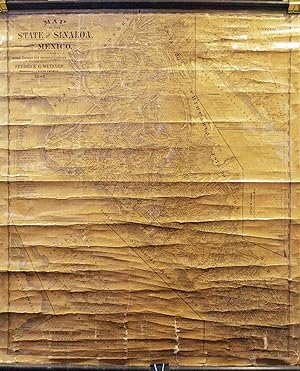
Published by San Francisco, San Francisco 1882
Seller: High Ridge Books, Inc. - ABAA, South Deerfield, MA, U.S.A.High Ridge Books, Inc. - ABAA
Contact seller5-star sellerWall map in good to very good condition, with original rods, varnish and linen backing. Somewhat limp near the top. Vertical cracks near bottom with some loss from chipping along those cracks with one larger chip at the extreme southeast of the map. Two large inset maps, "Ethongraphic-Linguistic Map of Sinaloa," documenting 9 "L…Iving Languages of Sinaloa." at the top right and "First Sketch of a Geological Map of Sinaloa" at the bottom right. There is a third inset "Profile of Sinaloa, following the road from Mazatlan to Durango" along the right side. Some copies of this map were issued with a 19-page pamphlet, Map of Sinaloa with Statistical and Geological Notes, but other copies, including this one, were issued separately. Fredrick Weidner was a civil and mining engineer who was working in Mexico as early as the mid-1860s. In testimony of David J. Garth, given to the US Senate Committee on Foreign Reiations on October 2, 1888, Garth reported that Weidner was a German metallurgis and mining enginer.

