
William Jackson Hooker: Signed (9 results)

Published by Privately Published,, Glasgow, 1837
- Hardcover
- First Edition
- Signed
Seller: Burwood Books, Wickham Market, United KingdomBurwood Books
Contact seller5-star sellerCondition: Used - Very good
US$ 233.47
US$ 30.00 shippingShips from United Kingdom to U.S.A.Quantity: 1 available
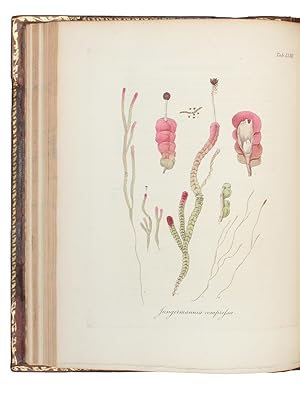
Add to basketCondition: Very Good. First Edition. Hardback. 4to. pp 52. Printed by Richardson and Hutchison in Glasgow and denoted on the title page 'unpublished.' Errata slip at table 15 ('Inflorescence.') Produced by Hooker as a teaching aid to show the plant to students ather than have to provide the real thing. Signed presentation from W… J Hooker - 'To his young botanical friend Miss Bickersteth. The Author.' Miss Bickersteth is proabbly 'the Honourable Miss Bickersteth' mentioned in the Botanical Gazette of 1850 (Dec) in connection with the finding of a new species of fern.Wkisource notes 'In 1837 a thin quarto volume of Botanical Illustrations was produced, "being a series of above a thousand figures, selected from the best sources, designed to explain the terms employed in a course of Lectures on Botany." The plates were executed by Walter Fitch, who was originally a pattern-drawer in a calico-printing establishment, and entered the service of Sir William in 1834. This great botanical artist continued to assist Sir William till the death of the latter, and himself died at Kew in 1892. A number of copies of this early work of Fitch remain to the present day in the Botanical Department in Glasgow.' There are 26 plates/ tables (the copy at Cambridge University has 25 plates) each with multiple small b/w drawings of plants, seemingly less than a 1000 in total, more like 700. Soundly boiund in recent half green leather lettered gilt at the spine with marbled boards. Some slight foxing to title page and first few and last few plates. Attractive binding. Very good. Signedes.
 More images
Published by Anon 1818-20, London 1818
- Hardcover
- First Edition
- Signed
Seller: Rooke Books PBFA, Bath, United KingdomRooke Books PBFA
Contact seller5-star sellerCondition: Used - Very good
US$ 3,570.78
US$ 26.65 shippingShips from United Kingdom to U.S.A.Quantity: 1 available
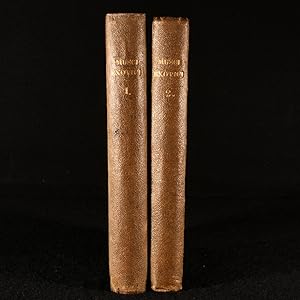
Add to basketLeather. Condition: Very Good. First edition. A very scarce signed first edition of this work on mosses by William Jackson Hooker. Signed, with a gift inscription from the author to the half-titles of both volumes 'To Dr Knight with the Author's Best Compliments'. Ownership inscriptions to the front endpaper and pastedown of Ala…n Burges, Botany School, Sydney and E H Linton.Illustrated, with 176 engraved plates total. Being 96 plates to volume I and 80 plates to volume II.Collated, complete.In the publisher's original cloth binding. With the errata to the final leaf.These illustrated plates are accompanied by unpaginated text.Loosely inserted are some specimens of mosses collected by a former owner. They have pasted the specimens to a single leaf card and numbered them.William Jackson Hooker was a celebrated author of botanical works. He published over 20 major botanical studies over a period of fifty years including 'Genera Filicum', 'Flora Scotia' and 'Species Filicum'.A bright example of one of Hooker's scarcer works. In the publisher's original cloth binding. Volume I has been rebacked preserving the original spine. Externally, generally smart with minor shelf wear. Internally, both volumes are firmly bound. Pages are bright. Inscriptions to the endpapers, and author's inscription to the half-titles. Several leaves remain untrimmed. Occasional scattered spotting, heavier to the edges of the plates. Minor damp stains to the plate edges in the final quarter of volume II, not affecting the overall image. Very Good. None (illustrator). signed by author. book.

Published by Glasgow 1828
- Softcover
- Signed
Seller: Jeremy Norman's historyofscience, Novato, U.S.A.Jeremy Norman's historyofscience
Contact seller4-star sellerHooker, William Jackson (1785-1865). Autograph letter signed to Richard Taylor (1781-1858). 1p. plus address leaf. Glasgow, Dec. 26, 1828. 206 x 128 mm. Some soiling, a few small marginal tears, but good to very good. From botanist William J. Hooker, the first full-time director of the Royal Botanic Gardens at Kew and author of…over two dozen works on botany, to printer and publisher Richard Taylor, editor of the Philosophical Magazine and founder of the firm of Taylor and Francis. Hooker was appointed head of the Royal Botanic Gardens in 1841; under his leadership Kew grew from eleven acres to its present size of nearly 300 acres, and its collections vastly increased, largely due to a network of Hooker's former students who brought in specimens from around the world. At the time of this letter, Hooker was regius professor of botany at the University of Glasgow, a position he held from 1820 until his appointment to Kew Gardens two decades later. During this time Hooker published a number of important botanical works, two of which are mentioned in our letter: "I send you the continuation of Bot. Miscellany & will thank you to let me have a proof sheet, or two if you can, sent to me as soon as possible by Mr. Plante. "The rest shall follow in a government pouch, along with some more of Icones Filicum. "The paging will be carried on from No. 1." "Bot. Miscellany" refers to Botanical Miscellany, an illustrated botany magazine edited by Hooker that was issued in three volumes between 1830 and 1833. Also mentioned in this letter is Hooker's Icones Filicum, a two-volume illustrated work on ferns co-authored with R. K. Greville and published between 1829 and 1831. .

Published by London 1860
- Signed
Seller: Jeremy Norman's historyofscience, Novato, U.S.A.Jeremy Norman's historyofscience
Contact seller4-star sellerHooker, William Jackson (1785-1865). Autograph letter signed in the third person to "Miss Smith." Kew Gardens, July 26, 1860. 2pp. plus integral blank. 184 x 114 mm. Traces of mounting and mounting removal on verso of blank leaf, but very good otherwise. From botanist William J. Hooker, the first full-time director of the Royal…Botanic Gardens at Kew and author of over two dozen works on botany. Hooker was appointed head of the Royal Botanic Gardens in 1841; under his leadership Kew grew from eleven acres to its present size of nearly 300 acres, and its collections vastly increased, largely due to a network of Hooker's former students who brought in specimens from around the world. In this letter, written in his capacity as director of the Royal Botanic Gardens, Hooker refuses "Miss Smith's" request for plant specimens: "Sir Wm. Hooker presents his compliments to Miss Smith, & begs to assure her that it is quite impossible to meet the views & wishes & applications for plants, of Amateur Botanists. All would instantly come to Kew for their supply:-& it is the less needful, seeing that the plants enumerated in the enclosed list are provided by Nurserymen, & their stock increased, for the express purpose of supplying the public with what they need." .
 More images
- Hardcover
- First Edition
- Signed
Seller: Herman H. J. Lynge & Søn ILAB-ABF, Copenhagen, DenmarkHerman H. J. Lynge & Søn ILAB-ABF
Contact seller4-star sellerCondition: Used
US$ 8,737.97
Free ShippingShips from Denmark to U.S.A.Quantity: 1 available
Add to basketLondon, Longman, Hurst, Rees, Orme, and Brown, (1812-) 1816 4to. Bound in a fine contemp. full calf with broad rectangular gilt borders on covers. Inner gilt borders. Professionally re-backed to style and spine richly gilt. Fine repairs along edges and to corners. Engraved frontispiece-portrait of Hooker. (28) incl.htitle,20 pp.…, (2) pp. of Index. Unnumbered leaves with descriptions to each plate. Complete with 88 fine hand-coloured engraved plates (Numb. I-LXXXIV and Supplementplates I-IV (bound first). Portrait with some brownspots, some offsetting from portrait to title. Inner margins of portrait and title-page with 2 larger brownspots, not reaching the text or the engraving. Otherwise a fine clean copy with broad margins, printed on good paper. Exquisite handcolouring. Interesting presentation-copy of the scarce first edition of Hooker's first botanical work, which is not only considered his most beautiful, but which is also the work that established hepaticology (the science of liverworts) as an independent entity and cemented Hooker's reputation. Presented on half-title: "To Francis Boott, Esq./ of Boston, N. America,/ as a testimony of the affectionate/ regard & esteem of/ The Author/ Halesworth Aug. 5.th 1818." Underneath the dedication in Francis Boott's hand: "Mr. Hooker in a letter to me from Halesworth of Aug 5. - says of this copy - "It will serve as a specimen of Country binding, printing and engraving - every thing in short belonging to it being executed in this neighbourhood."/ signed "F.B.". When Hooker returned from his botanical excursions, first to Iceland, then to France, Switzerland and Northern Italy, he devoted himself to the formation of his "Herbarium", which became of worldwide renown among botanists. In 1841 he was appointed director of the Royal Botanical Garden at Kew, where he founded the first museum of economic botany."Hooker spent twelve years at Halesworth, during which he produced his British Jungermanniae, with his own illustrations, widely considered to be his most beautiful work. This book established hepaticology as an independent entity and made Hooker's reputation." (Mea Allan in DSB).Francis Boott (1792-1863), to whom this copy was given, was a friend of Hooker. He had studied botany in America and medicine in London, where he practiced medicine and also gave lectures in botany, - he was also secretary to the Linnean Society. Pritzel: 4208 - BMC(NH) II.870 - Nissen: 916 - Staffleu & Covan: No 2987.

Published by London
- Signed
Seller: Jeremy Norman's historyofscience, Novato, U.S.A.Jeremy Norman's historyofscience
Contact seller4-star sellerHooker, William Jackson (1785-1865). Autograph letter signed to an unidentified correspondent. [London,] Royal Gardens, Kew, April 3, n.d. (probably 1857 or after). 3pp. 179 x 112 mm. Fine apart from a little faint spotting. Hooker, the first full-time director of the Royal Botanic Gardens at Kew, devoted himself to the study of… botany from an early age, specializing in mosses, liverworts and other cryptogamia. He served as regius professor of botany at the University of Glasgow from 1820 to 1841, when he was appointed to head Kew Gardens. Under Hooker's leadership Kew grew from eleven acres to its present size of nearly 300 acres, and its collections vastly increased, largely due to a network of Hooker's former students who brought in specimens from around the world. Hooker's own herbarium, which contained some 4000 volumes and one million dried plant specimens, was purchased by the British government for the nation after Hooker's death. Hooker was the author of over two dozen works on botany, including British Jungermanniae (1816), which established hepaticology (the study of liverworts) as a separate field; he also edited several botanical journals. The first part of Hooker's letter deals with the preparation of a forthcoming botanical publication, most likely The Museum of Economic Botany, or a Popular Guide to the Useful and Remarkable Vegetable Products in the Two Museum Buildings of the Royal Gardens of Kew (1858): "I have received & read & made 2 or 3 verbal corrections & transmitted as you desired to Mr. Wyatt (I presume at the Palace of Westminster) our Cat[alogue]. Having been unavoidably absent of late I know not what has been done by our Committee. If the present Catalogue is circulated by itself I think it requires a heading or title for not one word appears of the use & object of it: so that no one could comprehend the object of it. The asterisks before any name I understood were to indicate that specimens of the plant itself are required as well as the product. . . . I find asterisks against Chinese Tea, & Coffee & Theobroma Cacao:--but they must surely have a different meaning there, for one cannot desire them so against Salvadora Persica [the "toothbrush tree"] &c. &c. . . ." The next part of Hooker's letter touches on the work of Brian Houghton Hodgson (1800-1894), a naturalist and one of the pioneers of scientific ethnology. Hodgson spent much of his life in India, where he discovered 39 species of mammals and 124 species of birds that had hitherto been undescribed. He was the author of numerous books and papers, including Papers Relative to the Colonization, Commerce, Physical Geography, &c., &c. of the Himalaya Mountains and Nepal, published in Calcutta in 1857. He was a close friend of Hooker's son, the naturalist Joseph Dalton Hooker (1817-1911). "What an interesting acct. of the Physical Geography of the Himalayas Hodgson has published. You know Hodgson is preparing a capital Physico-geographical work on India written by Bagham[?]. He wishes a publisher. Do you think [.] Allen & Co. would be the men if I were to put the mst. into their hands?" "Allen & Co." most likely refers to the publisher W. H. Allen & Co., which issued a large number of books relating to India in the 1850s. .

Published by London 1848
- Signed
Seller: Jeremy Norman's historyofscience, Novato, U.S.A.Jeremy Norman's historyofscience
Contact seller4-star sellerHooker, William Jackson (1785-1865). Autograph letter signed to an unidentified correspondent. [London,] Royal Gardens, Kew, Nov. 16, 1848. 2-1/2pp. 178 x 112 mm. Fine. Hooker, the first full-time director of the Royal Botanic Gardens at Kew, devoted himself to the study of botany from an early age, specializing in mosses, liver…worts and other cryptogamia. He served as regius professor of botany at the University of Glasgow from 1820 to 1841, when he was appointed to head Kew Gardens. Under Hooker's leadership Kew grew from eleven acres to its present size of nearly 300 acres, and its collections vastly increased, largely due to a network of Hooker's former students who brought in specimens from around the world. Hooker's own herbarium, which contained some 4000 volumes and one million dried plant specimens, was purchased by the British government for the nation after Hooker's death. Hooker was the author of over two dozen works on botany, including British Jungermanniae (1816), which established hepaticology (the study of liverworts) as a separate field; he also edited several botanical journals. In his letter Hooker thanks his correspondent for sending him plant specimens from India: "The two cases of Plants for Dr. Falconer were delivered in good time. I have now to thank you for a parcel received today from Mr. Dalzell, Bombay, containing some very interesting Plants. "Truly I have much more novelty from the East of India than any other portion of that vast territory." "Dr. Falconer" refers to Hugh Falconer (1808-65), the distinguished botanist, geologist and paleontologist who was the first to come up with a "punctuated equilibrium" theory of evolution. Falconer spent many years in India, where he ran the Saharanpur and Calcutta botanical gardens and put together an enormous collection of plant and fossil specimens from the region. Hooker also touches on the activities of his son, naturalist Joseph Dalton Hooker (1817-1911): "You know, I dare say that Kinchinjunga [i.e., Kangchenjunga, in the Himalayas5] is now ascertained to be the highest mountain in the world, 28,172 ft.-about 60 miles north of Darjeeling. Dr. Hooker is now gone to explore it, as much as he can." Joseph Hooker spent three years (1848-50) exploring the Himalayas, and was the first European to collect plants from the region. Kangchenjunga, which straddles the border between India and Nepal, was believed to be the world's tallest mountain until 1852, when the results of the British Great Trigonometric Survey revealed that Mt. Everest was the taller peak. .
Language: French
- Signed
Seller: Librairie Rouchaleou, Saint-André-de-Sangonis, FranceLibrairie Rouchaleou
Contact seller5-star sellerCondition: Used - Fine
US$ 71.25
US$ 62.25 shippingShips from France to U.S.A.Quantity: 1 available
Add to basketPas de couverture. Condition: Très bon. Un billet manuscrit de 1 page en langue anglaise par William Hooker, datée: Dec. 20 1850, adressée à : '' Sir Conan Rogers? '', non signé. Feuillet de papier vergé de format: 180mm x 110mm. Lettre de compliments. Sir William Jackson Hooker, Norwich 1785 - Londres 1865, botaniste britanniqu…e. Signé par l'auteur.
 More images
- Signed
- Manuscript
Seller: bolkonsky, lewes, United Kingdombolkonsky
Contact seller5-star sellerCondition: Used - Very good
US$ 480.68
US$ 33.33 shippingShips from United Kingdom to U.S.A.Quantity: 1 available
Add to basketNo Binding. Condition: Very Good. Signed letter from the admiralty official and explorer, John Barrow (1764-1848), to the botanist, William Jackson Hooker (1785-1865), discussing the explorer Hugh Clapperton's mission to West Africa in 1825. 'My dear Sir, I this morning found your letter of the 11th & its enclosure, the latter o…f which I have forwarded to Portsmouth where I hope it will reach Mr Morrison before the ship sails, which I think will not be till the 18th til the soonest. I am equally. glad that Mr Morrison is engaged as I have no great opinion of the talent of Mr Dickson as a ?, but being and old friend of Capt Clapperton and showing a most eager desire to go and do his best, Lord Bathurst very good naturedly allowed him to do so, however he was equally ready to appoint Mr Morrison.Your very obliging offer to undertake the botanical part of any discoveries that may be made is highly creditable and to that readyness on your part the public is very much indebted. On the last expedition little has been done in that way. Poor Rodney might be considered as hors de combat at ?? and ought to have returned from there, for I do not find from his few notes that he either collected or described anything; and the other two had no knowledge of natural history - they however have brought home a few specimens of minerals & plants, the animals appear to be precisely those of Southern Africa - both birds and beasts. I believe Mr Brown has taken the few specimens of plants & fruits. What he will make of the mango in its wild state I know not, but I suppose it has hitherto been considered exclusively asiatic.'. Signed by Author(s).


