
Yoshitora (42 results)

Published by Contentum Ltd., Larnaca, Cyprus
- Art Print
Seller: Contentum, Nicosia, CyprusContentum
Contact seller4-star sellerCondition: New
US$ 21.45
US$ 16.78 shippingShips from Cyprus to U.S.A.Quantity: Over 20 available
Loose Leaf. Condition: New. Reproduction. Original title: Igirisu ny?jin|Englishmen Woman on Horseback German: Igirisu ny?jin. Englische Frauen auf dem Pferd French: Igirisu ny?jin.Hommes d'anglais Femmes à cheval Spanish: Igirisu ny?jinInglés Mujer a caballo High-quality fine-art reproduction based on an original work from the…Met. Creation period: 19th century (1st month, 1861). Professionally printed on premium fine-art paper (Photo Matt Fibre) in size A5. The motif is printed with a white border (museum-style presentation). No.

Published by Contentum Ltd., Larnaca, Cyprus
- Art Print
Seller: Contentum, Nicosia, CyprusContentum
Contact seller4-star sellerCondition: New
US$ 21.45
US$ 16.78 shippingShips from Cyprus to U.S.A.Quantity: Over 20 available
Loose Leaf. Condition: New. Reproduction. Original title: German: Der Präsident French: , Spanish: - No, no. High-quality fine-art reproduction based on an original work from the Met. Creation period: 19th century (19th century). Professionally printed on premium fine-art paper (Photo Matt Fibre) in size A5. The motif is printed… with a white border (museum-style presentation). No.

Published by Contentum Ltd., Larnaca, Cyprus
- Art Print
Seller: Contentum, Nicosia, CyprusContentum
Contact seller4-star sellerCondition: New
US$ 21.45
US$ 16.78 shippingShips from Cyprus to U.S.A.Quantity: Over 20 available
Loose Leaf. Condition: New. Reproduction. Original title: Michiyuki no emb?|Evening Glow on a Traveling Drama [Chinese watching a Kabuki play] German: Michiyuki no emb?-Abend Glow on a Traveling Drama [Chinesisch schaut ein Kabuki-Spiel] French: Michiyuki pas d'embro.Soirée Glow sur un théâtre itinérant [Chinois regardant une pi…èce de Kabuki] Spanish: Michiyuki no embEvening Glow on a Traveling Drama [chino viendo una obra de Kabuki] High-quality fine-art reproduction based on an original work from the Met. Creation period: 19th century (1st month, 1861). Professionally printed on premium fine-art paper (Photo Matt Fibre) in size A5. The motif is printed with a white border (museum-style presentation). No.

Published by Contentum Ltd., Larnaca, Cyprus
- Art Print
Seller: Contentum, Nicosia, CyprusContentum
Contact seller4-star sellerCondition: New
US$ 21.45
US$ 16.78 shippingShips from Cyprus to U.S.A.Quantity: Over 20 available
Loose Leaf. Condition: New. Reproduction. Original title: German: Der Präsident French: , Spanish: - No, no. High-quality fine-art reproduction based on an original work from the Met. Creation period: 19th century (19th century). Professionally printed on premium fine-art paper (Photo Matt Fibre) in size A5. The motif is printed… with a white border (museum-style presentation). No.

Published by Contentum Ltd., Larnaca, Cyprus
- Art Print
Seller: Contentum, Nicosia, CyprusContentum
Contact seller4-star sellerCondition: New
US$ 21.45
US$ 16.78 shippingShips from Cyprus to U.S.A.Quantity: Over 20 available
Loose Leaf. Condition: New. Reproduction. Original title: German: Der Präsident French: , Spanish: - No, no. High-quality fine-art reproduction based on an original work from the Met. Creation period: 19th century (1859, 2nd month). Professionally printed on premium fine-art paper (Photo Matt Fibre) in size A5. The motif is prin…ted with a white border (museum-style presentation). No.

Published by Contentum Ltd., Larnaca, Cyprus
- Art Print
Seller: Contentum, Nicosia, CyprusContentum
Contact seller4-star sellerCondition: New
US$ 21.45
US$ 16.78 shippingShips from Cyprus to U.S.A.Quantity: Over 20 available
Loose Leaf. Condition: New. Reproduction. Original title: German: Der Präsident French: , Spanish: - No, no. High-quality fine-art reproduction based on an original work from the Met. Creation period: 19th century (ca. 1861). Professionally printed on premium fine-art paper (Photo Matt Fibre) in size A5. The motif is printed wit…h a white border (museum-style presentation). No.

Published by Contentum Ltd., Larnaca, Cyprus
- Art Print
Seller: Contentum, Nicosia, CyprusContentum
Contact seller4-star sellerCondition: New
US$ 21.45
US$ 16.78 shippingShips from Cyprus to U.S.A.Quantity: Over 20 available
Loose Leaf. Condition: New. Reproduction. Original title: German: Der Präsident French: , Spanish: - No, no. High-quality fine-art reproduction based on an original work from the Fng. Creation period: unknown century (1850). Professionally printed on premium fine-art paper (Photo Matt Fibre) in size A5. The motif is printed with… a white border (museum-style presentation). No.

Published by Contentum Ltd., Larnaca, Cyprus
- Art Print
Seller: Contentum, Nicosia, CyprusContentum
Contact seller4-star sellerCondition: New
US$ 21.45
US$ 16.78 shippingShips from Cyprus to U.S.A.Quantity: Over 20 available
Loose Leaf. Condition: New. Reproduction. Original title: German: Der Präsident French: , Spanish: - No, no. High-quality fine-art reproduction based on an original work from the Fng. Creation period: unknown century (1850). Professionally printed on premium fine-art paper (Photo Matt Fibre) in size A5. The motif is printed with… a white border (museum-style presentation). No.

Published by Contentum Ltd., Larnaca, Cyprus
- Art Print
Seller: Contentum, Nicosia, CyprusContentum
Contact seller4-star sellerCondition: New
US$ 21.45
US$ 16.78 shippingShips from Cyprus to U.S.A.Quantity: Over 20 available
Loose Leaf. Condition: New. Reproduction. Original title: Paris, France (Furansu Parisu no fu), from the series "Collection of Scenic Places in Foreign Lands (Bankoku meisho zukushi no uchi)" German: Paris, Frankreich (Furansu Parisu no fu), aus der Serie "Sammlung szenischer Orte in fremden Ländern (Bankoku meisho zukushi no uc…hi)" French: Paris, France (Furansu Parisu no fu), de la série "Collection des lieux scéniques en terre étrangère (Bankoku meisho zukushi no uchi)" Spanish: París, Francia (Furansu Parisu no fu), de la serie "Colección de lugares escénicos en tierras extranjeras (Bankoku meisho zukushi no uchi)" High-quality fine-art reproduction based on an original work from the Artic. Creation period: 19th century (1862). Professionally printed on premium fine-art paper (Photo Matt Fibre) in size A5. The motif is printed with a white border (museum-style presentation). No.

Published by Contentum Ltd., Larnaca, Cyprus
- Art Print
Seller: Contentum, Nicosia, CyprusContentum
Contact seller4-star sellerCondition: New
US$ 21.45
US$ 16.78 shippingShips from Cyprus to U.S.A.Quantity: Over 20 available
Loose Leaf. Condition: New. Reproduction. Original title: England (Igirisu koku) German: England (Igirisu koku) French: Angleterre (Igirisu koku) Spanish: Inglaterra (Igirisu koku) High-quality fine-art reproduction based on an original work from the Artic. Creation period: 19th century (1865). Professionally printed on premium…fine-art paper (Photo Matt Fibre) in size A5. The motif is printed with a white border (museum-style presentation). No.

Published by Contentum Ltd., Larnaca, Cyprus
- Art Print
Seller: Contentum, Nicosia, CyprusContentum
Contact seller4-star sellerCondition: New
US$ 21.45
US$ 16.78 shippingShips from Cyprus to U.S.A.Quantity: Over 20 available
Loose Leaf. Condition: New. Reproduction. Original title: Picture of Steam Locomotives Traveling (Jokisha rikudo tsuko no zu) German: Bilder von Dampflokomotiven Reisen (Jokisha rikudo tsuko no zu) French: Image des locomotives à vapeur voyageant (Jokisha rikudo tsuko no zu) Spanish: Foto de Vapor Locomotives Traveling (Jokisha…rikudo tsuko no zu) High-quality fine-art reproduction based on an original work from the Artic. Creation period: 19th century (1870). Professionally printed on premium fine-art paper (Photo Matt Fibre) in size A5. The motif is printed with a white border (museum-style presentation). No.

Published by Contentum Ltd., Larnaca, Cyprus
- Art Print
Seller: Contentum, Nicosia, CyprusContentum
Contact seller4-star sellerCondition: New
US$ 21.45
US$ 16.78 shippingShips from Cyprus to U.S.A.Quantity: Over 20 available
Loose Leaf. Condition: New. Reproduction. Original title: English (Igirisujin), from the series "A Collection of Various Countries (Bankoku zukushi)" German: Englisch (Igirisujin), aus der Serie "Eine Sammlung verschiedener Länder (Bankoku zukushi)" French: Anglais (Igirisujin), de la série "Une collection de divers pays (Bankok…u zukushi)" Spanish: Inglés (Igirisujin), de la serie "Una colección de varios países (Bankoku zukushi)" High-quality fine-art reproduction based on an original work from the Artic. Creation period: 19th century (1860). Professionally printed on premium fine-art paper (Photo Matt Fibre) in size A5. The motif is printed with a white border (museum-style presentation). No.

Published by Contentum Ltd., Larnaca, Cyprus
- Art Print
Seller: Contentum, Nicosia, CyprusContentum
Contact seller4-star sellerCondition: New
US$ 21.45
US$ 16.78 shippingShips from Cyprus to U.S.A.Quantity: Over 20 available
Loose Leaf. Condition: New. Reproduction. Original title: Memorial Portrait of the Actor Kataoka Nizaemon VIII German: Erinnerungsporträt des Schauspielers Kataoka Nizaemon VIII. French: Portrait commémoratif de l'acteur Kataoka Nizaemon VIII Spanish: Retrato conmemorativo del actor Kataoka Nizaemon VIII High-quality fine-art re…production based on an original work from the Artic. Creation period: 19th century (1862). Professionally printed on premium fine-art paper (Photo Matt Fibre) in size A5. The motif is printed with a white border (museum-style presentation). No.

Published by Contentum Ltd., Larnaca, Cyprus
- Art Print
Seller: Contentum, Nicosia, CyprusContentum
Contact seller4-star sellerCondition: New
US$ 21.45
US$ 16.78 shippingShips from Cyprus to U.S.A.Quantity: Over 20 available
Loose Leaf. Condition: New. Reproduction. Original title: Memorial Portrait of the Actor Ichikawa Ichizo III German: Gedenkporträt des Schauspielers Ichikawa Ichizo III French: Portrait commémoratif de l'acteur Ichikawa Ichizo III Spanish: Retrato conmemorativo del actor Ichikawa Ichizo III High-quality fine-art reproduction bas…ed on an original work from the Artic. Creation period: 19th century (1865). Professionally printed on premium fine-art paper (Photo Matt Fibre) in size A5. The motif is printed with a white border (museum-style presentation). No.

Published by Contentum Ltd., Larnaca, Cyprus
- Art Print
Seller: Contentum, Nicosia, CyprusContentum
Contact seller4-star sellerCondition: New
US$ 21.45
US$ 16.78 shippingShips from Cyprus to U.S.A.Quantity: Over 20 available
Loose Leaf. Condition: New. Reproduction. Original title: Falling books on a man with a sword German: Bücher über einen Mann mit einem Schwert fallen French: Des livres tombés sur un homme avec une épée Spanish: Libros caídos en un hombre con una espada High-quality fine-art reproduction based on an original work from the Rijksm…useum. Creation period: 19th century (1850). Professionally printed on premium fine-art paper (Photo Matt Fibre) in size A5. The motif is printed with a white border (museum-style presentation). No.

Published by Contentum Ltd., Larnaca, Cyprus
- Art Print
Seller: Contentum, Nicosia, CyprusContentum
Contact seller4-star sellerCondition: New
US$ 21.45
US$ 16.78 shippingShips from Cyprus to U.S.A.Quantity: Over 20 available
Loose Leaf. Condition: New. Reproduction. Original title: Two Englishmen with horse and flag German: Zwei Engländer mit Pferd und Flagge French: Deux Anglais avec cheval et drapeau Spanish: Dos ingleses con caballo y bandera High-quality fine-art reproduction based on an original work from the Rijksmuseum. Creation period: 19th…century (1861). Professionally printed on premium fine-art paper (Photo Matt Fibre) in size A5. The motif is printed with a white border (museum-style presentation). No.

Published by Contentum Ltd., Larnaca, Cyprus
- Art Print
Seller: Contentum, Nicosia, CyprusContentum
Contact seller4-star sellerCondition: New
US$ 21.45
US$ 16.78 shippingShips from Cyprus to U.S.A.Quantity: Over 20 available
Loose Leaf. Condition: New. Reproduction. Original title: Dutch German: Niederländisch French: Néerlandais Spanish: Holandés High-quality fine-art reproduction based on an original work from the Rijksmuseum. Creation period: 19th century (1862). Professionally printed on premium fine-art paper (Photo Matt Fibre) in size A5. The…motif is printed with a white border (museum-style presentation). No.

Published by Contentum Ltd., Larnaca, Cyprus
- Art Print
Seller: Contentum, Nicosia, CyprusContentum
Contact seller4-star sellerCondition: New
US$ 21.45
US$ 16.78 shippingShips from Cyprus to U.S.A.Quantity: Over 20 available
Loose Leaf. Condition: New. Reproduction. Original title: Dutchman German: Niederländer French: Néerlandais Spanish: Holandés High-quality fine-art reproduction based on an original work from the Rijksmuseum. Creation period: 19th century (1861). Professionally printed on premium fine-art paper (Photo Matt Fibre) in size A5. The… motif is printed with a white border (museum-style presentation). No.

Published by Kato kiyoshi ita 1863
- Softcover
Seller: Sunny Day Bookstore, SINGAPORE, , SingaporeSunny Day Bookstore
Contact seller4-star sellerCondition: Used - Fine
US$ 110.00
US$ 15.00 shippingShips from Singapore to U.S.A.Quantity: 1 available
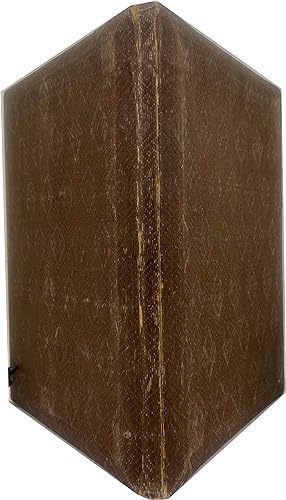
Condition: Fine. Size:- Number of books:1.
 More images
The lives of the loyal Ronins
UTAGAWA, Yoshitora [illustrated], USABURO, Tanaka (Ishikawa Nakamura) [edited]
Published by Unidentified 1885
- Hardcover
- First Edition
Seller: Kagerou Bunko (ABAJ, ILAB), Tokyo, , JapanKagerou Bunko (ABAJ, ILAB)
Contact seller2-star sellerCondition: Used - Very good
US$ 2,200.00
US$ 35.50 shippingShips from Japan to U.S.A.Quantity: 1 available
Hardcover. Condition: Very Good. 1st Edition. Colourful nishiki-e introducing a heroic story of Fourty-seven Ronins to the English reader. The legend is usually considered as historical and has a date on 31st January 1730, when brave samurais avenged the seppuku of the daimyo they were loyal to. Picture gallery represents the br…ave warrior and the folding illustration is a scene of the attack on the enemy palace. The illustrator Yoshitora Utagawa (active ca. 1850 - 1880) was master of Yokohama-e and Nishiki-e, depicting the foreigners in the famous Japanese port of Yokohama. Text in English. 26 leaves. 50 illustrations. 25x18,4cm. Folding illustration 37,5x75cm. Woodblock printed in colour. Oblong album. Bound in a wooden cover with brown silk cloth. Spine cracked. Pages oxidized. Very good condition.
 More images
Ujo Zatsuwa: Yume no Megane: Shohen
Hyohyotei, Sennari [text by] ; Utagawa, Yoshitora [illustrated by]
Published by Edo [Tokyo]: Moriya Jihe 1853
- Softcover
- First Edition
Seller: Kagerou Bunko (ABAJ, ILAB), Tokyo, , JapanKagerou Bunko (ABAJ, ILAB)
Contact seller2-star sellerCondition: Used - Good
US$ 1,895.00
US$ 35.50 shippingShips from Japan to U.S.A.Quantity: 1 available
Soft cover. Condition: Good. 1st Edition. A Comic Sketchbook of `Human Versions` of Animals. A humorous kyoka book that mimics Santo Kyoden`s `Harasuji Omuseki`. The book consists of comic details about the characteristics of birds, animals, insects, and sh, accompanied by illustrations of `human versions` of those creatures. Wh…ile the title reads `shohen` (`fi rst part`), it appears that this was the only part published. One of the scarcer books illustrated by artist Yoshitora. Original wrappers, somewhat wormholed and with light marginal soiling. Slight wormholing, repaired in some places, and small occasional marks to text. Some illustrations hand-coloured. Good. 1 v., possibly complete. 20 leaves. 17.8 x 12.1 cm. Text in Japanese.

Published by Meiji Gannen 1868
- Art Print
Seller: Kagerou Bunko (ABAJ, ILAB), Tokyo, , JapanKagerou Bunko (ABAJ, ILAB)
Contact seller2-star sellerCondition: Used - Fine
US$ 180.00
US$ 35.50 shippingShips from Japan to U.S.A.Quantity: 1 available
No Binding. Condition: Fine. A colour woodblock-print of the geisha 'Komakichi from the 'Edo Meisho Geisha' ['Famous Geisha of Edo'] series by Utagawa Yoshitora, the oldest pupil of Utagawa Kuniyoshi. A few light marks, small wormhole, repaired, otherwise fine. 1 leaf, 37x24.5cm.
- Hardcover
- Art Print
Seller: Antiquariat am St. Vith, Mönchengladbach, , GermanyAntiquariat am St. Vith
Contact seller5-star sellerCondition: Used
US$ 298.06
US$ 46.30 shippingShips from Germany to U.S.A.Quantity: 1 available
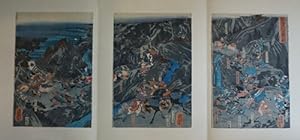
Hardcover. auf Karton punktuell montiert (Karton etwas gebräunt), Papier teils geringf. knitterig. vermutlich späterer Abzug - differenzbesteuert, daher kein Ausweis der Mehrwertsteuer.

Published by Yamash? 1860
Seller: Bolerium Books Inc., San Francisco, CA, U.S.A.Bolerium Books Inc.
Contact seller5-star sellerWoodblock print. 9.5x14.5 inch woodblock print, very good. Depicts Russian man with accordion, woman with small trumpet. Yoshitora was well known for his depictions of foreign subjects, a popular theme after the opening of the port of Yokohama.

Published by Tokyo: Uzumiya Ichibei Bunkyu Gannen 1861
- First Edition
Seller: Worlds End Bookshop (ABA, PBFA, ILAB), LONDON, , United KingdomWorlds End Bookshop (ABA, PBFA, ILAB)
Contact seller2-star sellerCondition: Used
US$ 552.67
US$ 40.24 shippingShips from United Kingdom to U.S.A.Quantity: 1 available
1st Edition. First Edition. A pre-Meiji period colour woodblock-printed illustration of a drunk Englishman dancing next to a geisha playing the shamisen in Yokohama. Trimmer, a little soiled, small repairs to verso. Light stain and three small pieces of washi pasted also to verso. 1 leaf, complete. 35 x 24cm. Text in japanese. B…ook.

Published by ??????. [Yamada Sh?jir?]. Bunkyu 1 [1862]., [Japan]. 1862
Seller: Asia Bookroom ANZAAB/ILAB, Canberra, ACT, AustraliaAsia Bookroom ANZAAB/ILAB
Contact seller5-star sellerCondition: Used
US$ 1,125.13
US$ 21.25 shippingShips from Australia to U.S.A.Quantity: 1 available
Colour woodblock print, 37.2 x 25.3 cms, the sheet a little age-toned, a spot of browning at the foot and a pinhole in the upper margin, but the image unaffected, very good condition. This colour woodblock print by Utagawa Yoshitora is an excellent example of Yokohama-e (Yokohama Prints), which were very popular in Japan after t…he country was opened in the mid-19th century. Yokohama was one of the trading ports with the outside world and many foreigners were residing in the area. The Yokohama-e was very similar to the Nagasaki-e (Nagasaki Prints), and depicted people and cultures which were foreign to the Japanese. Utagawa Yoshitora was active between the end of Edo Period to the mid-Meiji Period and produced numerous Nishiki-e prints, including Yokohama-e, in his career. He was regarded as one of the top Nishiki-e artists around that time. In this print, a Western man is strolling outside with his dog and a Mongolian boy who carries an umbrella for him. The man is observing something in the distance and about to jot down something in his notebook with a pen which he holds in his right hand. Behind him, his young attendant plays with the dog, unobserved by his pre-occupied master.
 More images
Published by n.p., [Japan] 1863
- Art Print
Seller: Tempo Books, Saint Paul, MN, U.S.A.Tempo Books
Contact seller5-star sellerColor woodblock print, approximately 14½" x 10", of an English couple beneath a running header of Japanese text. Utagawa Toshitora did a number of prints of foreigners. Sometimes, as in this print, above the image, a list of foreign vocabulary is depicted. On the top row are Japanese words, below which appears phonetic approxima…tion of (in this case) the English pronunciation of the word. .
 More images
Published by Kagaya Kichibei 1885
- Art Print
Seller: LIBRERIA ANTICUARIA MARGARITA DE DIOS, MADRID, M, SpainLIBRERIA ANTICUARIA MARGARITA DE DIOS
Contact seller5-star sellerCondition: Used - Very good
US$ 2,980.58
US$ 34.73 shippingShips from Spain to U.S.A.Quantity: 1 available
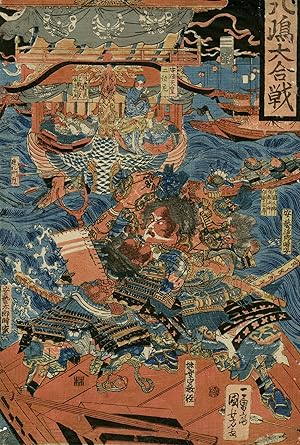
Sin Encuadernar. Condition: Bien. Materia: Xilografía antigua de finales del siglo XIX. Arte japonés. Globos aerostáticos. América - Utagawa Yoshitora. Publicación: Kagaya Kichibei, 1885. Dimensiones: 37'5 x 25 cm [cada plancha], 37'5 x 75 cm [tres hojas en total]. Firma: Las tres planchas "Yoshitora ga". Descripción visual: Mul…titud de personas se ha reunido para ver una ascensión en globo en Estados Unidos. Utagawa Yoshitora fue un artista japonés que vivió durante el período Edo. Yoshitora fue un pintor y editor de obras de arte aclamadas por la crítica en su tiempo. Sus obras fueron influenciadas por su maestro Utagawa Kuniyoshi y se destacaron por su uso creativo e imaginativo del espacio. También contribuyó a la propagación de los estilos artísticos posteriores Bijinga y Ukiyo-e. Desde la década de 1860, Yoshitora produjo grabados Yokohama-e de extranjeros en medio de la rápida modernización que llegó a Japón después de que el país se abriera al comercio. Conservación: Buen estado. Pequeñas manchas y desgastes. RSSS1 Este artículo necesita permiso de exportación / This item needs an export permit.
 More images
Published by Tokyo
Seller: Rob Zanger Rare Books LLC, Middletown, NY, U.S.A.Rob Zanger Rare Books LLC
Contact seller5-star sellerWoodblock print (nishiki-e) with ink and hand-coloring in watercolor on handmade mulberry paper, 14 7/16 x 9 15/16 inches (367 x 252 mm), ?ban tate-e, the full sheet. In good condition with some handling creases. Colors are fresh and extremely vibrant. The right panel from the triptych by Yoshitora depicting one of Japan's most…storied naval battles. An impression of this work may be found in the permanent collection of the Honolulu Museum of Art. The great naval battle of Dan-no-ura in 1185 was the final climax in a long series of bitter wars between two powerful families in feudal Japan. The Minamato clan, under their skilled military leader Yoshitsune, defeated the Taira. The protracted naval battle at the narrow straits separating the mainland from the northern tip of Kyushu marked a decisive end to the Gempei War, and set the stage for centuries of samurai rule. This defeat of the Taira forces led to the end of the Taira bid for control of Japan, and resulted in Minamoto no Yoritomo becoming the first sh?gun of Japan.

Published by Tokyo : Nodaya Tabe 1871
- First Edition
- Art Print
Seller: Kagerou Bunko (ABAJ, ILAB), Tokyo, , JapanKagerou Bunko (ABAJ, ILAB)
Contact seller2-star sellerCondition: Used - Very good
US$ 685.00
US$ 35.50 shippingShips from Japan to U.S.A.Quantity: 1 available
No Binding. Condition: Very Good. 1st Edition. A triptych of Beautiful Prostitutes in a Western-Style Building. A colour woodblock-printed triptych by Yochitora depicting the Shin-Yoshiwara area using western-style perspective techniques. Yoshitora was a pupil of Utagawa Kuniyoshi and painted many kaika-e and Yokohama-e (western…-style paintings). The Shin-Yoshiwara, a government-approved red-light district, became westernised in the Meiji period, when beautiful prostitutes were lined up and displayed. There are hardly any documents such as this one, which was rare at the time. Very minor soiling, slight wear to extremities, otherwise very good to near fine. 3 prints, complete. Each print measures 36.9 x 25 cm. Text in Japanese.


