

Order Total (1 Item Items):
Shipping Destination:

9780847823918 - Etruscans by Torelli, Mario (8 results)
Skip to main search results
Search filters
Product Type
- All Product Types
- Books (8)
- Magazines & Periodicals (No further results match this refinement)
- Comics (No further results match this refinement)
- Sheet Music (No further results match this refinement)
- Art, Prints & Posters (No further results match this refinement)
- Photographs (No further results match this refinement)
- Maps (No further results match this refinement)
- Manuscripts & Paper Collectibles (No further results match this refinement)
Condition Learn more
- New (No further results match this refinement)
- As New, Fine or Near Fine (3)
- Very Good or Good (4)
- Fair or Poor (No further results match this refinement)
- As Described (1)
Binding
- All Bindings
- Hardcover (8)
- Softcover (No further results match this refinement)
Collectible Attributes
- First Edition (4)
- Signed (No further results match this refinement)
- Dust Jacket (6)
- Seller-Supplied Images (3)
- Not Print on Demand (8)
Language (1)
Price
- Any Price
- Under US$ 25 (No further results match this refinement)
- US$ 25 to US$ 50
- Over US$ 50
Free Shipping
Seller Location
Seller Rating
-

Condition: good. Book is in good condition and may include underlining highlighting and minimal wear. The book can also include "From the library of" labels. May not contain miscellaneous items toys, dvds, etc. . We offer 100% money back guarantee and 24 7 customer service.
-
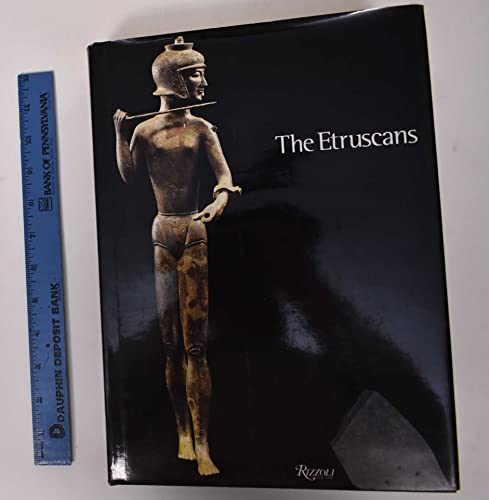
Hardcover. Condition: Fine. Dust Jacket Condition: Fine.
-
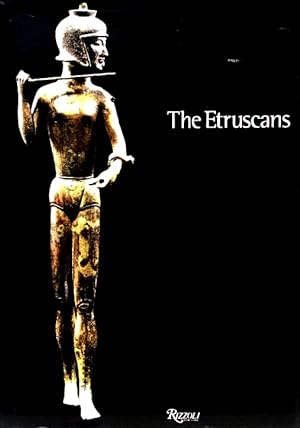
The Etruscans
Language: English
Published by Rizzoli International Publications, New York, 2001
ISBN 10: 0847823911 ISBN 13: 9780847823918
First Edition
Hardcover. Condition: Near Fine. Dust Jacket Condition: Very Good. 1st. Cloth, 671 pages, colour illustrations, maps, plans; 31 cm. English Edition. Catalogue of an exhibition organized by the Palazzo Grassi and the Ministero per i beni e le attivita culturale, held November 26, 2000 to July 1, 2001, Palazzo Grassi, Venice. Near fine. Firm binding, clean inside copy. Spine slightly rolled at the crown. Dust jacket, with light edgewear, protected in a mylar cover. OVERSIZE! Additional shipping charges may be requested for international & priority orders. Richly illustrated with colour plates. This monumental publication is probably the most comprehensive study of the Etruscan civilization. *** "This volume accompanies Palazzo Grassi's exhibition on the Etruscans. It contains 20 chapters by prominent scholars on diverse topics such as Etruscan city building, language, slavery and trade. Illustrations display richly frescoed tombs, jewellery and sculpture, metalwork and painted vases." - Publisher. *** CONTENTS: Presentation, by Mario Torelli; The original features of the Etruscan peoples, by Giovanni Colonna; THE HISTORICAL CONTEXT AND THE ECONOMIC, SOCIAL, AND POLITICAL FORMS. The origins of the Etruscans: a controversy handed down from antiquity, by Dominique Briquel; The origin and diffusion of Villanovan culture, by Gilda Bartoloni; Economic structure, by Marisa Bonamici; Coins, by Fiorenzo Catalli; Trade, by Michel Gras; The Etruscan aristocracy in the orientalizing period: culture, economy, relations, by Alessandro Naso; The woman's role, by Antonio Rallo; The Etruscan expansion into Campania, by Maria Bonghi Jovino; The Etruscan expansion in the Po Valley, by Giuseppe Sassatelli; Relations with neighbouring peoples, by Simonetta Stopponi; The Etruscans and the Veneti: forms of exchange and processes of acculturation, by Loredana Capuis; The Etruscans and the lands south of Campania, by Angelo Bottini; Political forms in the archaic period, by Mauro Menichetti; Republican political forms, by Adriano Maggiani; The ideology of the Etruscan city, by Luca Cerchiai; The social structure and the serf question, by Franc oise-Helene Massa-Pairault. CULTURE AND FORMS OF ART. Etruscan religion, by Mario Torelli; Etruscan urban planning, by Stephan Steingra ber; Civil, religious, and domestic architecture, by Luigi Donati; Tomb architecture, by Friedhelm Prayon; Painting, by Francesco Roncalli; Sculpture, by Stefano Bruni; Etruscan Bronzes, by Fabio Colivicchi; Archaic pottery: Impasto and Bucchero Wares, by Giovannangelo Camporeale; Painted pottery of the Archaic period, by Franc?oise Gaultier; Etruscan painted ware of the classical and Hellenistic period, by Maurizio Harari; The minor arts, by Marina Martelli, Ferdinando Gilotta; The writing, by Giovanna Bagnasco Gianni; The language, by Luciano Agostiniani; The Tyrrheni of Lemnos, by Carlo de Simone; THE REDISCOVERY OF THE ETRUSCANS. Etruscan Antiquarianism, by Fabio Colivicchi; The Vatican's Museo Gregoriano Etrusco from the nineteenth century and beyond, by Francesco Buranelli; The Museo Archeologico Nazionale of Florence, by Antonella Romualdi; The Museo Nazionale Etrusco di Villa Giulia, by Anna Maria Moretti Sgubini. CATALOGUE OF WORKS. The making. From the Bronze Age to the Iron Age; The Villanovan civilization; The apogee. The economy. Agriculture; The mines; Piracy and trade; Warfare; The ideal forms. Opulence; The role of women; The cult of the ancestors and the continuity of the clan; The rituals of the Archaic power; Hellenization; The urban political forms; The renewed society of the fourth century; The decline. The Roman conquest; The servants; The anguish of the decline. The role of the past and of the esoteric doctrines; The Diaspora and nostalgia. APPENDIX. Chronology; Topographical Index of Works. Size: 4to.
-
Hardcover. Condition: Very Good. 0847823911 Dust jacket shows a small 1/2 inch tear at bottom near spine (repaired). The inside flap has a 2 inch publisher flaw at the top when glued to the hard cover. Does not deter from this beautiful book. Actually this book is close to new condition. The pages are new. Too big and heavy for expedited or international sale.
-
Etruscans
Seller: Powell's Bookstores Chicago, ABAA, Chicago, IL, U.S.A.
Seller rating 5 out of 5 stars

First Edition
hardcover. Condition: Used-Very Good. First Edition. Cloth, dj. Minor scuffing and edge wear to dj. Minor shelf wear to boards. Else a bright, clean copy.
-
Hardcover. Condition: Very Good+. Dust Jacket Condition: Very Good. Very light bump to 1 corner of book. DJ has edgewear and minor chipping. ; The Etruscans have long been a rich source of research and intellectual inquiry as the most significant ethnic group who resided in ancient Etruria, current-day Tuscany and Umbria in Italy. A well-defined polity, the Etruscans were an advanced people whose presence on the Italian peninsula from the 8th to 4th century B. C. Had an enormous impact on Roman culture, whose rise of power saw the collapse of Etruscan civilization. This book is extensive in its scope; it traces the rise of the Etruscans at the end of the Bronze Age; examines the economic structure of the society; explores the emergence of a powerful aristocracy in the period from 750-650 B. C. ; and considers the religious and cultural life of the group. This knowledge has largely been gleaned from a wealth of monuments and material culture which the Etruscans left behind including architecture (the various forms of which indicate familial structure and socio-economic standing, not to mention the larger social structure of Etruscan society) and applied arts, such as bronze objects for both ceremonial use and everyday life, which were produced by an artisan class for a wealthy and demanding aristocracy. Etruscan contributions to the history of art are also of immense importance and are explored in depth in this volume. Etruscan wall painting was exceptional in that it is one of the few examples of pre-Roman artistic production of this genre. Sculpture was also a relatively highly developed form of art, and the Etruscans are known for their important experiments with form. Noted scholar Mario Torelli, editor of the book, gathers here an illuminating collection of essays reflective of the most current research on the Etruscans. As a professor of classical archaeology for nearly three decades who has directed archeological digs at some of the most significant Etruscan sites, Torelli offers a unique insight into the scholarly terrain of Etruscan studies. Torelli also contributes a substantive essay on Etruscan religion, exploring the rather exceptional character of this important aspect of Etruscan life. Lavishly illustrated with beautiful reproductions of Etruscan art and culture, this impressive catalogue explores every aspect of the Etruscan people and their artistic and cultural legacy in the most expansive consideration of their enormous contribution to Western culture to date. ; 4to 11" - 13" tall; 672 pages; Heavy book.
-
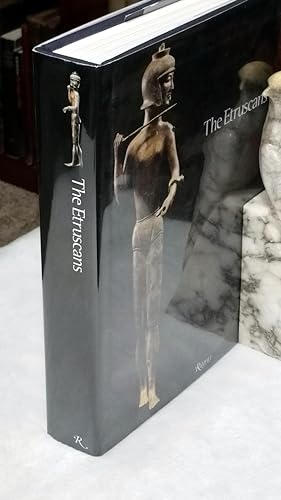
The Etruscans
Seller: Lloyd Zimmer, Books and Maps, Chanute, KS, U.S.A.
Seller rating 5 out of 5 stars
First Edition
Cloth - Hard Cover. Condition: Fine. Dust Jacket Condition: Fine. First Edition. 669 pages. Dust jacket is now protected in a clear mylar sleeve. Due to the size and weight of this book, additional charges will apply for Priority and/or International shipping.
-
THE ETRUSCANS
First Edition
Hardcover. Condition: VG. Dust Jacket Condition: VG. First Edition. OVERSEAS ORDERS WILL REQUIRE ADDITIONAL POSTAGE.

