

Order Total (1 Item Items):
Shipping Destination:

9783540540304 - A New Boundary Element Formulation in Engineering Lecture Notes in Engineering, 68 by Defigueiredo, Tania G B (11 results)
Skip to main search results
Search filters
Product Type
- All Product Types
- Books (11)
- Magazines & Periodicals (No further results match this refinement)
- Comics (No further results match this refinement)
- Sheet Music (No further results match this refinement)
- Art, Prints & Posters (No further results match this refinement)
- Photographs (No further results match this refinement)
- Maps (No further results match this refinement)
- Manuscripts & Paper Collectibles (No further results match this refinement)
Condition Learn more
- New (7)
- As New, Fine or Near Fine (No further results match this refinement)
- Very Good or Good (2)
- Fair or Poor (No further results match this refinement)
- As Described (2)
Binding
- All Bindings
- Hardcover (No further results match this refinement)
- Softcover (11)
Collectible Attributes
- First Edition (No further results match this refinement)
- Signed (No further results match this refinement)
- Dust Jacket (No further results match this refinement)
- Seller-Supplied Images (3)
- Not Print on Demand (9)
Language (1)
Free Shipping
- Free Shipping to U.S.A. (No further results match this refinement)
Seller Location
Seller Rating
-

A New Boundary Element Formulation in Engineering (Lecture Notes in Engineering) (Lecture Notes in Engineering (68))
Seller: Midtown Scholar Bookstore, Harrisburg, PA, U.S.A.
Seller rating 5 out of 5 stars

Paperback. Condition: Very Good. Very Good - Crisp, clean, unread book with some shelfwear/edgewear, may have a remainder mark - NICE PAPERBACK Standard-sized.
-
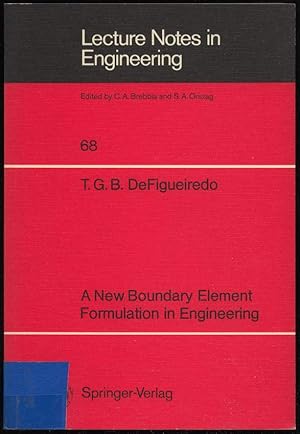
A New Boundary Element Formulation in Engineering.
Language: English
Published by Berlin, Heidelberg, New York u.a., Springer, 1991
ISBN 10: 354054030X ISBN 13: 9783540540304
Seller: Antiquariat Dennis R. Plummer, Bingen am Rhein, Germany
Seller rating 5 out of 5 stars
Gr.-8°, Original-Broschur. Condition: Akzeptabel. IX, 198 SS. Lecture Notes in Engineering, 68. - Ehemaliges Bibliotheksexemplar mit den üblichen Stempeln und Signaturen, Rücken mit Signaturschildchen. Seiten papierbedingt ganz leicht gebräunt. Sonst gutes Exemplar. / Ex library copy with the usual label, stamps and markings. Light browning. Else well preserved. Sprache: Englisch Gewicht in Gramm: 550.
-
A New Boundary Element Formulation in Engineering (Lecture Notes in Engineering)
Language: English
Published by Springer-Verlag Berlin and Heidelberg GmbH & Co. K., 1991
ISBN 10: 354054030X ISBN 13: 9783540540304
Seller: Powell's Bookstores Chicago, ABAA, Chicago, IL, U.S.A.
Seller rating 5 out of 5 stars
Paperback. Condition: Used-Very Good. Pbk. Some shelf-wear. Else clean copy.
-
A New Boundary Element Formulation in Engineering (Lecture Notes in Engineering, 68)
Seller: Ria Christie Collections, Uxbridge, United Kingdom
Seller rating 5 out of 5 stars
US$ 133.83
US$ 16.19 shipping
Ships from United Kingdom to U.S.A.Quantity: Over 20 available
Add to basketCondition: New. In.
-
A New Boundary Element Formulation in Engineering
Language: English
Published by Springer-Verlag GmbH, 1991
ISBN 10: 354054030X ISBN 13: 9783540540304
Condition: Gut. Zustand: Gut | Sprache: Englisch | Produktart: Bücher | 1. 1 The Hybrid Displacement Boundary Element Model This work is concerned with the derivation of a numerical model for the solution of boundary-value problems in potential theory and linear elasticity. It is considered a boundary element model because the final integral equation involves some boundary integrals, whose evaluation requires a boundary discretization. Furthermore, all the unknowns are boundary vari ables. The model is completely new; it differs from the classical boundary element formulation ·in the way it is generated and consequently in the fi nal equations. A generalized variational principle is used as a basis for its derivation, whereas the conventional boundary element formulation is based on Green's formula (potential problems) and on Somigliana's identity (elas ticity), or alternatively through the weighted residual technique. 2 The multi-field variational principle which generates the formulation in volves three independent variables. For potential problems, these are the potential in the domain and the potential and its normal derivative on the boundary. In the case of elasticity, these variables are displacements in the domain and displacements and tractions on the boundary. For this reason, by analogy with the assumed displacement hybrid finite element model, ini tially proposed by Tong [1] in 1970, it can be called a hybrid displacement model. The final system of equations to be solved is similar to that found in a stiffness formulation. The stiffness matrix for this model is symmetric and can be evaluated by only performing integrations along the boundary.
-
Condition: New. pp. 198 1st Edition.
-
US$ 176.09
US$ 13.51 shipping
Ships from United Kingdom to U.S.A.Quantity: 2 available
Add to basketPaperback. Condition: Brand New. 207 pages. 9.45x6.46x0.71 inches. In Stock.
-

A New Boundary Element Formulation in Engineering
Language: English
Published by Springer Berlin Heidelberg, 1991
ISBN 10: 354054030X ISBN 13: 9783540540304
US$ 143.05
US$ 57.35 shipping
Ships from Germany to U.S.A.Quantity: Over 20 available
Add to basketCondition: New. 1. 1 The Hybrid Displacement Boundary Element Model This work is concerned with the derivation of a numerical model for the solution of boundary-value problems in potential theory and linear elasticity. It is considered a boundary element model because the .
-

A New Boundary Element Formulation in Engineering
Language: English
Published by Springer, Berlin, Springer Berlin Heidelberg, Springer, 1991
ISBN 10: 354054030X ISBN 13: 9783540540304
Taschenbuch. Condition: Neu. Neuware - 1. 1 The Hybrid Displacement Boundary Element Model This work is concerned with the derivation of a numerical model for the solution of boundary-value problems in potential theory and linear elasticity. It is considered a boundary element model because the final integral equation involves some boundary integrals, whose evaluation requires a boundary discretization. Furthermore, all the unknowns are boundary vari ables. The model is completely new; it differs from the classical boundary element formulation in the way it is generated and consequently in the fi nal equations. A generalized variational principle is used as a basis for its derivation, whereas the conventional boundary element formulation is based on Green's formula (potential problems) and on Somigliana's identity (elas ticity), or alternatively through the weighted residual technique. 2 The multi-field variational principle which generates the formulation in volves three independent variables. For potential problems, these are the potential in the domain and the potential and its normal derivative on the boundary. In the case of elasticity, these variables are displacements in the domain and displacements and tractions on the boundary. For this reason, by analogy with the assumed displacement hybrid finite element model, ini tially proposed by Tong [1] in 1970, it can be called a hybrid displacement model. The final system of equations to be solved is similar to that found in a stiffness formulation. The stiffness matrix for this model is symmetric and can be evaluated by only performing integrations along the boundary.
-
US$ 169.96
US$ 8.78 shipping
Ships from United Kingdom to U.S.A.Quantity: 4 available
Add to basketCondition: New. Print on Demand pp. 198.
-
Condition: New. PRINT ON DEMAND pp. 198.

