

Order Total (1 Item Items):
Shipping Destination:

Game Difficulty 1979 (4 results)
Skip to main search results
Search filters
Product Type
- All Product Types
- Books (4)
- Magazines & Periodicals (No further results match this refinement)
- Comics (No further results match this refinement)
- Sheet Music (No further results match this refinement)
- Art, Prints & Posters (No further results match this refinement)
- Photographs (No further results match this refinement)
- Maps (No further results match this refinement)
- Manuscripts & Paper Collectibles (No further results match this refinement)
Condition Learn more
- New (No further results match this refinement)
- As New, Fine or Near Fine (No further results match this refinement)
- Very Good or Good (2)
- Fair or Poor (No further results match this refinement)
- As Described (2)
Binding
- All Bindings
- Hardcover (4)
- Softcover (No further results match this refinement)
Collectible Attributes
- First Edition (4)
- Signed (No further results match this refinement)
- Dust Jacket (4)
- Seller-Supplied Images (3)
- Not Print on Demand (4)
Language (2)
Free Shipping
- Free Shipping to U.S.A. (No further results match this refinement)
Seller Location
Seller Rating
-
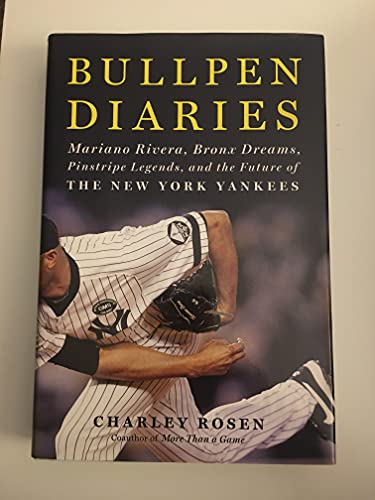
Bullpen Diaries; Mariano Rivera, Bronx Dreams, Pinstripe Legends, and the Future of The New York Yankees
Language: English
Published by Harper [An Imprint of HarperCollinsPublishers], New York, 2011
ISBN 10: 0062005987 ISBN 13: 9780062005984
Seller: Ground Zero Books, Ltd., Silver Spring, MD, U.S.A.
Seller rating 4 out of 5 stars

First Edition
Hardcover. Condition: Very good. Dust Jacket Condition: good. xiv, 370 pages. Illustrations. DJ has wear and soiling, with edge tears and chips. Minor edge soiling. Black dot on bottom edge. Bestselling sportswriter Charley Rosen takes the reader on the wild journey that is the evolution of relief pitching over the years and examines the eccentric characters who have taken on the pressure of closing out games-or not. Bullpen Diaries is full of interviews with key players, coaches, and scouts from around the league; replete with the drama of blown plays and walk-off grand slams; and laced with funny anecdotes about Yankee greats throughout the years. To underscore the drama and difficulty of being a reliever, Rosen uses key games in the 2010 season-acknowledged now as the Year of the Pitcher-to highlight strategies and mistakes, examine relievers on the rise or on the way out, and analyze the teams and the pitchers the Yankees faced. Bullpen Diaries also takes a look at Yankee strategies for success-past, present, and, most important, future. Lastly, Rosen reveals his predictions for 2011 and beyond for baseball's most storied franchise. With insight on current players from around the league and tales of Yankee legends, Stadium history, and the author's Bronx childhood, Bullpen Diaries is a love letter to baseball and a pure joy for all fans of America's favorite pastime. Charles Elliot "Charley" Rosen (born January 18, 1941) is an American author and former basketball coach. From 1983-1986, he was an assistant to Phil Jackson[2] with the Albany Patroons of the Continental Basketball Association (CBA). He also served as head coach of the Patroons, as well as the CBA's Rockford Lightning, Oklahoma City Cavalry and Savannah Spirits. The 6-foot-8 Rosen played college basketball at Hunter College in New York City for three seasons (1959-1962), setting school records for both scoring and rebounding, and earning most valuable player honors each season. After college, he played for Scranton and Camden in the old Eastern Basketball League and taught English at Hofstra University on Long Island. He also served as head coach of the women's basketball team at the State University of New York at New Paltz, a four-year college located between Albany and New York City, and was men's head coach at Bard College during the 1979-80 season, which he chronicled in the book Players and Pretenders. A native of The Bronx, N.Y., Rosen is the author of 16 books about basketball, including The First Tip Off, The House of Moses All-Stars, Barney Polan's Game, No Blood, No Foul, More Than a Game, The Pivotal Season, and The Wizard of Odds. He is a FOXSports analyst and writer.[ He is known for his in-depth analysis and caustic views. He is a lifelong Yankees fan and had a pitching tryout at Yankee Stadium in June, 1963. First Edition [stated], First Printing [stated].
-
MANIAC Game, Computer Brain see & hear / WORKS! 1979
Published by Ideal Toy Company, 1979
First Edition
Hardcover. Condition: Very Good. Dust Jacket Condition: Very Good. 1st Edition. TESTED PLAYED RUNS ON C SIZE BATTERIES. VERY GOOD COSMETICALLY. VERY GOOD BOX. "Ralph Baer is best known for developing the first video games, but he has accomplished more than that. In 1975, Baer, an engineer and inventor, started an independent consulting business and began to work in association with Marvin Glass & Associates in Chicago, the toy design firm responsible for some of the most successful American toys of the 20th century. Baer's job was to develop electronic toys and games. The best-known result of this partnership was Simon." Plastic (overall material) Measurements: overall: 2 1/2 in x 10 1/2 in x 10 1/2 in. How Maniac Works The Computer Brain : Maniac features a microcomputer that provides visual and audible intelligence, adjusting the difficulty to the players' skill levels. Player Response : Players respond to challenges by pressing large paddles. Scoring : Players earn points for their speed and accuracy, with scores displayed and updated after each round. The Four Challenges Musical Maniac: The computer plays a series of random musical notes and then stops suddenly. Players must press their paddles as quickly as possible after the music stops to earn points. Sounds Abound: The computer plays a sequence of random musical notes. Players must count the notes and then hit their paddles when the computer's beeping equals the number of tones they heard. Look Twice: Maniac displays a pattern of dazzling light patterns. Players must then spot the repeated pattern in a sequence of three additional light patterns. Your Time's Up: The computer plays a tone and players must estimate the length of the tone. After the tone ends, the computer beeps and falls silent, at which point players must estimate if the silence is the same length as the previous tone. Gameplay and Winning Each challenge is played three times in a row. Scores are cumulative, and the first player to reach 25 points wins the game.
-

Wittgenstein's Lectures: Cambridge 1932-1935. From the notes of Alice Ambrose and Margaret Macdonald.
Published by Basil Blackwell, Oxford, 1979
Seller: Athena Rare Books ABAA, Fairfield, CT, U.S.A.
Seller rating 2 out of 5 stars

First Edition
FIRST EDITION, SECOND ISSUE. Half title + TP + [v] = Contents + [vii] = Dedication page + ix-xi = Editor's Preface + half title + [3]-225 + 1 blank leaf. Octavo. First Edition, Second Issue (Fr/McG: W.s lectures. Cambridge 1932-35, p. 46). Published from sheets printed in the US, making this the "second issue" of this important book. The First UK Edition of Student Notes - Taken at Wittgenstein's Lectures - 1932-1935"Language-games are a clue to the understanding of logic"Unlike Desmond Lee & John King's notes from 1930-1932, Ambrose's collection introduces a Wittgenstein who has decisively turned away from the Tractatus, and is now firmly committed to working out his "New Philosophy".The book contains five sections. It begins with an introduction by Ambrose acknowledging the difficulty of publishing an honest recapitulation of Wittgenstein's lectures from this period. With this in mind, the content of the first chapter - Part I. Philosophy. Lectures 1932-1933 - becomes more lucid. It ranges from oft-returned-to topics such as the translatability of colors and toothaches to intelligible and meaningful speech, to more unconventional topics like the relationship of the body to the ego.In her second chapter - Part II. The Yellow Book (Selected Parts) - Ambrose presents selections from a mysterious supplement to the Blue Book. The Yellow Book never underwent official publication and, even still, remains something of an object of Wittgensteinian lore [see item #41 above]. Published as a supplement to the Blue Book, the Yellow Book was intended to be a further elaboration and explanation of the ideas published there. The selection presented in Part II incorporates Ambrose's notes with those of her peers - Margaret Masterman and Francis Skinner - to provide a still-yet unpublished, but nonetheless important, work of the Wittgenstein canon. Part III is a composite of Ambrose's notes on Wittgenstein's lectures, 1934-35. The lectures begin with a short deliberation on the idea of "negation" in a language-game and the obscurities of facts that are facts but, indeed, that do not exist - an example of which being, "the chair is not green." From this point, these lectures orbit around the principle of negation and negativity, with additional considerations of mathematical propositions that deal with negation.Part IV offers notes on Wittgenstein's 1932-33 lectures on the "Philosophy of Mathematics". This was the first of two iterations of this course, the second being the basis of the Blue Book. Ambrose was one of the five notetakers selected by Wittgenstein in the second iteration of the course, and would go on to be instrumental in publishing the Blue Book. Here, Ambrose presents a framework that anticipates the ideas of the Blue Book, some of which were published there, some of which were not. [See our Catalog 24: Ludwig Wittgenstein: The Man and His Thought for a collection of 81 books and pamphlets by and about Wittgenstein.] Publisher's original photo dust jacket with blue lettering to the front and the spine. The rear panel has a black and white listing of other Wittgenstein books published by Blackwell. Over the publisher's original blue cloth boards with gilt lettering on the spine. An immaculate copy of the important and popular book of Wittgenstein's early lectures. ADDITIONAL PHOTOS AVAILABLE UPON REQUEST.
-

Wittgenstein's Lectures: Cambridge 1932-1935. From the notes of Alice Ambrose and Margaret Macdonald.
Published by Rowman and Littlefield, Totowa, NJ, 1979
Seller: Athena Rare Books ABAA, Fairfield, CT, U.S.A.
Seller rating 2 out of 5 stars
First Edition
FIRST EDITION. Half title + TP + [v] = Contents + [vii] = Dedication page + ix-xi = Editor's Preface + half title + [3]-225 + 1 blank leaf. Octavo. First Edition, First Issue (Fr/McG: W.s lectures. Cambridge 1932-35, p. 46). The First Edition of Student Notes - Taken During Wittgenstein's 1932-1935 LecturesPublished from sheets printed in the US, so this should be considered the "first issue" of this important book. Unlike Desmond Lee & John King's notes from 1930-1932, Ambrose's collection introduces a Wittgenstein who has decisively turned away from the Tractatus, and is now firmly committed to working out his "New Philosophy".The book contains five sections. It begins with an introduction by Ambrose acknowledging the difficulty of publishing an honest recapitulation of Wittgenstein's lectures from this period. With this in mind, the content of the first chapter - Part I. Philosophy. Lectures 1932-1933 - becomes more lucid. It ranges from oft-returned-to topics such as the translatability of colors and toothaches to intelligible and meaningful speech, to more unconventional topics like the relationship of the body to the ego.In her second chapter - Part II. The Yellow Book (Selected Parts) - Ambrose presents selections from a mysterious supplement to the Blue Book. The Yellow Book never underwent official publication and, even still, remains something of an object of Wittgensteinian lore [see item #41 above]. Published as a supplement to the Blue Book, the Yellow Book was intended to be a further elaboration and explanation of the ideas published there. The selection presented in Part II incorporates Ambrose's notes with those of her peers - Margaret Masterman and Francis Skinner - to provide a still-yet unpublished, but nonetheless important, work of the Wittgenstein canon. Part III is a composite of Ambrose's notes on Wittgenstein's lectures, 1934-35. The lectures begin with a short deliberation on the idea of "negation" in a language-game and the obscurities of facts that are facts but, indeed, that do not exist - an example of which being, "the chair is not green." From this point, these lectures orbit around the principle of negation and negativity, with additional considerations of mathematical propositions that deal with negation.Part IV offers notes on Wittgenstein's 1932-33 lectures on the "Philosophy of Mathematics". This was the first of two iterations of this course, the second being the basis of the Blue Book. Ambrose was one of the five notetakers selected by Wittgenstein in the second iteration of the course, and would go on to be instrumental in publishing the Blue Book. Here, Ambrose presents a framework that anticipates the ideas of the Blue Book, some of which were published there, some of which were not. [See our Catalog 24: Ludwig Wittgenstein: The Man and His Thought for a collection of 81 books and pamphlets by and about Wittgenstein.] Publisher's original photo dust jacket with blue lettering to the front and the spine. The rear panel has a black and white listing of other Wittgenstein books "also this series". Over the publisher's original blue cloth boards with gilt lettering on the spine. With the bookplate of a former owner (Robert F. Thimmesh) to the inside front cover along with his name hand-written in blue ink to the upper right corner of the title page. Otherwise, an immaculate copy of this important and popular book of Wittgenstein's early lectures. ADDITIONAL PHOTOS AVAILABLE UPON REQUEST.


