
Order Total (1 Item Items):
Shipping Destination:

Synthesis Lectures on Computer Architecture (110 results)
Skip to main search results
Search filters
Product Type
- All Product Types
- Books (110)
- Magazines & Periodicals (No further results match this refinement)
- Comics (No further results match this refinement)
- Sheet Music (No further results match this refinement)
- Art, Prints & Posters (No further results match this refinement)
- Photographs (No further results match this refinement)
- Maps (No further results match this refinement)
- Manuscripts & Paper Collectibles (No further results match this refinement)
Condition Learn more
- New (97)
- As New, Fine or Near Fine (9)
- Very Good or Good (4)
- Fair or Poor (No further results match this refinement)
- As Described (No further results match this refinement)
Binding
- All Bindings
- Hardcover (No further results match this refinement)
- Softcover (110)
Collectible Attributes
- First Edition (No further results match this refinement)
- Signed (No further results match this refinement)
- Dust Jacket (No further results match this refinement)
- Seller-Supplied Images (53)
- Not Print on Demand (90)
Language (1)
Free Shipping
Seller Location
Seller Rating
-
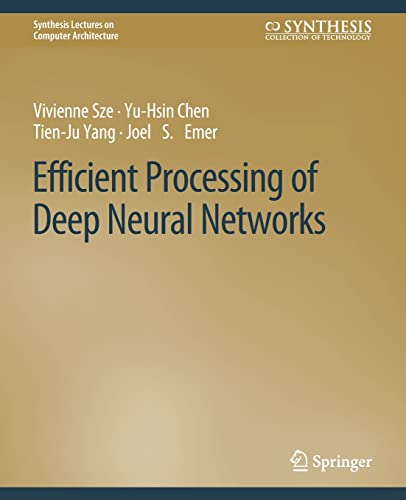
Paperback. Condition: Very Good. No Jacket. May have limited writing in cover pages. Pages are unmarked. ~ ThriftBooks: Read More, Spend Less.
-

Deep Learning Systems: Algorithms, Compilers, and Processors for Large-Scale Production (Synthesis Lectures on Computer Architecture)
Language: English
Published by Springer (edition 1), 2020
ISBN 10: 3031006410 ISBN 13: 9783031006418
Paperback. Condition: Very Good. 1. It's a well-cared-for item that has seen limited use. The item may show minor signs of wear. All the text is legible, with all pages included. It may have slight markings and/or highlighting.
-

Condition: As New. Unread book in perfect condition.
-

Condition: New.
-

-
Condition: New.
-

PAP. Condition: New. New Book. Shipped from UK. Established seller since 2000.
-

Condition: As New. Unread book in perfect condition.
-
Quantum Computing for Computer Architects, Second Edition
Seller: PBShop.store UK, Fairford, GLOS, United Kingdom
Seller rating 5 out of 5 stars

PAP. Condition: New. New Book. Shipped from UK. Established seller since 2000.
-
-

Condition: As New. Unread book in perfect condition.
-

-

Deep Learning Systems
Language: English
Published by Springer International Publishing AG, CH, 2020
ISBN 10: 3031006410 ISBN 13: 9783031006418
Seller: Rarewaves.com USA, London, LONDO, United Kingdom
Seller rating 5 out of 5 stars
US$ 51.56
Free Shipping
Ships from United Kingdom to U.S.A.Quantity: Over 20 available
Add to basketPaperback. Condition: New. This book describes deep learning systems: the algorithms, compilers, and processor components to efficiently train and deploy deep learning models for commercial applications. The exponential growth in computational power is slowing at a time when the amount of compute consumed by state-of-the-art deep learning (DL) workloads is rapidly growing. Model size, serving latency, and power constraints are a significant challenge in the deployment of DL models for many applications. Therefore, it is imperative to codesign algorithms, compilers, and hardware to accelerate advances in this field with holistic system-level and algorithm solutions that improve performance, power, and efficiency. Advancing DL systems generally involves three types of engineers: (1) data scientists that utilize and develop DL algorithms in partnership with domain experts, such as medical, economic, or climate scientists; (2) hardware designers that develop specialized hardware to accelerate the components in the DL models; and (3) performance and compiler engineers that optimize software to run more efficiently on a given hardware. Hardware engineers should be aware of the characteristics and components of production and academic models likely to be adopted by industry to guide design decisions impacting future hardware. Data scientists should be aware of deployment platform constraints when designing models. Performance engineers should support optimizations across diverse models, libraries, and hardware targets. The purpose of this book is to provide a solid understanding of (1) the design, training, and applications of DL algorithms in industry; (2) the compiler techniques to map deep learning code to hardware targets; and (3) the critical hardware features that accelerate DL systems. This book aims to facilitate co-innovation for the advancement of DL systems. It is written for engineers working in one or more of these areas who seek to understand the entire system stack in order to bettercollaborate with engineers working in other parts of the system stack. The book details advancements and adoption of DL models in industry, explains the training and deployment process, describes the essential hardware architectural features needed for today's and future models, and details advances in DL compilers to efficiently execute algorithms across various hardware targets. Unique in this book is the holistic exposition of the entire DL system stack, the emphasis on commercial applications, and the practical techniques to design models and accelerate their performance. The author is fortunate to work with hardware, software, data scientist, and research teams across many high-technology companies with hyperscale data centers. These companies employ many of the examples and methods provided throughout the book.
-
US$ 37.11
US$ 20.74 shipping
Ships from United Kingdom to U.S.A.Quantity: 10 available
Add to basketPF. Condition: New.
-
-

Quantum Computing for Computer Architects, Second Edition
Language: English
Published by Springer International Publishing AG, CH, 2011
ISBN 10: 3031006038 ISBN 13: 9783031006036
Seller: Rarewaves.com USA, London, LONDO, United Kingdom
Seller rating 5 out of 5 stars
Paperback. Condition: New. Quantum computers can (in theory) solve certain problems far faster than a classical computer running any known classical algorithm. While existing technologies for building quantum computers are in their infancy, it is not too early to consider their scalability and reliability in the context of the design of large-scale quantum computers. To architect such systems, one must understand what it takes to design and model a balanced, fault-tolerant quantum computer architecture. The goal of this lecture is to provide architectural abstractions for the design of a quantum computer and to explore the systems-level challenges in achieving scalable, fault-tolerant quantum computation. In this lecture, we provide an engineering-oriented introduction to quantum computation with an overview of the theory behind key quantum algorithms. Next, we look at architectural case studies based upon experimental data and future projections for quantum computation implemented using trapped ions. While we focus here on architectures targeted for realization using trapped ions, the techniques for quantum computer architecture design, quantum fault-tolerance, and compilation described in this lecture are applicable to many other physical technologies that may be viable candidates for building a large-scale quantum computing system. We also discuss general issues involved with programming a quantum computer as well as a discussion of work on quantum architectures based on quantum teleportation. Finally, we consider some of the open issues remaining in the design of quantum computers. Table of Contents: Introduction / Basic Elements for Quantum Computation / Key Quantum Algorithms / Building Reliable and Scalable Quantum Architectures / Simulation of Quantum Computation / Architectural Elements / Case Study: The Quantum Logic Array Architecture / Programming the Quantum Architecture / Using the QLA for Quantum Simulation: The Transverse Ising Model / Teleportation-Based Quantum Architectures/ Concluding Remarks.
-
Condition: New. 1st edition NO-PA16APR2015-KAP.
-

Deep Learning Systems : Algorithms, Compilers, and Processors for Large-scale Production
Seller: GreatBookPricesUK, Woodford Green, United Kingdom
Seller rating 5 out of 5 stars
US$ 40.52
US$ 20.09 shipping
Ships from United Kingdom to U.S.A.Quantity: Over 20 available
Add to basketCondition: New.
-

Condition: New. pp. 120.
-
US$ 40.98
US$ 20.74 shipping
Ships from United Kingdom to U.S.A.Quantity: 10 available
Add to basketPF. Condition: New.
-

Quantum Computing for Computer Architects
Seller: GreatBookPricesUK, Woodford Green, United Kingdom
Seller rating 5 out of 5 stars
US$ 44.45
US$ 20.09 shipping
Ships from United Kingdom to U.S.A.Quantity: Over 20 available
Add to basketCondition: New.
-
Quantum Computing for Computer Architects, Second Edition (Synthesis Lectures on Computer Architecture)
Seller: Ria Christie Collections, Uxbridge, United Kingdom
Seller rating 5 out of 5 stars
US$ 48.19
US$ 16.04 shipping
Ships from United Kingdom to U.S.A.Quantity: 1 available
Add to basketCondition: New. In English.
-
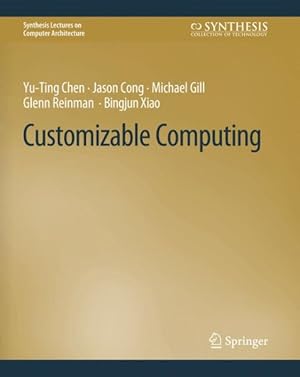
Customizable Computing
Seller: GreatBookPricesUK, Woodford Green, United Kingdom
Seller rating 5 out of 5 stars
US$ 44.41
US$ 20.09 shipping
Ships from United Kingdom to U.S.A.Quantity: Over 20 available
Add to basketCondition: New.
-

Deep Learning Systems : Algorithms, Compilers, and Processors for Large-scale Production
Seller: GreatBookPricesUK, Woodford Green, United Kingdom
Seller rating 5 out of 5 stars
US$ 44.84
US$ 20.09 shipping
Ships from United Kingdom to U.S.A.Quantity: Over 20 available
Add to basketCondition: As New. Unread book in perfect condition.
-
paperback. Condition: Very Good. Fast Shipping - Safe and Secure 7 days a week!
-
Condition: New. pp. 120.
-
Condition: New. 2nd edition NO-PA16APR2015-KAP.
-
Condition: New. 1st edition NO-PA16APR2015-KAP.
-

Customizable Computing
Seller: GreatBookPricesUK, Woodford Green, United Kingdom
Seller rating 5 out of 5 stars
US$ 49.42
US$ 20.09 shipping
Ships from United Kingdom to U.S.A.Quantity: Over 20 available
Add to basketCondition: As New. Unread book in perfect condition.
-

Quantum Computing for Computer Architects
Seller: GreatBookPricesUK, Woodford Green, United Kingdom
Seller rating 5 out of 5 stars
US$ 50.46
US$ 20.09 shipping
Ships from United Kingdom to U.S.A.Quantity: Over 20 available
Add to basketCondition: As New. Unread book in perfect condition.

