

Order Total (1 Item Items):
Shipping Destination:

Manhattan Rare Book Company, ABAA, ILAB
New York, NY, U.S.A.
 Seller rating 5 out of 5 stars
Signed from Manhattan Rare Book Company, ABAA, ILAB (99 results)
Refine with Advanced Search
Skip to main search results
Search filters
Product Type
- All Product Types
- Books (72)
- Magazines & Periodicals (No further results match this refinement)
- Comics (No further results match this refinement)
- Sheet Music (No further results match this refinement)
- Art, Prints & Posters (2)
- Photographs (No further results match this refinement)
- Maps (No further results match this refinement)
- Manuscripts & Paper Collectibles (25)
Condition Learn more
- New (No further results match this refinement)
- As New, Fine or Near Fine (37)
- Very Good or Good (56)
- Fair or Poor (No further results match this refinement)
- As Described (6)
Binding
Collectible Attributes
Language (1)
Free Shipping
- Free Shipping to U.S.A. (No further results match this refinement)
-
Autograph Letter Signed
Published by np, London, 1941
Seller: Manhattan Rare Book Company, ABAA, ILAB, New York, NY, U.S.A.
Seller rating 5 out of 5 stars

Signed
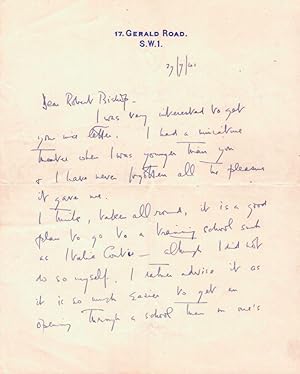
No Binding. Condition: Fine. AUTOGRAPH LETTER SIGNED by Noel Coward, with content pertaining to theater. Addressed to a young admirer, Robert Bishop, Coward writes: "I was very interested to get your nice letter. I had a miniature theater when I was younger than you & I have never forgotten all the pleasure it gave me. "I think, taken all round, it is a good plan to go to a training school such as Italia Conti - although I did not do so myself. I rather advise it as it is so much easier to get an opening through a school than on one's own. Anyway, all good luck to you. "Yours Sincerely [signed] Noel Coward" Quarto (8x10 in.), one sheet (recto and verso, 1.5 written pages); folds, otherwise fine. WITH: Three letters (three sheets total) on Coward's letterhead to Robert Bishop from Lorn Lorraine, Coward's secretary.
Seller Inventory # 722
-
World Without Men
Published by Xavier Moreau Inc, New York, 1984
Seller: Manhattan Rare Book Company, ABAA, ILAB, New York, NY, U.S.A.
Seller rating 5 out of 5 stars
First Edition Signed
Hardcover. Condition: Fine. 1st Edition. SIGNED LIMITED FIRST EDITION of one of Newton's most successful books, illustrated with 180 black-and-white photographs. Although the limitation is not stated, it is believed that the edition was limited to 200 copies. (New York): Xavier Moreau Inc., (1984). Tall quarto, original silver-stamped gray cloth, original slipcase. A fine copy.
Seller Inventory # 390
-
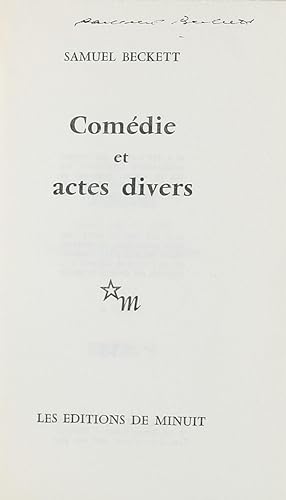
Comédie et actes Divers
Published by Les Editions De Minuit, Paris, 1966
Seller: Manhattan Rare Book Company, ABAA, ILAB, New York, NY, U.S.A.
Seller rating 5 out of 5 stars
First Edition Signed
Soft cover. Condition: Fine. Dust Jacket Condition: Fine. 1st Edition. First French edition, SIGNED BY BECKETT on title page; one of only 112 copies printed on "bouffant select marques" and reserved for the publishers. A collection of six short plays, translated from English by Beckett. Includes: Comédie, Va et vient, Cascando, Paroles et musique, Dis Joe, Acte sans paroles II. Paris: Les Editions de Minuit, (1966). Octavo, original printed wrappers; glassine. Unopened. A FINE COPY.
Seller Inventory # 939
-
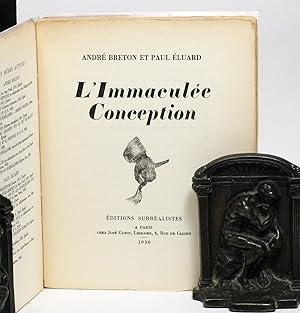
L'Immaculée Conception
Published by Surréalistes, Paris, 1930
Seller: Manhattan Rare Book Company, ABAA, ILAB, New York, NY, U.S.A.
Seller rating 5 out of 5 stars
First Edition Signed
Original wrappers. Condition: Good. First edition. FIRST EDITION ASSOCIATION COPY SIGNED AND INSCRIBED BY ANDRÉ BRETON. Written within the span of only three weeks during the summer of 1930, André Breton and Paul Éluard's L'Immaculée Conception is a quintessential example of the Surrealist practice of automatic writing. While Surrealism today may at first evoke painters such as René Magritte and Salvador Dalí, Surrealism was demarcated by its founders, namely Breton, as an experiment as much, if not more, in language and literature as the visual arts. Thus, the process of automatic writing which he developed across his lifetime sits at the heart of the first Surrealist Manifesto (1924)-and L'Immaculée Conception represents a pinnacle automatic text executed by two of the major Surrealist vanguards themselves. In a 1961 interview with Judith Jasmin, Breton maintained that the mission of Surrealism has been the same since 1924, and that Surrealism continues to be defined as: "automatisme psychique pur, par lequel on se proposait d'exprimer, par écrit ou de tout autre manière, le véritable mécanisme de la pensée. Il s'agissait d'une dicté de la pensée en dehors de tout contrôle-et ceci était très important-de tout contrôle exercé par la raison et en dehors de toute préoccupation esthétique ou morale." (Breton, 1961) [pure psychic automation, by which one proposes to express, in writing or any other manner, the true mechanism of thought. It was a dictation of thought beyond any control-and this was very important-any control exercised by reason and beyond any aesthetic or moral concern.] Barring re-reading and editing, the authors consequently forbade themselves "d'apprecier encours de route le produit de cette activité" [from appreciating, en route, the product of this activity] (Breton, 1961). At times losing "syntactical clarity" and "grammatical intelligibility", L'Immaculée Conception interrogates what it means to be human and divine and tackles sacred Christian doctrine in a meeting of Breton's and Éluard's characteristic wits (Conley, p. 607). Skirting all censorship and demonstrating an intelligence defiantly detached from the human faculties of reason and logic, L'Immaculée Conception reinforces the Surrealist style of surprise and inverted expectation. This first edition copy is signed by André Breton to Monique Fong (a.k.a. Monique Fong Wust) with the following inscription: "'Le rosier d'écume de mer' à Monique Fong avec les affectueux compliments d'André Breton" ["'The sea-foam rose' to Monique Font with the affectionate compliments of André Breton"] In this personalised message, Breton quotes from the penultimate chapter's final section, "L'idée du devenir": "Si c'était à recommencer, si c'était à recommencer. Le rosier d'écume de mer est debout à côté de moi dans ce portrait poétiquement définitif" (Breton and Éluard, p. 110) [If I had to star over, if I had to start over. the sea-foam rose stands at my side in this poetically-definitive portrait.] A Surrealist writer and intellectual closely connected with many other prominent champions of the movement, Fong Wust first met Breton at a party hosted by Claude Lévi-Strauss and would later maintain a lifelong correspondence with Marcel Duchamp-documenting much of the movement's aims, ambitions and successes. The book is number 179 of 2,000 copies printed on hand-made paper from Sorel-Moussel. Formerly "la véritable capitale du papier" [the true capital of paper], Sorel-Moussel is a village in northern France renown for its paper mills constructed in 1814 and operated by famed printer Firmin Didot, which ceased production in the later half of the twentieth century (Cathelinais, p. 5). References: André Breton, "Le sel de la semaine", interview by Judith Jasmin, Radio-Canada (27 February, 1961), C. Cathelinais, "L'ancienne papeterie devenue entrepôt abritera une turbine électrique", Paris-Normande (26 February, 1987) Katharine Conley, "Writing the Virgin's Body: Breton and Eluard's Immaculée Conception", The French Review 67.4 (1994), 600-608 BRETON, ANDRÉ and ÉLUARD, PAUL. L'Immaculée Conception. Paris: Surréalistes, 1930. Quarto (7¼ x 9¼ inch; 184 x 235 mm), number 179 of 2,000 copies printed on papier impondérable hand-made in Sorel-Moussel; pp. 130; originals wrappers, glassine; housed in a custom presentation box. Front wrapper detached (but held snugly under glassine), text block with splits. Fading to spine and perimeter of wrapper. RARE SIGNED, AND WITH AN INTERESTING ASSOCIATION.
Seller Inventory # 2504
-
Shantaram
Published by Scribe, Melbourne, 2003
Seller: Manhattan Rare Book Company, ABAA, ILAB, New York, NY, U.S.A.
Seller rating 5 out of 5 stars
First Edition Signed
Condition: Fine. Dust Jacket Condition: Fine. First edition. FIRST EDITION, SIGNED AND INSCRIBED BY ROBERTS ON THE TITLE PAGE: "May all those you love find the truth in you and be true to your love. November 2003 Gregory David Roberts" "In 1980, while serving a 19-year sentence for robbery in Australia, Roberts escaped from prison and fled to India, spending a decade on the lam before he was recaptured and extradited. As Australia's most wanted man -- or so he describes himself in this fictionalized account of his years in Bombay -- Roberts was a larger-than-life figure in his native country long before 'Shantaram' made him a best-selling author" (Megan O'Grady, The New York Times).? "Shantaram is a novel of the first order, a work of extraordinary art, a thing of exceptional beauty. If someone asked me what the book was about, I would have to say everything, every thing in the world. Gregory David Roberts does for Bombay what Lawrence Durrell did for Alexandria, what Melville did for the South Seas, and what Thoreau did for Walden Pond: He makes it an eternal player in the literature of the world" (Pat Conroy).? Melbourne: Scribe Publications, 2003. Thick octavo, original red cloth, original dust jacket. A fine copy. Note: This rare Australian first edition, first issue (with "Scribe" not in parenthesis on rear jacket flap), precedes all other editions. original cloth, original dust jacket.
Seller Inventory # 2928
-
I Want to Take Picture
Published by Nexus Press, Atlanta, 1987
Seller: Manhattan Rare Book Company, ABAA, ILAB, New York, NY, U.S.A.
Seller rating 5 out of 5 stars
First Edition Signed
Hardcover. Condition: Fine. 1st Edition. FIRST EDITION of one of the seminal photobooks of the 1980's. SIGNED BY BURKE INSIDE ORIGINAL DRAWING OF HIS HAND. One of only 1000 copies printed of the first edition. "Bill Burke has become known for his large-format portraits shot on Polaroid Land film, which have the formality and feel of nineteenth-century photographs whilst remaining acutely modern in their sensibilities. In his best book, I Want to Take Picture, this technique is entirely appropriate, since it records his personal pilgrimage to southeast Asia, duplicating the enterprise of the old colonialist photographers but adding a contemporary twist. "Although the pictures have a nineteenth-century feel, the book is also a diary that records a twentieth-century experience. Burke not only uses his photographs, but also employs documents- reproductions of ephemera like money and bus tickets- and collages them with handwritten captions. The result is a kaleidoscopic impression of his journeys, taking the book out of the documentary realm and into that of the personal road trip. However, this particular sojourn does not merely connate the search for self that occupies so much of late twentieth-century American photography. It also represents a moving attempt to come to terms with some of the events that haunted his generation" (Parr/Badger, The Photobook). Roth 101. Atlanta: Nexus Press, 1987. Folio, photo-pictorial boards. A fine copy. Rare signed.
Seller Inventory # 36
-
Derriere le Miroir. Saul Steinberg. Special Number 224
Published by Maeght, Paris, 1977
Seller: Manhattan Rare Book Company, ABAA, ILAB, New York, NY, U.S.A.
Seller rating 5 out of 5 stars
First Edition Signed
Hardcover. Condition: Fine. 1st Edition. LIMITED FIRST EDITION, number 128 of only 150 copies SIGNED BY STEINBERG. With three original color lithographs (one double-page) and numerous color reproductions throughout. Text by Italo Calvino. Printed on vélin d'Arches. Paris: Maeght, 1977. Folio, loose (as issued) in illustrated wrappers; housed in original chemise and slipcase. Fine condition.
Seller Inventory # 712
-
Om Atomernes Bygning [On the Structure of Atoms]
Published by Jul. Gjellerup, Copenhagen, 1923
Seller: Manhattan Rare Book Company, ABAA, ILAB, New York, NY, U.S.A.
Seller rating 5 out of 5 stars
First Edition Signed
Softcover, original wrappers. Condition: Very Good. FIRST EDITION, OFFPRINT ISSUE. FIRST EDITION, OFFPRINT ISSUE, INSCRIBED BY NIELS BOHR, of Bohr's Nobel Prize lecture, delivered on the occasion of Bohr's acceptance of the 1922 Nobel Prize in Physics. An association copy: Inscribed to J.A. Christiansen, noted scientist and student of Bohr. Inscribed in ink on the half-title by Bohr (in Danish): "Hr. Docent Dr. phil J.A. Christiansen med venlig Hilsen fra Forfatteren." [English translation: "Mr. Dr. Phil J.A. Christiansen with friendly greetings from the author"]. The recipient, Dr. Jens Anton Christiansen (1888-1969) "received his Ph.D from the Technical University of Denmark in 1921 and studied with Niels Bohr. He was the first to publish the term 'chain reaction,' which appeared in his doctoral thesis, Studies in Reaction Kinetics. Dr. Christiansen became Professor of Chemistry at the Technical University in 1931 and Head of the Institute for Physical Chemistry there in 1948" (The Sciences, Vol 7, Issue 6-7, Nov-Dec 1967). Professor J.A. Christiansen was also the recipient of the H.C. Oersted Medal in 1959, where he was introduced at the award ceremony by Bohr. Copenhagen: Jul. Gjellerup, 1923. Octavo, original wrappers; custom box. With printed letter from the publisher introducing the work laid-in. Light pencil notation on cover, minor rubbing to spine. A near-fine copy. Rare signed and in original wrappers.
Seller Inventory # 1615
-
Social Graces
Published by Aperture, Millerton NY, 1984
Seller: Manhattan Rare Book Company, ABAA, ILAB, New York, NY, U.S.A.
Seller rating 5 out of 5 stars
First Edition Signed
Hardcover. Condition: Fine. 1st Edition. SIGNED LIMITED FIRST EDITION, illustrated with 69 black and white images of Fink's photographs. One of 250 signed and numbered copies issued with an original photograph, "Tavern on the Green", signed and dated on the back. Millerton, NY: Aperture, 1984. Quarto (262 x 224mm), gilt-lettered brown cloth; matching slipcase. A fine copy. Rare.
Seller Inventory # 391
-
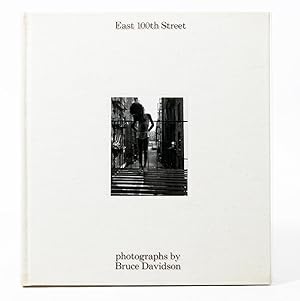
East 100th Street
Published by Harvard University Press, Cambridge, 1970
Seller: Manhattan Rare Book Company, ABAA, ILAB, New York, NY, U.S.A.
Seller rating 5 out of 5 stars
First Edition Signed
Hardcover. Condition: Fine. Dust Jacket Condition: Very Good. 1st Edition. FIRST EDITION, ASSOCIATION COPY, SIGNED AND INSCRIBED BY DAVIDSON: "To Lee Witkin / Bruce Davidson". Witkin was the enormously influential gallery owner who helped introduce the public to the masterpieces of contemporary photography. "Davidson returned to this blasted stretch of East Harlem regularly for nearly two years (always bringing prints for the people he photographed) until he and his bulky view camera began to be a part of the block's daily life. The published results are wrenching and revelatory. Davidson's strobe doesn't dispel the gloom or glamorize the ruin of the apartments, storefronts, and rubble-strewn lots where people stopped to pose for him, but the rapport he established allows those people to surrender to the camera with their humanity intact. The book's glossy duotone reproductions -- all face-to-face on spreads with wide white borders stripped of captions and page numbers -- give the grimiest surfaces a rich warmth and a luxurious sheen" (Roth, The Book of 101 Books). Roth 101. Parr/Badger II. Cambridge: Harvard University Press, 1970. Quarto (11.25 x 12.25 in), original cream linen with photographic image in center, original printed acetate. Small chip to acetate at the top of spine, otherwise fine. A beautiful copy, rare signed and with a good association.
Seller Inventory # 1448
-
Thomas Mann, New York
Published by n.p., New York, 1934
Seller: Manhattan Rare Book Company, ABAA, ILAB, New York, NY, U.S.A.
Seller rating 5 out of 5 stars
Art / Print / Poster Signed
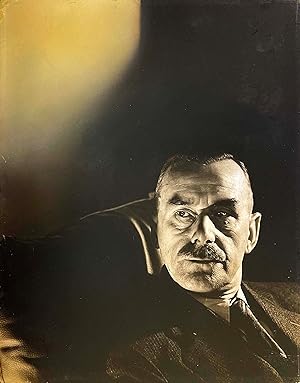
Condition: Very Good. POWERFUL STEICHEN PORTRAIT OF THOMAS MANN FROM CHANCE MEETING IN NEW YORK. Edward Steichen was one of the early pioneers of photographic art, leading the movement of photography from its established position as a utilitarian medium to a mode of creative expression. As a major contributor to Alfred Stieglitz's Camera Work magazine in the first decades of the twentieth century, Steichen had cemented his reputation as a new kind of photographer, enjoying both artistic and commercial success-working as chief photographer for Condé Nast and later heading the Met's photography department. In 1959, having completed the first decade in his tenure as director of the Museum of Modern Art's photography division, Steichen was approached by Tas Toth about curating a new display to serve as a counterpart to Steichen's astronomically successful The Family of Man-a MoMA exhibition that would become, and remains to-date, the most-viewed photographic exhibition. Toth's exhibition, to be called Das menschliche Antlitz Europas [The Human Face of Europe], would mirror The Family of Man's thematic emphasis on shared humanity, principally by showcasing images by distinguished figures, including Cartier-Bresson, Boubat, Brassai and Doisneau, alongside works by lesser-known artists. Initially, the renowned artists were hesitant to contribute towards this unique concept, and it was only after Steichen endorsed Toth by allowing him to exhibit his portrait of Thomas Mann that a large number of eminent photographers agreed to contribute to the group exhibition. Steichen's impactful photograph is the work present here. Steichen had taken the image in the United States, where Mann would emigrate in 1939 to avoid mounting persecution in his native Germany, and where Mann would remain until 1952. It was in 1934 that Mann, to promote his Jospeh series, made his first journey to America- embarking on RMS Volendam and arriving in New York to great fanfare-"scarcely dreaming," writes biographer Nigel Hamilton, "he would one day become an American citizen" (p. 283). The image of Mann follows in a line of portraits by Steichen of leading world figures, from Churchill and FDR to Chaplin and Gershwin. Furthermore, the present photograph preserves, in addition to Mann's likeness, the providential meeting of two of the most impactful twentieth century creatives who would both make their homes in the New World. Provenance: -Donated by Steichen to the original owner when he worked on the organization of the exhibition 'Das Menschliche Antlitz Europas'. -Christie's, lot 218, Sale 7415, 21 Nov. 1996 Exhibited: 'Das Menschliche Antlitz Europas', Municipal Museum of Munich, 1959. STEICHEN, EDWARD. Thomas Mann, New York (1934). Gelatin silver print, before 1959. 23.8 x 18.8 cm (9 â x 7 â in). Mounted on paperboard, signed on the reverse (in what does not appear to be Steichen's hand): "Edward Steichen", and numbered in pencil. With a tiny amount of touch-up at extreme top corner (almost entirely beneath the matte). Handsomely framed. References: Hamilton, Nigel, The Brothers Mann (New Haven: Yale University Press, 1979) Steichen, Edward, A Life in Photography (New York: Bonanza, 1984).
Seller Inventory # 2522
-
Public Opinion
Published by Harcourt, Brace and Company, New York, 1922
Seller: Manhattan Rare Book Company, ABAA, ILAB, New York, NY, U.S.A.
Seller rating 5 out of 5 stars
First Edition Signed
Original Cloth. Condition: Very Good. First Edition. RARE SIGNED FIRST EDITION OF WALTER LIPPMANN'S PRESCIENT TEXT EXAMINING THE INTERPLAY BETWEEN MEDIA, PUBLIC OPINION, AND DEMOCRACY. Signed and inscribed by Lippmann: "To E.W. Osborn / from his cell mate [?] / Walt Lippmann / March 1922." Everything old is new again. "For when there's panic in the air, with one crisis tripping over the heels of another, actual dangers mixed with imaginary scares, there is no chance at all for the constructive use of reasons, and any order soon seems preferable to any disorder." These words, written by Walter Lippmann in 1922 in Public Opinion, are as true today as they were over 100 years ago. Walter Lippmann (1889-1974), the father of modern journalism, won a Pulitzer Prize in 1958 and 1962, and a Presidential Medal of Freedom from President Johnson in 1964. He was also one of the the founding editors of the New Republic and the author of The New York Herald Tribune's nationally syndicated column "Today and Tomorrow" from 1931 to 1967 in which he shared his insights and analysis on domestic and international affairs. Lippmann was a political philosopher and President Wilson drew upon his ideas for, among other things, the post-World War I settlement plan (Fourteen Points). Lippmann was a confidante of every president from Teddy Roosevelt to Richard Nixon and a significant voice in global geopolitics. In April 1961 Soviet leader Nikita Khrushchev, dealing with a crisis in Berlin, asked Lippmann to delay a planned interview in Russia. When Lippmann said no, Khrushchev rearranged his plans to accommodate an interview with Lippmann (Harsch). The articles that resulted won Lippmann his second Pulitzer Prize. We have his preeminent text Public Opinion on offer. This work, about the media's role in shaping public opinion, is widely considered to be "the founding book of modern journalism" (Carey, 20). In this text, Lippmann exposed how the media shapes public perception and how that perception impacts society. His incisive analysis is increasingly relevant 100 years later and his work continues to be cited and built upon by those seeking to understand the complexities of modern public life. Lippmann was an intellectual and believed that journalism was vitally important as both a profession and an instrument of democracy. Public Opinion was prescient and foundational in media studies. In this text he coined the modern psychological meaning of the term "stereotype," which he defined as "cognitive shortcuts" used to navigate the complexities of the world. He also introduced the concept of "manufacture of consent," arguing that the media could shape public perception through framing and selective presentation of facts. Though this idea is commonly understood in today's media environment where commercialization and partisanship often upstage journalistic integrity, it was novel 100 years ago. He called this subjective, simplified version of reality the "pseudo-environment." Lippmann worried that these "pictures in our heads" led to opinions based on distorted or incomplete information, resulting in polarization and misinformation. In Public Opinion Lippmann shared his concerns about the fate of democracy, believing that society's complexity made it difficult for average citizens to fully understand and engage with public issues. He also shared his suspicion that some news stories were dominated by the emotions and hopes of the journalist rather than by the facts. To address these concerns, he advocated for expert analysis and interpretation to guide public opinion as well as elevated journalistic standards and professionalism. His analyses in this book provide context and lessons for political discourse and policy-making. While his ideas were ground-breaking and controversial in 1922, Lippmann's concerns about the media are indisputable. The modern media market is more competitive, more fragmented, and more profit-driven than that of Lippmann's day. As a life-long journalist Lippmann made many friends in the industry. While working at The New York World in the early 1920s, he met E. William Osborn, a drama critic and long-time editor. This copy that we have on offer is inscribed to Osborn, a member of the editorial staff of The New York World for 42 years. It's been 50 years since Walter Lippmann died, yet journalists today continue to grapple with many of the questions that defined Lippmann's life and career: How should news be created? What is the role of the media in shaping public opinion? How does one balance reporting and commentary? How do stereotypes affect public perception? What are the limitations of individual understanding in a complex world? New York: Harcourt, Brace and Company, 1922. Octavo, original cloth with paper spine label; custom box. Without the exceedingly rare dust jacket (we've never seen an example of the jacket). Some wear to cloth, with fraying at bottom corner of front panel, mild rubbing to spine label. A few early notations in text (underlinings and marginal lines), likely by Osborn. Notably, without any library stamps (a common problem with this book). A very good copy, exceptionally rare signed. References: James W. Carey, "The Press and the Public Discourse." The Center Magazine. March 1987. Marquis W. Childs and James Reston, eds. Walter Lippmann and His Times. New York: Harcourt, Brace, 1959. Christopher Daly. Covering America: A Narrative History of a Nation's Journalism. University of Massachusetts Press, 2012. Joseph C. Harsch. "Lippmann: statesman at a typewriter." The Christian Science Monitor, September 8, 1980. Nancy Snow. Information War: American Propaganda, Free Speech and Opinion Control Since 9/11. Canada: Seven Stories, 2003. Ronald Steel. "Lippmann, Walter." American National Biography, February 2000.
Seller Inventory # 2869
-
Typed Letter Signed [TLS]
Published by np, San Francisco, 1959
Seller: Manhattan Rare Book Company, ABAA, ILAB, New York, NY, U.S.A.
Seller rating 5 out of 5 stars
Manuscript / Paper Collectible First Edition Signed
custom folder. Condition: Very Good. First edition. A LONG LETTER TO A FELLOW PHOTOGRAPHER WITH REVEALING TECHNICAL INFORMATION ABOUT THE PHOTOGRAPHIC PROCESS. Written by Adams to fellow photographer Nicholas Dean, this letter engages many topics: first listing off a variety of impressive engagements and exhibits the two were involved with at the time, then settling finally on a detailed section on photographic techniques and tips. Adams explains first that he was arranging the logistics of a film about his life with art curator Beaumont (Newhall) which had been officially released the year before (1958). Then Adams goes on to congratulate Dean for his recent exhibition - a collection of photographs of the Boston Symphony Orchestra - and makes reference to an article called "Swell Egg" written in The New Yorker in October 1953 about the important American landscape photographer Paul Caponigro. Even in the first sentences, it becomes clear how well-ensconced Adams was in the photography world, how up-to-date he was with new developments and exhibits, for "photography was his calling, his métier, his raison d'être." ( Britannica ). Yet, what Adams seems most particularly interested in in this letter, however, is the light meter. These analog devices were used by photographers to 'read' the light in a situation, and then transfer the exposure information to a camera. Here, Adams makes reference specifically to the Weston meter - the most popular instrument of use by professionals at the time. In a marvelous moment of self-reference, the photographer uses the term "Zone VI value," while trying to explain to Dean how non-Weston meters misrepresent optimal "brightnesses." These "zone values" (numbered 0-X) were, in fact, formulated by Adams and Fred Archer, another celebrated American photographer, as part of the Zone System, a photographic technique for determining optimal film exposure and development. Based on a meticulous study of sensitometry (scholarship around which reached as far back as the 19th century) and written up extensively by Adams in one of his ten manuals (The Negative), the Zone System allowed for photographers to define a relationship between the way they visualized the photographic subject and the final results. This invention became so widely-used that starting in 1966, the scale was printed directly onto the Weston light meters. Adam's counsel to Dean, moreover, extended beyond the pre-photographic moment of light measurement. At the top of the letter are a series of instructions on how to develop photos - what developer to use, how long to sit in the water, at what angle to place the photograph in the tray. What this letter brings clearly to the fore, then, is Adam's "technical mastery [.] More than any creative photographer, before or since, he reveled in the theory and practice of the medium." ( The Ansel Adams Gallery ). The letter, typed on one 8.5x11 inch sheet of Adams's stationery with "ANSEL ADAMS" printed in red in large type at the top and his San Francisco address below it to the right, is dated December 7 '59 and reads in full: Dear Nick - - Good to get your two letters. This is just a rush reply because they are working out that Television movie with me (Beaumont is here) and things are hectic! Your picture which I returned was excellent ! Cheers for Symp. Hall exhibit! Camponiegro [sic] swell egg - have 3 prints of his for Polaroid collection. This "reading-in" business - Brrrrrrr!! You are still a bit haywire with the Meter business !!! The Weston is a pretty accurate device to read brightness in c/ft2. Pointing the meter down is merely a crutch and would help only with dark-gray pavement or grass. The fact that other meters give accurate readings when the Weston gives 1/2 optimum reading merely shows that those other meters are calibrated to overcome the statistical "average" brightnesses. However - read a single gray (or white, or dark) surface with those other meters and you will get near Zone VI value. The question is merely this - do you want "accurate" readings of actual brightness values (which you can then "place" as required, or do you want to use a meter which has been altered to meet a somewhat uncertain statistical situation? Its your dream!!!! Will be glad to get that Arts Fest cash so I can pay off the losersI [sic] What a lot of trouble that has been!!!! Stillwater, Okla.?????? Don't get it! No, I plan to arrive about the middle of March and stay until May 1st (in Cambridge). Would be glad to serve if can make date. When is???? Soundslike a good show! Look forward to the new 52!!! Sounds good! On what basis do you judge "speed" I have my own private systems which works BEAUTIFULLY (for me!) More soon - - - Good luck with the prints!!!!!!! Best to you and yours - - - - -and a better and longer visit next time! I was tired and sniffly this trip.- just a drip - that's what I wuz! [signed in red marker] Ansel [on top of page handwritten "TRY" followed by an arrow, then:] FG7 1 to 15 water 70 [deg] Tray HYPAN 15-16 minutes NORMAL VERSAPAN 12-13 " NORMAL Water pH may change times! San Francisco, CA: December 7, 1959. One side of one 8.5x11 inch sheet of Adams's letterhead. Signed "Ansel" in red marker. Usual folds, fine condition. Housed in custom folder. A WONDERFUL, IMPASSIONED LETTER WITH IMPORTANT AND SPECIFIC TECHNICAL CONTENT.
Seller Inventory # 2399
-
A Way of Seeing
Published by The Viking Press, New York, 1965
Seller: Manhattan Rare Book Company, ABAA, ILAB, New York, NY, U.S.A.
Seller rating 5 out of 5 stars
First Edition Signed
Condition: Fine. Dust Jacket Condition: Fine. First. FIRST EDITION SIGNED BY LEVITT on the title page; a fine copy. James Agee collaborated with Helen Levitt on A Way of Seeing, writing the introductory essay. His words bring attention to the grittiness of Levitt's street photographs, taken in Harlem, Spanish Harlem, and the Lower East Side, all lower income neighborhoods of New York City from the late 1930's until 1948. Her photographs punctuate the reality of New York City with garbage on the streets, buildings in disrepair, and other signs of obvious poverty. But a slightly longer glance at Levitt's photos reveals a work dominated by children, and children, unlike adults, are less consciously burdened by poverty; they busy themselves with childhood's unassuming playfulness. Levitt opens the book with several photographs of sidewalk chalk drawings, the kind one sees daily on any suburban or urban street, thereby inviting us into a world of children. We soon meet the actual children photographed, who engage in all kinds of play, from dress up to imagination games, to hiding in boxes, to "I dare you" types of games. The adults are hidden away and do not appear until fairly late in the book. They aren't missed as adults add little to children's play. Even when the grownups insert themselves into the children's world, their photographs are dominated by the babies they care for, babies whose job in these pictures is to bring joy-no diaper changings and inconsolable crying here. Furthermore, the photos are frequently funny; it's hard not to laugh at children so heartily engaged in their important work of play. In their humor, we see Levitt, the filmmaker. Levitt spent much of her career in film and in these photos we often see the slapstick comedies of the silent film era that influenced her work. But we aren't laughing at her subjects, we are delighting in their play. Yet, the book is not so condescending as to elevate or mock poverty and its victims. The photos are punctuated by the insidious elements of poverty-a boy holding a gun, children playing (gleefully) in gutters or precariously balanced on roofs, empty lots covered in garbage. In part Levitt does with photographs what Angela's Ashes does with words-she offers an honest way of seeing that is unafraid to show us the dirtiness of poverty but also unafraid to show us the joyfulness of living. Parr & Badger, The Photobook, v1 252-253: Roth 178-179. New York: Viking Press, 1965. Oblong quarto, original cloth, original dust jacket. Small, neat early owner signature on front free endpaper. A FINE COPY. Original Cloth, Original Dust Jacket.
Seller Inventory # 2855
-
Tales and Novels of J. De La Fontaine [Erotic Tales and Novels]
Published by G. J. Thieme, Nijmegen, Holland, 1929
Seller: Manhattan Rare Book Company, ABAA, ILAB, New York, NY, U.S.A.
Seller rating 5 out of 5 stars
First Edition Signed
Condition: Very Good. TICE, Clara (Illus) (illustrator). first. FIRST TICE EDITION ONE OF ONLY APPROXIMATELY FIVE COPIES WITH TWO ORIGINAL SIGNED CRAYON DRAWINGS AND TWELVE ORIGINAL ETCHINGS HAND COLORED BY TICE. Easily the most extravagant of Clara Tice's illustrated works, the extra-limited edition (approximately 5 copies) of Tales and Novels showcases the remarkable abilities of a revolutionary woman. Born in 1888, in Elmira, New York, Tice lived and worked at a time when female illustrators were a tiny minority whose artistic output was tightly constrained. Inspired by the views of her progressive parents, she used erotic and transgressive art to rebel against bourgeois boundaries and gender norms. In 1915, Anthony Comstock, then the head of the New York Society for the Suppression of Vice, led a raid on various "bohemian" institutions and confiscated the art. At the last minute, Tice's pieces were purchased by a patron, saving them and landing her on the front page of the New York Tribune. Thus began her rise to stardom. Marcel Duchamp befriended her, and Tice was welcomed into the exclusive Arensberg circle of avant-garde artists, which included luminaries such as William Carlos Williams and Wallace Stevens. Dadaism soon became a focus of the group, and Tice embraced its iconoclastic approach to visual art. Even Tice's lifestyle reflected her aesthetic philosophy. Her knee-length dresses traded conservatism for comfort and rebellion, and her bobbed hair started a trend in the Village. She died in Queens, in 1973, having been christened "the Queen of Greenwich Village," leaving behind a legacy that shaped New York and the art world. The highly decorated publisher's spines (with gilt nude lady in Tice's style in center) notes that this is "One of five copies with original drawings and etchings by Clara Tice." This copy, however, does not have the pasted in limitation slip noting the limitation and presenting it to the "Falstaff Connoisseur Collectors" seen in other copies. Otherwise it matches the other copies on record. It is possible it is an "extra" copy (bringing the total to slightly more than five) or that not all five were presented to the "Falstaff" collectors. Either way it is (obviously) exceedingly rare we have not been able to locate five other sets. Nijmegen, Holland: Privately printed at the printing house of G. J. Thieme, 1929. Quarto (approx. 9.5 x 6.5 in), publisher's deluxe three-quarter blue morocco with highly decorated spines and marbled boards; patterned edpapers, top edges gilt. Some mild scuffs to binding, interior fine. An exquisite and exceedingly rare set. Original publishers 3/4 morocco.
Seller Inventory # 3001
-
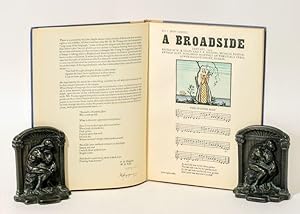
BROADSIDES, A COLLECTION OF NEW AND OLD SONGS, 1935
Published by Cuala Press, Dublin, 1935
Seller: Manhattan Rare Book Company, ABAA, ILAB, New York, NY, U.S.A.
Seller rating 5 out of 5 stars
First Edition Signed
Condition: Fine. Dust Jacket Condition: Very Good. ILLUSTRATIONS BY: YEATS, JACK B; BROWN, VICTOR; O'SULLIVAN, SEAN; PEET, E.C; KERNOFF, HARRY; MCGONIGAL, MAURICE MUSIC BY DUFF, ARTHUR (illustrator). SIGNED LIMITED FIRST EDITION. SIGNED LIMITED FIRST EDITION OF W.B. YEATS'S BROADSIDES, ONE OF ONLY 100 COPIES SIGNED BY W.B. YEATS AND F.R. HIGGINS AT END OF INTRODUCTORY ESSAY AND ACCOMPANIED BY BREATHTAKING HAND-COLORED ILLUSTRATIONS. Collection of 12 broadsides originally issued individually from January-December 1935. Containing both traditional and new Irish ballads written by Yeats, F.R. Higgins, Padraic Colum, and others. With engraved music throughout. Numerous evocative and emotional hand-colored woodblock illustrations, including many by Jack B. Yeats, brother of the famed W.B Yeats. Only 300 copies printed, with only 100 copies bound and signed, making this production EXTREMELY RARE. Signed by Yeats and Higgins at the end of their preface, Anglo-Irish Ballads. "Yeats is now seen as one of a handful of Irish writers whose influence and example helped create twentieth-century modernist literature in the English language.his huge international reputation is securely based on the mystery and grandeur of his late verse and the poignancy of his love poetry, but he first came to fame as the exotically Celtic poet of a 'new' nationalist Ireland: almost single-handed, he made Irishness culturally fashionable. Spearheading a great cultural renaissance, he moved into his maturity as the voice of his country" (Oxford Dictionary of National Biography) . It was not merely Yeats, however, who is responsible for arousing Irish patriotism. The Cuala Press, a small press started by Yeat's sister Elizabeth, is regarded as one of the first publishing houses to bring attention to Irish literature, art and music. Her production of Broadsidesis no different. "The glory that once was Ireland and could again be Ireland was the fire that burned unquenched in the mind and will of Elizabeth Corbett Yeats" (Colby Library Quarterly) . Dublin: Cuala Press, 1935. Small folio, original cloth backed boards with paper label to upper cover. Complete with what is almost certainly the original plain unlettered dust jacket (we can find no other examples of the jacket, but this is comparable to other jackets for Cuala Press books). Book remarkably bright and clean with only a couple of tiny spots to cloth. A few chips to dust jacket. Housed in vibrant red custom box. An VERY RARE AND NEARLY PERFECT COPY of a book of large cultural importance with dazzlingly fresh illustrations.
Seller Inventory # 1940
-
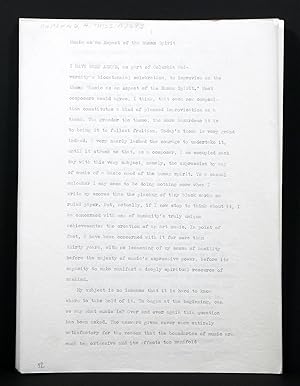
Music as an Aspect of the Human Spirit
Published by np, Ossining, 1954
Seller: Manhattan Rare Book Company, ABAA, ILAB, New York, NY, U.S.A.
Seller rating 5 out of 5 stars
First Edition Signed
No Binding. Condition: Fine. 1st Edition. Typescript Signed, an essay titled Music as an Aspect of the Human Spirit, written by the composer for Columbia University's bicentennial celebration. Signed on the last page. 11 1/4 pages, twelve 4to sheets. [Ossining?], circa 1954. An annotated typed draft of the same work is located in the Copland Papers at the Library of Congress.
Seller Inventory # 402
-
![Seller image for On the Influence of Magnetism on the Nature of the Light Emitted by a Substance (Parts I and II and Appendix) [Zeeman]; WITH: Radiation in a Magnetic Field [Michelson] for sale by Manhattan Rare Book Company, ABAA, ILAB](https://pictures.abebooks.com/inventory/md/md30773946122.jpg)
On the Influence of Magnetism on the Nature of the Light Emitted by a Substance (Parts I and II and Appendix) [Zeeman]; WITH: Radiation in a Magnetic Field [Michelson]
Published by various, Leiden, 1896
Seller: Manhattan Rare Book Company, ABAA, ILAB, New York, NY, U.S.A.
Seller rating 5 out of 5 stars
Manuscript / Paper Collectible First Edition Signed
Condition: Very Good. First edition. FIRST APPEARANCE IN ENGLISH IN ORIGINAL WRAPPERS OF THE DISCOVERY ("THE ZEEMAN EFFECT") THAT EARNED ZEEMAN THE SECOND EVER NOBEL PRIZE IN PHYSICS; WITH MICHELSON'S REPORT (IN OFFPRINT FORM) OF ONE OF THE EARLIEST OBSERVATIONS OF QUANTUM EFFECTS, "THE ANOMALOUS ZEEMAN EFFECT." Although it was not entirely unexpected following the work of Faraday, Zeeman was the first to observe the influence of a magnetic field on spectral emission lines - what would quickly become known as the Zeeman effect. "Initially, in late October 1896, Zeeman could only observe a diffuse line broadening that had actually been predicted by Joseph Larmor's electron theory. [But by] the spring of 1897, Zeeman first recorded distinct splittings of spectral lines into doublets and triplets." (Hentschel). Although the result may have been anticipated, Zeeman shared his observations with Hendrik Lorentz, "who showed Dr. Zeeman that the widening could be predicted from Lorentz's theory that light is generated by the vibrations of electrically charged particles or ions; and that the same theory indicated that the edges of the widened lines should be plane-polarized or circularly-polarized". (Reese). Zeeman confirmed Lorentz's predictions, and the two of them would share the 1902 Nobel Prize in physics "in recognition of the extraordinary service they rendered by their researches into the influence of magnetism upon radiation phenomena." Albert Michelson (winner of the 1907 Nobel Prize in physics) was among those who repeated Zeeman's experiments, and in 1897 his work "cast severe doubts" on Lorentz's results. (del Toro Iniesta). Although both the details of his observations and the theory he presented was recognized as problematic almost immediately (as can be seen, for example, in Reese's article in Science from 1900), what he observed was that Zeeman's spectral lines could be resolved into an even finer splitting. "Such splitting, which soon became known as the 'anomalous' Zeeman effect, remained absolutely mysterious in the classical electron theory and deeply problematic for Bohr's atomic model as well." (Hentschel). (The discovery of the anomalous Zeeman effect is often attributed to Preston, who independently also observed the splitting of Zeeman's spectral lines. (del Toro Iniesta). The attribution is therefore likely due to a defect in Michelson's experimental setup.) A number of explanations were offered for the anomalous Zeeman effect in the years that followed Michelson's observations, but these were almost entirely ad hoc. In fact, the anomalous Zeeman effect would become one of the problems that sent quantum theory into a "crisis period" in the early 1920s. (Hentschel). It would eventually be explained by appealing to electron spin, making Michelson's observations in the papers offered here one of the first experimental results only explicable by quantum mechanics. The first two of the Zeeman papers offered here are English translations of Zeeman's original papers in Dutch. Together (with the Appendix also included in a separate issue where Zeeman defends his priority), they form a single article with the same title that appeared in the Philosophical Magazine for March 1897. However, these issues of the Communications from the Physical Laboratory of the University of' Leiden were published between April 1896 and January 1897, predating the Philosophical Magazine publication. The first two Michelson offprints offered here are of a single paper printed in both the Astrophysical Journal and the Philosophical Magazine reporting early spectral line splitting observations that had not been yet been reported by Zeeman. The third is Michelson's report of the further splitting of the spectral lines, which marks the anomalous Zeeman effect. The first paper is inscribed with "Compliments of the Author" written on front wrapper but we have not been able to confirm that this is in Michelson's hand. References: Hentschel K. (2009) "Zeeman Effect". In: Greenberger D., Hentschel K., Weinert F. (eds) Compendium of Quantum Physics. Springer, Berlin, Heidelberg. Hentschel K. (2009) "Quantum Theory, Crisis Period 1923-Early 1925" ". In: Greenberger D., Hentschel K., Weinert F. (eds) Compendium of Quantum Physics. Springer, Berlin, Heidelberg. del Toro Iniesta, J.C. (1996) On the discovery of the Zeeman effect on the sun and in the laboratory. Vistas in Astronomy 40(2). Reese, H. (1900). The Zeeman Effect.ÂScience,Â12(295), 293-297. -------------- P. Zeeman, 'On the Influence of Magnetism on the Nature of the Light Emitted by a Substance (Part I)', Communications from the Physical Laboratory of the University of Leiden 33 (1896). l-8. WITH PART II (same issue). Spine perished (but issue held together with mylar); chips to front wrapper. [With Appendix issue, 1897]. A. Michelson. 'Radiation in a Magnetic Field'. The Astrophysical Journal, Vol VI, No. 1, June 1897. Offprint. Original grey printed wrappers. Small tear in top edge throughout the offprint, not near text. Light soiling to wrappers. A. Michelson. 'Radiation in a Magnetic Field'. Philosophical Magazine (5), 44 (1897), pp. 109-115 (Reprint of the previous item, published slightly later). Offprint. Original printed wraps. Some soiling to wrappers. A. Michelson, 'Radiation in a Magnetic Field'. Philosophical Magazine (5), 45 (1898), pp. 348-356. Original printed wraps. (This is a different paper in which Michelson shows that the spectral lines are split into more than 3 components in a magnetic field - this is the anomalous Zeeman effect). Some soiling to wrappers. Issues handsomely boxed together. A RARE SET IN ORIGINAL WRAPPERS DOCUMENTING AN IMPORTANT DISCOVERY IN PHYSICS.
Seller Inventory # 2393
-
Nursing Mother: Photograph Signed [Tasha Tudor and Child]
Published by np, 1940
Seller: Manhattan Rare Book Company, ABAA, ILAB, New York, NY, U.S.A.
Seller rating 5 out of 5 stars
Signed
Condition: Fine. RARE SIGNED PHOTOGRAPH OF AN ICONIC IMAGE BY NELL DORR. Wonder and magic are themes that American photographer Nell Dorr (1893 - 1988) explored throughout her life. She believed that terror and misery were already abundantly documented in American culture and thus committed herself to eliciting beauty. She had learned photography as a child (her father ran a successful photography studio) and began exhibiting her work professionally in order to support her young family after she divorced her first husband. Dorr famously looked beyond collicky infants and overwhelmed mothers, opting to evoke a dreamy atmosphere of calm, confident mothers and their cherubic children. Taken around 1940 the Nursing Mother photographs are a collaboration between Dorr and her good friend, Tasha Tudor, one of America's most beloved author-illustrators of children's literature. Nestled against a backdrop of home-spun lace, a young Tudor in this photo cradles her nursing infant. When one of her own daughters died in 1954, Dorr published the Nursing Mother photographs in an elegiac book called Mother and Child, which would become her best-known work. A year later, in 1955, she contributed a version of Nursing Mother to Edward Steichen's famed Family of Man Exhibition at the Museum of Modern Art. Conceived as a declaration of global solidarity in the decade following World War II, Family of Man traveled the world for 8 years and eventually over 8 million visitors viewed the exhibition. Throughout her life Dorr continued to plumb the relationship between mother and child through experimental sound film, photo murals, and photography. Provenance: Dorr gifted this signed photograph to Arthur Klein, who along with his wife Luce had pioneered the field of spoken art and recorded literature. A line in her presentation letter to Klein (a copy of which is included with the photo) elucidates Dorr's inspiring body of work: spring is coming into bud and the old magic has lost none of its wonders. Acquired directly from the Klein family. Size: photo: approx. 7.5 x 9.5. Framed = 13x16. Silver gelatin photograph. Taken c.1940, printed later. Signed by Dorr in full "Nell Dorr" in marker on the bottom left of the photo. Fine condition. Photographs signed by Dorr are rare.
Seller Inventory # 2653
-
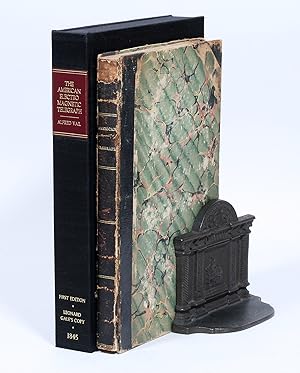
The American Electro Magnetic Telegraph: with the Reports of Congress, and a Description of all Telegraphs Known, employing Electricity or Galvanism
Published by Lea & Blanchard, Philidelphia, 1845
Seller: Manhattan Rare Book Company, ABAA, ILAB, New York, NY, U.S.A.
Seller rating 5 out of 5 stars
First Edition Signed
Hardcover. Condition: Very Good. First Edition. FIRST EDITION, LEONARD GALE'S COPY, of perhaps the most important book documenting the earliest history of telegraphy. Gale's work with Samuel Morse and Alfred Vail was critical to the success of the telegraph. With Gale's ownership signature on title page and front pastedown. On May 24, 1844, Samuel Morse famously sent the world's first telegraphic message: "What Hath God Wrought" from the Rotunda of the United States Capitol Building in Washington, DC to Baltimore, MD. On the other end of this transmission was Alfred Vail, the lesser known, but equally important inventor of the telegraph. Vail's contributions vastly improved upon Morse's design and were critical to the telegraph's success. Published in 1845, one year following the aforementioned successful telegraphic test, Vail's The American Electro Magnetic Telegraph describes in detail the workings of the device and its applications as well as the history of telegraphy. Containing 81 engravings and several reports of Congress on the subject of electro magnetic telegraphs, this book serves as the earliest, and most complete survey of the work done to that date in the field of telegraphy. This particular copy belonged to Dr. Leonard D. Gale. Like Vail, Gale's contributions to the success of the telegraph were critical, having worked closely with Morse and Vail on the invention. According to the Library of Congress, Gale was instrumental in pointing out the flaws in Morse's telegraph system and showing him how to boost the strength of the signal and overcome distance problems. Gale is quoted and/or mentioned numerous times in the book. Gale signed and dated the book twice: once on the front pastedown (dated 1845, the year of publication) and once on the title page (dated 1848). "From the Author" appears also on the title page, but does not appear to be in the author Vail's hand. There is a note at the bottom of the title page by Gale's grandson (Clarence Gale Allen) providing page numbers where his grandfather is mentioned in the book. There are also annotations on the cited pages in Clarence Gale Allen's hand. Philadelphia: Lea & Blanchard, 1845. Octavo, three-quarter black morocco over marbled boards; housed in custom presentation box. Rubbing to boards, joints tender (but holding). Text clean. Woodcut engravings thoughout showing schematic drawings of all aspects of telegraphs and the application of Morse Code. Howes V4; Wheeler 1087. An important association copy of one of the most significant books documenting the history of the telegraph.
Seller Inventory # 2745
-
Stuart Little: "Summer Memories" Signed Lithograph
Published by np, np, 1996
Seller: Manhattan Rare Book Company, ABAA, ILAB, New York, NY, U.S.A.
Seller rating 5 out of 5 stars
Art / Print / Poster First Edition Signed
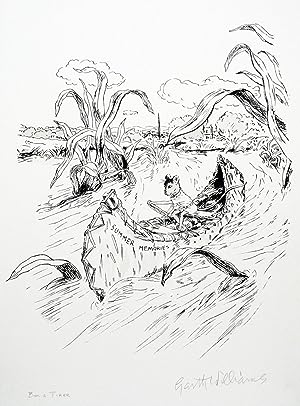
nb. Condition: Fine. First edition. EXTREMELY RARE LITHOGRAPH SIGNED BY ILLUSTRATOR GARTH WILLIAMS OF THE COVER ART FOR E.B. WHITE'S CLASSIC STUART LITTLE. WITH HAND-COLORING BY WILLIAMS. Pulled by hand from the original pen and ink drawing by Garth Williams. Marked "Bon à Tirer" ("ready for press") in pencil by the printer. This image was acquired directly from the lithographer; Williams added the delicate gray hand-coloring in this image as a guide for the lithographer to follow in coloring the full edition. Williams died in 1996 just after this "ready for press" lithograph was printed; therefore no copies of the final printing of approximately 300 were signed. 11.25 x 15 inches. Fine condition. A UNIQUE EXAMPLE OF ONE OF GARTH WILLIAMS'S MOST DESIRABLE IMAGES.
Seller Inventory # 2237
-
Photograph Signed
Published by np, np, 1978
Seller: Manhattan Rare Book Company, ABAA, ILAB, New York, NY, U.S.A.
Seller rating 5 out of 5 stars
First Edition Signed
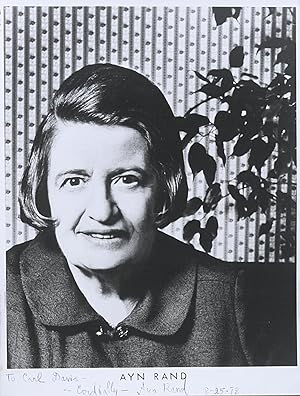
No Binding. Condition: Very Good. 1st Edition. LARGE (8 x 10 in ) PHOTOGRAPH OF RAND, SIGNED AND INSCRIBED in ink in the bottom margin: "To Carl Davis - / -Cordially - Ayn Rand / 8-25-78". A fine portrait of Rand in her later years. A little ink variation on the inscription, due to the glossy paper, otherwise fine. Signed Rand photographs are extremely rare on the market.
Seller Inventory # 1468
-
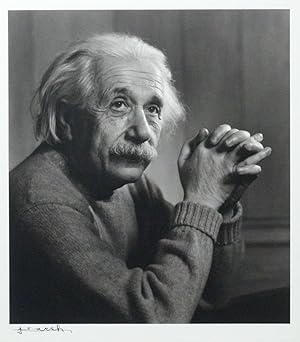
Portrait Photograph of Albert Einstein, signed by Yousuf Karsh
Published by np, Princeton, NJ, 1948
Seller: Manhattan Rare Book Company, ABAA, ILAB, New York, NY, U.S.A.
Seller rating 5 out of 5 stars
Signed
framed. Condition: Fine. ONE OF THE MOST CELEBRATED IMAGES OF EINSTEIN, SIGNED BY MASTER PHOTOGRAPHER, YOUSUF KARSH. On February 11, 1948, Yousuf Karsh, perhaps the most accomplished portrait photographer of his generation, visited The Institute for Advanced Study in Princeton to fulfill a dream of his: to photograph Albert Einstein. As he later explained: "Among the tasks that life as a photographer had set me, a portrait of Albert Einstein had always seemed a 'must' - not only because this greatest refugee of our century has been accounted by all the world as the [most] outstanding scientist since Newton, but because his face, in all its rough grandeur, invited and challenged the camera." (Karsh: Beyond the Camera, David Travis, ed.). "At Princeton's Institute for Advanced Study, I found Einstein a simple, kindly, almost childlike man, too great for any of the postures of eminence. One did not have to understand his science to feel the power of his mind or the force of his personality" (official Karsh website). "Awed before this unique intellect, I yet ventured to ask Einstein his views on human immortality. He mused for a moment and then replied, 'What I believe of immortality? There are two kinds. The first lives in the imagination of people and is thus an illusion. There is a relative immortality, which may conserve the memory of an individual for some generations. But there is only one true immortality, on a cosmic scale, ant that is the immortality of the cosmos itself. There is no other.' "He spoke of these ultimate mysteries as calmly as he might a student's question about mathematics - with such an air of quiet confidence, indeed, that I found his answer profoundly disturbing to one who held other views. Knowing him to be an accomplished violinist, I turned the conversation, and asked if there were any connection between music and mathematics. 'In art, he said, 'and in the higher ranges of science, there is a feeling of harmony which underlies all endeavour. There is no true greatness in art or science without that sense of harmony. He who lacks it can never be more than a great technician in either field.' "Was he optimistic about the future harmony of mankind itself? He appeared to ponder deeply and remarked in graver tones: 'Optimistic? No. But if mankind fails to find a harmonious solution than there will be disaster on a dimension beyond anyone's imagination.' To what source should we look for the hope of the world's future? 'To ourselves,' said Einstein. He spoke sadly yet serenely, as one who had looked into the universe far past mankind's small affairs. In this humor my camera caught him. the portrait of a man who had traveled beyond hope or despair." (Yousuf Karsh, Regarding Heroes). (Opening quote from: Colin Naylor, ed., Contemporary Photographers.) Silver print. Photo taken Princeton, 1948. Printed later. Signed by Karsh in full beneath the image on photographer's mount. With Karsh's original calling "card" - a 4x10 inch cardboard slip - included. Image: 8x9 inches. Framed to an overall size of 12x15 inches. Fine condition.
Seller Inventory # 2327
-
Photograph of Albert Einstein in his Study
Published by np, Princeton, 1950
Seller: Manhattan Rare Book Company, ABAA, ILAB, New York, NY, U.S.A.
Seller rating 5 out of 5 stars
First Edition Signed
Condition: Very Good. A beautiful photo of Einstein at work in his study, seemingly absorbed with his thoughts. The photographer, Hermann Landshoff, like Einstein, was a German-Jewish émigré who settled in the United States in the 1930s. His large body of work encompasses portraits of some of the most influential figures of the century. Landshoff was highly respected by his peers, with his work prompting the American photographer Richard Avedon to claim "I owe everything to Landshoff." Landshoff visited Einstein to photograph him several times in the 1940s and early 1950s, showing Einstein in quieter moments at his home or study in Princeton. With Landshoff's copyright stamp on verso marking this as a "Sample copy" and "Not for sale or reproduction." Also with Landshoff's signature on the original matte board. The original (non-archival) matte was removed during framing to better preserve the photo, but the signature was preserved and is now displayed on verso. Gelatin silver print with sepia tones. Taken c.1950, likely a contemporary or early printing. Approx. 9.25 x 10.5 in (235 x 263 mm). Archivally framed under museum glass to a size of 16 x 17.5 in. A few tiny spots to image, generally in fine condition, handsomely framed.
Seller Inventory # 2896
-

Typed Letter Signed
Publication Date: 1955
Seller: Manhattan Rare Book Company, ABAA, ILAB, New York, NY, U.S.A.
Seller rating 5 out of 5 stars
Signed
No Binding. Condition: Very Good. Typed letter, in Hebrew, signed "D. Ben-Gurion" as Minister of Defense on State of Israel letterhead, one page, 6" x 8", August 26, 1955. Translation of the Hebrew text: "I have no doubt that the problem of security disturbs your rest. True, the problem of security, at this time, is the principal problem of the State. Any person - just like an entire nation - can feel the danger waiting at his door. We are a small nation, and any boasting we do will only make a laughingstock out of us. But we are not powerless, not in the military sense, and certainly not in the moral and political sense. I, however, am calm and certain that, when it comes to the test, the Israel Defense Forces will be able to defend our peace and our sovereignty - the Israel Defense Forces is the army of the people, and of all its circles and factions." File holes along right margin, otherwise fine condition. A dramatic letter with excellent content from the first Prime Minister of Israel.
Seller Inventory # 33
-
Autograph Letters Signed
Publication Date: 1805
Seller: Manhattan Rare Book Company, ABAA, ILAB, New York, NY, U.S.A.
Seller rating 5 out of 5 stars
Signed
Condition: Very Good. FOUR AUTOGRAPH LETTERS with good content by Humphry Davy to his close friend and patron Davies Gilbert. In one letter, written on the recto of one sheet with Gilbert's address on verso, Davy mentions a recent visit to William Herschel (". I have been very much delighted to see the activity & zeal with which Mr Herschell pursues Astronomy & the perfect state of his instruments."); in another letter (one sheet, both sides), Davy writes emotionally to Gilbert about his health and the Presidency of the Royal Society: ".I am very anxious to learn the state of your feelings with respect to the Presidency, if what I fear must be the case the state of my health obliges me to resign.". Gilbert would indeed succeed Davy as President of the Royal Society in 1827 after Davy resigned due to illness. In the third letter (one sheet, both sides), Davy writes to Davy while convalescing with Coleridge's friend Tom Poole (".Mr Poole my kind Host desires to be respectfully remembered to the Pres. RS."). In the final letter (half sheet, one side) Davy addresses a simple business matter. Each letter is signed "H. Davy". 1805-27. Folds and a few spots of early tape reinforcement. Remnants of wax seal on letter mentioning Herschel. Generally very good. Note: A custom cloth box is available for $250.
Seller Inventory # 678
-
Inside World
Published by Thea Westreich, New York, 1989
Seller: Manhattan Rare Book Company, ABAA, ILAB, New York, NY, U.S.A.
Seller rating 5 out of 5 stars
First Edition Signed
Cloth, slipcase. Condition: Fine. First edition. SIGNED LIMITED FIRST EDITION, number 217 of only 250 copies, SIGNED BY PRINCE AND WITH ACCOMPANYING HANDWRITTEN JOKE, ALSO SIGNED. An exhibition catalogue/artist's book published on the occasion of a 1989 Kent Gallery show, co-curated by Richard Prince and Thea Westreich. Including images by Prince interspersed with those of Richard Artschwager, Troy Brauntuch, Francis Picabia, Sigmar Polke, Man Ray, Gerhard Richter, Cindy Sherman, and Andy Warhol; each copy with its own personalized joke penned by Prince. Signed by Prince on the limitation page with accompanying handwritten joke, also signed, reading: "With all I've heard about A-bombs that'll destroy a city and H-bombs that'll destroy a state and chain reactions that'll destroy the world - you know I just don't have the incentive to buy a two pants suit." New York: Thea Westreich, 1989. Number 217 or 250 copies. Octavo (12 5/8" x 8 3/4"), original red cloth, original slipcase. Signed joke laid in (as issued). Tiny bump to bottom edge of joke page. A fine copy.
Seller Inventory # 2590
-
Photograph: Georgia O'Keeffe After Supper, Ghost Ranch, 1975
Published by np, Ghost Ranch, New Mexico, 1975
Seller: Manhattan Rare Book Company, ABAA, ILAB, New York, NY, U.S.A.
Seller rating 5 out of 5 stars
Signed
Condition: Fine. ARTIST'S PROOF, SIGNED BY THE PHOTOGRAPHER BUDNIK. A wonderful, evocative photograph of O'Keeffe at 87 years old, taken at her beloved Ghost Ranch, just north of Abiquiú, New Mexico. By March 1975, when this photograph was taken, O'Keeffe had begun to explore pottery as her chief artistic medium. The photographer Budnik powerfully foregrounds the hands that shaped the clay, reminding us of O'Keeffe's relentless pursuit of art and creativity. At an age where most famous people are photographed looking wise or contemplative, it's refreshing to see Budnik capturing the joy of O'Keeffe in her later stage of life. The photographer Dan Budnik, whose career ranged from artist portraiture to major documentary work on the Civil Rights Movement, brought to his sitters an unusual mixture of intimacy and formal rigor. His 1975 photographs of O'Keeffe at Ghost Ranch are among the most compelling visual records her in the last years of her life. Gelatin silver print, artist's proof (noted "AP" by Budnik at bottom left), from an unspecified edition; printed later. Not examined out of frame. Size: 16 x 10.5 in; framed to an overall size of approx. 26 x 23 in. Fine condition.
Seller Inventory # 3036
-
China Diary: Red Square and the Forbidden City
Published by Thames and Hudson Ltd, London, 1982
Seller: Manhattan Rare Book Company, ABAA, ILAB, New York, NY, U.S.A.
Seller rating 5 out of 5 stars
First Edition Signed
Hardcover. Condition: Fine. 1st Edition. FIRST EDITION, WITH AN ORIGINAL LITHOGRAPH SIGNED BY DAVID HOCKNEY. One of only 1000 copies (#334) signed by Spender and Hockney. With the original folding five-color lithograph ("Red Square and the Forbidden City") signed in pencil by Hockney loose in printed card sleeve; book with 158 illustrations, 84 in color. London: Thames and Hudson Ltd, 1982. Quarto, original red cloth gilt, original card box with red printed label. Red paper chemise housing folded lithograph. A FINE COPY, with lithograph in perfect condition with bright colors and no offsetting (protected by tissue guards). RARE COMPLETE, since over time many lithographs have been separated from the book. (Note: Video shows a different copy.).
Seller Inventory # 2917
-
Typed Letter Signed [TLS]
Published by NP, Atlanta, 1936
Seller: Manhattan Rare Book Company, ABAA, ILAB, New York, NY, U.S.A.
Seller rating 5 out of 5 stars
Manuscript / Paper Collectible First Edition Signed
Letter. Condition: Very Good. LETTER WRITTEN AND SIGNED BY MARGARET MITCHELL DETAILING NAMING OF CLASSIC CHARACTER SCARLETT O'HARA. Margaret Mitchell's Gone With the Wind was published in the summer of 1936 to almost instantaneous successreaching one million in sales by December at the unheard-of price of three dollars, a monumental fee in an America still recovering from the Great Depression. Immediately, the book polarized public debate. On one side were the critics: so-called 'serious' writers and high-brow detractors bemoaning, as Nathaniel Hawthorne once put it, "a damned mob of scribbling women," feeding, "trash," to the public imagination. On the other side was a public deeply engaged with Mitchell's powerful storytelling. As even Mitchell's harshest critics admitted, even if Gone With the Wind was not a great novel, it did, undoubtedly, make the reader "weep at a deathbed," and, "exult at a sudden rescue." In an America still reeling from the Great Depression, this escape was a much-needed one. Straight away, Gone With the Wind's protagonist Scarlett O'Hara confounded the public. Psychoanalytic journals and public psychiatrists concluded that, "America's new princess was a 'partial psychopath' and a person of 'inward hollowness.'" Mitchell was amused and excited by the public's response (although at times frustrated by the press's questions). When asked by a Vogue reporter to analyze Scarlett O'Hara in terms of her 'modernity,' Mitchell responded by asking the reporter if they thought, "hard-headed women only came to life in the 1930s? Why don't they read the Old Testament?" Some argued that Scarlett O'Hara served as a symbol of new and changing gender roles. A 1939 Reader's Digest poll found that O'Hara's primary appeal lay in her position as, "the master of her world rather than its victim." A 1957 survey of high school girls found that three-quarters of respondents identified themselves as Scarlett over any other character in the book. In this way, many young women in the mid-20th century saw Scarlett O'Hara as a symbol of the bold women they might want to bea character defined by, as the novel's dust jacket put it, her identity as, "a loyal friend and true gentlewoman." This is a letter postmarked January 5th, 1937, only seven months after the original publication of Gone With the Wind, during the crucial period in which the public discussed, analyzed, and fought over who Scarlett O'Hara wasand what she might represent. In this letter, Mitchell responds to a fan named Miss Gay Scarlett, asking about the origin of the name Scarlett O'Hara. In response to this question, Mitchell expresses concern regarding the naming of her characterclaiming she, "didn't wish to embarrass any present owners of the name," although she wished to convey to Miss Gay Scarlett that her full "name is so pretty that I wish I had thought of it, for it would make a wonderful name for a character in a book." It is quite unique that Mitchell expresses fear of embarrassing someone with the last name Scarlett, rather than O'Hara, demonstrating the intense care Mitchell put into her writing, researching individuals with the first and last name Scarlett, before naming her characters. Mitchell also shows her sensitivity towards the concerns of her reader, responding to their questions with kindness and interest. As part of an America searching for themselves in Scarlett O'Hara, the letter writer Miss Scarlett looked for a deeper understanding of her own name by prodding Margaret Mitchell on her character's identity. Even as Gone With the Wind's critics derided the book as empty, Miss Scarlett's letter shows the intense meaning imbued in every aspect of the book, by a deeply interested American public. The text reads in full: "Atlanta, Georgia January 4, 1936 [but actually 1937] Dear Miss Scarlett: I have been away from town for a month and received no letters during my absence, so I am just now finishing your letter. Your name is so pretty that I wish I had thought of it for it would make a wonderful name for a character in a book. As to where I got the name Scarlett that is a long story. Scarlett was not originally her name, and when I found it necessary to change her name I decided I wanted a two-syllable "family" name. I wanted a Georgia name too, but not a name ever borne by a family living in Clayton County. I didn't wish to embarrass any present owners of the name who might be living now in this section of Georgia. The name Scarlett is a very well known and old name in our coast section near Savannah and Brunswick. After considering hundreds of names I chose it as I couldn't find in the records of Clayton County that any family named Scarlett had ever lived there. It may interest you to know that the Scarlett family is a prominent one in Maryland. Sincerely, [signed] Margaret Mitchell [printed] Margaret Mitchell" Atlanta: np, 1936. One page on one sheet (7.25 x 11 in) of Mitchell's letterhead with her name printed in blue at top left. With original envelope postmarked Jan 5, 1937 from Atlanta and with Mitchell's address on back. Letter with usual folds, a few spots (around folds) but generally very good with signature particularly dark. Envelope with significant toning. Housed is custom presentation folder. References -Pierpont, Claudia Roth. "A Critic at Large: A Study in Scarlett." The New Yorker, August 31, 1992, p.?87.
Seller Inventory # 2961


![Seller image for Om Atomernes Bygning [On the Structure of Atoms] for sale by Manhattan Rare Book Company, ABAA, ILAB](https://pictures.abebooks.com/inventory/md/md17446490645.jpg)


![Seller image for Typed Letter Signed [TLS] for sale by Manhattan Rare Book Company, ABAA, ILAB](https://pictures.abebooks.com/inventory/md/md30778558152.jpg)

![Seller image for Tales and Novels of J. De La Fontaine [Erotic Tales and Novels] for sale by Manhattan Rare Book Company, ABAA, ILAB](https://pictures.abebooks.com/inventory/md/md32290866108.jpg)
![Seller image for Nursing Mother: Photograph Signed [Tasha Tudor and Child] for sale by Manhattan Rare Book Company, ABAA, ILAB](https://pictures.abebooks.com/inventory/md/md31388249544.jpg)





![Seller image for Typed Letter Signed [TLS] for sale by Manhattan Rare Book Company, ABAA, ILAB](https://pictures.abebooks.com/inventory/md/md32248545605.jpg)