
Acts Passed First Session Second: Signed (1 results)
Published by [1875] 1875
- Softcover
- First Edition
- Signed
Seller: Raptis Rare Books, Palm Beach, FL, U.S.A.Raptis Rare Books
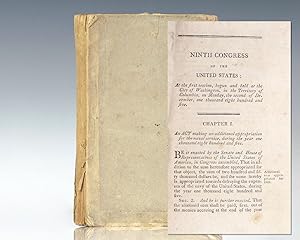
Contact seller5-star sellerRare printing of the Acts Passed at the First Session of the Ninth Congress of the United States including Indian treaties with the Creek, Cherokee, Delaware, Pottawatomie, Miami Indian tribes. Octavo, bound in contemporary wrappers. The Ninth Congress of the United States was a significant legislative Congress which passed the…first laws abolishing importation of slavesÂin its second session. In very good condition. Proclaimed on February 8, 1839, the Treaty with the Miami was made and concluded at the Forks of the Wabash in the State of Indiana, between the United States of America, by Commissioner Abel C. Pepper, and the Miami tribe of Indians. The Miami agreed to cede the remainder of tribal lands in their possession to the United States including 511,000 acres left of the Big Miami Reserve in exchange for $550,000, agreeing to vacate the area within five years to a 500,000 acre reservation in Kansas. The Treaty with the Miami, along with several other treaties between Indian tribes and the United States government during the first decades of the nineteenth century, marked a dramatic increase in calculated U.S. government efforts to strategically and forcibly remove the old Northwest Territory's American Indians from their ancestral homelands to a designated Indian Territory (roughly, present-day Oklahoma) west of the Mississippi River. The Indian Removal Act, the key law which authorized the removal of Native tribes, was signed by Andrew Jackson in 1830 and enforced by the Martin Van Buren administration. After the passage of the Indian Removal Act in 1831, approximately 60,000 members of the Cherokee, Muscogee (Creek), Seminole, Chickasaw, and Choctaw nations (including thousands of their black slaves) were forcibly removed from their ancestral homelands, with thousands dying during the Trail of Tears.
