
After Battle: Signed (32 results)
 More images
- Hardcover
- Signed
Seller: Dublin Bookbrowsers, Dublin, NONE, IrelandDublin Bookbrowsers
Contact seller2-star sellerCondition: Used - Fine
US$ 17.08
US$ 12.07 shippingShips from Ireland to U.S.A.Quantity: 1 available
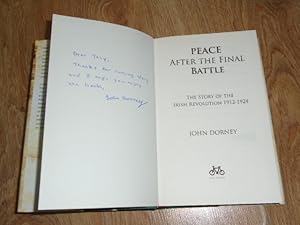
Hardcover. Condition: Fine. Dust Jacket Condition: Fine. Pp. 376. Signed & Inscribed presentation copy from the author. Signed by Author.
 More images
Language: English
Published by Trafford Publishing/Lake Erie Islands Historical Society 2004
- Softcover
- First Edition
- Signed
Seller: Friendly Books, Lakewood, OH, U.S.A.Friendly Books
Contact seller5-star sellerCondition: Used - Good
US$ 25.00
US$ 7.00 shippingShips within U.S.A.Quantity: 1 available
Soft cover. Condition: Good. 1st Edition. First Edition per number line. Softcover without dust jacket. Wrinkling and some wear to front upper edges into head of spine. Pages clean and unmarked with many illustrations of the islands. SIGNED BY Michael Gora, Editor on first title page. There are many wonderful stories and picture…s about the history of Put-in-Bay, Middle Bass Island, North Bass Island, Pelee Island and Kelleys Island, as well as many of the smaller islands, that we have compiled into this volume. The first of six sections in the book includes all of Lydia Ryall's 1913 Sketches and Stories of the Lake Erie Islands - Perry Centennial Edition 1813-1913.The other sections contain a wealth of additional information and pictures, some of which has never been published before. Many footnotes are provided to point out errors in the original material, and to provide interesting additional information. A publication of the Lake Erie Islands Historical Society, the book contains 266 pictures and is fully indexed. Keeping the book interesting to read while also allowing it to be a good reference work has been of high priority. Many of the original pictures have been digitally cleaned up and enhanced, and the material has been carefully selected to be enjoyable to browse or read carefully. We believe that this is the most complete history of the Lake Erie Islands that has ever been published. Signed by Author(s).
- Hardcover
- First Edition
- Signed
Seller: Greystone Books, Margate, , United KingdomGreystone Books
Contact seller5-star sellerCondition: Used - Very good
US$ 20.78
US$ 22.19 shippingShips from United Kingdom to U.S.A.Quantity: 1 available
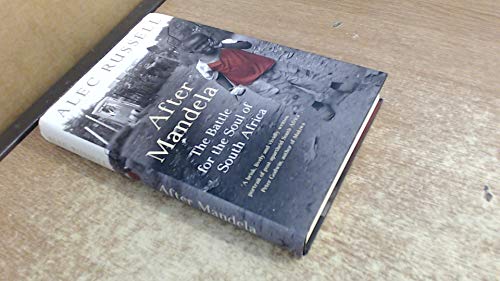
Hardback. Condition: Very Good Plus. Very Good Plus. First Edition, First Printing. VG+/VG+. First edition, first printing in d/w not price clipped. SIGNED BY THE AUTHOR, without inscription or dedication on title-page. A well-researched and authoritative study of the challenges facing South Africa at a turbulent time for many A…frican countries as they emerge into the second phase of the post-independence era. The author draws on his expert knowledge of South Africa and his relationships with its most important figures - Mbeki, Zuma, Desmond Tutu and of course Mandela. With Bibliography and Index. A very good plus copy, in a very good plus d/w, of a SCARCE first edition, first printing, SIGNED BY THE AUTHOR. Signed by Author.

Published by Amon Carter Museum, The, Fort Worth, TX 1968
- Hardcover
- First Edition
- Signed
Seller: Oak Knoll Books, ABAA, ILAB, NEW CASTLE, DE, U.S.A.Oak Knoll Books, ABAA, ILAB
Contact seller5-star sellercloth, dust jacket. square 8vo. cloth, dust jacket. 67 pages. First edition, signed by the author. Jacket has a faded spine, with a tear at the head of the spine. Else very good. From the private reference library of Dorothy Sloan with a commemorative bookplate loosely inserted.
 More images
- Softcover
- First Edition
- Signed
Seller: Chapter 1, Johannesburg, GAU, South AfricaChapter 1
Contact seller5-star sellerCondition: Used - Very good
US$ 20.00
US$ 29.01 shippingShips from South Africa to U.S.A.Quantity: 1 available
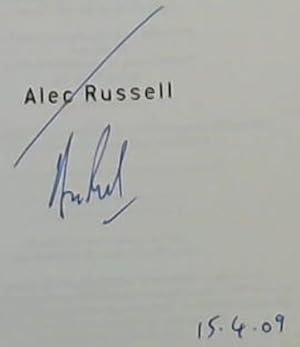
Paperback. Condition: Very Good. First Edition. Signed by the author. The wraps are a little shelf rubbed. The text within the book is clear and bright. The binding is excellent. GK. Our orders are shipped using tracked courier delivery services. Signed.
 More images
Published by Amon Carter Museum of Western Art,
- Hardcover
- Signed
Seller: ThriftBooksVintage, Tukwila, WA, U.S.A.ThriftBooksVintage
Contact seller5-star sellerHardcover. Condition: Good. Dust Jacket Condition: Good. Dust jacket has minor scuffing and tearing; jacket price is clipped. This could have light cosmetic flaws, but remains in good condition. The book is signed by Author. Dust jacket condition is Good. Secure packaging for safe delivery. signed by author.

Published by Patrick L. O'Neill
- Signed
Seller: Wonder Book, Frederick, MD, U.S.A.Wonder Book
Contact seller5-star sellerCondition: Used - Very good
US$ 27.04
Free ShippingShips within U.S.A.Quantity: 1 available
Condition: Very Good. Signed Copy . Inscribed by author on title page. [9781631920684] (United States Army, War of 1812, Military Campaigns).
Lake Erie Islands - Sketches and Stories of The First Century after the Battle of Lake Erie [Signed]
Published by Lake Erie Islands Historical Society 2004
- Softcover
- Signed
Seller: Riverby Books, Fredericksburg, VA, U.S.A.Riverby Books
Contact seller5-star sellerCondition: Used - Very good
US$ 30.00
US$ 6.95 shippingShips within U.S.A.Quantity: 1 available
Soft cover. Condition: Very Good. Oversized blue soft cover with yellow lettering on front cover and spine. No date on title page. Copyright page dated 2004. Number Line: 10 9 8 7 6 5 4 3 2 1. 438 pages. Illustrations of scenes from around Lake Erie on front cover. Very light shelf wear along edges of covers. Lettering is neat a…nd legible. Pages are clean and tidy with various illustrations and photographs of Lake Erie throughout. Text neat and legible. Binding strong and secure. Very Good condition. Signed by the editor on the title page with a 2 line inscription made out to "Walter". This is an oversized book, so extra shipping will be necessary for priority or international shipping. Please contact us with questions or if you would like to see photographs. Signed by Author(s).
Published by published by the author 2015
- Softcover
- Signed
Seller: Berryville Old Book Shop, Berryville, VA, U.S.A.Berryville Old Book Shop
Contact seller5-star sellerOversized paperback. Second Edition. 319 pgs. Inscribed to previous owner by the author. Illustrations. Near fine oversized softcover copy. (shop).
Published by Patrick L. Patrick
- Signed
Seller: Wonder Book, Frederick, MD, U.S.A.Wonder Book
Contact seller5-star sellerCondition: Good. Signed Copy . Inscribed by author on title page. 2nd edition. (war of 1812; burning washington dc, history).
Published by Privately Printed by Author 1991
- Hardcover
- First Edition
- Signed
Seller: Fred M. Wacholz, Elkhart, IN, U.S.A.Fred M. Wacholz
Contact seller5-star sellerCondition: Used - Very good
US$ 35.00
US$ 6.00 shippingShips within U.S.A.Quantity: 1 available
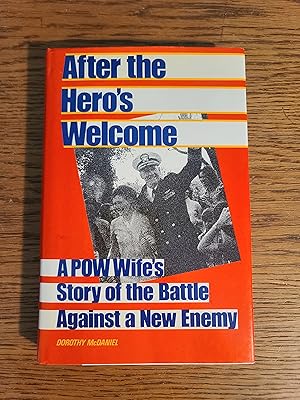
Hardcover. Condition: Very Good. Dust Jacket Condition: Very Good. 1st Edition. Very good author inscribed book and unclipped D.J. in clear plastic cover. The authors inscription and signature is on the front end paper along with the Notation of the 6th Regimental Combat Team Association. There are no other previous owners marks… found in the clean bright text. White cloth and red and strong inner hinges. For much of Red's 6 years imprisonment, Dorothy did not know whether Red was alive or not. Inscribed by Author(s).

Language: English
Published by Xulon Press, [Place of publication not identified], 2015 2015
- Softcover
- Signed
Seller: Joseph Valles - Books, Stockbridge, GA, U.S.A.Joseph Valles - Books
Contact seller5-star sellerCondition: Used - Fine
US$ 49.00
US$ 16.95 shippingShips within U.S.A.Quantity: 1 available
Soft cover. Condition: Fine. 238 pages : portraits, map ; 23 cm ; SIGNED by author on title page ; ISBN 9781498441858, 1498441858 ; OCLC 1007066080 ; pictorial stiff paper wrappers ; Contents: Orphans -- Summer of 1862 -- Cloud's Family -- Brekinridge -- Orphans, All -- The Battle of Stones River -- Before the battle -- The new…year -- After the fight -- Exodus -- A savior -- Rock Chapel -- The run -- Philadelphia -- Going west -- Epilogue ; The March of the Orphans is a historical fiction book by Kevin Horgan on the Civil War Battle of Stones River. One of the bloodiest battles of the Civil War, the Battle of Stones River (also known as Murfreesboro) was almost a tied battle, but the pride of General Bragg forced one last rebel attack, and a superior Union Army routed the confederates on January 2, 1863, after three days of fighting. All of the Kentucky Confederate regiments were known as "Orphans," as both the United and Confederate States of America had a star on their flags, claiming allegiance of the state. In this battle, Major General Breckenridge, former vice president of the United States, led the "Orphan Brigade" of Kentucky volunteers. The March of the Orphans is an enlightening, entertaining book about a remarkable time in United States history. ; Kevin Horgan is a USMC veteran ('79-'84) and served as an infantry officer. He is committed to giving half his royalties to veteran allies . Signed by Author(s). Book.
 More images
Language: English
Published by Macmillan and Co., Limited, London 1948
- Hardcover
- Signed
Seller: Kerr & Sons Booksellers ABA, Cartmel, CMA, United KingdomKerr & Sons Booksellers ABA
Contact seller5-star sellerCondition: Used - Very good
US$ 27.71
US$ 40.35 shippingShips from United Kingdom to U.S.A.Quantity: 1 available
Hardcover. Condition: Very Good. 1948, 1st edition. PRESENTATION COPY - INSCRIBED by the author on corner of end paper. Small Octavo. 44pp. Original cloth. Binding square and firm. Off-setting to end papers. Otherwise a 'Very Good' copy. Inscribed by Author(s).
Published by Amon Carter Museum of Western Art, N.p. 1968
- Hardcover
- First Edition
- Signed
Seller: Main Street Fine Books & Mss, ABAA, Galena, IL, U.S.A.Main Street Fine Books & Mss, ABAA
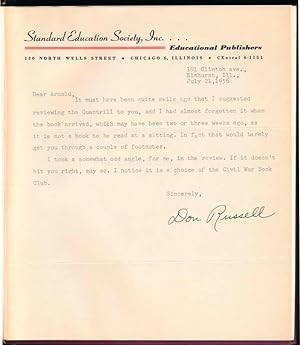
Contact seller5-star sellerHardcover. Small 4to. Purple cloth, pictorial dust jacket. v, 67pp. Numerous illustrations (2 in color). Very good/good plus. Binding ever so slightly edgeworn; jacket has large chip at head of spine, small chip at foot of spine and chips along lower edge of front panel. A tight and fairly attractive first edition, with a unique… autograph addition: Tipped to an inner flyleaf is a Typed Note Signed from Russell, 1p, 8" X 9½", Elmhurst, IL, 1956 July 21. Addressed to noted Lincoln and Civil War scholar Arnold Gates. Near fine. On letterhead of the "Standard Education Society," Russell discusses reviewing a book on Quantrill -- most likely for "Civil War Times," for which Gates was book review editor. "I took a somewat odd angle, for me, in the review," Russell notes. "If it doesn't hit you right, say so." Large full signature. Autograph material from Civil War scholar Russell (1899-?) is seldom encountered.

- Signed
- Art Print
Seller: Antique Paper Company, ASHFORD, KENT, United KingdomAntique Paper Company
Contact seller2-star sellerCondition: Used
US$ 22.17
US$ 8.07 shippingShips from United Kingdom to U.S.A.Quantity: 2 available
1888 - Antique Print FINE ART After the Battle Drawn by E Michel (072) For more info please ask seller a question. Royal Mail 2nd Class - £0.00 Royal Mail 2nd Class Signed For - £4.50 Standard Int'l age - £4.00 Royal Mail International Signed - £8.00 No PICK UP OPTIONSorry, our items are NOT available for pick-up.PAYING VIA PAYP…ALWe accept on our all our items so you can shop with confidence.Simple choose the option when proceeding through the checkout.

Published by Illuminated History of North America
- Signed
- Art Print
Seller: Artisans-lane Maps & Prints, Sidney, BC, CanadaArtisans-lane Maps & Prints
Contact seller4-star sellerCondition: Used - Very good
US$ 22.13
US$ 19.00 shippingShips from Canada to U.S.A.Quantity: 1 available
no binding. Condition: very good. This 1854 hand-colored wood engraved historical print, titled "Scene After the Battle of New Orleans", is from An Illuminated History of North America, published by Bill, Witter & Co., New York. It visually dramatizes the aftermath of the Battle of New Orleans, which took place on January 8, 181…5, during the War of 1812. The image captures a chaotic yet solemn scene with American soldiers attending to the wounded and dead amid the debris of war, including overturned wagons, broken cannons, and scattered gear. Central figures, including officers likely representing General Andrew Jackson and his aides, are depicted giving orders or surveying the battlefield. In the background, a large American flag waves triumphantly over a makeshift barricade of cotton bales and earthworks, symbolizing American resilience and victory against British forces. This decisive American victory not only secured control of the Mississippi River but also elevated Jackson to national hero status, contributing to his eventual presidency. The engraving is signed "W. Croome" (artist) and "H. Britcher" (engraver), both known for their contributions to 19th-century American historical illustration, and it reflects the patriotic sentiment and historical romanticism common in mid-19th century American publications. Approximate Overall Size: 9 ins x 5 1/2 ins. Image: 6 1/2 x 3 3/4 ins. Blank on the back . There is typical period light ageing .Print is in excellent condition. NOTE THE FOLLOWING BEFORE YOU PURCHASE: This is a GENUINE VINTAGE/ANTIQUE PRINT. It is NOT a modern reproduction, ie. a laser scan, photocopy etc. It is the original from the vintage/antique publication. This print was published on the date mentioned, or circa of the date mentioned at the top of the page. The term "print" is referred to an image on a piece of paper. The print I have for sale, like many vintage/antique prints that you see online, originate from an antique or vintage book or atlas publication. The publication may not always be known. If you have any questions, emails are welcome. Shipped Unmatted.
 More images
Published by Macmillan, London, 1948 1948
- Hardcover
- First Edition
- Signed
Seller: ROBIN SUMMERS BOOKS LTD, Aldeburgh, United KingdomROBIN SUMMERS BOOKS LTD
Contact seller5-star sellerCondition: Used - Very good
US$ 41.56
US$ 39.00 shippingShips from United Kingdom to U.S.A.Quantity: 1 available
Condition: Very Good. First edition. Hardback. Signed presentation copy from the author. Light wear otherwise near very good indeed. No dust jacket.
Language: English
Published by UK 1914
- Softcover
- First Edition
- Signed
Seller: Lasting Words Ltd, Northampton, UK, United KingdomLasting Words Ltd
Contact seller5-star sellerCondition: Used - Good
US$ 207.80
US$ 26.83 shippingShips from United Kingdom to U.S.A.Quantity: 1 available
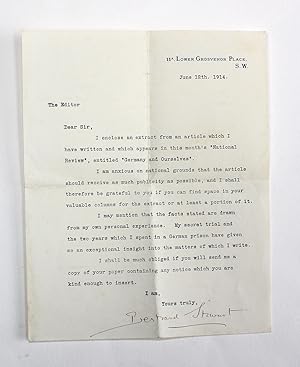
Paper. Condition: Good. First Edition. An Original Typed and Signed Letter By British Spy and Officer Bertrand Stewart to the National Review editor Leopold Maxse. Dated 1914. A fascinating letter in reference to his years spying for the British in Germany. He died a few months after writing the letter at the Battle of the Marne…. Bertrand Stewart 1872-1914 worked as a solicitor in London and was also a military officer in the Queen's Own West Kent Yeomanry, he fought in the Second Boer War and the First World War. In between the two wars he volunteered to spy on German naval actions. He was famously arrested in Germany on 2 August 1911 and sentenced to four years in prison. Stewart and another British spy, Captain Trench, were pardoned and released by the German Kaiser as a present to Ernest Augustus the Duke of Brunswick when Augustus married the Kaiser's daughter, Princess Victoria Louise of Prussia. He died fighting off a German attack near the River Vesle during the Battle of the Marne. Leopold James Maxse 1864-1932 was an English amateur tennis player and journalist and editor of the conservative British publication, National Review, between August 1893 and his death in January 1932; Under editor Leopold Maxse, the National Review took an unfriendly attitude towards Imperial Germany in the years leading up to World War I. Size 255mm x 205mm. Condition is good. Light folding creases. More images can be taken upon request. Ref17703. Signed by Author(s).
 More images
Language: English
Published by Printed for W Strahan, J & F Rivington, W Johnson, R Baldwin., London 1770
- Hardcover
- Signed
Seller: Berrishill Books, Whitley Bay, , United KingdomBerrishill Books
Contact seller5-star sellerCondition: Used - Very good
US$ 27,360.55
US$ 33.62 shippingShips from United Kingdom to U.S.A.Quantity: 1 available
Hardcover. Condition: Very Good. No Jacket. 4th Edition. All four volumes (12mo) are signed in ink at the top of the title page by Admiral Lord Collingwood (Cuthbert Collingwood). With their small size in mind, these four volumes had been bought by Collingwood to be taken onboard ship during his campaigns. There is more than a d…istinct possibility they were present on HMS Sovereign during The Battle of Trafalgar. An unique set of books, linked to a pivotal event in British Naval history. On the death of Nelson, Collingwood assumed his position as Commander-in-Chief, transferring his flag to the frigate HMS Euryalus. Without Collingwood the outcome of the 21st October 1805 might have been very different, as would the future of Britain. Collingwood was in command of the very first ship to break through the French line. All four volumes are Very Good+, bindings are tight, pages clean, no signs of cracking. Apart from the signature of Cuthbert Collingwood in each volume, there are no other inscriptions or bookplates. A superb set. Books are exempt from US tariffs. Signed by Author(s).

Published by David Horovitz, Brewood 1992
- Hardcover
- First Edition
- Signed
Seller: Tombland Bookshop, Norwich, NFLK, United KingdomTombland Bookshop
Contact seller5-star sellerCondition: Used - Very good
US$ 34.63
US$ 55.82 shippingShips from United Kingdom to U.S.A.Quantity: 1 available
Hard Cover. Condition: Very Good. Dust Jacket Condition: Very Good. Revised and Enlarged Editon. 8vo. 416 pp. second edition, revised and enlarged with corrections, presentation inscription signed by the author, very good in very good original cloth and lightly shelfworn dustwrapper, some wear at corners at at top and tail of sp…ine. Size: 8vo - over 7¾" - 9¾" Tall. Signed by the Author.
Published by Glasgow: Printed by Robert and Andrew Foulis and sold by John Balfour bookseller in Edinburgh 1766
- Hardcover
- First Edition
- Signed
Seller: Forest Books, ABA-ILAB, Grantham, LINCS, United KingdomForest Books, ABA-ILAB
Contact seller4-star sellerCondition: Used
US$ 270.14
US$ 33.62 shippingShips from United Kingdom to U.S.A.Quantity: 1 available
First Glasgow Edition, 8vo, viii, 190 pp., some light browning at the beginning, contemporary green morocco, spine ruled in gilt, crimson label, a nice copy. Printed from a manuscript in the Pepysian Collection, Magdalen College, Cambridge. The preface is signed by the editor, the jurist and historian Sir David Dalrymple, Lord H…ailes. Gaskell, 449.
 More images
Published by Stanley Paul & Co., London 1912
- Hardcover
- First Edition
- Signed
Seller: Rooke Books PBFA, Bath, United KingdomRooke Books PBFA
Contact seller5-star sellerCondition: Used - Very good
US$ 761.94
US$ 26.89 shippingShips from United Kingdom to U.S.A.Quantity: 1 available
Cloth. Condition: Very Good Indeed. First edition. The first edition of this account of Charles II"s legendary flight after Worcester, enriched by Broadley"s own pilgrimage along the escape route, warmly inscribed by the author. In the publisher's original red cloth binding. First edition. Inscribed by the author to the front fr…ee endpaper: "To C. G. Harper with the writer's kind regards," dated, 1912. Illustrated with thirty-four monochrome plates, including a frontispiece. Collated, complete. This work details Charles II's wanderings between September and October after the Battle of Worcester in 1651, and was inspired by the play 'The Royal Oak.' Charles was defeated at the Battle of Worcester in, upon which he hid in the Royal Oak tree at Boscobel House before successfully fleeing England to Normandy in disguise; he then dwelt at Saint-Germain-en-Laye near Paris. Later, after the death of Cromwell, Charles II was restored to the throne.Written by Alexander Meyrick Broadley (1847-1916), who was a British author, barrister and social figure, known for defending Ahmed 'Urabi after the Urabi Revolt. Broadley penned numerous historical works later in life, particularly regarding Napoleon. He made a pilgrimage across the route followed by Charles II before undertaking this work. In the publisher's original red cloth binding.Externally, very smart. Slight rubbing to boards. One or two minor handling marks to spine. Slight pulling to spine ends. Slight offsetting to endpapers. Author's inscription to front free endpaper. Internally, firmly bound. Pages bright and clean if slightly age toned. Light scattered spotting to first and last few leaves. The odd light spot to fore edge. Very Good Indeed. A. M. Broadley (illustrator). signed by author. book.
 More images
Published by Saunders and Otley, London 1840
- Hardcover
- Signed
Seller: Cedar Tree Antiques, Upland, CA, U.S.A.Cedar Tree Antiques
Contact seller5-star sellerCondition: Used - Very good
US$ 1,250.00
US$ 7.00 shippingShips within U.S.A.Quantity: 1 available
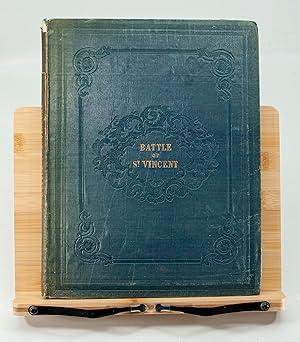
Hardcover. Condition: Very Good. No Jacket. 2nd Edition. NARRATIVE OF THE BATTLE OF ST. VINCENT by Colonel John Drinkwater Bethune. 2nd edition. Published in London in 1840 by Saunders and Otley. Describes the sea battle at Cape St Vincent, in which the English fleet under Sir John Jervis defeats a larger Spanish fleet. The auth…or, John Drinkwater Bethune (1762-1844), was an eye-witness to the battle. He published the first edition of this book anonymously. This second edition expands upon the contribution of Lord Nelson, and included anecdotes of Nelson himself. Gift inscription on free front endpaper from the author to his daughter: "To Georgiana Augusta D.Bethune with the parental love of the author. Thorncroft, March 16th, 1841. J. Drinkwater Bethune" Quarto, xii, 97 pp. with frontispiece portrait of Lord Nelson and 8 plates describing the positions of the Spanish and English fleet, starting with when the Spanish fleet was first discovered, and ending with the evening of February 14, 1797. Condition: Very good. Spine has closed tear and small loss to head. Front hinge starting, has been reinforced. Text block in very good+ condition. Aforementioned gift inscription on FFEP. Two bookplates on front pastedown. Larger is for D. M. Coffin with a version of the Coffin family crest. Sir Isaac Coffin was a friend of Lord Nelson, and a pallbearer at his funeral. Smaller is for Ira Dye, U.S.N., who was a submarine captain and naval historian. Inscribed by Author(s).
Published by London: Moon Boys & Graves 1831
- First Edition
- Signed
- Art Print
Seller: historicArt Antiquariat & Kunsthandlung, Wiesbaden-Breckenheim, , GermanyhistoricArt Antiquariat & Kunsthandlung
Contact seller5-star sellerCondition: Used
US$ 143.42
US$ 13.92 shippingShips from Germany to U.S.A.Quantity: 1 available
1. large etching by and after Henry Melling (signed in the plate) on heavy hand-made paper, verso blank, size of image ca. 24,5 x 38 cm, paper size ca. 29,5 x 42,5 cm, characterized as a "proof" copy, some tears in the margins, folded several times, otherwise in good condition, very rare copy 2100 gr.
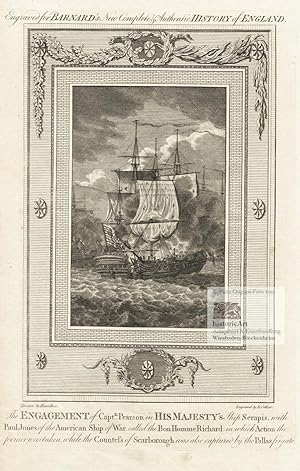
USS Bonhomme Richard warship of the Continental Navy under the command of John Paul Jones on fire and sinking in the Sea Battle of Flamborough Head September 1779. Original copper plate engraving of Collier after Hamilton in Barnard's New Complete & Authentic History of England 1782
R. Collier (18th century), English engraver; William Hamilton (1751-1801), English painter and illustrator
Published by London: Alexander Hogg 1782
- First Edition
- Signed
- Art Print
Seller: historicArt Antiquariat & Kunsthandlung, Wiesbaden-Breckenheim, , GermanyhistoricArt Antiquariat & Kunsthandlung
Contact seller5-star sellerCondition: Used
US$ 418.30
US$ 13.92 shippingShips from Germany to U.S.A.Quantity: 1 available
1. original copper plate engraving by Collier (signature in the copper plate) after a painting of Hamilton on handmade paper, size of the copper plate about 31,5 x 21 cm, paper size about 37 x 22 cm, in very good condition, rare 2100 gr.
 More images
Published by [Near New Orleans. January 17, 1815]. 1815
- Signed
Seller: William Reese Company, New York, NY, U.S.A.William Reese Company
Contact seller5-star sellerA significant manuscript from the aftermath of the celebrated victory of the United States Army under Andrew Jackson at the Battle of New Orleans. Taking place on January 8, 1815, after the Treaty of Ghent was signed but prior to its ratification by Congress, the battle was the culmination of Britain's months-long campaign to ca…pture what was then the southwestern boundary of the United States. As impressive as the American victory over a force superior in both numbers and training may have been, the battle's most enduring legacy was the ascendancy of Andrew Jackson, whose success propelled him to national fame and ultimately the presidency. The present document is a manuscript true copy of the articles of agreement for a prisoner exchange between the American and British armies following the battle, likely in the hand of British Major Harry George Smith. These "Provisional Articles agreed on between Major Smith authorized by Major General Lambert and Edward Livingston aide-de-camp to Major General Jackson" were finalized nine days after the battle, on January 17. The ratio of soldiers captured at New Orleans, estimated at 484 British to only nineteen American, allowed Jackson to negotiate for the return of every American prisoner taken by Admiral Cochrane and the late General Pakenham's forces in the southwest. These articles decree that all American prisoners of both the army and navy held in the British camp or on prison ships by Cochrane will be returned, "and that on receipt of the said Prisoners a number of British Prisoners equal in rank and number.shall be sent to the mouth of the Mississippi to be received by ships appointed for that purpose by the Admiral." They further stipulate that, according to standard practice at the time, "Officers of equal rank shall be exchanged for equal rank and wounded for wounded as far as circumstances will permit." The document is designated a true copy and signed "H.G. Smith," with the signature of "Ed. Livingston" reproduced in the same hand. Also included here, on a separate folio sheet, is a brief "Extract of a letter from General Jackson, Commanding the Army of the United States of America at New Orleans, dated 9th January 1815." This excerpt, written in a different hand some years later, describes the sole success story of the British battle effort. In Jackson's own words: "Simultaneously with his advance upon my lines, he had thrown over in his Boats a considerable Force to the other side of the River. These having landed, were hardy enough to advance against the Works of General Morgan, and what is strange and difficult to account for, at the very moment when their entire discomfiture was looked for with a confidence approaching to certainty, the Kentucky Reinforcements, in whom so much reliance had been placed, ingloriously fled, and thus yielding to the Enemy that most fortunate Position. The Batteries which had rendered me for many days the most important service, tho' bravely defended, were of course now abandoned.The Enemy now occupied a Position from which they might survey us without hazard, and by means of which they might have been enabled to defeat in great measure the effects of our success on this side the River." The retreat of the Kentucky forces described by Jackson was less due to cowardice and more due to American General David Morgan's poor deployment of his command, which had left them with no realistic way to defend their position. Fortunately for the Americans, their routed forces managed to sabotage their artillery before retreating, and Thornton's gravely injured command was unable to provide support to their floundering allies on the other side of the river. Written on paper with an 1821 watermark, the purpose of this manuscript is not entirely clear, though it seems likely that an English contemporary was eager to prove that the battle had not been a complete failure for their forces. An interesting pair of British documents from the aftermath of one of the most famous military engagements in United States history. Light tanning, minimal edge wear. Both documents near fine.
 More images
Published by 21 August 1704, Camp at Sindelfingen, Germany 1704
- Signed
Seller: Churchill Book Collector ABAA/ILAB/IOBA, San Diego, CA, U.S.A.Churchill Book Collector ABAA/ILAB/IOBA
Contact seller5-star sellerLetter. This 21 August 1704 autograph letter is signed by John Churchill, first Duke of Marlborough and Captain-General of English and allied forces in the War of the Spanish Succession, eight days after the battle of Blenheim, from his field camp in Germany to Thomas Coningsby, later first Earl of Coningsby.The letter is writte…n entirely in Marlborough's hand on the first panel of a single sheet of watermarked laid paper measuring 13.1 x 8.6 inches folded once to form four 8.6 x 6.6 inch panels. The letter is dated at the upper left "Camp at Sefelingben Aug. 21 1704" and addressed "My Lord". The letter reads in full: "Your Lord will excuse me that I had not time to thank you for your kind congratulation on our success at Schellinberg, before we had gain'd a second, and much greater victory, which I hope will soon make an end of the War in the Country, it is a particular pleasure to me that my friends are satisfied in my endeavors to serve the Publick, and I shall be always glad of any opertunity to assure you that I am with truth." The letter closes with the valediction "My Lord. your Lordships most obedient humbler servant" and his signature, "Marlborough".Condition is very good, the letter complete, the paper substantially clean, the ink still distinct. Evidenced by faint creases, the letter was subsequently folded three times horizontally and twice vertically. Two notations, plausibly those of the recipient, appear at the upper left corner and just below the date and location, respectively "Duke of Marlborough to Ld. Coningsby" and "after the Battle of Blenheim". It is inked on the fourth and final panel in three lines "Duke of | Marlborough | Aug 1704" with an original ink stain partially extending down from the "u" in "Duke" to blot the "l" in "Marlborough". The letter is protected within a clear, removable, archival sleeve housed within a rigid crimson cloth folder.Sindelfingen, the location of Marlborough's field camp where this letter was written, is a city in Baden-Württemberg in Germany, near Stuttgart, at the headwaters of the Schwippe.In July Marlborough captured the Franco-Bavarian garrison at Schellenberg Heights. This allowed him to cross the Danube into Bavaria, where his 52,000-man force vanquished the 56,000-man Franco-Bavarian army at Blenheim on 13 August 1704. Some 30,000 French troops were killed, wounded or captured. Even the French commander, Marshal Tallard, became a prisoner. Blenheim cemented Marlborough's place among England's greatest generals. "For a symbolic quitrent" for the lands and incomes with which he was rewarded by Queen Anne,"Marlboroughand his descendants were required to present annually to the sovereign at Windsor Castle, on the anniversary of the battle, a facsimile of the silk standard of the French royal household troops, thecorps du roi, whichMarlborough'stroops had taken during the battle."The recipient of this letter, Thomas Coningsby, first Earl of Coningsby (1657-1729) was a Whig politician, and Member of the House of Commons continuously from 1679-1710. "In the latter part ofWilliam'sreignConingsbyseems to have followedGodolphinin establishing connections withJohn Churchill,earl and later duke of Marlborough The alliance helped maintain Coningsby's position as a leader of the government side in the Commons following the accession ofQueen Annein 1702 Coningsbywas reckoned one of the foremost 'lord treasurer's whigs', working for Godolphin, Anne's lord treasurer, by managing parliamentary business." Coningsby was forced from power in 1708 and left Parliament in 1710, but "returned from the political wilderness at the accession ofGeorge I" in 1714 "and was rewarded for his services to the whig cause on 18 June 1716 when he was createdBaron Coningsby of Coningsby, Lincolnshire. He was created Earl of Coningsby in 1719. When "he published a pamphlet maligning lord chancellorMacclesfield, and as a result in January 1721 was stripped of his lieutenancies and imprisoned in the Tower of Lo.
 More images
Published by Art Journal
- Signed
- Art Print
Seller: Artisans-lane Maps & Prints, Sidney, BC, CanadaArtisans-lane Maps & Prints
Contact seller4-star sellerCondition: Used - Very good
US$ 73.76
US$ 30.00 shippingShips from Canada to U.S.A.Quantity: 1 available
no binding. Condition: very good. This steel engraving, produced in 1850, depicts a dramatic and detailed scene from the Battle of Borodino, a pivotal clash during Napoleon's 1812 invasion of Russia. The artwork is signed by G. Jones, R.A., as the painter, and J.B. Allen as the engraver, showcasing their collaborative effort to…bring historical scenes to life. The image features the chaos and intensity of the battlefield, with soldiers, horses, and officers prominently displayed in the foreground, likely including commanding figures from both the French and Russian sides. The distant horizon is filled with troops engaged in combat, with billowing smoke emphasizing the ferocity of the conflict. The engraving is rich in detail, illustrating the tumult of war and the solemnity of command decisions. The print serves as both an artistic and historical document, offering a glimpse into 19th-century efforts to commemorate and romanticize significant military events. Approx Image Size: 10 ins x 6 1/2 ins - Approx Overall Size With Borders : 12 1/2 x 9 1/2 ins CONDITION: FULL PAGE STEEL ENGRAVING. BLANK ON THE BACK. HEAVY CARD STOCK PAPER OF THE AGE. Image is clear and sharp with beautiful detail. As scanned. This beautiful print would look great matted and framed. Or an art supply store can provide you with a selection of frames for old art treasures. NOTE THE FOLLOWING BEFORE YOU PURCHASE: This is a GENUINE ANTIQUE VINTAGE 1850 Print. It is NOT a modern reproduction, ie. a laser scan, photocopy, etc. It is the original from the antique or vintage atlas or book publication. This print was published on the date mentioned, or circa the date mentioned at the top of the page. The print I have for sale, like many antique vintage prints and maps that you see online, originate from an antique vintage book or atlas publication. The publication may not always be known. If you have any questions, emails are welcome. Shipped Unmatted.

- Signed
Seller: Stuart Lutz Historic Documents, Inc., South Orange, NJ, U.S.A.Stuart Lutz Historic Documents, Inc.
Contact seller5-star sellerEDWARD ORD (1818-1883). Ord, a Union Civil War general, fought at Vicksburg and in the Appomattox campaign.DS. 2pg. 17 x 14. July 31, 1864. Near Petersburg [Virginia]. A large, partly printed document signed E O C Ord as Major General commanding. It concerns Unserviceable Ordnance Stores from the Second Regiment of New Hampshire… Volunteer Infantry. The Second Regiment was involved in assaulting Petersburg from June 15 to 19, and sieging Petersburg from June 16, 1864 to April 2, 1865. This document is dated the day after the famous Battle of the Crater at Petersburg. There is also a rubber stamped signature of General Benjamin Butler. It has mailing folds and is in fine condition. Ord signed on the verso.

- Signed
Seller: Stuart Lutz Historic Documents, Inc., South Orange, NJ, U.S.A.Stuart Lutz Historic Documents, Inc.
Contact seller5-star sellerWILLIAM W. COOKE (1846-1876). Cooke was a Civil War officer. He was Custers adjutant and was killed at Little Big Horn. He wrote the famous message to Frederick Benteen, Benteen. Come On. Big village. Be quick. Bring packs. WW Cooke. P.S. Bring Packs shortly before his death. Cookes body was found close to Custers and he was sca…lped.ANNA ABBOTT COOKE (1827-1906). Anna Abbott Cooke was a Canadian woman and the mother of William W. Cooke. Through her son, Anna became closely connected with the other military families of the Seventh Cavalry, leaning on them when her son was killed during the Battle of the Little Bighorn.ALS. 4pg. September 27, 1876. Hamilton [Ohio]. An autograph letter signed A. A. Cooke to Libbie Custer. My dear Mrs. Custer, Your letter was received and I have done as well as I could. As you wished me so the loss of my darling son Willie has broken my poor heart, but what can we do but submit sometimes my anguish is so great that I think I cannot live I think of you continually the loss of your dear noble husband is very hard to bear and dearhe was here with my now dead son last Autumn, both so full of health and happy. What can we do. When I think of my darling Willies cruel death I cannot be comforted, in reading over some of his letters, after his arrival at Fort Riley [Kansas], you were so kind to him. In one letter he wrote - Mrs. Custer says I belong to the Custer family. You knew him so intimately my dear Mrs. Custer that you could have told Mr. [Frederick] Whitaker more interesting things about Willie than I can if you were equal to the task. I must see you as soon as you are well enough to see me. I think I would feel better to know from you how now my darling spent the winter. I have not seen anyone that knew him. What cowards [Alfred] Terry and [Marcus] Reno have proved themselves to be. Will they never be punished for their conduct. I feel so much for the Gens father and mother. Now his dear mother must suffer as muchto her with much love when you feel well enough do write to me. I think dear Willies name should be associated with the Generals death, they were suchin life. With love believe me yoursympathetic friend A A Cooke All send theirlove. In 1876, shortly after Custers death, the British writer Frederick Whittaker wrote a glamorized biography of Custer entitled the Complete Life of Gen. George A. Custer; in the book, he blamed Captain Frederick Benteen and Major Marcus Reno for the defeat and death of Custer. The letter is written cross-hatched on black bordered mourning stationery. It comes with the original mailing envelope addressed to Mrs. G.A. Custer Monroe Michigan, although the stamp was removed. The letter has mailing folds and is in very fine condition. An amazing content letter written just a couple months after Little Big Horn and the death of her son.


