
Albert Einstein Philosopher Scientist: First Edition (26 results)

Published by Harper Torchbooks 1959
- Hardcover
- First Edition
Seller: World of Rare Books, Goring-by-Sea, United KingdomWorld of Rare Books
Contact seller5-star sellerCondition: Used - Good
US$ 20.66
US$ 6.44 shippingShips from United Kingdom to U.S.A.Quantity: 1 available
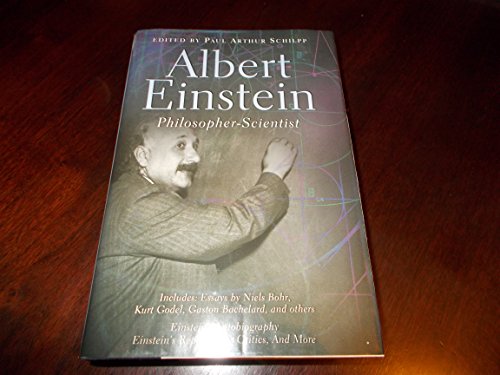
Add to basketCondition: Good. 1959. First Edition Thus. 781 pages. No dust jacket. This is an ex-Library book. Green cloth boards with gilt lettering. Volume II. Black and white illustrated frontispiece. Book has been rebound by library, with expected inserts, stamps and inscriptions. Pages and binding are presentable with no major defects.…Minor issues present such as mild cracking, inscriptions, inserts, light foxing, tanning and thumb marking. Boards have mild shelf wear with light rubbing and corner bumping. Some light marking and sunning. Gilt lettering is bright and clear.
- Hardcover
- First Edition
Seller: M & M Books, ATHENS, U.S.A.M & M Books
Contact seller3-star sellerCondition: Used - Fine
US$ 45.00
US$ 5.00 shippingShips within U.S.A.Quantity: 1 available
Hardcover. Condition: Fine. Dust Jacket Condition: Fine. 1st Edition. very small signature on front end page.
- Hardcover
- First Edition
Seller: C. Trowbridge, OZARK, U.S.A.C. Trowbridge
Contact seller5-star sellerCondition: Used - Fine
US$ 65.00
US$ 6.50 shippingShips within U.S.A.Quantity: 1 available
Hardcover. Condition: Fine. Dust Jacket Condition: Fine. 1st Edition. First edition. Fine in similar dust jacket. Essays by Neils Bohr, Kurt Godel, Gaston Bachelard, and others. Einstein's Autobiography, Einstein's reply to his critics, and more. Also included: Einstein's Contributions to Quantum Theory. by Wolfgang Pauli. Gener…al Relativity and the Structure of our Universe by Leopold Infeld. (.
 More images
Language: English
Published by Harper & Brothers 1959
- Softcover
- First Edition
Seller: The Modern Library, Columbus, U.S.A.The Modern Library
Contact seller5-star sellerCondition: Used - Near fine
US$ 95.00
US$ 6.00 shippingShips within U.S.A.Quantity: 1 available
Add to basketSoft cover. Condition: Near Fine. 1st Edition. Albert Einstein Philosopher-Scientist **2 VOLUME COMPLETE SET FIRST PRINTING 1959 IN NEAR FINE CONDITION!** Gorgeous 2 volume set. First Edition, first printing 1959. Both books are in NEAR FINE condition with blemishes from removed price sticker.

Albert Einstein: Philosopher-Scientist (Contains Einstein's 'Autobiographical Notes [In English And German]', A Series Of Essays On His Work By Physicists, Mathematicians, And Philosophers, And Einstein's 'Remarks' Concerning These Essays' ).
Einstein, Albert, Edited By Paul Arthur Schilpp, Articles By Arnold Sommerfeld, Louis De Broglie, Ilse Rosenthal-Schneider, Wolfgang Pauli, Max Born, Walter Heitler, Niels Bohr, H. Margenau, Philipp G. Frank, Hans Reichenbach, H. P. Robertson, P. W. Bridgman, Victor F. Lenzen, Filmer S. C. Northrop, E. A. Milne, Georges Edward Lemaitre, Karl Menger, Leopold Infeld, Max Von Laue, Herbert Dingle, Kurt Godel, Gaston Bachelard, Aloys Wenzel, Andrew Paul Ushenko, Virgil Hinshaw Jr; Bibliography By Margaret C. Shields
Language: English
Published by The Library Of Living Philosophers, New York 1949
- Hardcover
- First Edition
Seller: Arroyo Seco Books, Pasadena, Member IOBA, Pasadena, U.S.A.Arroyo Seco Books, Pasadena, Member IOBA
Contact seller4-star sellerCondition: Used - Near fine
US$ 327.75
US$ 8.00 shippingShips within U.S.A.Quantity: 1 available
Add to basketHardcover. Condition: Near Fine. No Jacket. 1st Edition. Xvi, 781 Pp. Blue Cloth, Gilt. Stated First Edition. First Printing Of Einstein's Autobiography, With Text In Both German And English; First Publication Of Major Essays On Einstein, And An Important Discussion With Niels Bohr. Book Is Near Fine, Gilt Brilliant, Lightly Use…d. Short Owner's Last Name On Front Pastedown. Light Browning To Endpapers, As Usual. Small Dampstain At Bottom Of Text Block Adjacent To Spine.
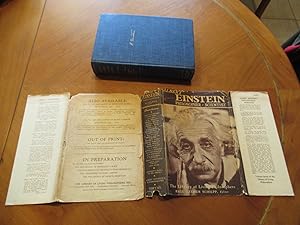
Albert Einstein: Philosopher-Scientist (Contains Einstein's 'Autobiographical Notes [In English And German]', A Series Of Essays On His Work By Physicists, Mathematicians, And Philosophers, And Einstein's 'Remarks' Concerning These Essays' ).
Einstein, Albert, Edited By Paul Arthur Schilpp, Articles By Arnold Sommerfeld, Louis De Broglie, Ilse Rosenthal-Schneider, Wolfgang Pauli, Max Born, Walter Heitler, Niels Bohr, H. Margenau, Philipp G. Frank, Hans Reichenbach, H. P. Robertson, P. W. Bridgman, Victor F. Lenzen, Filmer S. C. Northrop, E. A. Milne, Georges Edward Lemaitre, Karl Menger, Leopold Infeld, Max Von Laue, Herbert Dingle, Kurt Godel, Gaston Bachelard, Aloys Wenzel, Andrew Paul Ushenko, Virgil Hinshaw Jr; Bibliography By Margaret C. Shields
Language: English
Published by The Library Of Living Philosophers, New York 1949
- Hardcover
- First Edition
Seller: Arroyo Seco Books, Pasadena, Member IOBA, Pasadena, U.S.A.Arroyo Seco Books, Pasadena, Member IOBA
Contact seller4-star sellerCondition: Used - Near fine
US$ 500.25
US$ 8.00 shippingShips within U.S.A.Quantity: 1 available
Add to basketHardcover. Condition: Near Fine. Dust Jacket Condition: Fair. 1st Edition. Xvi, 781 Pp. Blue Cloth, Gilt. Stated First Edition. First Printing Of Einstein's Autobiography, With Text In Both German And English; First Publication Of Major Essays On Einstein, And An Important Discussion With Niels Bohr. Book Is Near Fine, Gilt Bril…liant, Lightly Used, Previous Owner's Name Under Front Flap. Dust Jacket Priced $8.50, Very Worn, Interior And Exterior Clear Tape Reinforcement Along Front Spine Edge, Entirely Separated Along Rear Spine Edge, Small Chips And Tears, With Chipping Removing Part Of Einstein's First Name And Most Of Volume Number On Spine, No Other Losses Of Lettering.

Albert Einstein: Philosopher-Scientist (Contains First Printing Of Einstein's 'Autobiographical Notes [In English And German]', A Series Of Essays On His Work By Physicists, Mathematicians, And Philosophers, And Einstein's 'Remarks' Concerning These Essays' ).
Einstein, Albert, Edited By Paul Arthur Schilpp, Articles By Arnold Sommerfeld, Louis De Broglie, Ilse Rosenthal-Schneider, Wolfgang Pauli, Max Born, Walter Heitler, Niels Bohr, H. Margenau, Philipp G. Frank, Hans Reichenbach, H. P. Robertson, P. W. Bridgman, Victor F. Lenzen, Filmer S. C. Northrop, E. A. Milne, Georges Edward Lemaitre, Karl Menger, Leopold Infeld, Max Von Laue, Herbert Dingle, Kurt Godel, Gaston Bachelard, Aloys Wenzel, Andrew Paul Ushenko, Virgil Hinshaw Jr; Bibliography By Margaret C. Shields
Language: English
Published by The Library Of Living Philosophers, New York 1949
- Hardcover
- First Edition
Seller: Arroyo Seco Books, Pasadena, Member IOBA, Pasadena, U.S.A.Arroyo Seco Books, Pasadena, Member IOBA
Contact seller4-star sellerCondition: Used - Near fine
US$ 661.25
US$ 8.00 shippingShips within U.S.A.Quantity: 1 available
Add to basketHardcover. Condition: Near Fine. Dust Jacket Condition: Very Good. 1st Edition. Xvi, 781 Pp. Blue Cloth, Gilt. Stated First Edition. First Printing Of Einstein's Autobiography, With Text In Both German And English; First Publication Of Major Essays On Einstein, And An Important Discussion With Niels Bohr. Near Fine Book, Gilt Br…ight, No Marks. Dust Jacket Priced $8.50, Wear, Browning, Minute Losses At Edges, Dust To Rear Panel.
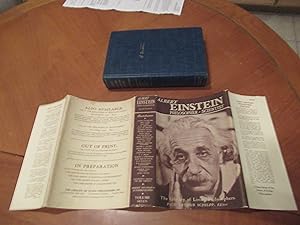
Albert Einstein: Philosopher-Scientist (Contains First Printing Of Einstein's 'Autobiographical Notes [In English And German]', A Series Of Essays On His Work By Physicists, Mathematicians, And Philosophers, And Einstein's 'Remarks' Concerning These Essays' ).
Einstein, Albert, Edited By Paul Arthur Schilpp, Articles By Arnold Sommerfeld, Louis De Broglie, Ilse Rosenthal-Schneider, Wolfgang Pauli, Max Born, Walter Heitler, Niels Bohr, H. Margenau, Philipp G. Frank, Hans Reichenbach, H. P. Robertson, P. W. Bridgman, Victor F. Lenzen, Filmer S. C. Northrop, E. A. Milne, Georges Edward Lemaitre, Karl Menger, Leopold Infeld, Max Von Laue, Herbert Dingle, Kurt Godel, Gaston Bachelard, Aloys Wenzel, Andrew Paul Ushenko, Virgil Hinshaw Jr; Bibliography By Margaret C. Shields
Language: English
Published by The Library Of Living Philosophers, New York 1949
- Hardcover
- First Edition
Seller: Arroyo Seco Books, Pasadena, Member IOBA, Pasadena, U.S.A.Arroyo Seco Books, Pasadena, Member IOBA
Contact seller4-star sellerCondition: Used - Near fine
US$ 1,750.00
US$ 8.00 shippingShips within U.S.A.Quantity: 1 available
Add to basketHardcover. Condition: Near Fine. Dust Jacket Condition: Near Fine. 1st Edition. Xvi, 781 Pp. Blue Cloth, Gilt. Stated First Edition. First Printing Of Einstein's Autobiography, With Text In Both German And English; First Publication Of Major Essays On Einstein, And An Important Discussion With Niels Bohr. Book Is Near Fine, Gilt… Brilliant, Lightly Used, No Marks. Dust Jacket Priced $8.50, Very Slight Wear, 1/2" Closed Tear At Top Of Rear Flap Fold.

Published by The Library of Living Philosophers, Inc., NY 1949
- Hardcover
- First Edition
Seller: J. HOOD, BOOKSELLERS, ABAA/ILAB, Baldwin City, U.S.A.J. HOOD, BOOKSELLERS, ABAA/ILAB
Contact seller5-star sellerHardcover. First edition. 781pp. Very good with light shelf wear,and age toned paper else clean & sound condition without dust jacket.

Published by Harper Torchbooks, New York 1959
- Softcover
- First Edition
Seller: Rare Book Cellar, Pomona, U.S.A.Rare Book Cellar
Contact seller5-star sellerSoftcover. First Edition Thus; First Printing. Both volumes Very Good in wraps. Owner bookplate on front pastedown of both volumes.
Published by The Library of Living Philosophers, Inc, Evanston IL 1949
- Hardcover
- First Edition
Seller: J. Wyatt Books, Ottawa, CanadaJ. Wyatt Books
Contact seller5-star sellerCondition: Used - Very good
US$ 86.25
US$ 23.00 shippingShips from Canada to U.S.A.Quantity: 1 available
Add to basketHardcover. Condition: Very Good+. 1st Edition. THE LIBRARY OF LIVING PHILOSOPHERS, VOLUME VII. 781 pages. Frontispiece ilustrated with b/w plate of Einstein. Pages good conditino. Endpapers with previous owner's name and embossed stamp on ffep. Blue cloth, gilt bands and title on spine and gilt signature on upper cover. Edges sh…ow light wear. Small stain at foredge of upper cover. VG+. Book.

Published by Library of Living Philosophers, [1949, Book Date], Evanston, Ill 1949
- Hardcover
- First Edition
Seller: TBCL The Book Collector's Library, Montreal, CanadaTBCL The Book Collector's Library
Contact seller5-star sellerCondition: Used
US$ 200.00
US$ 25.00 shippingShips from Canada to U.S.A.Quantity: 2 available
Add to basketNo Binding. Condition: Clamshell As New. No Jacket. 1st Edition. 1st Edition. No Binding. First Edition Clamshell Case. Albert Einstein. ALBERT EINSTEIN: PHILOSOPHER-SCIENTIST. Edited by Paul Arthur Schilpp. Evanston, Ill.: Library of Living Philosophers, 1949. First Trade Edition. Superb Custom Fitted Modern Collector's Clamshe…ll [Not A Book] HAND-CRAFTED by our conservation team, each case features, a gilt stamped spine title piece & signature cut on the upper cover, both on maroon leather. The clamshell case is finished in fine black cloth & black Nuba®. Nuba® is a fine, supple & durable covering with a neutral ph that has the feel of velvety soft Italian Nubuck® leather. An excellent Collector's Custom Case for this uncommon Einstein. Other Einstein Cases are readily available. TBCL Web Site photo/link available for OVER 100 generally in-stock titles. Book definitely NOT included. Custom Craft available.
Published by Library of Living Philosophers 1949
- Hardcover
- First Edition
Seller: Brentwood Books, Kinnelon, U.S.A.Brentwood Books
Contact seller5-star sellerCondition: Used - Very good
US$ 350.00
US$ 3.98 shippingShips within U.S.A.Quantity: 1 available
Add to basketHardcover. Condition: Very Good. Dust Jacket Included. 1st Edition. Almost like new book in VG+ jacket. First printing. Dark blue hardcover published by the Library of Living Philosophers, 1949 on title page, "First Edition" on copyright page. Book perfect except endpapers a little tanned, page edges not quite pristine. Book fee…ls like it has never been opened. Jacket is price-clipped, a little tanned, slight wear along upper edge. No marks or writing. **OVERSIZE - priority mail and overseas orders may require additional shipping. **We are a small family business with over 30 years experience providing fine new and pre-owned books online. You can expect professional service and individual attention to your order, daily shipments, and sturdy packaging.

Published by Library of Living Philosophers, Evanston, Ill 1949
- Hardcover
- First Edition
Seller: TBCL The Book Collector's Library, Montreal, CanadaTBCL The Book Collector's Library
Contact seller5-star sellerCondition: Used
US$ 380.00
US$ 25.00 shippingShips from Canada to U.S.A.Quantity: 1 available
Add to basketNo Binding. Condition: Clamshell As New. 1st Edition. 1st Edition. No Binding. Albert Einstein. ALBERT EINSTEIN: PHILOSOPHER-SCIENTIST. Edited by Paul Arthur Schilpp. Evanston, Ill.: Library of Living Philosophers, 1949. First Trade Edition. Superb Custom Fitted Modern Collector's Clamshell [Not A Book] HAND-CRAFTED by our conse…rvation team, each case features, a gilt stamped spine and stamped signature on black leather with cloth sides with black velour interior. An excellent Collector's Custom Case for this uncommon Einstein. Other Einstein Cases are readily available. TBCL Web Site photo/link available for OVER 100 generally in-stock titles. Book definitely NOT included. Custom Craft available.
 More images
Published by The Library of Living Philosophers, Inc, Evanston, Illinois 1949
- Hardcover
- First Edition
Seller: Evening Star Books, ABAA/ILAB, Madison, U.S.A.Evening Star Books, ABAA/ILAB
Contact seller5-star sellerCondition: Used - Very good
US$ 550.00
US$ 6.50 shippingShips within U.S.A.Quantity: 1 available
Add to basketHardcover. Condition: Very Good. Dust Jacket Condition: Very Good. First edition. Large 8vo. [4], v-xvi, [1], 2-781, [3] pp. Blue cloth with gold lettering on the front board and spine; brown topstain. Price of $8.50 on the front flap of the dust jacket. Illustrated with a frontispiece portrait of Einstein. Edited by Paul Arthur… Schilpp. Volume seven of the Library of Living Philosophers. Boni 512. Contains Einstein's autobiography, a bibliography of his work, twenty-five scholar's discussions of Einstein's work and achievements, with Einstein's replies to these various scholars. Includes essays by Bohr, Born, Reichenbach, Pauli, and the well-known essay by Godel in which he argues (based upon his solutions to the field equations of general relativity in 1949) that Parmenides was right in that change is an illusion based upon our conceptual framework and our sensory perceptions. A fascinating study of the scientist who so profoundly shaped the twentieth century. A small soil spot on the bottom textblock and two small dog-ears; jacket with a closed tear on its spine panel and light edge wear.
 More images
Published by The Library of Living Philosophers 1949
- Hardcover
- First Edition
Seller: curtis paul books, inc., Crestline, U.S.A.curtis paul books, inc.
Contact seller5-star sellerCondition: Used - Very good
US$ 599.99
US$ 4.49 shippingShips within U.S.A.Quantity: 1 available
Add to basketHardcover. Condition: Very Good+. Dust Jacket Condition: Very Good. First Edition. First edition of Einstein's autobiography. Blue cloth. Bookplate to ffep. Glue darkening along hinges. Book is tight and square. Gilt unfaded. The clipped jacket shows wear along edges and shows general toning. ; The Library of Living Philosophers…; Vol. 7; 8vo 8" - 9" tall.
Published by Library Of Living Philosophers, Evanston 1949
- Hardcover
- First Edition
- Signed
Seller: Thomas J. Joyce And Company, Chicago, U.S.A.Thomas J. Joyce And Company
Contact seller2-star sellerCondition: Used - Fine
US$ 15,000.00
US$ 7.00 shippingShips within U.S.A.Quantity: 1 available
Add to basketHardcover. Condition: fine. Dust Jacket Condition: no glassine. First, Limited edition. Octavo, publisher's green cloth, bevelled edges, in a custom-made clamshell cloth box with morocco spine labels Numbered copy 161 of only 760 numbered copies. Autographed: "Albert Einstein 49." Contains Einstein's own "Autobiographical Notes…(bi-lingual text, German & English)," and "Remarks to the Essays Appearing in this Collective Volume". Includes a Bibliography of Einstein's writings to 1949. At least 6 of the 25 contributors to this volume were awarded the Nobel Prize in Science. The contributors include Niels Bohr ("Discussion with Einstein on Epistemological Problems in Atomic Physics"), Kurt Godel, F.S.C. Northrop, Wolfgang Pauli etc. Illustrated with Yousuf Karsh's frontispiece portrait of Einstein, photos, facsimiles. [ Boni, BIBLIOGRAPHICAL CHECKLIST, 512]. Karsh frontis, photos, facs (illustrator).

Published by The Library of Living Philosophers, Inc., Evanston 1949
- Softcover
- First Edition
Seller: Raptis Rare Books, Palm Beach, U.S.A.Raptis Rare Books
Contact seller5-star sellerFinely bound edition of Einstein's singular autobiography. Octavo, original cloth with gilt titles to the spine, top edge gilt, frontispiece of Einstein by Yousuf Karsh. Edited by Paul Arthur Schilpp. In near fine condition. Written by the man considered the "Person of the Century" by Time magazine, this is not a glimpse into Ei…nstein's personal life, but an extension and elaboration into his thinking on science. Two of the great theories of the physical world were created in the early 20th century: the theory of relativity and quantum mechanics. Einstein created the theory of relativity and was also one of the founders of quantum theory. Here, Einstein describes the failure of classical mechanics and the rise of the electromagnetic field, the theory of relativity, and of the quanta. "The greatest physicist of the 20th century" (PMM 408).
 More images
Published by Evanston: Library of Living Philosophers, 1949
- Hardcover
- First Edition
- Signed
Seller: 19th Century Rare Book & Photograph Shop, Stevenson, U.S.A.19th Century Rare Book & Photograph Shop
Contact seller5-star sellerCondition: Used - Fine
US$ 18,500.00
US$ 18.00 shippingShips within U.S.A.Quantity: 1 available
Add to basketHardcover. Condition: Fine. 1st Edition. Original brown cloth, top edge gilt, publisher's slipcase. Very fine, with the fragile slipcase in excellent condition. A superb copy. FIRST EDITION. One of 760 numbered copies signed and dated by Einstein. This important volume contains Einstein's autobiography, specially written for the… book, a bibliography of his works, twenty-five scientists' discussions of Einstein's work and achievements, with Einstein's replies. Contributors of essays include Niels Bohr, Max Born, Wolfgang Pauli, and Kurt Godel. I. I. Rabi's review in Science hailed this as a "most important and significant volume. It is most difficult to get scientists to write simply and clearly about the fundamentals of their science and the leading philosophical ideas that guide them. In this book there is played out a great scientific drama of the last two decades. The book starts with an intellectual autobiography by Einstein himself. He satirically calls it his obituary. I know of no other to compare with it. Neither Newton nor Maxwell nor any of the other great giants of physics had his Schilpp [the editor] to catalyze such an effort. After reading Einstein's article one realizes the great loss this is to scientific culture" (Science, 21 April 1950). This is an especially fine signed copy of an important book in the Einstein canon. Signed by Author(s).
 More images
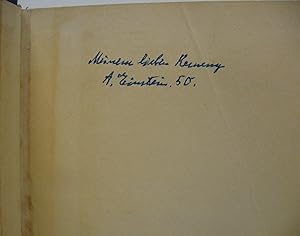
Albert Einstein: Philosopher-Scientist. SIGNED BY ALBERT EINSTEIN TO JOHN KEMENY.
SCHILPP, Paul Arthur (ed.) [EINSTEIN, Albert] [KEMENY, John]
Published by Evanston: Library of Living Philosophers, 1949. 1949
- Hardcover
- First Edition
- Signed
Seller: Scientia Books, ABAA ILAB, Arlington, U.S.A.Scientia Books, ABAA ILAB
Contact seller4-star sellerCondition: Used - Very good
US$ 17,500.00
US$ 8.00 shippingShips within U.S.A.Quantity: 1 available
Add to basketHardcover. Condition: Very Good. Dust Jacket Included. 1st Edition. Frontispiece, xvi, 781 pp; 8 figs. Original blue cloth. There is creasing of some pages in the margins. Good, in dust jacket. The dust jacket is quite worn (see photos). First Edition. SIGNED BY ALBERT EINSTEIN TO JOHN KEMENY: "Meinem lieben Kemeny/ A. Einstein…50". "In 1943, Kemeny entered Princeton University where he studied mathematics and philosophy, but he took a year off during his studies to work on the Manhattan Project at Los Alamos National Laboratory, where his boss was Richard Feynman. He also worked there with John von Neumann. Returning to Princeton, Kemeny graduated with an A.B. in mathematics in 1946 after completing a senior thesis, titled 'Equivalent logical systems', under the supervision of Alonzo Church. He then remained at Princeton to pursue graduate studies and received a Ph.D. in mathematics in 1949 after completing a doctoral dissertation, titled 'Type-theory vs. set-theory', also under the supervision of Alonzo Church. He worked as Albert Einstein's mathematical assistant during graduate school" (Wikipedia article on John Kemeny). "At age 22, a year before he earned his Ph.D., Kemeny became Albert Einstein's mathematical assistant. I once asked him why Dr. Einstein, of all people, needed a mathematician. With that gentle, mustached smile, John said, 'Einstein wasn't very good at math' (Campion, "True Basic. A Sketch of John Kemeny for the Dartmouth Alumni Magazine"; a .pdf of this article can be found online). "People would ask did you know enough physics to help Einstein? My standard line was: Einstein did not need help in physics. But contrary to popular belief, Einstein did need help in mathematics. By which I do not mean that he wasn't good at mathematics. He was very good at it, but he was not an up-to-date research level mathematician. His assistants were mathematicians for two reasons. First of all, in just ordinary calculations, anybody makes mistakes. There were many long calculations, deriving one formula from another to solve a differential equation. They go on forever. Any number of times we got the wrong answer. Sometimes one of us got the wrong answer, sometimes the other. The calculations were long enough that if you got the same answer at the end, you were confident. So he needed an assistant for that, and, frankly, I was more up-to-date in mathematics than he was" (ask me for the source of this quote and I will tell you). A biography of John Kemeny was published in 2019: John G. Kemeny and Dartmouth College: The Man, the Times, and the College Presidency by Stephen Nelson. The book incorporates material from Kemeny's unpublished autobiography and includes a couple pages on how Kemeny became Einstein's mathematical assistant and their interaction when he was. NOTE: I am offering the trade edition of Albert Einstein: Philosopher-Scientist. There was also a limited and signed edition published in 1949 of 760 copies. Given the celebrity of Einstein, copies of the limited and signed edition always seem to be available (as I write this, six such copies are for sale online). They are nicely done, with the top edge gilt, and with a slipcase, so they are more sumptuous than the trade edition, and with the limited and signed edition of this book, you know you have a genuine Einstein signature. BUT: There is nothing personal about these copies (in rare instances Einstein did add a personal inscription to a limited and signed copy). So aside from differences in condition, these 760 copies are identical (unless you think a copy with a lower number is better than one with a higher number). The copy of the trade edition I am offering is in a very different category, because it was inscribed, and given personally, by Einstein to the recipient. And the recipient was someone who mattered to him. John Kemeny was a graduate student at Princeton when he became Einstein's mathematical assistant. This copy was Einstein's gift to "my dear Kemeny". The fact that John Kemeny went on to fame. Signed by Author(s).
Published by Library of Living Philosophers 1949
- Hardcover
- First Edition
Seller: Book Alley, Pasadena, U.S.A.Book Alley
Contact seller4-star sellerCondition: Used - Good
US$ 300.00
US$ 6.00 shippingShips within U.S.A.Quantity: 1 available
Add to baskethardcover. Condition: Good. First Edition. First edition stated. Unclipped dust jacket shows a few areas of minor chipping; several spots of rubbing / scuffing; some staining and sun fading to rear and spine; jacket now in protective mylar. Blue cloth boards with gold stamped lettering; boards show very little shelfwear; a hint…of fraying at two corners, one corner slighly crumpled. Pastedowns show soiling; front has previous owner's name. Hinges feel weakend but no visible sign of defect. Pages are lightly age toned but unmarked. Binding is tight.
 More images
Published by Evanston, Illinois: The Library of Living Philosophers, Inc., 1949 1949
- First Edition
- Signed
Seller: Peter Harrington. ABA/ ILAB., London, United KingdomPeter Harrington. ABA/ ILAB.
Contact seller5-star sellerCondition: Used
US$ 34,430.19
US$ 29.42 shippingShips from United Kingdom to U.S.A.Quantity: 1 available
Add to basketFirst edition, signed limited issue, number 555 of 760 copies signed and dated by Einstein. The book and slipcase are in fine condition, and they are housed in the elusive original cardboard packaging, which is numbered to match the limitation. This is the first copy that we have handled in its original packaging. Issued on his…70th birthday, this handsomely produced volume includes the first appearance in print of Einstein's autobiography, specially written for the book and itself an important scientific contribution. In addition to the autobiographical notes, in which Einstein famously describes the awakening of his scientific curiosity when shown a compass as a child, the book presents a series of essays on Einstein's work and achievements by 25 of his contemporaries, including Niels Bohr, Max Born, Kurt Gödel, and Wolfgang Pauli. Several of these have become seminal papers in their own right: "Bohr's account of his discussion with Einstein has been called 'one of the great masterpieces of modern scientific reporting'" (Jammer, p. 136) and Gödel's "appears to be the only published piece by [him] that deals with philosophical issues not directly concerned with mathematics" (Feferman, p. 199). A bibliography of Einstein's writings is also included. This copy is accompanied by correspondence between a former owner, George Pratt of Portland, Oregon, and the Open Court Publishing Company, who issued the Library of Living Philosophers series from 1959 onwards. Pratt's name is written in ink on the cardboard packaging. Primarily dated between 1974 and 1975, the typed letters (mostly supplied in photocopy) detail Pratt's successful verification of Einstein's signature. They include testimony from R. F. Gehner, a representative of the George Banta Publishing Company (printer of the series), in which Gehner recounts personally delivering 760 copies of Philosopher-Scientist to Einstein and observing him sign them. A portion of the original glassine jacket is also present in the envelope. Weil Appendix, p. 41. Solomon Feferman, introductory note to Gödel's Collected Works, vol. 2, 1990; Max Jammer, The Philosophy of Quantum Mechanics, 1974. Octavo. Portrait frontispiece after Yousuf Karsh and plate (facsimile of Einstein's handwriting and portrait in his studio with the editor). Original brown morocco-grain cloth over bevelled boards, spine lettered and ruled in gilt, gilt facsimile of Einstein's signature to front board, top edge gilt, others untrimmed. With original brown card slipcase and the original cardboard packaging, the latter annotated "no. 555". Housed in a brown quarter morocco solander box by the Chelsea Bindery. All in fine condition.
 More images
- Softcover
- First Edition
Seller: Manhattan Rare Book Company, ABAA, ILAB, New York, U.S.A.Manhattan Rare Book Company, ABAA, ILAB
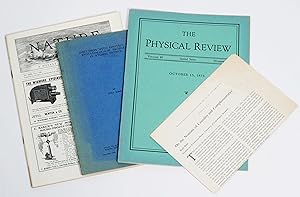
Contact seller5-star sellerOriginal wrappers. Dust Jacket Condition: Very Good. First edition. IMPORTANT PAPERS BY NIELS BOHR CONCERNING HIS DEBATES WITH ALBERT EINSTEIN OVER FOUNDATIONAL ISSUES IN QUANTUM MECHANICS. From the mid-1920s to the mid-1930s, at scientific conferences, in published papers and in informal discussions, two of the greatest physici…sts of their generation-Albert Einstein and Niels Bohr-argued about the emerging theory of quantum mechanics. Quantum theory had been phenomenally successful in explaining experimental results that had puzzled physicists for decades, and in accurately predicting new results. No one denied its predictive power, least of all Einstein who had been one of the early pioneers of the theory. However, the interpretation of the theory-the elucidation of its relationship to some (presumably) underlying physical reality-was a different matter. Quantum theory predicted only the probabilities of various experimental outcomes. Of course, probabilistic (or statistical) models of nature were nothing new to physicists. In the nineteenth century, Ludwig Boltzmann and others had developed the theory of statistical mechanics, which was concerned with predicting the bulk thermodynamic properties of materials through a statistical analysis of the motions of large ensembles of molecules, without attempting the impossible task of measuring or predicting the motion of each individual molecule. In statistical mechanics, the results were understood to be mere summaries of a more detailed underlying reality that was, as a practical matter, inaccessible to experimental observation. The question raised by quantum theory was whether its predictions merely reflected an incomplete knowledge of the underlying physical systems, as with statistical mechanics, or whether quantum systems were statistical (or probabilistic) in a more fundamental and ontological sense. Put another way, was the underlying reality itself probabilistic, or were there "hidden variables"-like the motions of individual molecules in statistical mechanics-which, even if not experimentally accessible, explained the rules of the theory? Bohr advanced the former view, and made it one of the fundamental pillars of the so-called "Copenhagen interpretation" of quantum theory that is associated with him and his followers. Initially, Einstein seemed willing to accept some elements of what later became solidified as the Copenhagen interpretation. "In 1905 Einstein had proposed that under certain circumstances monochromatic light [.] behaves as if it consists of light quanta, photons, particle-like objects" (Pais, p. 230). In trying to reconcile his proposal with the traditional wave theory of light, Einstein, in a 1909 paper, stated, "Deshalb ist es meine Meinung, daß die nächste Phase der Entwicklung der theoretischen Physik uns eine Theorie des Lichtes bringen wird, welche sich als eine Art Verschmelzung von Undulations- und Emissionstheorie des Lichtes auffassen läßt." [Therefore it is my opinion that the next phase of in the development of theoretical physics will bring us a theory of light that can be understood as a sort of fusion of the wave and particle theories light.] (Einstein, p. 817). Such a "profound statement", writes Bohr's assistant and later college of Einstein's, Abraham Pais, "foreshadows the fusion achieved in quantum mechanics-the new mechanics so offensive to Einstein's later views." (Pais, p. 231). But when physicists began to take sides on Bohr's emerging theory of complementarity, Einstein joined Schrödinger, Planck and others who were unable to accept the view of the natural world that was implicit in the Copenhagen interpretation. (Schrödinger's best-known contribution to the debate was his famous "Schrödinger's cat" thought experiment. Heisenberg, on the other hand, sided with Bohr.) These disputes became a focus of the Fifth Solvay Conference on Physics, held in Brussels in 1927. "All the creators of both the old and the new quantum theory were in attendance. The general discussion was opened by the venerable Lor.
 More images
Published by The Library of Living Philosophers, Inc, Evanston, IL 1949
- First Edition
Seller: Burnside Rare Books, ABAA, Portland, U.S.A.Burnside Rare Books, ABAA
Contact seller5-star sellerCondition: Used - Fine
US$ 2,000.00
Free ShippingShips within U.S.A.Quantity: 1 available
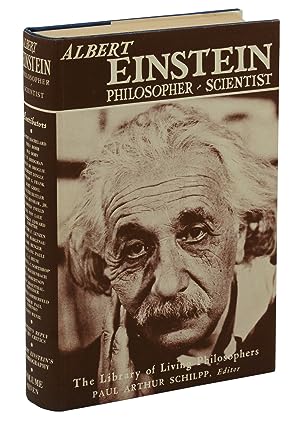
Add to basketCondition: Fine. Dust Jacket Condition: Fine. First Edition. First edition, trade issue. xvi, 781 pp. Bound in publisher's navy cloth with gilt spine lettering. Fine with offsetting to endpapers, in a Fine dust jacket, unfaded and unworn. A very sharp copy of a collectible volume all about the famous theoretical physicist.
 More images
Published by The Library of Living Philosophers, Inc, Evanston, IL 1949
- First Edition
Seller: Burnside Rare Books, ABAA, Portland, U.S.A.Burnside Rare Books, ABAA
Contact seller5-star sellerCondition: Used - Near fine
US$ 1,250.00
Free ShippingShips within U.S.A.Quantity: 1 available
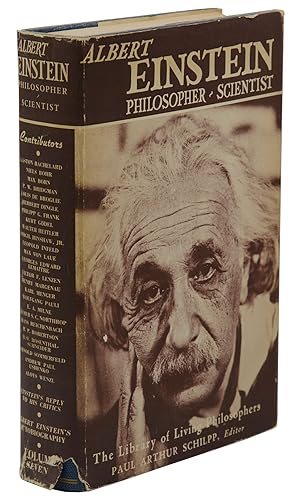
Add to basketCondition: Near Fine. Dust Jacket Condition: Very Good. First Edition. First edition, first printing. Bound in publisher's original dark blue cloth stamped in gilt. Near Fine with toning to pages, offsetting to endsheets, former owner name to front free endpaper and small sticker ghost to front paste down. In a Very Good dust ja…cket with fraying and chip at bottom spine end and short closed tear at head, light edge wear, toning, and soiling to rear panel.

- First Edition
Seller: Le Chemin des philosophes, Paris, FranceLe Chemin des philosophes
Contact seller5-star sellerCondition: Used
US$ 100.98
US$ 54.21 shippingShips from France to U.S.A.Quantity: 1 available
Add to basketThe Library of Living Philosophers, Evanston, Illinois, 1949, fort vol. in-8, rel pl. toile éd., portrait en front., XVI - 781 p. E.O. Bon ex. (II).


