
Order Total (1 Item Items):
Shipping Destination:

Analysis Design Machine Learning by Stalph Patrick (15 results)
Skip to main search results
Search filters
Product Type
- All Product Types
- Books (15)
- Magazines & Periodicals (No further results match this refinement)
- Comics (No further results match this refinement)
- Sheet Music (No further results match this refinement)
- Art, Prints & Posters (No further results match this refinement)
- Photographs (No further results match this refinement)
- Maps (No further results match this refinement)
- Manuscripts & Paper Collectibles (No further results match this refinement)
Condition Learn more
- New (11)
- As New, Fine or Near Fine (4)
- Very Good or Good (No further results match this refinement)
- Fair or Poor (No further results match this refinement)
- As Described (No further results match this refinement)
Binding
- All Bindings
- Hardcover (No further results match this refinement)
- Softcover (15)
Collectible Attributes
- First Edition (No further results match this refinement)
- Signed (No further results match this refinement)
- Dust Jacket (No further results match this refinement)
- Seller-Supplied Images (9)
- Not Print on Demand (12)
Language (1)
Price
- Any Price
- Under US$ 25 (No further results match this refinement)
- US$ 25 to US$ 50
- Over US$ 50
Free Shipping
- Free Shipping to U.S.A. (No further results match this refinement)
Seller Location
Seller Rating
-

-

-
Analysis and Design of Machine Learning Techniques: Evolutionary Solutions for Regression, Prediction, and Control Problems
Seller: Ria Christie Collections, Uxbridge, United Kingdom
Seller rating 5 out of 5 stars

US$ 67.23
US$ 15.86 shipping from United Kingdom to U.S.A.Quantity: Over 20 available
Add to basketCondition: New. In.
-
Analysis and Design of Machine Learning Techniques : Evolutionary Solutions for Regression, Prediction, and Control Problems
Published by Springer Vieweg 2014-02, 2014
ISBN 10: 3658049367 ISBN 13: 9783658049362
Language: English
PF. Condition: New.
-

Analysis and Design of Machine Learning Techniques : Evolutionary Solutions for Regression, Prediction, and Control Problems
Seller: GreatBookPricesUK, Woodford Green, United Kingdom
Seller rating 5 out of 5 stars
US$ 68.12
US$ 19.86 shipping from United Kingdom to U.S.A.Quantity: Over 20 available
Add to basketCondition: New.
-
Analysis and Design of Machine Learning Techniques: Evolutionary Solutions for Regression, Prediction, and Control Problems
Published by Vieweg + Teubner Verlag, 2014
ISBN 10: 3658049367 ISBN 13: 9783658049362
Language: English
Paperback. Condition: Brand New. 2014 edition. 188 pages. 8.25x5.75x0.50 inches. In Stock.
-

Analysis and Design of Machine Learning Techniques : Evolutionary Solutions for Regression, Prediction, and Control Problems
Published by Springer Fachmedien Wiesbaden, 2014
ISBN 10: 3658049367 ISBN 13: 9783658049362
Language: English
Taschenbuch. Condition: Neu. Druck auf Anfrage Neuware - Printed after ordering - Manipulating or grasping objects seems like a trivial task for humans, as these are motor skills of everyday life. Nevertheless, motor skills are not easy to learn for humans and this is also an active research topic in robotics. However, most solutions are optimized for industrial applications and, thus, few are plausible explanations for human learning. The fundamental challenge, that motivates Patrick Stalph, originates from the cognitive science: How do humans learn their motor skills The author makes a connection between robotics and cognitive sciences by analyzing motor skill learning using implementations that could be found in the human brain - at least to some extent. Therefore three suitable machine learning algorithms are selected - algorithms that are plausible from a cognitive viewpoint and feasible for the roboticist. The power and scalability of those algorithms is evaluated in theoretical simulations and more realistic scenarios with the iCub humanoid robot. Convincing results confirm the applicability of the approach, while the biological plausibility is discussed in retrospect.
-
Analysis and Design of Machine Learning Techniques | Evolutionary Solutions for Regression, Prediction, and Control Problems
Published by Springer Fachmedien Wiesbaden, 2014
ISBN 10: 3658049367 ISBN 13: 9783658049362
Language: English
Taschenbuch. Condition: Neu. Analysis and Design of Machine Learning Techniques | Evolutionary Solutions for Regression, Prediction, and Control Problems | Patrick Stalph | Taschenbuch | xix | Englisch | 2014 | Springer Fachmedien Wiesbaden | EAN 9783658049362 | Verantwortliche Person für die EU: Springer Vieweg in Springer Science + Business Media, Abraham-Lincoln-Str. 46, 65189 Wiesbaden, juergen[dot]hartmann[at]springer[dot]com | Anbieter: preigu.
-

Analysis and Design of Machine Learning Techniques : Evolutionary Solutions for Regression, Prediction, and Control Problems
Seller: GreatBookPricesUK, Woodford Green, United Kingdom
Seller rating 5 out of 5 stars
US$ 124.08
US$ 19.86 shipping from United Kingdom to U.S.A.Quantity: Over 20 available
Add to basketCondition: As New. Unread book in perfect condition.
-
Paperback. Condition: Like New. Like New. book.
-

Condition: As New. Unread book in perfect condition.
-
Analysis and Design of Machine Learning Techniques : Evolutionary Solutions for Regression, Prediction, and Control Problems
Published by Springer Fachmedien Wiesbaden, 2014
ISBN 10: 3658049367 ISBN 13: 9783658049362
Language: English
Condition: Sehr gut. Zustand: Sehr gut | Sprache: Englisch | Produktart: Bücher.
-
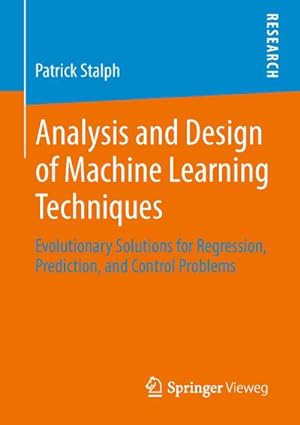
Analysis and Design of Machine Learning Techniques
Published by Springer Fachmedien Wiesbaden Feb 2014, 2014
ISBN 10: 3658049367 ISBN 13: 9783658049362
Language: English
Seller: BuchWeltWeit Ludwig Meier e.K., Bergisch Gladbach, Germany
Seller rating 5 out of 5 stars
Taschenbuch. Condition: Neu. This item is printed on demand - it takes 3-4 days longer - Neuware -Manipulating or grasping objects seems like a trivial task for humans, as these are motor skills of everyday life. Nevertheless, motor skills are not easy to learn for humans and this is also an active research topic in robotics. However, most solutions are optimized for industrial applications and, thus, few are plausible explanations for human learning. The fundamental challenge, that motivates Patrick Stalph, originates from the cognitive science: How do humans learn their motor skills The author makes a connection between robotics and cognitive sciences by analyzing motor skill learning using implementations that could be found in the human brain - at least to some extent. Therefore three suitable machine learning algorithms are selected - algorithms that are plausible from a cognitive viewpoint and feasible for the roboticist. The power and scalability of those algorithms is evaluated in theoretical simulations and more realistic scenarios with the iCub humanoid robot. Convincing results confirm the applicability of the approach, while the biological plausibility is discussed in retrospect. 176 pp. Englisch.
-

Analysis and Design of Machine Learning Techniques
Published by Springer Fachmedien Wiesbaden, 2014
ISBN 10: 3658049367 ISBN 13: 9783658049362
Language: English
Condition: New. Dieser Artikel ist ein Print on Demand Artikel und wird nach Ihrer Bestellung fuer Sie gedruckt. Publication in the field of technical sciencesIntroduction and Motivation.- Introduction to Function Approximation and Regression.- Elementary Features of Local Learning Algorithms.- Algorithmic Description of XCSF.- How and Why XCSF works.- Evolutionar.
-

Analysis and Design of Machine Learning Techniques
Published by Springer Fachmedien Wiesbaden, Springer Fachmedien Wiesbaden Feb 2014, 2014
ISBN 10: 3658049367 ISBN 13: 9783658049362
Language: English
Seller: buchversandmimpf2000, Emtmannsberg, BAYE, Germany
Seller rating 5 out of 5 stars
Taschenbuch. Condition: Neu. This item is printed on demand - Print on Demand Titel. Neuware -Manipulating or grasping objects seems like a trivial task for humans, as these are motor skills of everyday life. Nevertheless, motor skills are not easy to learn for humans and this is also an active research topic in robotics. However, most solutions are optimized for industrial applications and, thus, few are plausible explanations for human learning. The fundamental challenge, that motivates Patrick Stalph, originates from the cognitive science: How do humans learn their motor skills The author makes a connection between robotics and cognitive sciences by analyzing motor skill learning using implementations that could be found in the human brain ¿ at least to some extent. Therefore three suitable machine learning algorithms are selected ¿ algorithms that are plausible from a cognitive viewpoint and feasible for the roboticist. The power and scalability of those algorithms is evaluated in theoretical simulations and more realistic scenarios with the iCub humanoid robot. Convincing results confirm the applicability of the approach, while the biological plausibility is discussed in retrospect.VS Verlag für Sozialw., Abraham-Lincoln-Straße 46, 65189 Wiesbaden 176 pp. Englisch.


