
Aristee Divinite (9 results)
 More images
Published by A Paris [Haarlem ou La Haye] 1779
- Softcover
- First Edition
Seller: Bonnefoi Livres Anciens, Paris, FranceBonnefoi Livres Anciens
Contact seller4-star sellerCondition: Used
US$ 1,880.49
US$ 46.37 shippingShips from France to U.S.A.Quantity: 1 available
In-12 relié sur brochure de (2)-X-208 pp., dem-vélin, dos lisse orné, pièce de titre en maroquin rouge, entièrement non rogné (reliure du XIXe siècle). Édition originale tirée à petit nombre.François Hemsterhuis (1721-1790), "le Platon hollandais", s'occupa principalement d'esthétique et de philosophie morale. Attaché au Conseil… d?État des Provinces-Unies à La Haye de 1755 à 1780, il se lia à la même époque à la famille Galitzin et sollicita Diderot à propos de sa Lettre sur l'Homme et ses rapports publiée en 1772. Alexis ou de l?A?ge d?or appartient aux quatre Dialogues platoniques de?die?s a? Ame?lie Galitzin, qui ouvrent une nouvelle période « perhaps influenced by contemporary German philosophy, presented for the first time his concept of the golden age and the harmonious development of the individual. [.] His thought was received with admiration and approval by representatives of the Sturm und Drang and romantic movements in philosophy » (Leendert Brummel).Bel exemplaire relié sur brochure.Roger Stoddard, A Bibliographical List of Books by François Hemsterhuis (1721-1790) (The Bookollector 2001, 189-201), n°9 ; Fresco, Geeraedts & Hammacher, Frans Hemsterhuis (1721-1790), Sources, Philosophy and Reception, p. 644.
 More images
Published by A Paris. 1779. Paris, 1779. 1779
- Hardcover
- First Edition
Seller: Amanda Hall Rare Books ABA ILAB, Shaftesbury, WILTS, United KingdomAmanda Hall Rare Books ABA ILAB
Contact seller4-star sellerCondition: Used
US$ 2,280.01
US$ 25.49 shippingShips from United Kingdom to U.S.A.Quantity: 1 available
First Edition. in contemporary green morocco, unsigned binding, possibly by Thomas Van Os, with elaborate floral tooling to covers, spine gilt in compartments, slightly rubbed, red morocco label lettered in gilt, simple gilt dentelles, marbled endpapers, gilt edges. 12mo, (162 x 94), pp. x, 208, preserving the initial blank, the… engraved vignette on the title-page and the head- and tail-pieces are unsigned, A scarce philosophical work by the 'Dutch Socrates', Frans Hemsterhuis, a Dutch aesthete who lavished as much care in the design of his works as he did in their composition. He wrote a number of essays and dialogues on moral philosophy which brought him into contact with Goethe, Herder and and his life-long friend, Princess Amalia von Gallitzin, who did much to strengthen his reputation amongst the German intelligentsia and encourage the translation of many of his works. Hemsterhuis' ideas influenced some of the greatest German thinkers, including Kant, Novalis, Schlegel and Schiller. As with all of Hemsterhuis' works, Aristée was privately printed and distributed. The printing is typically elegant, the text block measuring 93 x 47 mm, a small and dense block of text within wide margins, in the present copy measuring 167 x 96 mm. The elaborate green morocco binding on this copy is probably by Thomas Van Os, a leading binder of the last quarter of the eighteenth century in the Netherlands. Van Os was commissioned by Hemsterhuis to create bindings for some of his later works, alongside Christiaan Micke, who bound so many copies of Hemsterhuis? earlier works for presentation. Of the two, Van Os is more associated with the flat spin, as here, in addition to which this binding bears many similarities with the two bindings (particularly fig. 7) by Van Os reproduced in Jan Storm van Leeuwen?s article in The Book Collector (see The Book Collector, Summer 2001, figs. 6 and 7, pp. 215-216). 'So, let this stand as a charge to collect Hemsterhuis', writes Roger Stoddard in conclusion, 'to look more closely at his books, to solve their mysteries, and to connect the careful designs of his bookmaking with the philosophical texts they embrace and convey with such eloquence. This is just a way of asking you to leave your place marker here to honour Hemsterhuis who always provided a ribbon place marker in the bindings he commissioned for presentation' (p. 189). See Roger Eliot Stoddard, 'François Hemsterhuis: Some Uncollected Authors VIII', in The Book Collector, Summer 2001, pp. 186-201; Jan Storm van Leeuwen, 'Frans Hemsterhuis' Binders and some bindings on Lettre sur l'Homme, ibid, pp. 202-216. Stoddard 9.
 More images
Published by S.N. 1779
- Softcover
- First Edition
Seller: Yesterday's Muse, ABAA, ILAB, IOBA, Webster, NY, U.S.A.Yesterday's Muse, ABAA, ILAB, IOBA
Contact seller5-star sellerCondition: Used - Good
US$ 756.99
Free ShippingShips within U.S.A.Quantity: 1 available
Trade Paperback. Condition: Good. First Edition. First edition. Spine faded and creased with some loss along edges, wrappers rubbed, rear wrapper edge reinforced with some material added along fore edge. 1779 Trade Paperback. x, 208 pp. Plain wrappers with handwritten spine label, sewn binding. A dialogue by the Dutch philosophe…r who influenced Immanuel Kant and the Romantic movement. Hemsterhuis, in discussing the existence of God and God's relationship to man, attempts to reconcile Newton's mechanical system of philosophy with Socratic ideas on more metaphysical topics. "His most valuable contributions are in the department of aesthetics or the general analysis of feeling. His philosophy has been characterized as Socratic in content and Platonic in form. Its foundation was the desire for self-knowledge and truth, untrammeled by the rigid bonds of any particular system. His most important works, all of which were written in French, are: Lettre sur la sculpture (1769), in which occurs the well-known definition of the Beautiful as 'that which gives us the greatest number of ideas in the shortest space of time'; its continuation, Lettre sur les desirs (1770); Lettre sur l'homme et ses rapports (1772), in which the 'moral organ' and the theory of knowledge are discussed; Sopyle (1778), a dialogue on the relation between the soul and the body, and also an attack on materialism; Aristee (1779), the 'theodicy' of Hemsterhuis, discussing the existence of God and his relation to man; Simon (1787), on the four faculties of the soul, which are the will, the imagination, the moral principle (which is both passive and active); Alexis (1787), an attempt to prove that there are three golden ages, the last being the life beyond the grave; Lettre sur l'atheisme (1787)." - 1911 Encyclopaedia Britannica.
 More images
Published by Paris [= The Hague or Haarlem], 1779
- Hardcover
- First Edition
- Signed
Seller: Antiquariaat FORUM BV, Houten, , NetherlandsAntiquariaat FORUM BV
Contact seller5-star sellerCondition: Used
US$ 2,328.23
US$ 28.98 shippingShips from Netherlands to U.S.A.Quantity: 1 available
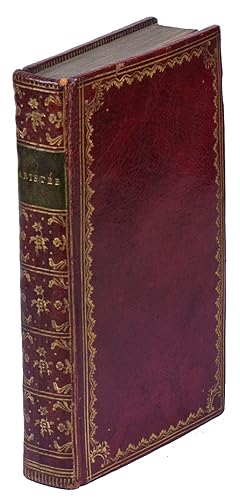
First edition of the famous philosophical dialogues by Frans Hemsterhuis (1721-1790), probably the most original Dutch philosopher of the 18th century, who influenced Immanuel Kant and romanticism. In the dialogues between Aristée and Dioclès, Hemsterhuis discussed the existence of God and his relation to man, aiming at a synthe…sis of Newtonian mechanical philosophy and Socratic philosophy of man, elaborating on topics as the nature of evil, the conception of beauty, religion etc.With a manuscript note in French on the first blank leaf, written in red ink, signed and dated: "Montasacre, A. Binaux, 1861". In very good condition, with generous margins.l Buijnsters 7; Cohen-De Ricci, col. 481; STCN 240058658; Stoddard 9. Contemporary gold-tooled red morocco, gold-tooled spine with green title-label, gold-tooled board edges and turn-ins, marbled endpapers, gilt edges. With engraved vignette on the title-page and 3 engraved head- and tailpieces, all printed in brown. Pages: [2 blank], X, 208 pp.

- Hardcover
- First Edition
Seller: Antiquariaat Wim de Goeij, Kalmthout, ANTW, BelgiumAntiquariaat Wim de Goeij
Contact seller5-star sellerCondition: Used
US$ 526.54
US$ 40.34 shippingShips from Belgium to U.S.A.Quantity: 1 available
Paris ('s Gravenhage), 1779, in-8°, 17 x 10 cm, title with engraved vignet + ii-viii + 208 pp with three engraved vignets, ontemporary green morocco, large floral gilt fillets on both covers, raised gilt spine, all edges gilt. Nice copy with wide margins and printed on thick laid paper. Binding with some signs of use at extremit…ies, title label on spine is missing. First edition of this philosophical treatise on the faculties of the soul; imagination, intelligence, desire and moral feeling. Hemsterhuis, born in Franeker (Friesland) is considered a precursor to Novalis, Schiller and Schlegel. The author was himself a bibliophile, the original editions of his works were printed in small numbers and with the highest typographical care by the The Hague printer Ch.W.F.Dumas.
 More images
Published by [Ch. W. F. Dumas], Paris (La Haye) 1779
- First Edition
Seller: Librairie-Galerie Emmanuel Fradois, Paris, , FranceLibrairie-Galerie Emmanuel Fradois
Contact seller5-star sellerCondition: Used
US$ 788.02
US$ 40.57 shippingShips from France to U.S.A.Quantity: 1 available
UN TRAITÉ SUR L'ÂME DU PHILOSOPHE BIBLIOPHILE In-12° (188 x 120 mm, hauteur : 183 mm), [1] f. bl. - x - 208 pp. (sign *6 A-R6), vélin à recouvrements, dos à 5 nerfs, tête rouge, non rogné en queue, témoins en gouttière (reliure pastiche de la fin du XIXe siècle). Exemplaire grand de marges de cette édition originale imprimée sur… papier fort de Hollande à petit nombre et non mise dans le commerce illustrée de 4 vignettes en taille-douce. Il s'agit ici du plus important des 4 dialogues platoniciens de l'auteur avec Alexis ou de l'âge d'or. « Hemsterhuis, qui croyait à l'origine en un dieu personnel, est converti à un clair panthéisme. L'omniprésence de dieu est à la base de la relation de l'homme avec lui, et c'est principalement grâce à l'« organe moral » comme on l'appelle, que l'homme est capable de s'approcher de dieu. » (Gale, Encycl. of Phil., 2006, III, p. 474). François Hemsterhuis (1721-1790), né à Franeker en Frise, ne fut pas un philosophe de troisième rang, épigone venu trop tard ou adversaire borné d'une philosophie jugée trop audacieuse à son goût. Il enthousiasma les penseurs et poètes du « Sturm und Drang » avant de captiver les premiers Romantique. Il est considéré comme un précurseur de Novalis, Schiller et Schlege. L'oubli quasi général dans lequel il est tombé de nos jours contraste avec une réelle notoriété d'époque. Bien qu'assez peu connu à Paris, il eut de nombreux lecteurs au large de l'Europe française des Lumières dont il remit en cause le rationalisme. Bibliophile, il fit imprimer les éditions originales de ses oeuvres à petit nombre et avec le plus grand soin typographique par l'imprimeur de La Haye, Ch. W. F. Dumas. PROVENANCE : Eugène Forgues avec son ex-libris gravé contrecollé au premier contreplat, qui commença comme son père - Paul-Émile Daurand-Forgues (également connu sous les pseudonymes d'Old Nick et de Tim), journaliste, critique littéraire et écrivain - par collaborer à diverses revues. En 1884, il publie Mémoires et relations politiques du baron de Vitrolles, puis continue l'oeuvre de son père en publiant Lettres inédites de Lamennais à Montalembert en 1898. Il publiera aussi Le dossier secret de Fouché (juillet-septembre 1815) ainsi qu'une Vie de Gavarni. Magistrat colonial, il séjourna à la Martinique, en Guadeloupe, Indochine et à Madagascar. En 1912 à sa retraite, il est premier président de la Cour d'Appel. Complet du premier feuillet blanc *1 qui manque souvent.
- Hardcover
- First Edition
Seller: Antiquariaat Wim de Goeij, Kalmthout, ANTW, BelgiumAntiquariaat Wim de Goeij
Contact seller5-star sellerCondition: Used
US$ 1,247.69
US$ 40.34 shippingShips from Belgium to U.S.A.Quantity: 1 available
Paris ('s Gravenhage), 1779, in-8°, 17 x 10 cm, title with engraved vignet + ii-viii + 208 pp with three engraved vignets, early 19th century full red morocco, triple gilt fillets on both covers, smooth gilt back, all edges gilt. Very nice copy with wide margins and printed on thick laid paper. First edition of this philosophica…l treatise on the faculties of the soul; imagination, intelligence, desire and moral feeling. Hemsterhuis, born in Franeker (Friesland) is considered a precursor to Novalis, Schiller and Schlegel. The author was himself a bibliophile, the original editions of his works were printed in small numbers and with the highest typographical care by the The Hague printer Ch.W.F.Dumas.
 More images
Seller: Antiquariaat Brinkman, since 1954 / ILAB, Amsterdam, , NetherlandsAntiquariaat Brinkman, since 1954 / ILAB
Contact seller4-star sellerCondition: Used
US$ 1,074.57
US$ 22.95 shippingShips from Netherlands to U.S.A.Quantity: 1 available
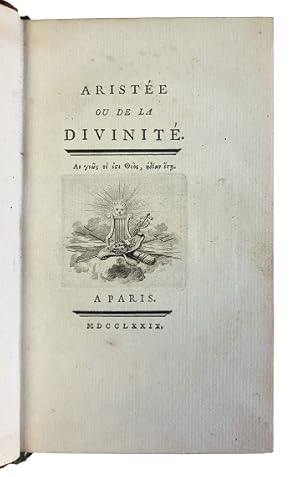
Paris (=Haarlem, The author), 1779. 12mo. (17x10 cm.) x,208 pp. With title vignette & 3 vignettes in the text. Half-leather; gilt spine, marbled edges. (first blank missing; bottom of upper joint slightly damaged; slight offsetting on pastedowns, some sporadic vague foxing; but a clean, fresh copy) Rare, as are all his original…works, printed in small editions for private circulation only. Van Sluis Bibl.Hemsterhusiana 7.17.
 More images
Language: German
- First Edition
Seller: Antiquariat Martin Barbian & Grund GbR, Saarbruecken, , GermanyAntiquariat Martin Barbian & Grund GbR
Contact seller5-star sellerCondition: Used
US$ 2,125.26
US$ 52.16 shippingShips from Germany to U.S.A.Quantity: 1 available
Paris (eigentlich: Den Haag), ohne Verlag, 1778 und 1779, Kl.-8°, 99 S., Zwischentitel mit Vignette, X, 208 S., mit 2 Vignetten, goldgeprägter Ganzledereinband der Zeit mit umlaufendem Goldschnitt (etwas berieben, etwas fleckig) *Jeweils Erstausgabe *Seltene, zuerst anonym erschienene Schriften des bedeutenden niederländändische…n Philosophen in Erstausgaben. *Frans Hemsterhuis, auch Franz oder François (1721 - 1790) war ein niederländischer Philosoph und Schriftsteller in der Zeit der Aufklärung.


