

Order Total (1 Item Items):
Shipping Destination:

Armorial Binding, Used (24 results)
Skip to main search results
Search filters
Product Type
- All Product Types
- Books (24)
- Magazines & Periodicals (No further results match this refinement)
- Comics (No further results match this refinement)
- Sheet Music (No further results match this refinement)
- Art, Prints & Posters (No further results match this refinement)
- Photographs (No further results match this refinement)
- Maps (No further results match this refinement)
- Manuscripts & Paper Collectibles (No further results match this refinement)
Condition Learn more
- New (No further results match this refinement)
- As New, Fine or Near Fine (5)
- Very Good or Good (11)
- Fair or Poor
- As Described (8)
Binding
- All Bindings
- Hardcover (19)
- Softcover (No further results match this refinement)
Collectible Attributes
- First Edition (6)
- Signed (1)
- Dust Jacket (No further results match this refinement)
- Seller-Supplied Images (22)
- Not Print on Demand (24)
Language (1)
Free Shipping
Seller Location
Seller Rating
-
The Owners of The Carpe Diem Armorial Binding Stamp. This is an original article separated from an issue of The Book Collector journal, 2005.
Published by The Book Collector, London, 2005
US$ 12.02
US$ 15.96 shipping
Ships from United Kingdom to U.S.A.Quantity: 1 available
Add to basketBooklet - Unbound Pages. Condition: Very Good. 4 pages, 2 figures. An authentic standalone article, extracted from a larger volume. Not a reprint or reproduction, but an original work in its own right. Supplied without title page or cover. Category: Book Collector; Cosmo Books : 29 years on ABE, 47 years taking care of customers. A bookseller you can rely on.
-
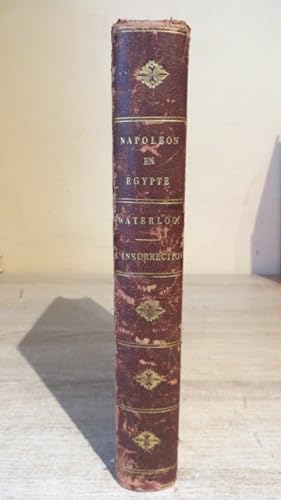
NAPOLEON EN EGYPTE - POEME EN HUIT CHANTS - GOOD COPY IN ORIGINAL HALF LEATHER BINDING - SUPER ARMORIAL BOOKPLATE
Published by Ambroise Dupont, 1928
US$ 34.54
US$ 22.80 shipping
Ships from United Kingdom to U.S.A.Quantity: 1 available
Add to basketHardcover. Condition: Good. Interesting military literaturereference. A good copy - clean and bright . In contemporary half leather binding with gilt title on spine. The book presents very nicely on the shelf. PARROTT BOOKS - established for over 20 years offering a prompt friendly and efficient service.
-
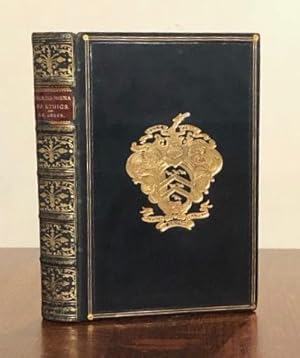
Prolegomena to Ethics. Armorial Binding.
Published by Oxford: Clarendon Press, 1899
Seller: Moroccobound Fine Books, IOBA, Lewis Center, OH, U.S.A.
Association Member: IOBA
Seller rating 5 out of 5 stars

Hardcover. Condition: Near Fine. Fourth edition. 485 pp. Hardcover, bound in full calf with armorial gilt stamp of Worcester College, Oxford. Scuffing to the binding with minor loss along the spine.
-
Les Provinciales ou Lettres Ecrites Par Louis de Montalte a un Provincial de ses Amis, et aux RR. PP. Jesuites [Irish armorial binding]
Published by Les Freres Lefranc, Clermont en-Auvergne, 1752
Seller: Pazzo Books, Boston, MA, U.S.A.
Association Member: ABAA ILAB SNEAB
Seller rating 5 out of 5 stars
Hardcover (Full Leather). Condition: Good Condition. Later Edition. Full contemporary leather worn at corners and spine ends, hinges cracked spine worn dry and degraded, binding still sound; attractive marbled endpapers. Attractive armorial crest on the front board still mostly intact. A few minor paper flaws, a few wormholes early on the the margin but mostly clean and bright internally. A nice little edition of Pascal's influential letters.448pp. Provenance: Rev. Charles Lawrence, Lawrencetown of Galway (bookplate and binding). His papers are held by the Galway County Council Archives. The family came to Ireland in 1571, Rev. Charles Lawrence (1828-1905) was head of the family in the 19th century. Size: duodecimo (12mo). Quantity Available: 1. Shipped Weight: Under 1 kilo. Category: Philosophy; Religion & Theology. Inventory No: 044020.
-
British armorial fine binding by R. Ingalton Drake. POEMS BY THOMAS GRAY. PRINTED AT THE ETON COLLEGE PRESS.
Published by Eton [Berkshire, England]: Eton College Press, 1894., 1894
Seller: David Hallinan, Bookseller, Columbus, MS, U.S.A.
Seller rating 5 out of 5 stars
R. INGALTON DRAKE BINDING. xiv, 165 pages. Hardcover: H 28.25cm x L 18.75cm. Full leather (smooth calf) binding; gilt tooling to spine with five raised bands and gilt lettered green title label; gilt stamped heraldic lion crest at centers of front and rear boards along with gilt borders and other gilt decorative elements; slender gilt tooling to board edges with gilt inner dentelles; some rubbing and edge abrasions. All edges gilt. Marbled endpapers; discreet stamp "R. Ingalton Drake, Binder" at ffep verso's top left. Printed presentation block on page i but marred by modern ink writing; slight interior foxing. Binding is firm. With engraved b/w plates on unpaged leaves including frontispiece portrait of Thomas Gray. Text comprised of four sections: {#1} POEMS (includes "Ode on the Spring," "Ode on the Death of a Favourite Cat, drowned in a Tub of Gold Fishes," "Ode on a Distant Prospect of Eton College," "The Progress of Poesy. A Pindaric Ode," "The Bard. A Pindaric Ode," "The Fatal Sisters. An Ode," "Sonnet on the Death of Mr. Richard West," "Elegy written in a Country Church-yard," etc.); {#2} TRANSLATIONS INTO ENGLISH VERSE; {#3} POEMATA; and {#4} TRANSLATIONS INTO LATIN VERSE. Please note that this book has an approximate shipping weight of 3.5 pounds (1.58 kg) and may require additional postage for any postal class other than domestic Media Mail.
-

The Works of the Right Honorable Lady Mary Wortley Montagu. including Her Correspondence, Poems and Essays. [5 volumes set in armorial leather binding]
Published by Richard Phillips. London, 1803
Hardcover. Condition: Good. Hardcover. 5 volumes in early leather bindings, with armorial blindstamp on the covers. Gold lettering and modest decorations on the spine. Vol. 1 has 309 pages. Bottom half of spine is chipped and shows poor repair where spine broke off and was clued back on. Vol. 2 has 339 and slightly better repair to spine-strip damage. Vol. 3 has 288 pages. Vol. 4 has 326 pages. Vol. 5 has 292 pages + long General Index. Volumes 3, 4,5 do not have any of the spine damage that the first 2 do. A handsome set. Bindings tight. Pages clean. This seems to be the first collection edition of Montagu's writings. She did not seek publication in her lifetime. Extra shipping will be required for international shipping.
-
![Seller image for Notes on the Miracles of Our Lord. Fourth Edition, Revised [together with] Notes on the Parables of Our Lord. Sixth Edition, Revised. SPLENDID NINETEENTH CENTURY ARMORIAL BINDING for sale by Island Books](https://pictures.abebooks.com/inventory/md/md213132758.jpg)
Notes on the Miracles of Our Lord. Fourth Edition, Revised [together with] Notes on the Parables of Our Lord. Sixth Edition, Revised. SPLENDID NINETEENTH CENTURY ARMORIAL BINDING
Published by John W. Parker, 1854-55, 1854
Seller: Island Books, Thakeham, West Sussex, United Kingdom
Seller rating 4 out of 5 stars

US$ 310.87
US$ 31.12 shipping
Ships from United Kingdom to U.S.A.Quantity: 1 available
Add to basket2 vols., roy. 8vo., very handsomely bound in a splendid mid-nineteenth century armorial binding of full near-black calf, sides with triple gilt frame border stopped at corners by gilt rosettes, enclosing a triple frame border similarly stopped in blind, the whole containing an elaborate armorial bearing blocked in gilt, backs gilt with five raised bands, all compartments tooled with multiple frame borders in gilt and blind, first compartment tooled in gilt with the Tudor rose surmounted by a crown, last compartment tooled in gilt with a figurative portcullis surmounted by similar crown, leather labels gilt, blind doublures, marbled endpapers, marbled edges, an excellent example of a private armorial binding of the period. A lovely set of Archbishop Trench's two major works (first published in 1846 and 1841 respectively) both of which are keystones of Victorian theology. The lists of contents in both volumes have been skilfully and neatly annotated in a contemporary and scholarly hand (probably that of the original owner) to attribute to each miracle and parable the appropriate point in the clerical calendar.
-

History of the United Netherlands: from the Death of William the Silent to the Twelve Years' Truce, 1609. Second Edition. BRIGHT, CLEAN SET IN SPLENDID OXFORD ARMORIAL BINDING
Published by John Murray,, 1867
Seller: Island Books, Thakeham, West Sussex, United Kingdom
Seller rating 4 out of 5 stars
Signed
US$ 386.87
US$ 31.12 shipping
Ships from United Kingdom to U.S.A.Quantity: 1 available
Add to basket4 vols., 8vo., Second Edition, with 4 engraved frontispieces and a large folding plan, blank preliminaries and plan lightly spotted; handsomely bound in blue full morocco, upper board with triple frame border stopped at corners by rosettes all in blind enclosing arms and motto of the Lodge family elaborately blocked in gilt, lower board with triple frame border stopped at corners by rosettes all in bind enclosing arms of Oxford University elaborately blocked in gilt, backs with five raised bands, second and third compartments lettered and tooled in gilt, all edges gilt, bevelled boards, doublures richly tooled in gilt, marbled endpapers, backstrip lettering faded to near-blind else a remarkably bright, crisp, clean set in a most impressive nineteenth century armorial binding. With the trade ticket of Rivingtons of Oxford in front paste-down of first volume. A PRESENTATION COPY FROM SIR RICHARD LODGE TO THE GIRLS' LIBRARY OF CHRISTS HOSPITAL WITH THE LATTER'S BOOKPLATE ON FRONT PASTE-DOWNS. Motley's classic study was first published in 1860.
-
[Armorial Binding] Praedium Rusticum
Published by Apud Joannem Le Clerc, Paris [Lutetiae Parisiorum], 1707
Seller: Fine Editions Ltd, Willow Street, PA, U.S.A.
Association Member: IOBA
Seller rating 5 out of 5 stars
First Edition
Full Calf. Condition: Fine-. First Edition. 12mo: [6],268,[12], with engraved initials and head and tail pieces, and 10 charming full-page plates by Laurent Cars after Dumesnil, one at the beginning of each book. In Latin. Full speckled calf, contemporary to publication, covers framed in blind with gilt-stamped coat-of-arms on both, spine in six compartments richly gilt, red leather lettering piece gilt, edges speckled red, marbled end papers. About Fine, joints skillfully reinforced; clean, well-margined leaves with occasional mild foxing and edge stains; most plates with faint tide mark to upper edge. Huzard II 944. Thiébaud 917-918. Schwerdt II, p. 278-79. First Edition (according to Schwerdt, but Thiébaud calls the Paris edition of 1696, which is "fort rare," the "Édition originale") of this didactic poem in ten books praising the pleasures of life in the countryside. Vanière instructs on the art of gardening while inspiring, in picturesque verse, a love of weather and landscape, the grape harvest, winemaking, hunting and fishing, orchards and vegetable gardens, and bees. His poems were highly esteemed, with editions of Praedium Rusticum issued for more than a hundred years, until 1829. The 1707 edition contains ten books, but the poem would ultimately comprise sixteen, in the second edition of 1730. The title refers to Charles Estienne's sixteenth-century treatise on gardening of the same name, but Vanière's poem is more than a reiteration, also providing a response to Rene Rapin (a French Jesuit, as was Vanière), emphasizing the value of herbs and vegetables over flowers and topiaries, which Rapin championed in his Hortorum (1665). Vanière's instructive content and practical perspective made his poem one of the most popular published in seventeenth century France. Gilt-stamped arms on both boards are those of Henry William Paget (1768-1854), 2nd Earl of Uxbridge and, later, 1st Marquis of Anglesey. A distinguished officer, Paget commanded the English cavalry at the battle of Waterloo, where he lost a leg. N. B. With few exceptions (always identified), we only stock books in exceptional condition, carefully preserved in archival, removable polypropylene sleeves. All orders are packaged with care and posted promptly. Satisfaction guaranteed.
-

A Dictionary of the Natural History of the Bible; or a Description of all the Quadrupeds, Birds, Fishes, Reptiles, and Insects, Tress, Plants, Flowers, Gums, and Precious Stones. UNIQUE COPY IN NINETEENTH CENTURY ARMORIAL BINDING
Published by Printed for T T and J Tegg, No. 73 Cheapside [and others in Glasgow and Dublin],, 1833
Seller: Island Books, Thakeham, West Sussex, United Kingdom
Seller rating 4 out of 5 stars
US$ 580.30
US$ 31.12 shipping
Ships from United Kingdom to U.S.A.Quantity: 1 available
Add to basket12mo., text in double-column, with engraved title-vignette and very numerous fine woodcut illustrations in the text; handsomely bound in black full roan, sides with debossed multiple frame border stopped at corners by rosettes all in blind and enclosing Coape crest blocked in gilt, back with four raised bands, second compartment lettered in gilt, gilt edges, gilt doublures, red endpapers, a most attractive copy ideal as a gift or for presentation. WITH THE FINE NINETEENTH CENTURY ENGRAVED ARMORIAL BOOKPLATE OF JAMES COAPE ON FRONT PASTE-DOWN. Harris's 'Natural History' was first published in 1793. This scarce edition is, we believe, the first issue with the title 'Dictionary'. 'In the present edition of Dr. Harris's valuable work it has been deemed advisable to throw the Appendix into the general alphabet. No other alterations have been made; but some important corrections and copious additions have been introduced, both the in the body of the work and in the notes' (Advertisement following title). A DELIGHTFUL AND HIGHLY DESIRABLE COPY OF AN ELEGANT AND EXTREMELY SCARCE EDITION PRINTED AT THE CHISWICK PRESS.
-
Our Village [LIMITED EDITION, IN HENRY ARTHUR JOHNSTONE ARMORIAL BINDING]
Published by MacMillan and Co, London, New York, 1893
Seller: ERIC CHAIM KLINE, BOOKSELLER (ABAA ILAB), Santa Monica, CA, U.S.A.
Seller rating 3 out of 5 stars

Hardcover. Condition: vg+ to near fine. Large Paper Edition. 1/470. Quarto, lx, 256pp. Period custom red morroco binding with gilt lettering and tooling on the front cover and spine. Top edge gilt. Custom brown leather endpapers. Armorial binding of noted British book collector Henry Arthur Johnstone (b.1861), with his gilt stamp on the front cover and his illustrated debossed Ex-libris (dated to 1899) stamped on the front endpaper. Frontispiece engraving. Illustrated headpieces and decorative initials. One of 470 copies of this limited Large paper edition. Includes one hundred illustrations by Hugh Thomson, twelve of them full page. First published in book form in 1824, the series of Our Village sketches depicting village scenes had appeared first in The Lady's Magazine five years earlier. Mitford's ambition had been to become a great poetess. She published several volumes of poetry and staged some plays. But it was the need to make a living that drove her to write prose which turned to become successful and financially rewarding though it was received with mixed opinions. Binding with very minor wear and smudges to the covers and spine. Binding tight with interior clean. Binding in very good+, interior in near fine condition overall. From the library of Henry Arthur Johnstone.
-
Journal d'un missionnaire au Texas et au Mexique (1846-1852) Journal of a missionary in Texas and Mexico. EXEMPLAIRE AUX ARMES DE L'IMPERATRICE EUGENIE. ARMORIAL BEARING OF IMPRESS EUGENIE ON THE BINDING. Reliure signée C. Parisot.
Published by Librairie de Gaumes Frères, Paris, 1857
Seller: Librairie Christian Chaboud, Bruxelles, Belgium
Seller rating 5 out of 5 stars
First Edition
in-8 reliure de l'époque en plein maroquin rouge orné au centre des armes de l'Impératrice Eugénie, entourées d'un semé d'abeilles et d'un décor en encadrement filigrané; coupes ornée de pointillés, chasses décorées d'un triple filet doré, toutes tranches dorées, gardes en papier moiré blanc; signet, xiii,477p. Edition originale. Complet de sa carte dépliante du Texas. Mention manuscrite ancienne sur une garde blanche : Livre provenant de la bibliothèque de sa Majesté l'Impératrice. Bel état de la reliure. ROUSSEURS. NB. Les commandes et questions sont traitées dans les 24h, les expéditions reprendront le 13 juin. Tous les ouvrages de notre catalogue peuvent être consultés et retirés sous quelques jours à Saint-Gilles ou Paris, 5e arr. Merci de nous contacter.
-
Designs by Mr. R. Bentley, for Six Poems by Mr. T. Gray. [Armorial binding of Charles Coote, 1st Earl of Bellomont ] Second edition.
Published by London: R. Dodsley, 1753
Seller: Wittenborn Art Books, San Francisco, CA, U.S.A.
Seller rating 5 out of 5 stars
Condition: Good. Folio. 27 x 37. Contemporary gilt calf with the gilt armorial of Charles Coote, 1st Earl of Bellomont KB PC. [4], 36 numbered leaves printed on recto only, 4 page "Explanation of Prints" at the rear. With 6 engraved plates and 13 vignettes by Richard Bentley. (Folio) period calf with armorial stamp in gilt. Second edition.Second edition, with "Designs, &c." on the half-title. Pioneering work of collaboration between poet and artist and recognized as a landmark work of its kind. The instigator behind it was Horace Walpole, who was friends with Bentley, Gray and the publisher Dodsley. The text reprints four poems by Gray and two, "A Long Story" and "Hymn to Adversity," appear here for the first time. Hazen, Horace Walpole, 42; Rothschild 1061; Northup 178; NCBEL II, 579; Univ. Cat. I. p. 720; Graesse III. p. 141 (1773); T-B. III p. 356.Charles Coote, 1st Earl of Bellomont KB PC(I) (6 April 1738 - 20 October 1800), was an Irish peer. He held a senior political position as one of the joint Postmasters General of Ireland. Charles was briefly styled as The 5th Baron Coote between February 1766 and his elevation to the earldom in September 1767. Arms A chevron between three coots Crest A coot Motto VINCIT ? VERITAS.
-
Lexicon Chaldaicum, Talmudicum et Rabbinicum (Lexicon of Aramaic, Talmudic and Rabbinic Hebrew) [FINE ARMORIAL BINDING EMBOSSED WITH THE PORTRAIT OF AUGUSTUS I AND THE ARMS OF THE ELECTORS OF SAXONY]
Published by Ludwig König, Basel, 1639
Seller: ERIC CHAIM KLINE, BOOKSELLER (ABAA ILAB), Santa Monica, CA, U.S.A.
Seller rating 3 out of 5 stars
First Edition
Hardcover. Condition: Fine. First edition. Folio in fours: [asterisk in parens]6, A-8N4, 8O6 (= 708 leaves); [12]pp., 2680 columns (1391-1392 omitted; 1997-1998 repeated), [64 = index and emendanda]pp. Engraved portrait; extra engraved title page. Woodcut printer's device at letterpress title; woodcut head- and tail-pieces, initials; letterpress ornamentation. Contemporary tawed pigskin over wooden boards, elaborately tooled in blind with central cartouches at both covers (portrait of August I at front; Electors of Saxony arms at back), spine with raised bands. Pair of mounted leather straps and brass catches intact, along with a single brass clasp (second clasp replaced with a simple modern brass replica). Edges stained green. Two old cellotape repairs along top edge verso of the portrait (not affecting image). Bottom outer corner section (2 in. by 4 in.) of the main title margin excised and expertly replaced. Faintly toned text, crisp and fine throughout. A very attractive copy in a handsome armorial binding, complete with both the author's portrait and the engraved title. First edition of this lexicon of Aramaic and post-biblical Hebrew, comprising the vocabulary of the Aramaic paraphrases (targum) of the Old Testament, the Jerusalem and Babylonian Talmuds, as well as later midrashic and and rabbinic literature, all copiously illustrated with extracts and examples. This present issue is dated M.DC.XXXIX. (1639) at the engraved title, and M.DC. XXXX. (1640) at the main title, the latter likely in error, according to Prijs. The numeral "2" in the 1629 date of death on the portrait is reversed (in some copies it has been erroneously replaced with a "3"). The dedication (Basel, February 1639) is addressed to the Ordines of Groningen and Holland in recognition of the establishment in 1614 of the University of Groningen. Two faculty members, Franciscus Gomarus and Heinrich Alting had specifically requested that Buxtorf publish a dictionary for use in the study of Jewish rabbinic literature. (Prijs) Begun in 1610, the work would occupy the elder Buxtorf for the next twenty years, in the midst of his copious academic schedule and other scholarly projects. "By 1617 he had reached the letter Ayin. Between 1617 and 1619 he worked on the rabbinical Bible and probably had no time to devote to the lexicon. Finally in 1628 he completed the first draft. His manuscript work was in no shape to be published, however" (Burnett). "In the course of the work the material grew more and more, so that after completing the whole thing up to the letter Tav, he had to set about bringing the earlier letters up to date by using other sources" (Prijs). Buxtorf died in 1629 before completing the revisions of the letter Bet. His son, Johann, would complete the revisions and finally publish the lexicon after ten more years of labor. While the younger Buxtorf states in the preface "maneat parenti gloria authoris" (may the glory of the Author remain with the Parent), "in his hands it became almost a new work" (Smitskamp). Burnett notes that "Buxtorf's fame as a lexicographer. was not a result of his work in biblical Hebrew, but in post-biblical Hebrew and talmudic Aramaic." Two centuries later, bibliographers and scholars were still singing the praises of the Lexicon Chaldaicum: "All the Chaldaic, Talmudical, and Rabbincal words which occur in the paraphrases of the Old Testament, in the Babylonish and Jerusalem Targums, in the common or more private writings of the Hebrew commentarors, philosophers, theologians, cabbalists, and lawyers, are fully explained. Numerous extracts, and examples are given; proverbs, apophthegms, opinions, rites, and other things relating to sacred philology and antiquities, are illustrated. All subsequent writers have been greatly indebted to this Lexicon of Buxtorf.? (Orme). "The World is more beholden to him for his learned and judicious Labours, than to any other that lived in his time, and his name ought ever to be preserved with Honour in Acknowledgment of it? (Prideaux.
-

Caeremoniale Benedicti XIV. Pontificis Maximi Jussu Editum Pro Basilica Assisiensi Sancti Francisci In Patriarchalem Et Cappellam Papalem Erecta. Papal Armorial Binding.
Published by Generosi Salomoni, Romae, 1754
Seller: Moroccobound Fine Books, IOBA, Lewis Center, OH, U.S.A.
Association Member: IOBA
Seller rating 5 out of 5 stars
First Edition
Hardcover. Condition: Very Good. 1st Edition. xxxii, 76 pp. Hardcover, bound in full vellum with the papal coat of arms in gilt on the front and rear boards. The binding edge-worn; boards splayed as usual with vellum. Modern bookplate on both sides of the first blank. Pope Benedict XIV here published his own ceremony for raising the church of St. Francis in Assisi to the dignity of patriarchal basilica and papal chapel.
-
Almanach Iconologique Année 1768 Quatrieme Suite ETRES Metaphisiquee les Figures et leurs Explications Par M Gravelot. Avec Privilege du Roy [Armorial Binding French Family Crest Full Leather Binding]
Published by Paris: Chez Lattré Graveur, 1768
Seller: Louis88Books (Members of the PBFA), Andover, United Kingdom
Association Member: PBFA
Seller rating 5 out of 5 stars
US$ 829.00
US$ 38.90 shipping
Ships from United Kingdom to U.S.A.Quantity: 1 available
Add to basketHardcover. Condition: Good. Paris: Chez Lattré Graveur, rue S Jacques a la Viille de Bordeaux, 1768, small volume (12mo) First Edition. Small volume, approximately 4 ¾ inches (12cm) tall in full decorated calf binding, gilt title to the spine, gilt decorated spine, gilt page edges, an attractive volume. Unnumbered pages with 12 engraved plates with H Gravelot to the bottom left corner and various Scult to the bottom right, 12 pages of text alongside 12 engravings after the 12 months of the year. Hubert-François Bourguignon, commonly known as Gravelot (26 March 1699 20 April 1773), was a French engraver, a famous book illustrator, designer and drawing-master. Born in Paris, he emigrated to London in 1732, where he quickly became a central figure in the introduction of the Rococo style in British design, which was disseminated from London in this period, through the media of book illustrations and engraved designs as well as by the examples of luxury goods in the "French taste" brought down from London to provincial towns and country houses. Approximately 4 ¾ inches tall. Condition Report Externally Spine good condition gilt titles to dark label, gilt decoration, gently worn and marked. Joints good condition worn and chipped but intact. Corners good condition gently bumped and worn. Boards good condition full calf, gilt family crest to both boards, gently worn. Page edges good condition top slightly darkened, all gilt. See above and photos. Internally Hinges good condition sound. Paste downs good condition marbled paper. End papers good condition marbled paper. Title good condition tanned with foxing. Pages good condition gently tanned, with some foxing, good and tightly bound. Binding good condition attractive. See photos Publisher: see above. Publication Date: 1768 Binding: Hardback.
-
Full-Leather. Condition: Good. Folio measuring approx. 16x10 inches, blank, title and dedication leaves, text in 2 columns numbered 1-760 [some errors noted], blank leaf at end; title and dedication leaves somewhat browned, lower blank margins in the first half of the book show residual effects of dampness seldom entering the text; full leather binding at some time rebacked and endpapers refreshed, edges of boards and corners worn, binding now tight; Scottish thistles in the corners of the gilt ruled boards front and rear, both boards also bearing the arms of King Charles I [Stamp 21a in the University of Toronto Library listing of British Armorial Bindings]. Additional photos available on specific request.
-
LA SPAGNA: DE IRUN A MALAGA ( Armorial Binding Duc de Montpensier)
Published by Nicola Zanichelli, Bologna., 1879
Hardcover. Condition: Very Good. 8vo. (1)f + vii + 502 + vii pp. Bound in full contemporary red calf with gilt stamped arms of the Duke of Montpensier, prince consort of the princess Isabel; gilt ornamental borders and gilt designs in 5 compartments on spine. Boards' edges gilt, all edges gilt and yellow endpapers. Adolfo De Foresta (Nizza Marittima, 26 November 1825 - Rome, 29 November 1886) was an Italian politician. He was a senator of the Kingdom of Italy in the XV legislature.
-
L'OFFICE DE LA SEMAINE SAINTE A L ' USAGE DE LA MAISON DU ROY. Fine Armorial Binding with the Arms of Louis XV.
Published by Imprimerie de Jacques-François Collonbat, 1748
Hardcover. Condition: Very Good. In 8vo. Engraved frontispiece and title, 4 engraved plates after Humblot. Full contemporary red morocco bearing the arms of Louis XV, richly tooled with gilt frames, floral tools, palmettes, and sunbursts. Spine gilt-tooled. All edges gilt. Printed on fine Dutch laid paper. Paris: Jacques-Francois Collombat, 1748. A fine example of an 18th-century French royal armorial binding. In French. Hardcover.
-
Histoire de la conquête et des révolutions du Pérou. (Armorial Binding with Pedro II's arms)
Published by Camuzeaux, Paris, 1835
Hardcover. Condition: Good. In-8º. Two volumes in one. (3)f + 280pp + (2)f + 272pp. 2 engraved frontispieces by Dorgez & Moret after Caboche. The internal condition is very good. Bound in full brown calf; gilt frame on covers, and the arms of the Empire of Brazil in centre of front cover. Spine with morocco label; and decorative gilt borders. Some signs of wear on joints; tail a bit torn. In French. Hardcover.
-
Reflections sur Quelques Parolles de Jesus-Christ: Particulierement sur les sept dernieres qu'il à[!] prononcées sur la croix. Pour servir d'un saint entretien à l'ame chrétienne pendant la messe [Dedication Copy in Madame de Maintenon's armorial binding]
Published by N. Bonnart, Paris, 1690
Seller: Capitol Hill Books, ABAA, Washington, DC, U.S.A.
Seller rating 5 out of 5 stars
First Edition
Condition: Very Good. First Edition. Paris: N. Bonnart, [ca. 1690]. First Edition. 12mo (15.5cm.); armorial binding of Madame de Maintenon, full crimson morocco adorned with her coat-of-arms on both covers, triple-ruled in gilt with diminutive repeating rampant lions at each corner, elaborate gilt spine in six compartments, all edges gilt, marbled endpapers; 100pp.; illus. and calligraphic text printed entirely from copper-plates, this copy featuring the more often-found depiction of an empty cross within a crown of thorns printed on title page verso. Light rubbing to extremities, brief discoloration to upper cover from exposure to damp, inoffensive surface abrasion to front pastedown from previously-removed ex libris, slightly later ink note in Latin to front flyleaf, else a Very Good or better copy of an exquisite production in a desirable presentation binding. Though dedication signed in text "N.D.T.," a sermon of this title can be found in the complete works of Jacques Bénigne Bossuet (1627-1704), tutor of the same children to whom Maintenon had served as governess. Small and beautifully-produced prayer book dedicated to Madame de Maintenon (1635-1719), by then the morganatic not-so-secret second wife of Louis XIV, published for the use of the Maison Royale de Saint-Louis, a boarding school Maintenon founded in St. Cyr for the education of the orphans and children of the poorer French nobility. The text, printed entirely from copper-plates, is interspersed with delicate vignettes of flowers, views of the French countryside, and soothing religious imagery (the lamb asleep on the cross), details presumably dotting the text to keep Maintenon's wards engaged while deep in prayer. Volumes bound in the Maintenon armorial bindings are relatively scarce, their owner having not organized any semblance of a personal library until quite late in life. Though married to the king of France for over thirty years, Madame de Maintenon (née Françoise d'Aubigné, later Madame Scarron) came from a modest background she never forsook. Raised in the Calvinist church, the young Aubigné was orphaned at an early age and subsequently educated in an Ursuline convent where she converted to Catholicism, her devotion to the Church one of her most notable qualities throughout her long and increasingly illustrious career. By the time she reached womanhood, her straitened circumstances led her to marry the significantly older and paralytic author Monsieur Scarron, noting that "I have entered a union in which the heart requires little and the body, in truth, nothing at all" (my translation). Widowed within less than a decade, the beautiful and pious Madame Scarron had by now seduced the French nobility at court and was quickly summoned by the Marquise de Montespan to be governess to the children she had borne Louis XIV out of wedlock. It was in this role that she caught the king's attention, who bestowed upon her the money which she used to purchase the Chateau de Maintenon as well as the title of Marquise de Maintenon. During the decade of the 1670s the king spent more and more of his time with his children's governess, causing a predictable rupture between her and the Marquise de Montespon, though Maintenon forever avowed that she never stooped to the level of mistress. In 1683 Louis XIV and Madame de Maintenon were married in a secret ceremony, and while she never filled the role of Queen of France, she was the king's chief advisor until the end of his days. (See Ernest Quentin-Bauchart, "Les Femmes Bibliophiles de France" (1886), pp. [269]-272.) A note about the binding: The example of the Maintenon coat-of-arms depicted on this volume not listed in Olivier-Hermal-Roton, presumably having been produced specially for this, the dedication copy--the British Library notes a similar example of another unique cut, on their dedication copy of Cordemoy's "Divers Traitez de Controverse" (1701).
-
POETICAL WORKS OF JOHN MILTON With a Life of the Author by Wm. Haley. [Charles Hering] [British armorial binding]. Three volumes.
Published by Printed by W. Bulmer and Co., Shakespear Printing Office, for John and Josiah Boydell, and George Nicol; from the types of W. Martin: London. 1794, 1795, 1797, 1794
Seller: John K King Used & Rare Books, Detroit, MI, U.S.A.
Seller rating 4 out of 5 stars
Bound by Charles Hering. Thirty-five plates with tissue guards, volume I has 13 plates by artists Giovanni Cipriani (3), William Gardiner (3), George Romney (1) and Richard Westall (6), volume II has 10 (all Westall), Volume III has 12 (all Westall) 17 x 13, contemporary straight grain red morocco, covers have three gold tooled rows: two floral and one Greek key with disc and three blind tooled rows: rosette, broken cable and filet, all corners have a gold eight pointed star within another within another gold star within a gold ruled octagon, flat spine with 14 gold tooled panels: alternating rows of floral, diamond and annular dots/chains with dots/overlapping scallops with dots, three panels with lettering: Milton's Poetical Works/armorial stamp: bull's head with an arrow surrounded by this motto: Prodesse Quam Conspici (to be useful rather than conspicuous), stamp is unknown (at least four British families have this motto but bull and arrow is not on their crests) with cupid's heads, dots and rosettes in margins/volume I, volume II, volume III with cupid's heads, stars and circles in margins, gold scroll pattern along cover edges, gold floral pattern on inner dentelles, gauffered edges, blue watered silk endpapers, bookbinder ticket on reverse of free front endpaper of volume I: Bound by C. HERING No. 10 London, all volumes have silk page markers. Covers have scuffing/scraping (esp volume III), spotting (esp volume I), scratches, rubbing, shelfwear, corners bumped and worn, spines darkened, volume I is missing small pieces from spine tips and lower headband and the outer/inner front hinges is cracked and cover is becoming detached. Contents: inner hinges cracked, endpapers fading, page markers frayed, offsetting, toning, spotting, smudging, volume I has detached title page and blank page with chipping and is almost detached, one plate torn out (but present) and a few tears; title page almost detached in volumes II and III, staining to volume III else all are tight and in good condition. The Boydells, well known for their "Shakespeare Gallery," honored Milton by publishing "The Poetical Works of John Milton," a three volume, "spare- no-expense," publication with contributions by well known artists. These sets were bound by various bookbinders including Charles Hering, C. Kalthoeber and F.B. Neumayer. During this time period of the late 18th c and early 19th c the passion for collecting books was at a fever pitch among the royalty and affluent nobles and gentlemen. The collectors wanted to enhance their new possessions and bookbinders had more work than they could manage. Charles Hering, a German native, started his business as a master bookbinder in London in 1794 at 34 St. Martins street and approximately a year later moved to 10 St. Martins Street. Hering was known as superior craftsman who created elegant bindings. Dibdin wrote about Hering: "No one could presume to 'measure business' with him. There was a strength, a squareness, and a good style of work about his volumes which rendered him deservedly a great favorite." Some of his clients included the Prince Regent, the 2nd Earl of Spencer, his mother-in-law the Countess Lucan, statesman Thomas Grenville, Lord Byron, landscape painter Joseph Farington, Curators of the Faculty of Advocates' Library in Edinburgh. Some of the books he bound: the Book of Hours (1465), Pollux. Onomastican (1502), Harvey. Exercitationes de Generatione Animalium (1651), Curtis. Flora Londinensis (1775-78). Of the several copies of this set currently being offered for sale none are bound by Hering. A truly beautiful set, a fine example of Hering's work.
-

Rare original armorial binding in gold and silver thread bearing a coat of arms reminiscent of the Durazzo family of Venice. Small octavo, empty, white silk with pink silk pastedowns, the outer border decorated with floral repeating motives in silver and green foil leaves, and the escutcheon crowned by a pink hat with six tassels on either side designating the rank of Apostolic Prothonotary. This distinguishes the owner of the binding as member of the highest college of prelates in the Roman curia, and also marks him as honorary prelate to whom the pope conferred this specific title and its privileges. The escutcheon on the front panel is embroidered with a shield of three bands: the first depicting an aigle à ployà e couronnà e or a heraldic eagle shown with wings spread and surmounted by a crown, the second an argent lion passant accompagnà de trois coquillesÂor a heraldic lion with one paw raised on a silver background accompanied by three scallop shells, and the third a bantà dâargent et dâazureÂor the background of a shield with diagonal stripes of silver and blue. The escutcheon on the rear panel is embroidered with a shield with a silver background and the initials CR. In very good condition. Accompanied by clippings regarding the meaning to the armorial shield and the Durazzo family laid in. French coats of arms are a central component of heraldic tradition, combining symbolic imagery, codified colors, and precise terminology to represent lineage, authority, and identity. Typical elements include the escutcheon (shield), which bears charges such as lions, eagles, or scallop shells, and is described in formalized blazonry using French heraldic vocabularyâ"for example, argent lion passant or accompagnà de trois coquilles (âa gold lion passant on a silver field, accompanied by three scallop shellsâ) or bantà dâargent et dâazur (âa shield striped diagonally in silver and blueâ). These designs were not merely decorative but functioned as visual markers of nobility, kinship ties, and feudal allegiance, while also incorporating religious and cultural symbolism, such as the scallop shell for pilgrimage. Over centuries, French heraldry developed strict rules of color (tincture) and form, ensuring both clarity and continuity, and contributed significantly to the broader European heraldic system by codifying a language that combined artistry with social and political meaning.
-
[Faux Book] Notepad in an Eighteenth Century Full Calf Armorial Binding
Seller: White Fox Rare Books and Antiques, ABAA/ILAB, New York, NY, U.S.A.
Association Member: ABAA ESA ILAB PBFA
Seller rating 4 out of 5 stars
Full Calf. Condition: Very Good Minus. The binding is late 18th century (or early 19th century), with gilt border decoration, an armorial vignette centerpiece, raised bands and elaborate gilt fleurets in between. The calf is somewhat dry, cracked, abraded and rubbed, with heavier wear by the spine extremities, but still handsome nonetheless. Within there is an earthy orange and blue marbled endpaper that is possibly not as old as the calf but is certainly nineteenth century. The notepad, which was fitted later to the older binding, is bound with the same marbled paper. The top sheet is an eighteenth century copper engraving of an illustration for "Le Malade Imaginaire", a play by Moliere, and below this are well over 200 blank sheets, bound together from above. These sheets are now toned but otherwise clean, excepting a few scribbles on the very top sheet. To the side is a pencil holder and an old pencil. From the looks of things, this binding was refitted for the notepad over a century ago, and thus, qualifies as an antique faux book no matter how one evaluates it. (This distinguishes it from a dummy book, say, made yesterday from a discarded antique leather binding.) The dimensions of the binding are 17 by 10.5 cm.

![Seller image for Les Provinciales ou Lettres Ecrites Par Louis de Montalte a un Provincial de ses Amis, et aux RR. PP. Jesuites [Irish armorial binding] for sale by Pazzo Books](https://pictures.abebooks.com/inventory/md/md31886236140.jpg)


![Seller image for [Armorial Binding] Praedium Rusticum for sale by Fine Editions Ltd](https://pictures.abebooks.com/inventory/md/md19597185915.jpg)
![Seller image for Our Village [LIMITED EDITION, IN HENRY ARTHUR JOHNSTONE ARMORIAL BINDING] for sale by ERIC CHAIM KLINE, BOOKSELLER (ABAA ILAB)](https://pictures.abebooks.com/inventory/md/md32335632516.jpg)


![Seller image for Designs by Mr. R. Bentley, for Six Poems by Mr. T. Gray. [Armorial binding of Charles Coote, 1st Earl of Bellomont ] Second edition. for sale by Wittenborn Art Books](https://pictures.abebooks.com/inventory/md/md31928943480.jpg)
![Seller image for Lexicon Chaldaicum, Talmudicum et Rabbinicum (Lexicon of Aramaic, Talmudic and Rabbinic Hebrew) [FINE ARMORIAL BINDING EMBOSSED WITH THE PORTRAIT OF AUGUSTUS I AND THE ARMS OF THE ELECTORS OF SAXONY] for sale by ERIC CHAIM KLINE, BOOKSELLER (ABAA ILAB)](https://pictures.abebooks.com/inventory/md/md31504756217.jpg)
![Seller image for Almanach Iconologique Année 1768 Quatrieme Suite ETRES Metaphisiquee les Figures et leurs Explications Par M Gravelot. Avec Privilege du Roy [Armorial Binding French Family Crest Full Leather Binding] for sale by Louis88Books (Members of the PBFA)](https://pictures.abebooks.com/inventory/md/md30766826153.jpg)
![Seller image for Minshæi Emendatio . sui Ductoris in Linguas . The guide into the Tongues: with their agreement . one with another, as also their Etymologies . in these nine languages, viz. 1. English, 2. Low Dutch, 3. High Dutch, 4. French, 5. Italian, 6. Spanish, 7. Latine, 8. Greeke, 9. Hebrew . Also the exposition of the terms of the Lawes of this land . with . the Etymologies of proper names of the Bible, etc. The Second Edition. [King Charles I armorial binding] for sale by Stony Hill Books](https://pictures.abebooks.com/inventory/md/md30415048924.jpg)


![Seller image for Reflections sur Quelques Parolles de Jesus-Christ: Particulierement sur les sept dernieres qu'il à[!] prononcées sur la croix. Pour servir d'un saint entretien à l'ame chrétienne pendant la messe [Dedication Copy in Madame de Maintenon's armorial binding] for sale by Capitol Hill Books, ABAA](https://pictures.abebooks.com/inventory/md/md31400754781.jpg)
![Seller image for [Faux Book] Notepad in an Eighteenth Century Full Calf Armorial Binding for sale by White Fox Rare Books and Antiques, ABAA/ILAB](https://pictures.abebooks.com/inventory/md/md16443585013.jpg)