Order Total (1 Item Items):
Shipping Destination:

Atomic Information, First Edition (10 results)
Skip to main search results
Search filters
Product Type
- All Product Types
- Books (10)
- Magazines & Periodicals (No further results match this refinement)
- Comics (No further results match this refinement)
- Sheet Music (No further results match this refinement)
- Art, Prints & Posters (No further results match this refinement)
- Photographs (No further results match this refinement)
- Maps (No further results match this refinement)
- Manuscripts & Paper Collectibles (No further results match this refinement)
Condition Learn more
- New (No further results match this refinement)
- As New, Fine or Near Fine (4)
- Very Good or Good (5)
- Fair or Poor (No further results match this refinement)
- As Described (1)
Binding
Collectible Attributes
Language (2)
Free Shipping
- Free Shipping to U.S.A. (No further results match this refinement)
Seller Location
Seller Rating
-

Sources of Information on Atomic Energy.
Language: English
Published by Oxford, et al: Pergamon Press: (1966)., 1966
Seller: Pride and Prejudice-Books, Ballston Lake, NY, U.S.A.
Seller rating 5 out of 5 stars

First Edition
Hardcover. Condition: Very Good. 1st Edition. First edition. Red cloth. Ex-library with usual markings and pocket, else VG.
-
Enrico Fermi Reactor: Use for Irradiation Testing. Hearing before the Joint Committee on Atomic Energy, Congress of the United States: Eighty-Ninth Congress, Second Session on Enrico Fermi Reactor: Use for Irradiation Testing and Background Information.
Published by U.S. Government Printing Office, 1st edn, 1966
First Edition
Soft cover. Condition: Very Good. 1st Edition. 271 pages, a Very Good paperback.
-
The International Control Of Atomic Energy: Scientific Information Transmitted to the United Nations Atomic Energy Commission June 14, 1946-October 14, 1946
Published by Department of State, Washigton, D.C., 1946
Seller: Between the Covers-Rare Books, Inc. ABAA, Gloucester City, NJ, U.S.A.
Association Member: ABAA ESA ILAB IOBA
Seller rating 5 out of 5 stars
First Edition
Softcover. Condition: Very Good. First Edition. First edition. About very good in wrappers. Paper back.
-
Radioisotope Measurement Applications in Engineering. Published Under the Auspices of the Division of Technical Information- United States Atomic Energy Commission
Published by Reinhold, 1967
First Edition
Hard Cover. Condition: Fine. Dust Jacket Condition: Fine. First Edition. This is a fine hardcover first edition copy in a mylar protected DJ, brown spine.
-
Current Membership of the Joint Committee on Atomic Energy, Congress of the the United States; Joint Committee on Atomic Energy Membership, Publications, and other Pertinent Information through the 94th Congress, 1st Session
Published by U.S. Government Printing Office, Washington DC, 1976
Seller: Ground Zero Books, Ltd., Silver Spring, MD, U.S.A.
Seller rating 5 out of 5 stars
First Edition
Wraps. Condition: Good. Presumed first printing thus. v, [1], 81, [1] pages. 94th Congress 2d Session Joint Committee Print. Some wear and soiling. Includes Foreword, Membership of the Joint Committee; Organization and functions of the Joint Committee on Atomic Energy; Service of current membership of the Joint Committee; Membership of the Joint Committee, 1945-76; Assignment of Joint Committee members to other committees of Congress; Membership of the Atomic Energy Commission, Nuclear Regulatory Commission, and Energy Research and Development Administration, 1946-76; Tenure of AEC General Managers; tenure of Joint Committee executive directors; Atomic energy legislative references, 1946-75; Publications of the Joint Committee, 1945-75; Legislative reports of the Joint Committee, 1948-75; International agreements for cooperation; Energy Research and Development Administration report collections and film libraries; and Activities and accomplishments of the Joint Committee on Atomic Energy in the 94th Congress, 1st Session (1975). This document contains a comprehensive list of the unclassified publications issued by the Joint Committee since its formal establishment by Congress; references to and brief descriptions of atomic energy legislation that has been enacted since the first such enactment in 1946; a complete list of the legislative reports of the committee; a tabulation of committee reports on agreements for cooperation; and the names and locations of Energy Research and Development Administration depository libraries in this country and abroad. This is one of the last JCAE documents. The Joint Committee on Atomic Energy (JCAE) was a United States congressional committee that was tasked with exclusive jurisdiction over "all bills, resolutions, and other matters" related to civilian and military aspects of nuclear power from 1946 through 1977. It was established by the United States Atomic Energy Act of 1946, and was the overseer of the United States Atomic Energy Commission. It had been preceded by the Senate Special Committee on Atomic Energy, chaired by Senator Brian McMahon. For its broad powers, it is described as one of the most powerful congressional committees in U.S. history. It was the only permanent joint committee in modern times to have legislative authority. The panel coupled these legislative powers with exclusive access to the information upon which its highly secretive deliberations were based. In particular its relations with the U.S. Department of Defense and the individual armed services were especially close. The joint committee was also entitled by statute to be kept "fully and currently informed" of all commission activities and vigorously exercised that statutory right, demanding information and attention from the executive branch in a fashion that arguably has no equivalent today. During the early years of the Cold War, McMahon became the Senate's most prominent expert on atomic energy matters and as chairman exercised considerable influence towards increasing the focus on nuclear weapons as being essential to the American national interest. In this McMahon was aided by the executive director of the committee's staff, William L. Borden, who became Senator Bourke Hickenlooper also served as chair during the early years of the committee and shared a similar sensibility. Indeed regardless of which party controlled the committee, the push for increased production of nuclear materials, and a resultant increase in the American nuclear stockpile, continued. One major power wielded by the JCAE was the "Legislative Veto". This unique power enabled the JCAE to influence policy decisions while matters were pending. This enabled the JCAE to act as a co-decision maker with the executive branch rather than only providing congressional oversight of actions that had already occurred. The legislative veto power was later found to be unconstitutional by the United States Supreme Court in 1983. This committee was the main opponent to the creation of the EPA. The Ash Cou.
-
John Dalton: Some Unpublished Letters of Personal and Scientific Interest with Additional Information About His Colour-Vision & Atomic Theories
Published by Manchester University Press, Manchester, 1944
Seller: Bibliodisia Books, Caxton Club, Chicago, IL, U.S.A.
Association Member: MWABA
Seller rating 5 out of 5 stars
First Edition Signed
Hardcover. Condition: Fine. First Edition. SIGNED BY THE AUTHOR. A tight, clean copy, with no other inscription than the signature. Out of print. Signed.
-
John Dalton. Some Unpublished Letters of Personal and Scientific Interest, with Additional Information About His Colour-Vision and Atomic Theories.
Published by Manchester: University Press, 1944., 1944
Seller: Ted Kottler, Bookseller, Redondo Beach, CA, U.S.A.
Seller rating 4 out of 5 stars

First Edition Signed
Signed, presentation copy of the First Edition. Frontispiece, 62 pp; illus. Very Good, in original wrappers. Publications of the University of Manchester No. CCLXXXVII. Scarce.
-
Safety of Life at Sea [bound with] North Atlantic Treaty: Cooperation Regarding Atomic Information: Agreement Between the Parties to the North Atlantic Treaty Signed at Paris June 22, 1955, [bound with] Statues of the International Atomic Energy Agency Between the United States of American and Other Governments, Done at the Headquarters of the United Nations October 26, 1956; Convention, with Regulations London, June 10, 1948
Published by U. S. Government Printing Office, Washington DC, 1948
Seller: Ground Zero Books, Ltd., Silver Spring, MD, U.S.A.
Seller rating 5 out of 5 stars
First Edition
Hardcover. Condition: Good. Presumed First Edition, First printing. Ex-library with usual library markings. Pencil erasure residue on fep. A number of blank pages at back to fill out the binding. This is part of the Treaties and Other International Acts series 2495, Department of State Publication 4728 [Literal print]--iii, [1], 241 pages. The North Atlantic Treaty item is part of the Treaties and Other International Acts series 3521, Department of State [Literal print]--19 pages. . The IAEA item is part of the Treaties and Other International Acts series 3873, Department of State Publication [Literal print]--132 pages. Regarding NATO, For more than 40 years, the ATOMAL Agreement has served as the framework within which NATO and the other NATO members that have become parties to this agreement have received the information that is necessary to an understanding and knowledge of, and participation in, the political and strategic consensus upon which the collective military capacity of the Alliance depends. This agreement permits only the transfer of atomic information, not weapons, nuclear material, or equipment. This is important for the cohesiveness of the Alliance and will enhance its effectiveness. The International Convention for the Safety of Life at Sea (SOLAS) is an international maritime treaty which requires Signatory flag states to ensure that ships flagged by them comply with minimum safety standards in construction, equipment and operation. The first version of SOLAS was passed in 1914 in response to the sinking of the RMS Titanic. It prescribed numbers of lifeboats and other emergency equipment along with safety procedures, including continuous radio watches. The 1914 treaty never entered into force due to the outbreak of the First World War. Further versions were adopted in 1929 and 1948. The current version of the SOLAS Convention is the 1974 version, known as SOLAS 1974, which came into force on 25 May 1980. As of March 2016, SOLAS 1974 has 162 contracting States, which flag about 99% of merchant ships around the world in terms of gross tonnage. The SOLAS Convention in its successive forms is generally regarded as the most important of all international treaties concerning the safety of merchant ships. The main objective of the SOLAS Convention is to specify minimum standards for the construction, equipment and operation of ships, compatible with their safety. Flag States are responsible for ensuring that ships under their flag comply with its requirements, and a number of certificates are prescribed in the Convention as proof that this has been done. Control provisions also allow Contracting Governments to inspect ships of other Contracting States if there are clear grounds for believing that the ship and its equipment do not substantially comply with the requirements of the Convention - this procedure is known as port State control. The current SOLAS Convention includes Articles setting out general obligations, amendment procedure and so on, followed by an Annex divided into 12 Chapters.In 1953, the President of the United States, Dwight D. Eisenhower, proposed the creation of an international body to both regulate and promote the peaceful use of atomic power (nuclear power), in his Atoms for Peace address to the UN General Assembly.[2][3] In September 1954, the United States proposed to the General Assembly the creation of an international agency to take control of fissile material, which could be used either for nuclear power or for nuclear weapons. This agency would establish a kind of "nuclear bank." The United States also called for an international scientific conference on all of the peaceful aspects of nuclear power. By November 1954, it had become clear that the Soviet Union would reject any international custody of fissile material if the United States did not agree to a disarmament first, but that a clearing house for nuclear transactions might be possible. From 8 to 20 August 1955, the United Nations held the International Conference on the Peaceful Uses of Atomic E.
-
Scientific Information Transmitted to the United Nations Atomic Energy Commission by the United States Representative. Volume I. June 14, 1946. Prepared in the office of Mr. Bernard M. Baruch United States Representative. [with]: Scientific Information Transmitted to the United Nations Atomic Energy Commission by the United States Member. Volume II. July 10, 1946. Prepared in the office of Mr. Bernard M. Baruch United States Member. [with]: Scientific Information Transmitted to the United Nations Atomic Energy Commission by the United States Representative. Volume III. August 15, 1946. Prepared in the office of Mr. Bernard M. Baruch United States Representative [THREE VOLUMES]
Published by The United Nations Atomic Enery Commision, New York, 1946
Seller: Between the Covers-Rare Books, Inc. ABAA, Gloucester City, NJ, U.S.A.
Association Member: ABAA ESA ILAB IOBA
Seller rating 5 out of 5 stars
First Edition
Softcover. Condition: Near Fine. First editions. Three volumes. Octavos. 71; 20; 25pp. A trifle dust soiled, else near fine.
-
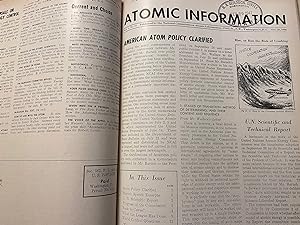
ATOMIC INFORMATION. (Journal/Magazine)
Published by National Committee on Atomic Information, 1946
Seller: JF Ptak Science Books, Hendersonville, NC, U.S.A.
Seller rating 5 out of 5 stars
First Edition
Hardcover. Condition: Fine. 1st Edition. ATOMIC INFORMATION. Published by the National Committee on Atomic Information, Washington D.C. Volume 1/1 to Volume 3/1, January 20 1946 to December 1947; 18 issues bound together. Includes volume 1/1 to I/12, January 20, 1946; volume 2/numbers 1-5 January 20-May 20, 1947); vol 3, no. 1, December 1947. Approximately 180pp altogether. The first article ("Spy Hysteria Dramatizes the Futility of Atomic Secrecy") is by William Higginbotham--I wonder if this is F.W. Higgenbotham of Ultra Secret fame? Many fine short articles as well as numerous (small) political cartoons (many by Herblock Mr. Block was a neighbor in Georgetown). Very nicely bound in an attractive blue cloth and gilt-y spine.


![Seller image for Scientific Information Transmitted to the United Nations Atomic Energy Commission by the United States Representative. Volume I. June 14, 1946. Prepared in the office of Mr. Bernard M. Baruch United States Representative. [with]: Scientific Information Transmitted to the United Nations Atomic Energy Commission by the United States Member. Volume II. July 10, 1946. Prepared in the office of Mr. Bernard M. Baruch United States Member. [with]: Scientific Information Transmitted to the United Nations Atomic Energy Commission by the United States Representative. Volume III. August 15, 1946. Prepared in the office of Mr. Bernard M. Baruch United States Representative [THREE VOLUMES] for sale by Between the Covers-Rare Books, Inc. ABAA](https://pictures.abebooks.com/inventory/md/md4037656674.jpg)