
Autograph by Albert Einstein (28 results)

- Softcover
Seller: Harry Alter, Sylva, NC, U.S.A.Harry Alter
Contact seller5-star sellerCondition: Used - Very good
US$ 35.00
US$ 3.95 shippingShips within U.S.A.Quantity: 1 available
paperback. Condition: Very Good. Dover, NY, c.1997, 8-1/2"x11", paperbk., sewn, 66pp., VG $.

Published by Princeton, NJ, 5 Aug. 1949. 1949
- Softcover
- Manuscript
Seller: Antiquariat INLIBRIS Gilhofer Nfg. GmbH, Vienna, A, AustriaAntiquariat INLIBRIS Gilhofer Nfg. GmbH
Contact seller5-star sellerCondition: Used
US$ 26,002.39
US$ 34.43 shippingShips from Austria to U.S.A.Quantity: 1 available
4to. 1 page. To the German-American mathematician Ernst Gabor Straus. Einstein refers to a work he has just written in which he resolves the equations of the gravitational field issues from Bianchi's identities; he also congratulates Straus on a beautiful mathematical discovery and invokes by comparison the proof of transcendenc…e of numbers that the latter had simplified. - An assistant to Einstein from 1944 to 1948, Ernst Gabor Straus detected a computational error in one of Einstein's works and, in order to correct it, wrote a paper with him in 1946 entitled "A Generalization of the Relativistic Theory of Gravitation". In 1949, having left his position with Einstein at Princeton University, he published "Some Results in Einstein's Unified Field Theory". The two scientists remained in a working relationship afterwards. - On headed paper; perfectly preserved.
 More images
Published by [Berlin], June 30, 1920 1920
- Softcover
- Manuscript
Seller: Kotte Autographs GmbH, Roßhaupten, , GermanyKotte Autographs GmbH
Contact seller5-star sellerCondition: Used
US$ 35,457.81
US$ 22.95 shippingShips from Germany to U.S.A.Quantity: 1 available
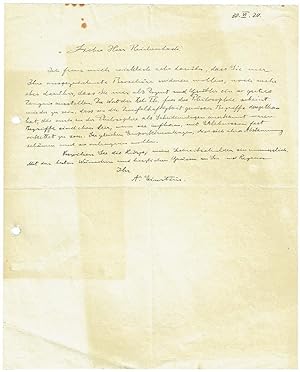
4to. 1 page. Einstein on the value of relativity for philosophy. Einstein writes to Hans Reichenbach, the philosopher of science and an influential expositor of Relativity. In part (translation): "I am really very pleased that you want to dedicate your excellent brochure to me, but even more so that you give me such high marks a…s a lecturer and thinker. The value of the th.[eory] of rel.[ativity] for philosophy seems to me to be that it exposed the dubiousness of certain concepts that even in philosophy were recognized as small change. Concepts are simply empty when they stop being firmly linked to experiences. They resemble upstarts who are ashamed of their origins and want to disown them." The letter was published in the Collected Papers of Albert Einstein, vol 10, doc 66, pp 323-324 (CPAE Translation, vol 10, doc 66, p 201). Slightly uneven toning, a few spots in upper margin, two-hole punch at left margin, folding creases.
 More images
Published by Caputh, 30 July [1929] 1929
- Manuscript
Seller: Kotte Autographs GmbH, Roßhaupten, , GermanyKotte Autographs GmbH
Contact seller5-star sellerCondition: Used
US$ 11,819.27
US$ 22.95 shippingShips from Germany to U.S.A.Quantity: 1 available
1 p. 4to. 28 x 22 cm. A deeply personal and affectionate letter to Einstein's younger son Eduard ("Tetel"), inviting him to Caputh in the hope of cheering him and strengthening his spirits. Combining paternal concern, philosophical reflection, and intimate glimpses into Einstein's private life, the letter is among the most human… and emotionally revealing types of Einstein correspondence.Einstein writes that he will travel to Zurich on the 9th for "eine zionistische Sache" ("a Zionist matter") and proposes that Eduard accompany him back to Caputh, where he is living alone with Elsa in a small house by the lake: "Mein neues herrliches Schiff ist nun fertig und ich segle täglich. Es ist wunderbar für die Erholung" ("My splendid new boat is now finished and I sail every day. It is wonderful for recuperation"). Referring to the unusually cool weather, he suggests that the lakeside environment might benefit his son more than the mountains.The emotional core of the letter lies in Einstein's concern over Eduard's psychological condition and lack of vitality, which he senses between the lines of his son's recent letter: "Dein Brief bedrückt mich ein wenig, weil so wenig Unternehmungsgeist und Lebensfreude daraus spricht" ("Your letter depresses me somewhat because it shows so little enterprise and joy in life"). He stresses the moral and existential importance of meaningful work, invoking Arthur Schopenhauer as an example of a genius destroyed by the absence of practical occupation: "Selbst ein Genie wie Schopenhauer wurde zermürbt durch die Berufslosigkeit" ("Even a genius like Schopenhauer was worn down by the lack of a profession").Einstein continues with reflections of striking ethical clarity: "Man muss das Gefühl haben, dass man den anderen durch ehrliche Arbeit zurückgibt, was man empfängt. Sonst bleibt der moralische Katzenjammer nicht aus" ("One must feel that one gives back to others through honest work what one receives. Otherwise the moral hangover cannot fail to appear"). He concludes reassuringly that it will do Eduard good to spend more time in his company: "du wirst sehen" ("you will see").The letter was written during a transitional and physically fragile period in Einstein's life. Following a serious heart condition in 1928, he spent nearly a year recovering. In 1929 he built his celebrated summer house in Caputh near Potsdam, though at the time of the present letter he was still living in rented accommodation on Potsdamer Straße. The "new splendid boat" mentioned here was the sailing boat Tümmler, presented to Einstein by friends on the occasion of his fiftieth birthday in March 1929.Eduard Einstein (19101965), the second son of Albert Einstein and Mileva Mari , was highly gifted and musically talented. After excelling in his school examinations in 1929, he began medical studies with the intention of becoming a psychiatrist. Only a short time later, however, he developed schizophrenia, abandoned his studies, and spent much of his later life under psychiatric care at the Burghölzli clinic in Zurich.An exceptionally moving and psychologically revealing family letter, illuminating Einstein not as public icon or scientist, but as a deeply reflective and concerned father. From an important French private collection.
 More images
Published by [Scharbeutz, after 26 July 1928]. 1928
- Manuscript
Seller: Antiquariat INLIBRIS Gilhofer Nfg. GmbH, Vienna, A, AustriaAntiquariat INLIBRIS Gilhofer Nfg. GmbH
Contact seller5-star sellerCondition: Used
US$ 33,093.95
US$ 34.43 shippingShips from Austria to U.S.A.Quantity: 1 available
4to (222 x 280 mm). 2 pp. In pencil on cream-coloured paper with traces of perforation at top edge. In German. With the original envelope, addressed in ink. To the Polish German mathematician Chaim Herman Müntz (1884-1956), setting out several equations in the body of the letter: "Ich danke Ihnen bestens für die Mitteilung der a…llgemeinen Integrationsmethode für die Näherungsgleichungen, die zu der zweiten Hamilton-Invariante (Dichte) [.] gehört. Das ganze Problem liegt aber wesentlich schwieriger, als ich gedacht hatte [.] Damit hängt es zusammen, dass mir eine physikalische Interpretation der Theorie bisher überhaupt nicht gelungen ist. Es ist aber dabei im Auge zu behalten, dass gemäss Bohrs Resultaten der Zusammenhang zwischen der Bewegung der Singularitäten und dem Wellenfelde überhaupt nicht so einfach ist, wie es nach Maxwell sein sollte [.]". The letter closes: "Wenn ich wieder zurück komme, wollen wir ausführlich über die Sache reden. Man kann natürlich die ganze Bemühung als utopisch erklären. Aber eine mathematisch so natürliche Theorie ist ernsthafter Beachtung wert, zumal bei der gegenwärtigen disperaten Lage der theoretischen Physik" - a remark that appears to be levelled at the new developments in quantum mechanics. - A dense scientific communication from Einstein's Berlin period, aligning with his intensive work on a unified field theory in 1928-29 and reflecting his reliance on other figureheads of contemporary physics and mathematics. Müntz, noted for the Müntz approximation theorem, worked with Einstein from 1927 and is thanked in Einstein's paper "On Unified Field Theory" (1929) for "laboriously precise calculation on the basis of Hamilton's principle", underscoring the present letter's context. - A fine association piece at the intersection of physics and higher mathematics, documenting Einstein's ongoing attempts to ground unification in a Hamiltonian variational framework. - Folded horizontally and vertically; envelope torn open somewhat roughly at the side. - From a Swedish private collection. - The Collected Papers of Albert Einstein (Princeton UP, 2021), vol. 16, p. 389f., no. 245 (edited from a photocopy).

Published by [Probably California], 1932. 1932
- Signed
- Manuscript
Seller: Antiquariat INLIBRIS Gilhofer Nfg. GmbH, Vienna, A, AustriaAntiquariat INLIBRIS Gilhofer Nfg. GmbH
Contact seller5-star sellerCondition: Used
US$ 68,551.76
US$ 34.43 shippingShips from Austria to U.S.A.Quantity: 1 available
Vintage gelatin silver photograph (216 x 165 mm). Photographer's credit stamp "Keystone View Co. Inc., New York" (extremely light) to verso. An exceptional vintage portrait showing Einstein, pipe in mouth, standing on the deck of the Dutch steamship SS Rotterdam on his arrival in New York from Europe in April 1921. Captured at t…he height of his worldwide fame on his first U.S. visit, the image recalls the public reception that accompanied the transatlantic voyage, undertaken in part to support the Hebrew University project in Jerusalem. - Signed and inscribed in fountain pen at upper left. Unusually, Einstein has filled the opposite corner with six lines of autograph mathematical equations, transforming a celebrity portrait into a personal scientific memento. The recipient, Faris M. Brown, was a California violin dealer whom Einstein met during his Caltech visiting professorships of 1931-33. - Einstein was himself a dedicated and passionate amateur violinist. His mother arranged for him to take lessons from the age of six, and he would continue to play the violin throughout most of his life, often drawing scientific inspiration from a few minutes of practice. While in Pasadena during his visits to Caltech, Einstein played with Artur Rodzinski, the L.A. Philharmonic's conductor. His instrument, which he affectionately named "Lina" (short for "Violina"), survives and recently commanded £860,000 at Dominic Winter Auctioneers in Gloucester. - Signed photographs of Einstein are scarce in any form, and examples further augmented by autograph equations remain a notable rarity. - Some light age wear; minor corner creases, short closed tear to the left blank border. Very minor traces of former mounting to the edges of the verso. - Inscribed to Faris McDonald Brown (1901-1961), a Los Angeles-based violin dealer long with the Rudolph Wurlitzer company who worked with such artists als Fritz Kreisler, Gregor Piatigorsky, and Mischa Elman.
 More images
Published by n.p. 1940
Seller: Heritage Book Shop, ABAA, Beverly Hills, CA, U.S.A.Heritage Book Shop, ABAA
Contact seller5-star sellerCondition: Used
US$ 45,000.00
US$ 20.00 shippingShips within U.S.A.Quantity: 1 available
n.p.: 1940. Full Description: [EINSTEIN, Albert]. Autograph Manuscript in Pen. [n.p., n.d, ca: 1940]. Autograph manuscript in German in Einstein's hand. Manuscript is on the "Unified Field Theory" and is a draft from his published article "A Generalization of the Relativistic Theory of Gravitation." One quarto page (11 x 8 1/2 i…nches; 280 x 217 mm). Manuscript in black ink on recto, verso blank. With 31 lines of manuscript text in German, including over 180 words, and eleven equations. Because this is a working document, there are numerous revisions on the page. He strikes through and makes additions in eight places. At the top right corner, the page is numbered "(6)" in his hand. Leaf is very lightly toned, but generally about fine. It is quite rare to find manuscripts of Einstein works that has been published. Housed in a full morocco clamshell. "A Generalization of the Relativistic Theory of Gravitation" was an article written by Einstein in German and translated into English for publication by his assistant E.G. Straus in approximately 1945. The article was long and so it was divided in two parts. The present leaf comes from Part II and the translated text is on pages 735-736 of the published article. "The published translation appears to follow this original manuscript very closely and without alteration. In this section of his paper, Einstein is discussing the field equations for the Hamiltonian operator, which plays a central role in the equations of motion for General Relativity (and is defined in terms of the metric tensor and its conjugate momenta); and in this particular page of the paper, Einstein is here considering the implications of embracing a stronger form of the field equations." (University Archives) During the course of World War II, Einstein came to the conclusion that the General Theory of Relativity was the proper basis for the development of Unified Field Theory; and using this framework, he explored the implications of using new and complex forms of number within Unified Field Theory. The publication of this article marked the beginning of Einstein's final approach to Unified Field Theory, an approach which Einstein pursued until the end of his life. ( (University Archives) . HBS 69509. $45,000.
 More images
Published by Potsdam, Germany 1931
- Signed
Seller: Second Story Books, ABAA, Rockville, MD, U.S.A.Second Story Books, ABAA
Contact seller4-star sellerTwo letters by Albert Einstein. The first is a single-paged autograph letter signed by Albert Einstein with one horizontal fold and one vertical fold. In Very Good condition . Measuring 22.5 x 28.5 cm. Letter accompanied with mailing envelope, both with matching paper-clip rust stain. Letter with some light wear along edges, sma…ll staining to lower corner. Addressed to G. W. Meyer and dated 8 Oktober 31 in Potsdam, the Letter reads in full: "Sehr geehrter Herr! Indem ich Ihnen für die Uebersendung des Buches von Henry George bestens danke, sende ich Ihnen anliegend die gewünschte Meinungsäusserung mit der Bitte um Weiterleitung an Mrs. Evans. Mit ausgezeichneter Hochachtung" and signed in ink "A. Einstein". He thanks Meyer for serving as an intermediary in getting a book to him and for forwarding the enclosed letter. The second letter is a typed copy of Einstein's previously enclosed letter, presumably made by Meyer before he passed the original on to Evans. Addressed to R. W. Evans and dated 8.10.1931 in Potsdam, the letter discusses Henry George's economic theory of poverty and land nationalization, compares it to Franz Oppenheimer's work, and proposes questions to be asked. Presumably he was sent a copy of Henry George's Progress and Poverty. First published in 1879, it sparked the Progressive Era, discussing the paradox of increasing inequality and poverty amid economic and technological progress as well as the economic value of land. Consignment. Shelved Case 3. The Letter reads in full: "Sehr geehrte Mrs. Evans! Ich habe das Buch von Henry George zum grössten Teil mit ausserordentlichem Interesse gelesen und glaube, dass es in der Hauptsache einen unanfechtbaren Standpunkt vertritt, insbesondere was die Ursache der Armut betrifft. Nie in diesem Buch vertretenen Ansichten stimmen, soweit ich es beurteilen kann vollkommen mit den Resultaten des zeitgenössischen Professors Franz Oppenheimer überein, der sie offenbar selbständig herausgefunden hat. Nicht einverstanden bin ich mit der Theorie des Zinses. Mit dem vorgeschlagenen Heilmittel der Verstaatlichung des Bodens und der Bodenschätzung scheint mir allerdings mehr ein Problem als eine Lösung gegeben zu sein. Soll z. Beispiel ein Boden Eigentum der Gemeinschaft, das darauf hingestellte Haus aber Privateigentum sein? Jedenfalls ist es schon von höchster Wichtigkeit, dass das Wesen des Uebels klar aufgezeigt ist. Schon darum wäre es wichtig, wenn das Buch die ihm gebührende Beachtung fände. Mit ausgezeichneter Hochachtung gez. A. Einstein." 1403337. Shelved Dupont Bookstore. Signed.
 More images
Published by No place, [March 1950 - early April 1951]. 1951
- Manuscript
Seller: Antiquariat INLIBRIS Gilhofer Nfg. GmbH, Vienna, A, AustriaAntiquariat INLIBRIS Gilhofer Nfg. GmbH
Contact seller5-star sellerCondition: Used
US$ 44,913.22
US$ 34.43 shippingShips from Austria to U.S.A.Quantity: 1 available
4to (280 x 216 mm). 1½ pages. Dated (likely in the hand of Helen Dukas) in pencil at upper and lower right. The manuscript comprises approximately 31 lines of mathematical workings. Einstein devoted the last thirty years of his life to the quest to combine general relativity and Maxwell's theory of electromagnetism into a single… physical and mathematical framework which would account for all of the then-known fundamental forces of nature - a "unified field theory". Although his early attempts in the 1920s focused on "distant parallelism", he later concentrated on an approach treating both the metric tensor and the affine connection as fundamental fields, often introducing an element of asymmetry (in variance to the theory of general relativity). Einstein often complained of the heavy mathematical burden imposed by this approach, as demonstrated in the present manuscript. - In mint condition. - Sotheby's, 30 May 1979, lot 49 (part).

Published by Princeton, New Jersey, 4. XII. 1949. 1949
- Manuscript
Seller: Antiquariat INLIBRIS Gilhofer Nfg. GmbH, Vienna, A, AustriaAntiquariat INLIBRIS Gilhofer Nfg. GmbH
Contact seller5-star sellerCondition: Used
US$ 33,093.95
US$ 34.43 shippingShips from Austria to U.S.A.Quantity: 1 available
4to. 1 page. In German. To the Hungarian-born physicist Cornelius Lanczos (1893-1974) with thanks for sending him a copy of his book "The Variational Principles of Mechanics" (1949) and for his having dedicated it to him, pointing out that it has freed him for the time being from the burden of being a passionate non-reader. Eins…tein ironically adds that despite everything he has learned so far about the American people he hopes the work will gradually find general distribution in U.S. universities: "Sie wissen, dass ich ein leidenschaftlicher Nichtleser bin. Aber Ihr Buch wird mich für eine Zeit von diesem Laster befreien [.] Ich zweifle nicht, dass dies Buch allmählich eine allgemeine Verbreitung in den hiesigen Universitäten finden wird, trotz allem was ich von unseren neuen Landsleuten allmählich in Erfahrung gebracht habe". - Returning to their shared obsession with gravitational theory, Einstein provides three equations which he now feels certain constitute the "overdetermined system" which is "the only natural generalisation of the gravitational equations". The reasoning that has brought him to this conclusion appears as an appendix in "the new edition of my old relativity book", which he will send Lanczos as soon as he has a copy. - Very well preserved.

Published by Princeton, New Jersey, 19. VI. 1943. 1943
- Manuscript
Seller: Antiquariat INLIBRIS Gilhofer Nfg. GmbH, Vienna, A, AustriaAntiquariat INLIBRIS Gilhofer Nfg. GmbH
Contact seller5-star sellerCondition: Used
US$ 17,728.90
US$ 34.43 shippingShips from Austria to U.S.A.Quantity: 1 available
4to. 1 page. In German. To the Hungarian-born physicist Cornelius Lanczos (1893-1974), approving of his philosophical lecture, with a snappy remark about the Austrian philosopher Otto Weininger (1880-1903). Einstein comments that positivists and pragmatists appear as "bearers of a world-feeling" in the same way that the Epicurea…ns must have seemed to pious Jews and Christians, or the way "the female" appeared to the misogynic Weininger, pointing out that "unmusical engineering souls" obsessed with sense-data have lost their understanding for questions of philosophy: "Die Positivisten und Pragmatisten erscheinen da so ähnlich als Träger eines Weltgefühls wie die Epicuräer den frommen Juden und Christen erschienen, oder das Weibliche dem Weininger. Es ist aber etwas Wahres daran, nämlich, dass diese philosophischen Richtungen mit auf die Sens-data starrendem Blick, das Verständnis für das Wunder der Begreiflichkeit des nur so indirekt Gegebenen verloren haben, unmusikalische Ingenieur-Seelen". - Einstein concludes that Lanczos's reasoning seems quite "un-American" and wonders how the learned people in the United States reacted to such thoughts, considering it a kind of "psychological test": "Es würde mich interessieren zu erfahren, wie so was Unamerikanisches auf das hiesige gelehrte Volk wirkt. Haben Sie diesbezügliche Erfahrungen gesammelt? Es würde eine Art psychologischer 'test'". - Einstein's use of the word "un-American" in relation to Lanczos's philosophical exploration is prophetic, as Lanczos would indeed be suspected of "Un-American" leanings during the McCarthy-era. - Lower left corner slightly worn, otherwise very well preserved.
 More images
Published by Berlin, 22. III. 1929. 1929
- Manuscript
Seller: Kotte Autographs GmbH, Roßhaupten, , GermanyKotte Autographs GmbH
Contact seller5-star sellerCondition: Used
US$ 23,047.58
US$ 22.95 shippingShips from Germany to U.S.A.Quantity: 1 available
8vo. 1 1/2 pp. Double sheet. Printed letterhead Haberlandstr. 5 | Berlin W.". To Marie Barthelts in Winterhur : Ich erinnere mich noch ganz gut an unser Musizieren vor 29 Jahren. Seitdem hab ich viel heruntergefiedelt und auch sonst ein so merkwürdig arbeits- und ereignisreiches Leben geführt, dass das versprochene Kikeriki mir…im Halse stecken geblieben ist. Es hätte Ende 1905 sein müssen. Ihr Briefchen war für mich vom schönsten, was bei diesem 50. Geburstag kam. Es wurde mir wieder alles von damals lebendig, die frohe, wenn auch harte Jugend, die guten Menschen, die fast alle aus dem Leben oder meinem Gesichtskreis weggegangen sind. Ich selbst bin ein grauhaariger, leidender Mensch geworden, aber der frohe Sinn und die Freude am Musizieren sind geblieben. Meine Eltern sind längst tot. Ich freue mich für Sie, dass Sie Ihre Mutter haben behalten dürfen. Seien Sie mit ihr bestens gegrüsst von Ihrem alten A. Einstein"Translation: I remember quite well our music-making from 29 years ago. Since then, I've fiddled away a lot and led such a strangely eventful life that the promised cock-a-doodle-doo has stuck in my throat. It must have been the end of 1905. Your little letter was the loveliest thing that came for me on this 50th birthday. It brought everything back to me from those days, the joyful, albeit tough youth, the good people, most of whom have passed away or left my circle. I myself have become a gray-haired, suffering person, but the joyful spirit and the pleasure in making music have remained. My parents have long been dead. I am happy for you that you have been able to keep your mother. Please give her my best regards. Yours sincerely, your old A. Einstein".
 More images
Published by [Berlin], 27. II. 1924. 1924
- Manuscript
Seller: Kotte Autographs GmbH, Roßhaupten, , GermanyKotte Autographs GmbH
Contact seller5-star sellerCondition: Used
US$ 33,093.95
US$ 22.95 shippingShips from Germany to U.S.A.Quantity: 1 available
Folio. 1 p. Folded. To Hermann Anschütz-Kaempfe: Der freundliche Brief von Ihrer Frau [Reta Stöve] und auch von Ihnen hat sehr wohlgethan und meiner Frau [Elsa Eisntein] das Vorurteil verscheucht, dass Sie ihr in irgend einer Weise übelwollen oder mich von ihr abzuziehen suchen. Man muss Frauen nehmen wie sie sind und ihnen das…Leben so leicht als möglich machen wenn nicht aus purer Gutmütigkeit, halbaus Gutmütigkeit, so doch halb aus Klugheit. Dazu haben Sie mir in freundlicherWeise verholfen. Ich komme dann sehr gern wieder nach Kiel, nur muss ich anfangs Mai zum Philoesophenkongress nach Neapel. Das hat sich nichtvermeiden lassen, weil dort ein besonderer Tag der Rel[ativitäts]-Theorie gewidment ist. Mitte Mai kann ich aber gut nach Kiel kommen und freue mich schon darauf. Dass bei bewegter Kugelschale durch das Magnetfeld Drehmomente auf die Kugel übertragen werden, ist nicht ganz zu vermeiden, aber der dadurch erzeugte systematische Fehler kann nicht bedeutend sein, wohl nicht grösser als der durch Wasserreibung bedingte.Dagegen wird eben nichts zu machen sein. Wichtig ist, dass der Blasring schöngleichmässig ist, dass bei blosser Drehung um die Vertikale nichts derartigesauftritt. Ich arbeite fest, wurde aber von der physikalischen Muse an der Naseherumgeführt. Hoffentlich kommts besser []"Translated: "The kind letter from your wife [Reta Stöve] and also from you has been very comforting, dispelling any prejudice my wife [Elsa Einstein] may have had that you bear ill will towards her or seek to alienate me from her in any way. One must take women as they are and make life as easy for them as possible - if not out of pure good nature, then partly out of good nature and partly out of prudence. You have helped me in a friendly manner towards this end. I will be very happy to return to Kiel, but I must go to the Philosophy Congress in Naples at the beginning of May. This could not be avoided, as a special day dedicated to the Theory of Relativity will be observed there. However, I can come to Kiel in mid-May and look forward to it. The fact that torques are transferred to the ball due to the moving ball shell through the magnetic field cannot be completely avoided, but the systematic error thus generated cannot be significant, probably not greater than that caused by water friction. However, there will be nothing to be done about it. It is important that the bubble ring is evenly formed, so that nothing of the sort occurs with mere rotation around the vertical axis. I am working hard, but have been led astray by the muse of physics. Hopefully, it will improve [.]".
 More images
Published by No place , 21 December 1937 1937
- Manuscript
Seller: Kotte Autographs GmbH, Roßhaupten, , GermanyKotte Autographs GmbH
Contact seller5-star sellerCondition: Used
US$ 29,548.17
US$ 22.95 shippingShips from Germany to U.S.A.Quantity: 1 available
4to. 1 p. Faint scattered soiling, minor loss to lower left corner, folds. Nice letter to Ruth Norden, in German, praising her translation, approving of her community with some exceptions [participants in 1939 World's Fair?], suggesting other acceptable candidates, inquiring about possible candidates from other countries, compar…ing a potential candidate to Freud, observing that people would be less vulnerable if their quality were as high as they are numerous, and expressing gratitude for a long telegram. Norden who was responsible for translating a number of Einstein's writings into English. One of these was his 1938 article "Why do they hate the Jews?", which was his only public discussion of Hitler's campaign against the Jews."You have done a great translating job and it is factually better than the original. The community that you take interest in seems very likable to me, except for Lindberg [Charles Lindbergh], who hasn't shown much concern for the suffering of human beings. As far as Maderiaga [Salvador de Madariaga] is concerned, I am not quite sure whether he is an honest human being--so I'll have to add a question mark to him as well. . . . I would also accept Andre Gide and Albert Schweitzer as well. Maybe [Ignazio] Silone as well . . . . Is there any Russian out there that seems acceptable and has not been decapitated yet? I know of none, and neither do I know any Scandinavian, Dutch, South American, Spaniard and none from the English Colonies. Just like with Freud; probably only to be used as a one-horse carriage. "Looking at today's humankind, one can only notice with regret that the numbers do not make up for quality: if quantity would substitute for quality we'd be in great shape compared to tiny old Greece. "Finally, I have to express my condolences for your poor wallet since you have sent such a lengthy telegram. I was very touched and will show it to your potential husband to keep him from making the wrong decision; so please keep me informed." In September of 1938, the Westinghouse Electric and Manufacturing Company deposited a time capsule at the site of the 1938 New York World's Fair to be opened 5,000 years hence. The capsule contained letters addressed to the future inhabitants of Earth by luminaries of the day, including Thomas Mann, Robert A. Millikan, and Albert Einstein. According to a September 16, 1938 New York Times article, "Einstein Hopeful for Better World," the uncredited but "authorized English translation" of Einstein's letter contained the observation that "people living in different countries kill each other at irregular time intervals, so that . . . any one who thinks about the future must live in fear and terror. This is due to the fact that the intelligence and character of the masses are incomparably lower than the intelligence and character of the few who produce something valuable for the community. I trust that posterity will read these statements with a feeling of proud and justified superiority." It is likely that the translator of Einstein's time capsule letter was Ruth Norden, who was responsible for many of Einstein's English translations at the time, including "Why Do They Hate the Jews," published in Collier's Magazine on November 26, 1938. The work praised in the present lot is probably the very same time capsule letter translation.Sie haben die Sache prachtvoll übersetzt; es ist faktisch besser als das Original. Die von Ihnen ins Auge gefasste Gemeinschaft gefällt mir recht gut bis auf Lindberg [d.i. Charles Lindbergh], der doch nicht gezeigt hat, dass er für die Leiden der Menschenwelt viel übrig hat. Bei Maderiaga [d.i. Salvador de Madariaga] bin ich nicht sicher, ob er ein ehrlicher Mensch ist; zu ihm muss ich auch ein Fragezeichen setzen. Über mich selbst will ich schweigen oder zu meinen Gunsten anführen, dass mich die andern ja nicht so genau kennen. Ich würde den André Gide doch aufnehmen, ausserdem Albert Schweizer. Vielleicht auch den [Ignazio] Silone, jenen wund.
 More images
Published by no place , 25. V. 1937. 1937
- Manuscript
Seller: Kotte Autographs GmbH, Roßhaupten, , GermanyKotte Autographs GmbH
Contact seller5-star sellerCondition: Used
US$ 29,548.17
US$ 22.95 shippingShips from Germany to U.S.A.Quantity: 1 available
4to. 1 p. Minor paper loss to upper border. Some age toning and expected folds. To the young aspiring Romanian physicist Melanie Serbu (1909-1979), in German."I believe the fundamental idea is partially correct. However, in my view, it stems from an incorrect conception of the solid body. When you deform such a body, the elastic… stress forces disappear more or less rapidly with the given deformation. With constant deformation forces, a more or less pronounced flow occurs accordingly - independent of the current deformation process. The body bends very slowly. Think of solid pitch or wax, but also lead.In comparison to sufficiently rapid processes, the material behaves similarly to an ideal, i.e., non-flowing but only elastic solid body. However, with very slowly changing loads, the flowing aspect takes precedence. I believe that the natural transition to liquids is to be sought here.The idea of liquids as easily flowing solid bodies would then suggest the existence of high-frequency transverse waves in liquids but not that they do not deform with sufficiently small deformation limits. So, I see the transition in a very different way than you do: Liquids would be solid bodies where the property of flowing far outweighs that of elastic angular deformation. I don't know if attempts have been made to generate high-frequency transverse waves in liquids, which would make the elasticity properties observable despite the predominant flowing characteristics."Ich glaube der Grundgedanke ist teilweise richtig. Aber er geht nach meiner Ansicht von einer unrichtigen Auffassung des festen Körpers aus. Wenn Sie nämlich einen solchen deformieren, dann verschwinden die elastischen Spannungs-Kräfte bei gegebener Deformation mehr oder weniger rasch. Bei konstant gegebenen Deformationskräften tritt demgemäss ein mehr oder weniger ausgeprägtes Fliessen auf - unabhängig von dem momentanen Deformationsvorgang. Der Körper verbiegt sich ganz langsam. Denken Sie an festes Pech oder Wachs, aber auch an Blei.Genügend raschen Vorgängen gegenüber verhält sich das Ding ähnlich einem idealen, d.h. nichtfliessenden sondern nur elastischen festen Körper. Bei ganz langsam veränderlichen Belastungen aber tritt das Fliessen in den Vordergrund. Ich glaube nun, dass hier der natürliche Übergang zu den Flüssigkeiten zu suchen ist.Die Auffassung von Flüssigkeiten als leicht fliessende feste Körper würde dann erwarten lassen, dass es in Flüssigkeiten Transversalwellen von sehr hoher Frequenz gebe, aber nicht, dass sie sich bei genügend kleinen Deformationsgrenzen nicht deformieren. Ich sehe also den Übergang in ganz anderer Weise wie Sie: Flüssigkeiten wären feste Körper bei denen die Eigenschaft des Fliessens die der elastischen Angular-Deforation weit überwiegt. Ich weiss nicht ob man schon versucht hat, in Flüssigkeiten Transversalwellen von hoher Frequenz zu erzeugen, die dann die Elastizitätseigenschaften beobachtbar erscheinen liessen trotz der vorwiegenden Fliesseigenschaften. []".
 More images
Published by Princeton, 7. V. 1936. 1936
- Manuscript
Seller: Kotte Autographs GmbH, Roßhaupten, , GermanyKotte Autographs GmbH
Contact seller5-star sellerCondition: Used
US$ 33,684.92
US$ 22.95 shippingShips from Germany to U.S.A.Quantity: 1 available
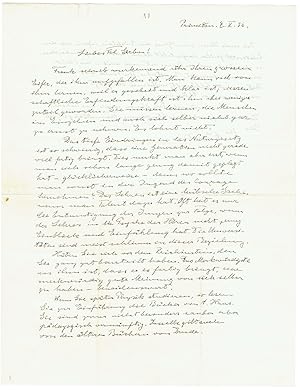
4to. 1 1/3 pp. Blind embossed letterhead. To the young aspiring Romanian physicist Melanie Serbu (1909-1979), in German giving her advises. "Frank wrote approvingly of your great enthusiasm, which caught his attention. One can learn a lot from him because he is intelligent and clear, though scientific inventiveness has not been…bestowed upon him to the same extent. You must learn not to take people, including yourself, too seriously. It's not worth it.The deep penetration into the laws of nature is so difficult that a generation doesn't accomplish much in this regard. However, this is only apparent after struggling with it long enough, fortunately, because where else would one find the courage in youth? Teaching is a lovely thing if one has the talent for it. Often, it only results in discouragement for the young when the teacher lacks sufficient insight and empathy into the psyches of the listeners. Universities are usually bad in this respect.Beware of Reichinstein [i.e., David Reichinstein (1882-1955)], whom you have judged quite well. The strangest thing about him is that he manages to have a strangely good opinion of himselfadmirable.If you later study physics, read the introductory books by A. Haas. They are not particularly clean but pedagogically reasonable. The same applies to the older books by Drude [i.e., Paul Drude (1863-1906)].As a greeting, I am sending you a little book in which I presented the theory of relativity earlier because I believe it is quite readable, and there is a picture of me inside. However, it is a picture from the time of my full strength, while now I am a white-haired old man.Now I wish you a pleasant time and fruitful studies."Frank schrieb anerkennend über Ihren grossen Eifer, der ihm aufgefallen ist. Man kann viel von ihm lernen, weil er gescheit und klar ist; wissenschaftliche Erfindungskraft ist ihm eben weniger zuteil geworden. Sie müssen lernen, die Menschen im Einzelnen und auch sich selber nicht gar zu ernst zu nehmen. Es lohnt nicht. Das tiefe Eindringen in das Naturgesetz ist so schwierig, dass eine Generation nicht gerade viel fertig bringt. Dies merkt man aber erst, wenn man sich schon lange genug damit geplagt hat - glücklicherweise - denn wo sollte man sonst in der Jugend die Courage hernehmen? Das Lehren ist eine hübsche Sache, wenn man Talent dazu hat. Oft hat es nur die Entmutigung der Jungen zur Folge, wenn der Lehrer in die Psyche der Hörer nicht genug Einblick und Einfühlung hat. Die Universitäten sind meist schlimm in dieser Beziehung. Hüten Sie sich vor dem Reichinstein [d.i. David Reichinstein (1882-1955), den Sie ganz gut beurteilt haben. Das Merkwürdigste an ihm ist, dass er es fertig bringt, eine merkwürdig gute Meinung von sich selber zu haben - beneidenswert. Wenn Sie später Physik studieren, so lesen Sie zur Einführung die Bücher von A. Haas. Sie sind zwar nicht besonders sauber aber pädagogisch vernünftig. Dasselbe gilt auch von den älteren Büchern von Drude [d.i. Paul Drude (1863-1906)]. Ich sende Ihnen zum Gruss ein Büchlein, indem ich die Relativität früher dargestellt habe, weil ich glaube, dass es ziemlich gut zu lesen ist und weil - ein Bild von mir drin ist. es ist aber ein Bild aus der Zeit meiner Vollkraft, während ich jetzt ein weisshaariger Alter bin. Nun wünsche ich Ihnen noch eine schöne Zeit und fruchtbares Studium. []"The chemophysicist Reichinstein emigrated to Prague in 1933 and in 1938 to Switzerland; he was acquainted with Einstein. This edition is expanded from the 1932 version to include a chapter on 1933. In 1932, Einstein, frustrated, wrote that "my patience has come to an end" and threatened him: "If you publish this manuscript anywhere and in any way, our relationship is over forever." Reichinstein did not comply with the prohibition and used Einstein's emigration to publish his book in Prague in 1934.Der Chemo-Physiker Reichinstein emigrierte 1933 nach Prag und 1938 in die Schweiz und war mit Einstein bekannt. Gegenüber der Ausgabe v.
 More images
Published by Berlin 1924
- Signed
Seller: Heritage Book Shop, ABAA, Beverly Hills, CA, U.S.A.Heritage Book Shop, ABAA
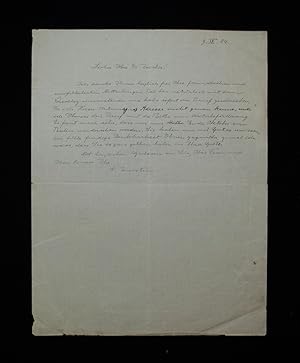
Contact seller5-star sellerBerlin: 1924. Full Description: EINSTEIN, Albert. Autograph Letter Signed. [Berlin]: 9. IX [September] 1924. Autograph letter signed ("A. Einstein"), to Mr. Zeisler. One quarto page (11 x 8 1/2 inches; 280 x 217 mm). Manuscript letter on recto, verso blank. With one horizontal center crease and one vertical center crease as expe…cted in a letter. A few other light creases. Some minor chipping along edges. A closed split along horizontal crease, not affecting manuscript. Overall very good. This letter with text in German is addressed to "Herr Dr. Zeisler" (Sigmund Zeisler), an German-Jewish U.S. attorney, born in Austria. He was known for his defense of radicals in Chicago in the 1880s, also known as the Haymarket Affair. His wife was the famous concert pianist Fannie Bloomfield Zeisler. Some unproven sources have said that Zeisler was Einstein's lawyer, but regardless it is known that he and Einstein were good friends and had much correspondence over the years. According to "The Collected Papers of Albert Einstein" published by Princeton University, Einstein was in correspondence during the 1920s with Zeisler regarding various American investments. According to a letter from Zeisler to Einstein on October 15, 1921 "Zeisler had invested $4,300 in American shares on Einstein's behalf in October 1921. He subsequently informed Einstein of the accumulated interest." Einstein wrote another letter in April of 1924 asking Zeisler to transfer American investments to his daughter and soon to be son-in-law as a dowery. Zeisler was to ensure the interest was paid on an annual basis to his daughter. In this present letter just six months later, Einstein is thanking Zeisler for doing "many good things" and stating that he looks forward to seeing him again in Berlin. Translated by an outside party: "9. IX. 24. Dear Dr, Zeisler, Many thanks for your friendly and clearly stateed letter. Of course I agree with the offer. I immediately wrote the letter. Since I don;t know the exact address, I an sending you the letter and ask that you forward it. It pleases me that we shall see each other again in Berlin. You have done many good things, for which I thank you. I know that you have done these things gladly since you are a good person. Regards to you, your wife and to your sons. A. Einstein." HBS 68960. $7,500. Signed.
 More images
Published by Princeton, New Jersey, [10 April] 1954. 1954
- Manuscript
Seller: Antiquariat INLIBRIS Gilhofer Nfg. GmbH, Vienna, A, AustriaAntiquariat INLIBRIS Gilhofer Nfg. GmbH
Contact seller5-star sellerCondition: Used
US$ 14,774.09
US$ 34.43 shippingShips from Austria to U.S.A.Quantity: 1 available
Oblong small 8vo. 1 page. With typed envelope. In German. To the Swiss jurist and women's rights activist Elisabeth Nägeli (1897-1988) in response to her birthday greetings: "Freundlichen Dank für Ihre Mitteilungen, die alte Zeiten lebendig werden lassen. Ein alter Zigeuner hat es in dieser Beziehung nicht leicht [.]" ("Thank yo…u kindly for your communications, which revive old times. These things are never easy for an old gypsy like myself [.]"). - From a prestigious old Basel private collection. Perfectly preserved.
 More images
Published by Peacock Inn, Princeton, NJ, 17. X. 1933. 1933
- Signed
- Manuscript
Seller: Antiquariat INLIBRIS Gilhofer Nfg. GmbH, Vienna, A, AustriaAntiquariat INLIBRIS Gilhofer Nfg. GmbH
Contact seller5-star sellerCondition: Used
US$ 41,367.44
US$ 34.43 shippingShips from Austria to U.S.A.Quantity: 1 available
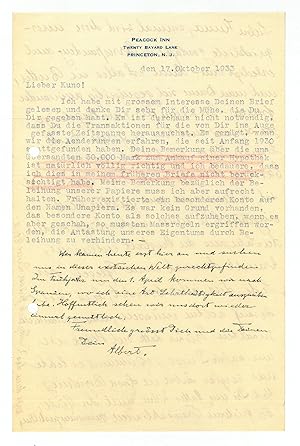
8vo. 1 p. With an autograph letter signed by Elsa on the reverse. - Includes: 3 autograph letters signed by his wife Elsa Einstein (folio and 8vo; Caputh, 21 August 1932 and no date), one with a 6-line autograph postscript signed by Albert Einstein, and a slip of paper (ca. 40 x 80 mm) with autograph note, date (Princeton, 9 May… 1934), and signature in full. Intimate correspondence with Einstein's cousin Kuno Kocherthaler, director of a mining company in Spain and also an art collector. - Typing on hotel stationery on the day of his arrival in the USA as a stateless refugee, having escaped from ever-increasing persecution in Nazi Germany, Einstein thanks Kuno for a letter of his about financial matters, adding below in his own hand: "Wir kamen heute erst hier an und suchen uns in dieser exotischen Welt zurechtzufinden. Im Frühjahr um den 1. April kommen wir nach Spanien, wo ich eine Art Lehrtätigkeit auszuüben habe. Hoffentlich sehen wir uns dort wieder einmal gemütlich [.]". - In an earlier letter of Elsa's, also regarding family investments administered by Kuno (undated but written aboard the "Oakland", probably in the port of Bremen on 10 December 1932, about to depart for a winter cruise to Pasadena via Middle America), Einstein adds a poignant note about his younger son Eduard, who suffered from schizophrenia and had recently been committed to a mental asylum in Switzerland: "Nimm bitte diese schleichende Sorge von uns; das Leben hat in letzter Zeit Schweres gebracht, da mein liebster Sohn, der Jüngere, in einer Anstalt hat untergebracht werden müssen (Geisteskrankheit) [.]". - In the final missive, possibly another postscript torn from a longer letter, Einstein gives his consent in a single word ("Einverstanden"), signing and dating: "Princeton, 9. Mai 1934 / Albert Einstein". Elsa's own letters discuss travel, finances, Albert Einstein's stay in Spa, etc. - Each sheet with marginal binder holes affecting a few letters, otherwise flawless.
 More images
Published by np, Princeton, NJ 1943
- First Edition
- Signed
- Manuscript
Seller: Manhattan Rare Book Company, ABAA, ILAB, New York, NY, U.S.A.Manhattan Rare Book Company, ABAA, ILAB
Contact seller5-star sellerCondition: Used - Fine
US$ 85,000.00
US$ 6.00 shippingShips within U.S.A.Quantity: 1 available
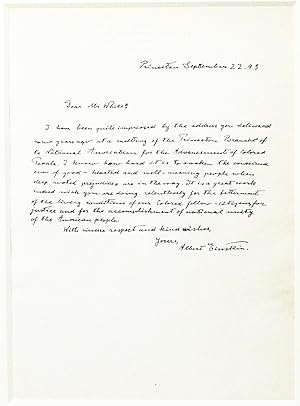
nb. Condition: Fine. First edition. EINSTEIN OFFERS STRONG AND PRESCIENT WORDS OF ENCOURAGEMENT TO THE LEADER OF THE NAACP IN THE FIGHT AGAINST RACIAL SEGREGATION AND DISCRIMINATION IN THE UNITED STATES. Background: Einstein's fight against racial discrimination in the United States: The imperative "to protect the rights of the…individual. was Einstein's most fundamental political tenet. Individualism and freedom were necessary for creative art and science to flourish. Personally, politically, and professionally, he was repulsed by any restraints. "That is why he remained outspoken about racial discrimination in America. As a Jew who had grown up in Germany, Einstein was acutely sensitive to such discrimination. 'The more I feel an American, the more this situation pains me,' he wrote in an essay called 'The Negro Question' for the January 1946 issue of Pageant magazine. 'I can escape the feeling of complicity in it only by speaking out.'" (Isaacson, Albert Einstein, 505). Even more directly, in his 1946 commencement speech to Lincoln University, the first degree-granting Historically Black College and University (HBCU) in the United States, Einstein strongly denounced segregation as "an American tradition which is uncritically handed down from one generation to the next" noting that "There is separation of colored people from white people in the United States. That separation is not a disease of colored people. It is a disease of white people. I do not intend to be quiet about it." This remarkable letter - from 1943 -is one of the earliest examples of his interest in condemning racism in the United States. The letter: Dated 22 September 1943 and handwritten on his embossed Mercer Street, Princeton letterhead, Einstein writes in English to Walter F. White, the enormously influential African-American civil rights leader who led the NAACP from 1929-1955, praising him for his work and revealing his own awareness of and frustrations with racism and prejudice in America. â The text reads in full: Dear Mr. White: I have been quite impressed by the address you delivered some years ago at a meeting of the Princeton Branch of the National Association for the Advancement of Colored People. I know how hard it is to awaken the conscience even of good-hearted and well-meaning people when deep rooted prejudices are in the way. It is a great work indeed which you are doing relentlessly for the betterment of the living conditions of our Colored fellow-citizens, for justice and for the accomplishment of national unity of the American people. With sincere respect and kind wishes, Yours, Albert Einstein ------------- On April 28, 1940, White was the keynote speaker at "an inter-racial meeting sponsored by the Princeton branch of the National Association for the Advancement of Colored People" where his topic was "What Happens to Democracy When It Encounters the Color Line." (Princeton Herald, April 26, 1940). At the time, Princeton did not admit African Americans and the community was debating the question of whether or not to end segregation at the university. (Princeton, in fact, did not admit its first African-American student until the fall of 1947). Einstein -writing in 1943 -notes that he heard White speak "some years ago". Something clearly must have deeply impressed Einstein about White's speech for him to write this thoughtful letter to White over three years after the event. Note: In addition to its content, this apparently unpublished letter is also remarkable for being one of the very few letters Einstein hand-wrote in English during this period, as German was still very much his preferred tongue. Princeton: September 22, 1943. One page on Einstein's embossed Mercer Street, Princeton letterhead (7.25x10 in visible), handsomely matted and framed with a photograph of Einstein. Fine condition.
 More images
Published by np, Princeton, NJ 1953
- First Edition
- Signed
- Manuscript
Seller: Manhattan Rare Book Company, ABAA, ILAB, New York, NY, U.S.A.Manhattan Rare Book Company, ABAA, ILAB
Contact seller5-star sellerCondition: Used - Very good
US$ 35,000.00
US$ 6.00 shippingShips within U.S.A.Quantity: 1 available
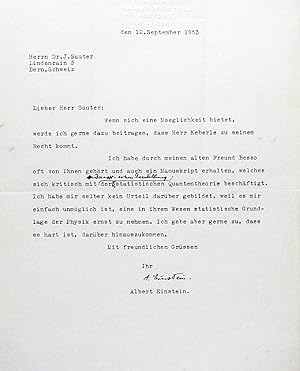
custom folder. Condition: Very Good. First edition. TOWARDS THE END OF HIS LIFE, EINSTEIN WRITES TO ONE OF HIS FRIENDS FROM THE PATENT OFFICE CONCERNING ONE OF THE CENTRAL STRUGGLES OF HIS SCIENTIFIC LIFE. COMMENTING ON THE WORK OF DIRAC, EINSTEIN ADMITS THAT ALTHOUGH HE "CAN'T TAKE A STATISTICAL FOUNDATION OF PHYSICS SERIOUSLY"… HE FINDS IT "DIFFICULT TO MOVE BEYOND IT". Background: Einstein's struggle with accepting a strictly statistical quantum theory has been one of the most discussed and debated topics of twentieth-century physics. When introduced to the statistically-based quantum mechanics of Heisenberg, Born, and Jordan in 1926, Einstein famously wrote to Max Born that "Quantum mechanics is certainly imposing. But an inner voice tells me that it is not yet the real thing. The theory says a lot, but does not really bring us any closer to the secret of the 'old one.' I, at any rare, am convinced that He is not playing at dice." (Einstein letter to Born from 4 December 1926.) From the onset, "Einstein regarded the quantum theory as descriptively incomplete. What he meant was that, in typical cases, the probabilistic assertions provided by the theory for an individual quantum system do not exhaust all the relevant and true physical assertions about the system. Put briefly, according to Einstein, the typical statistical story told by quantum theory is not the whole story." (Arthur Fine, "What is Einstein's Statistical Interpretation, or, Is It Einstein for Whom Bell's Theorem Tolls?"). Einstein's discomfort with the new theory haunted him for the next three decades and his challenges to the theory were the cause of some of the most fertile and defining moments of modern science, notably the celebrated "Bohr-Einstein debates" begun at the Fifth Solvay Conference (1927) and his monumentally influential "EPR" paper of 1935 ("Can Quantum-Mechanical Description of Physical Reality Be Considered Complete?", written with Boris Podolsky and Nathan Rosen). As late as 1949, in his "Reply to Criticisms" (published in Albert Einstein: Philosopher-Scientist), Einstein notes that Born and Wolfgang Pauli, in their contributions to the volume "deprecate the fact that I reject the basic idea of contemporary statistical quantum theory, insofar as I do not believe that this fundamental concept will provide a useful basis for the whole of physics" and spends the majority of the essay explaining his position (and distinguishing between his acceptance of the model for "ensembles of systems" while still rejecting it for an "individual physical system"). The letter: Dated September 12, 1953, and written to his old colleague at the patent office in Bern, Joseph Sauter, the letter (translated from the original German) reads in full: Dear Mr. Sauter, If I am able to, I will gladly assist Mr. Keberle. I have heard of you often from my old friend Besso and I have also received a manuscript which deals critically with [handwritten] Dirac's presentation of the statistical approach to quantum theory. I have not been able to judge it myself because it is simply impossible for me to take a statistical foundation of physics seriously. But I have to admit that it is difficult to move beyond it. Yours sincerely, [signed] A. Einstein. Albert Einstein. The recipient, Joseph Sauter, worked with Einstein at the Bern Patent office during the years he was developing the ideas for his revolutionary papers of 1905. "Among his colleagues at the Patent Office Einstein discovered one with similar scientific interests-Dr. Josef Sauter, a French-Swiss, who had also studied at the Polytechnic and who had been Professor Weber's chief assistant for a while. Sauter, like Einstein, tried to fill the gaps in the Polytechnic's syllabus by private study, so that Einstein was able to discuss with him Maxwell's thermodynamics and Helmholtz's and Hertz's theoretical concepts. The two also discussed Einstein's publications on thermodynamics with the result that Sauter discovered a mistake in them, which Einstein accepted 'without being.
 More images
Published by Berlin, October 19, 1928 1928
- Manuscript
Seller: Kotte Autographs GmbH, Roßhaupten, , GermanyKotte Autographs GmbH
Contact seller5-star sellerCondition: Used
US$ 41,367.44
US$ 22.95 shippingShips from Germany to U.S.A.Quantity: 1 available
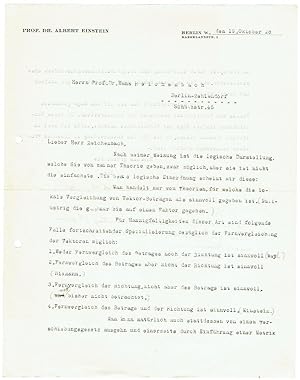
4to. 2 pp. Punch holes. On his personal letterhead. Einstein writes to Reichenbach (1891-1953), a colleague and important expositor of Relativity, to suggest to him a clearer way of explaining one aspect of his theory. He opens the letter by saying (in translation): "I think the logical presentation that you give of my theory is… indeed possible, but it's not the simplest one." After providing a list of four possibilities for "increasing specialization regarding the distant comparison of vectors" he comments: "Of course one can also start with an affine connection and specialize either by introducing a metric or by introducing integrability conditions; i.e. do it the way you did. But this is less simple, less natural." He goes on to assert that "[t]he naturalness of the field of structure envisaged by me seems indisputable to me. I will only know in a few months whether this construction contains deeper traits of reality; for the problems needed to be solved to make this decision are not at all easy." The letter ends with a postscript in Einstein's hand, inviting Reichenbach and his wife to tea, noting "Schrödinger is supposed to come as well.".
 More images
Published by Princeton (NJ), Peconic, New York and Saranac Lake (NY), 1939 to 1948. 1948
- Manuscript
Seller: Antiquariat INLIBRIS Gilhofer Nfg. GmbH, Vienna, A, AustriaAntiquariat INLIBRIS Gilhofer Nfg. GmbH
Contact seller5-star sellerCondition: Used
US$ 29,548.17
US$ 34.43 shippingShips from Austria to U.S.A.Quantity: 1 available
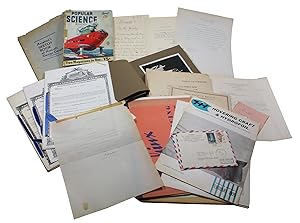
I: Albert Einstein. 4to. 2 pp. - II: Elsa Einstein: 8vo. 2 pp. - III: Helene Dukas. 4to. 2 pp. Grünberg, who later in life changed his name to Waldemar A. Craig, was a hydrodynamic engineer who developed an important design for the hydrofoil. The letters accompany a large archive of Grünberg's papers, consisting of well over 1,0…00 pages of material including some of his original drawings for his hydrofoil improvements, copies of his patents, (including a large dossier of declassified tests performed in the years immediately following WWI), photographs, correspondence, and other related documents and ephemera. - Wsevolode Grünberg was the nephew of the Russian orthodontist and collector Josef Grünberg, one of the few close friends of Albert Einstein, who gave him the nickname "Bolshie". It appears that Einstein and his second wife Elsa had become acquainted with Wsevolode Grünberg shortly before their friend's death in 1932, if not personally, then by correspondence. In an undated letter from Berlin, written sometime before 1932, Elsa Einstein commented to Wsevolode Grünberg: "I am assuming you are just as kind and clever as your uncle, our dear friend. My husband and I were so glad having been able doing this small favor for you. Mr. Dunne wrote a most gracious note to us from Florida. In particular I want to thank you for the delicious grapefruits [.]", adding, "Feel free to call on me anytime if you think I could be of help. Please be sure and do so". - Apparently Grünberg acted on her advice, and travelling to the United States in 1939 approached Einstein for an introduction to fellow engineers in the U.S. in order to demonstrate his hydrofoil designs. The two met in June 1939 at the home of Irving Lehman in Port Chester, New York. Einstein assisted Grünberg with the inheritance issue, acting as a go-between for Grünberg in the U.S. and Plesch in England. - Despite some annoyance, Einstein did what he could for Grünberg both regarding his inheritance and his scientific pursuits. Grünberg's personal papers concern his research on his hydrofoil designs which he first developed in France. The archive includes some of Grünberg's original drawings demonstrating applications for his design as well as some manuscript calculations in his hand, some original U.S. patent certificates for several inventions, one German patent awarded to him in 1930, original photographs, likely from the early 1930s, and several magazines including Popular Science and others discussing Grünberg's work and designs. - Detailed description available upon request.
Published by No place, [1948]. 1948
- Manuscript
Seller: Antiquariat INLIBRIS Gilhofer Nfg. GmbH, Vienna, A, AustriaAntiquariat INLIBRIS Gilhofer Nfg. GmbH
Contact seller5-star sellerCondition: Used
US$ 35,457.81
US$ 34.43 shippingShips from Austria to U.S.A.Quantity: 1 available
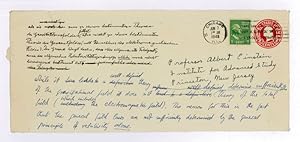
¼ page. 112 x 258 mm. Draft of most of the final paragraph of Einstein's article, "Relativity: Essence of the Theory of Relativity", published in 1948 in the American People's Encyclopedia: "als sie zwar zu einer bestimmten Theorie des Gravitationsfeldes führt, aber nicht zu einer bestimmten Theorie des Gesamtfeldes (mit Einschl…uss des elektromagnetischen Feldes). Der Grund liegt darin, dass dies allgemeine Feldgesetz durch das allgemeine Relativitätsprinzip allein noch nicht hinreichend bestimmt ist". - The present draft shows the original text written by Einstein in German. Written below by a different hand is the English translation as it was finally published: "while it leads to a well-defined theory of the gravitational field it does not determine sufficently the theory of the total field (which includes the electromagnetic field). The reason for this is the fact that the general field laws are not sufficently determined by the general principle of relativity alone". - An exceedingly fine autograph, wherein Einstein implicitly states why he spent so many of his final years searching for a Unified Field Theory. Written on the address side of an envelope addressed to him. Slight damage to edges, somewhat wrinkled.

- Signed
- Manuscript
Seller: Markus Brandes Autographs GmbH, Kesswil, TG, SwitzerlandMarkus Brandes Autographs GmbH
Contact seller3-star sellerCondition: Used
US$ 17,609.21
US$ 34.43 shippingShips from Switzerland to U.S.A.Quantity: 1 available
Autograph letter signed, one page, 7 x 9 inch, Cromer (England), 1.10.1933, in German, to Sir W.D. Ross (Provost of Oriel College, Oxford, from 1929 to 1947 and Vice-Chancellor of Oxford University from 1941 to 1944) - concerning an invitation for Prof. Stenzel as a guest lecturer, written and signed in dark ink "A. Einstein", a…ttractively mounted (removable) for fine display with a photograph, shows Albert Einstein in a chest-up portrait (altogether 16,5 x 11,75 inch), with intersecting letter folds, and a few mild stains - in fine condition. "Herrn Prof. Ross, University Oxford. Sehr geehrter Herr Kollege! Herr Prof. Zangger, Prof der gerichtlichen Medizin an der Universität Zürich, veranlasst mich, Sie auf Prof. Stenzel in Kiel aufmerksam zu machen, der seine Stellung an der Universität Kiel verloren hat. Er beschäftigt sich mit der Geschichte der Wissenschaft des alten Griechenland, und ist selber nicht in der Lage, Ihnen von Deutschland aus zu schreiben. Die Frage ist, ob eine Möglichkeit dafür besteht, dass dieser Mann nach England oder Amerika eingeladen werden könnte, um Gastvorlesungen zu halten. Prof. Zangger schreibt mir, dass Sie über die Forsehungen des erwähnten Kollegen genau Bescheid wüssten. Einer Antwort an mich bedarf es nicht, da ich in dieser Angelegenheit nur Vermittler sein kann. Wenn irgendeine Möglichkeit besteht, so lassen Sie am besten eine Nachricht an Prof. Zangger gelangen, zumal ich dieser Tage nach Amerika (Princeton) fahre. Freundlich grüsst Sie Ihr - A. Einstein"Translated:"Prof. Ross, University of Oxford. Dear colleague, Prof. Zangger, Professor of forensic medicine at the University of Zurich, asked me to make you aware of Prof. Stenzel in Kiel, who lost his position at the University of Kiel. He researches the history of science of ancient Greece, and is not in the psoition to contact you from Germany. The question is if there is a possibility to invite this gentleman to England or America to deliver guest lectures. Prof. Zangger writes that you are aware of the the research of the noted researcher. There is no need to answer me as I can only act as a messenger in this matter. If there is any possibility, it is best to send a message to Prof. Zangger, especially since I am traveling to America (Princeton) these days. Kind regards - Your A. Einstein" Einstein fled from his native Germany when Adolf Hitler came to power. The scientist, who was Jewish, arrived in England while a bounty had been put on his head by the Nazis who named him an enemy of the regime. Commander Oliver Locker-Lampson, an MP and naval officer, had become politically anti-fascist in the lead up to the Second World War. Hearing that the world-famous scientist had received death threats from Nazi sympathisers in Belgium, Commander Locker-Lampson reached out to Einstein and offered him refuge at a camp on Roughton Heath near his home, Newhaven Court, in Cromer, North Norfolk. On October 17, 1933 Albert Einstein and his wife Elsa moved to the US and Albert took up a position at the Institute for Advanced Study at Princeton, New Jersey.Professor Julius Stenzel was a German classical philologist and philosopher. He l was a member of a disciplinary committee that expelled some Nazi students from the university in 1930 who had disturbed the service of the liberal theologian Otto Baumgarten . After the seizure of power of the National Socialists, Stenzel was denounced by a student and given a temporary leave of absence. Despite political rehabilitation, he was transferred to the University of Halle on November 1, 1933, on the basis of Section 5 of the Law for the Restoration of the Professional Civil Service . Here he died two years later after a short, serious illness.
- Signed
Seller: Bauman Rare Books, Philadelphia, PA, U.S.A.Bauman Rare Books
Contact seller4-star sellerCondition: Used
US$ 35,000.00
US$ 10.00 shippingShips within U.S.A.Quantity: 1 available
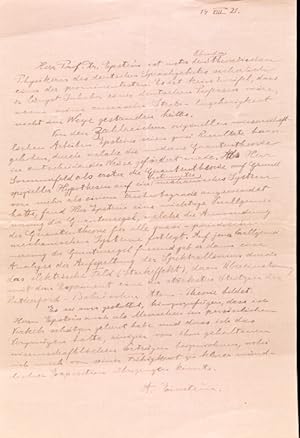
EINSTEIN, Albert. Autograph letter signed. No place, August 14, 1921. Single sheet of cream lined paper, measuring 7-1/2 by 11 inches; p. 1. $35,000.Rare heartfelt autograph letter of recommendation written and signed by Einstein in German, enthusiastically recommending his friend and colleague, physicist Prof. Dr. Paul Epstein,… for an academic position.The autograph letter, dated "14 VIII 21," written entirely in Einstein's hand reads (translated from the original German): "Prof. Dr. Epstein is certainly one of the most prominent living theoretical physicists of the German-speaking world. Without a doubt, he would have been appointed to a German professorship a long time ago, had his Russian nationality not stood in the way. Among Epstein's numerous original scientific papers, two findings, which advanced the modern quantum theory in crucial ways, should be noted. After Mr. Sommerfeld, as the first physicist who, on the basis of special hypotheses, had applied the quantum theory to a certain mechanical system of more than one degree of freedom, Mr. Epstein discovered an important generalization of the quantum principle, which established the application of the quantum theory for all quasi-periodic mechanical systems. Based on that general application of the quantum principle, he then provided an analysis of the splitting of spectral lines in the electrical field (Stark effect), the accordance of which with the experiment provides one of the strongest supports for the Rutherford-Bohr atomic theory. I would like to add that I have also come to appreciate Mr. Epstein in personal interactions as a human being, and that I had the pleasure of attending several scientific lectures given by him, which enabled me to convince myself of his competence in delivering clearly understandable oral exposition. / A. Einstein."Einstein and Epstein were friends and longtime correspondents who shared an interest in physics, Judaism, and the founding of Israel. Paul Epstein was a Russian-American mathematical physicist. He remains best known for his contributions to the development of quantum mechanics. Indeed, he was one of a select group that included Lorentz, Einstein, Minkowski, Thomson, Rutherford, Sommerfeld, Röntgen, von Laue, Bohr, de Broglie, Ehrenfest, and Schwarzschild. Born in Warsaw, then part of Imperial Russia, Epstein was brought up solidly middle class. He later stated that his mother recognized his potential at the age of four and predicted his future as a mathematician. Epstein studied mathematics and physics for his entire university career, eventually earning a degree from the Imperial University of Moscow. He then went on to earn a Ph.D. at the Technical University of Munich in 1914, concentrating on a problem in the theory of diffraction of electromagnetic waves. However, the outbreak of World War I rendered Epstein an enemy alien in Germany. Sommerfeld intervened on his behalf and he was allowed to stay as a private citizen and continue his research. In 1916, Epstein published an important paper explaining the Stark Effect using the Bohr-Sommerfeld quantum theory. After the war, Epstein went to Leiden and worked as an assistant for Lorentz and Ehrenfest. In 1921the year this letter was writtenEpstein was recruited by Robert Millikan to join the physicists at the California Institute of Technology. Epstein accepted the position and stayed there for the rest of his career, publishing extensively on quantum theory. Epstein was something of polymath and worked in numerous areas outside of quantum theory including work on air resistance, the settling of gasses, the theory of vibration, and the absorption of sound. He was an avid supported of Freudian psychoanalysis (including as one of the founding members of the Psychoanalytic Study Group that later merged with the Los Angeles Institute for Psychoanalysis). Epstein was also notably anti-communist and worried about the threat of nationalism.The areas of study mentioned in Eins. Signed.

- Manuscript
Seller: Antiquariat J. Voerster, Stuttgart, BW, GermanyAntiquariat J. Voerster
Contact seller4-star sellerCondition: Used - Near fine
US$ 22,456.61
US$ 51.64 shippingShips from Germany to U.S.A.Quantity: 1 available
Kein Einband. Condition: Gut bis sehr gut. Watch Hill R.I., 26.9.[19]34, Octavo oblong 1 page. Quer-Oktav. 1 Seite. Traces of folding, outer margin faded. "MY OCCUPATION WITH MUSIC IS MERE DILETTANTISM". ONE OF HIS VERY RARE STATEMENTS ABOUT MUSIC In a few words, Einstein describes his relationship to music to James F. Cooke, th…e long-time editor of the musical magazine "The Etude", who had asked him for a contribution to his magazine: " . Due to overloading with work and duties of various kinds, I am unfortunately unable to make use of your kind offer. My occupation with music is, by the way, mere dilettantism and my judgment is in no way authoritative. ." Einstein was by no means a musical dilettante, but above all a passionate violin, but also piano player. There are numerous photographs showing him with his violin "Lina" in his hand. He loved to play Mozart, Bach, Schubert and chamber music with friends and colleagues such as Max Planck or Artur Schnabel, but also with unknown ship passengers. He also maintained close contacts with musicians and composers. For him, making music was a refuge and a balance to the enormous challenges he faced as a scientist. His legendary saying: "To Schubert I have only to remark: Make music, love, and shut up" is indicative of his relationship to music. He saw himself as a performer, but did not want to comment on music as an expert. For this reason, there are only a few, but concise statements from him. He once said of himself that if he had not become a scientist, he would definitely have become a musician.

Language: German
- Manuscript
Seller: Miramar Antiques Art and Books Co. SL, MADRID, M, SpainMiramar Antiques Art and Books Co. SL
Contact seller4-star sellerCondition: Used - Near fine
US$ 17,137.94
US$ 16.64 shippingShips from Spain to U.S.A.Quantity: 1 available
Sin Encuadernar. Condition: Muy bien. Excellent historical photo autograph signed by Albert Einstein during a travel on 1921. The size is 14 cm x 12 cm. With COA certification.


