Order Total (1 Item Items):
Shipping Destination:

Autograph by Albert Einstein, First Edition (2 results)
Skip to main search results
Search filters
Product Type
- All Product Types
- Books (No further results match this refinement)
- Magazines & Periodicals (No further results match this refinement)
- Comics (No further results match this refinement)
- Sheet Music (No further results match this refinement)
- Art, Prints & Posters (No further results match this refinement)
- Photographs (No further results match this refinement)
- Maps (No further results match this refinement)
- Manuscripts & Paper Collectibles (2)
Condition Learn more
- New (No further results match this refinement)
- As New, Fine or Near Fine (1)
- Very Good or Good (1)
- Fair or Poor (No further results match this refinement)
- As Described (No further results match this refinement)
Binding
- All Bindings
- Hardcover (No further results match this refinement)
- Softcover (No further results match this refinement)
Collectible Attributes
- First Edition (2)
- Signed (2)
- Dust Jacket (No further results match this refinement)
- Seller-Supplied Images (2)
- Not Print on Demand (2)
Language (1)
Price
- Any Price
- Under US$ 25 (No further results match this refinement)
- US$ 25 to US$ 50 (No further results match this refinement)
- Over US$ 50
Free Shipping
- Free Shipping to U.S.A. (No further results match this refinement)
Seller Location
Seller Rating
-
Autograph Letter Signed [ALS] Denouncing Racial Segregation
Published by np, Princeton, NJ, 1943
Seller: Manhattan Rare Book Company, ABAA, ILAB, New York, NY, U.S.A.
Seller rating 5 out of 5 stars

Manuscript / Paper Collectible First Edition Signed
nb. Condition: Fine. First edition. EINSTEIN OFFERS STRONG AND PRESCIENT WORDS OF ENCOURAGEMENT TO THE LEADER OF THE NAACP IN THE FIGHT AGAINST RACIAL SEGREGATION AND DISCRIMINATION IN THE UNITED STATES. Background: Einstein's fight against racial discrimination in the United States: The imperative "to protect the rights of the individual. was Einstein's most fundamental political tenet. Individualism and freedom were necessary for creative art and science to flourish. Personally, politically, and professionally, he was repulsed by any restraints. "That is why he remained outspoken about racial discrimination in America. As a Jew who had grown up in Germany, Einstein was acutely sensitive to such discrimination. 'The more I feel an American, the more this situation pains me,' he wrote in an essay called 'The Negro Question' for the January 1946 issue of Pageant magazine. 'I can escape the feeling of complicity in it only by speaking out.'" (Isaacson, Albert Einstein, 505). Even more directly, in his 1946 commencement speech to Lincoln University, the first degree-granting Historically Black College and University (HBCU) in the United States, Einstein strongly denounced segregation as "an American tradition which is uncritically handed down from one generation to the next" noting that "There is separation of colored people from white people in the United States. That separation is not a disease of colored people. It is a disease of white people. I do not intend to be quiet about it." This remarkable letter - from 1943 -is one of the earliest examples of his interest in condemning racism in the United States. The letter: Dated 22 September 1943 and handwritten on his embossed Mercer Street, Princeton letterhead, Einstein writes in English to Walter F. White, the enormously influential African-American civil rights leader who led the NAACP from 1929-1955, praising him for his work and revealing his own awareness of and frustrations with racism and prejudice in America. â The text reads in full: Dear Mr. White: I have been quite impressed by the address you delivered some years ago at a meeting of the Princeton Branch of the National Association for the Advancement of Colored People. I know how hard it is to awaken the conscience even of good-hearted and well-meaning people when deep rooted prejudices are in the way. It is a great work indeed which you are doing relentlessly for the betterment of the living conditions of our Colored fellow-citizens, for justice and for the accomplishment of national unity of the American people. With sincere respect and kind wishes, Yours, Albert Einstein ------------- On April 28, 1940, White was the keynote speaker at "an inter-racial meeting sponsored by the Princeton branch of the National Association for the Advancement of Colored People" where his topic was "What Happens to Democracy When It Encounters the Color Line." (Princeton Herald, April 26, 1940). At the time, Princeton did not admit African Americans and the community was debating the question of whether or not to end segregation at the university. (Princeton, in fact, did not admit its first African-American student until the fall of 1947). Einstein -writing in 1943 -notes that he heard White speak "some years ago". Something clearly must have deeply impressed Einstein about White's speech for him to write this thoughtful letter to White over three years after the event. Note: In addition to its content, this apparently unpublished letter is also remarkable for being one of the very few letters Einstein hand-wrote in English during this period, as German was still very much his preferred tongue. Princeton: September 22, 1943. One page on Einstein's embossed Mercer Street, Princeton letterhead (7.25x10 in visible), handsomely matted and framed with a photograph of Einstein. Fine condition.
-
Typed Letter Signed with Autograph Annotation
Published by np, Princeton, NJ, 1953
Seller: Manhattan Rare Book Company, ABAA, ILAB, New York, NY, U.S.A.
Seller rating 5 out of 5 stars
Manuscript / Paper Collectible First Edition Signed
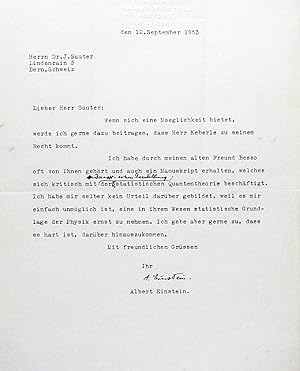
custom folder. Condition: Very Good. First edition. TOWARDS THE END OF HIS LIFE, EINSTEIN WRITES TO ONE OF HIS FRIENDS FROM THE PATENT OFFICE CONCERNING ONE OF THE CENTRAL STRUGGLES OF HIS SCIENTIFIC LIFE. COMMENTING ON THE WORK OF DIRAC, EINSTEIN ADMITS THAT ALTHOUGH HE "CAN'T TAKE A STATISTICAL FOUNDATION OF PHYSICS SERIOUSLY" HE FINDS IT "DIFFICULT TO MOVE BEYOND IT". Background: Einstein's struggle with accepting a strictly statistical quantum theory has been one of the most discussed and debated topics of twentieth-century physics. When introduced to the statistically-based quantum mechanics of Heisenberg, Born, and Jordan in 1926, Einstein famously wrote to Max Born that "Quantum mechanics is certainly imposing. But an inner voice tells me that it is not yet the real thing. The theory says a lot, but does not really bring us any closer to the secret of the 'old one.' I, at any rare, am convinced that He is not playing at dice." (Einstein letter to Born from 4 December 1926.) From the onset, "Einstein regarded the quantum theory as descriptively incomplete. What he meant was that, in typical cases, the probabilistic assertions provided by the theory for an individual quantum system do not exhaust all the relevant and true physical assertions about the system. Put briefly, according to Einstein, the typical statistical story told by quantum theory is not the whole story." (Arthur Fine, "What is Einstein's Statistical Interpretation, or, Is It Einstein for Whom Bell's Theorem Tolls?"). Einstein's discomfort with the new theory haunted him for the next three decades and his challenges to the theory were the cause of some of the most fertile and defining moments of modern science, notably the celebrated "Bohr-Einstein debates" begun at the Fifth Solvay Conference (1927) and his monumentally influential "EPR" paper of 1935 ("Can Quantum-Mechanical Description of Physical Reality Be Considered Complete?", written with Boris Podolsky and Nathan Rosen). As late as 1949, in his "Reply to Criticisms" (published in Albert Einstein: Philosopher-Scientist), Einstein notes that Born and Wolfgang Pauli, in their contributions to the volume "deprecate the fact that I reject the basic idea of contemporary statistical quantum theory, insofar as I do not believe that this fundamental concept will provide a useful basis for the whole of physics" and spends the majority of the essay explaining his position (and distinguishing between his acceptance of the model for "ensembles of systems" while still rejecting it for an "individual physical system"). The letter: Dated September 12, 1953, and written to his old colleague at the patent office in Bern, Joseph Sauter, the letter (translated from the original German) reads in full: Dear Mr. Sauter, If I am able to, I will gladly assist Mr. Keberle. I have heard of you often from my old friend Besso and I have also received a manuscript which deals critically with [handwritten] Dirac's presentation of the statistical approach to quantum theory. I have not been able to judge it myself because it is simply impossible for me to take a statistical foundation of physics seriously. But I have to admit that it is difficult to move beyond it. Yours sincerely, [signed] A. Einstein. Albert Einstein. The recipient, Joseph Sauter, worked with Einstein at the Bern Patent office during the years he was developing the ideas for his revolutionary papers of 1905. "Among his colleagues at the Patent Office Einstein discovered one with similar scientific interests-Dr. Josef Sauter, a French-Swiss, who had also studied at the Polytechnic and who had been Professor Weber's chief assistant for a while. Sauter, like Einstein, tried to fill the gaps in the Polytechnic's syllabus by private study, so that Einstein was able to discuss with him Maxwell's thermodynamics and Helmholtz's and Hertz's theoretical concepts. The two also discussed Einstein's publications on thermodynamics with the result that Sauter discovered a mistake in them, which Einstein accepted 'without being.
![Seller image for Autograph Letter Signed [ALS] Denouncing Racial Segregation for sale by Manhattan Rare Book Company, ABAA, ILAB](https://pictures.abebooks.com/inventory/md/md30742309183.jpg)