Order Total (1 Item Items):
Shipping Destination:

Autograph by Albert Einstein, Signed (8 results)
Skip to main search results
Search filters
Product Type
- All Product Types
- Books (3)
- Magazines & Periodicals (No further results match this refinement)
- Comics (No further results match this refinement)
- Sheet Music (No further results match this refinement)
- Art, Prints & Posters (No further results match this refinement)
- Photographs (No further results match this refinement)
- Maps (No further results match this refinement)
- Manuscripts & Paper Collectibles (5)
Condition Learn more
- New (No further results match this refinement)
- As New, Fine or Near Fine (1)
- Very Good or Good (1)
- Fair or Poor (No further results match this refinement)
- As Described (6)
Binding
- All Bindings
- Hardcover (No further results match this refinement)
- Softcover (No further results match this refinement)
Collectible Attributes
- First Edition (2)
- Signed (8)
- Dust Jacket (No further results match this refinement)
- Seller-Supplied Images (8)
- Not Print on Demand (8)
Language (1)
Price
- Any Price
- Under US$ 25 (No further results match this refinement)
- US$ 25 to US$ 50 (No further results match this refinement)
- Over US$ 50
Free Shipping
- Free Shipping to U.S.A. (No further results match this refinement)
Seller Location
Seller Rating
-

Vintage photograph signed and inscribed "Mr. F. M. Brown, Albert Einstein", with autograph mathematical equations.
Published by [Probably California], 1932., 1932
Seller: Antiquariat INLIBRIS Gilhofer Nfg. GmbH, Vienna, A, Austria
Association Member: ILAB PADA VDA VDAO
Seller rating 5 out of 5 stars

Manuscript / Paper Collectible Signed
Vintage gelatin silver photograph (216 x 165 mm). Photographer's credit stamp "Keystone View Co. Inc., New York" (extremely light) to verso. An exceptional vintage portrait showing Einstein, pipe in mouth, standing on the deck of the Dutch steamship SS Rotterdam on his arrival in New York from Europe in April 1921. Captured at the height of his worldwide fame on his first U.S. visit, the image recalls the public reception that accompanied the transatlantic voyage, undertaken in part to support the Hebrew University project in Jerusalem. - Signed and inscribed in fountain pen at upper left. Unusually, Einstein has filled the opposite corner with six lines of autograph mathematical equations, transforming a celebrity portrait into a personal scientific memento. The recipient, Faris M. Brown, was a California violin dealer whom Einstein met during his Caltech visiting professorships of 1931-33. - Einstein was himself a dedicated and passionate amateur violinist. His mother arranged for him to take lessons from the age of six, and he would continue to play the violin throughout most of his life, often drawing scientific inspiration from a few minutes of practice. While in Pasadena during his visits to Caltech, Einstein played with Artur Rodzinski, the L.A. Philharmonic's conductor. His instrument, which he affectionately named "Lina" (short for "Violina"), survives and recently commanded £860,000 at Dominic Winter Auctioneers in Gloucester. - Signed photographs of Einstein are scarce in any form, and examples further augmented by autograph equations remain a notable rarity. - Some light age wear; minor corner creases, short closed tear to the left blank border. Very minor traces of former mounting to the edges of the verso. - Inscribed to Faris McDonald Brown (1901-1961), a Los Angeles-based violin dealer long with the Rudolph Wurlitzer company who worked with such artists als Fritz Kreisler, Gregor Piatigorsky, and Mischa Elman.
-
ALBERT EINSTEIN AUTOGRAPH LETTER SIGNED [with] LETTER ON ECONOMICS
Published by Potsdam, Germany, 1931
Seller: Second Story Books, ABAA, Rockville, MD, U.S.A.
Seller rating 4 out of 5 stars

Signed
Two letters by Albert Einstein. The first is a single-paged autograph letter signed by Albert Einstein with one horizontal fold and one vertical fold. In Very Good condition . Measuring 22.5 x 28.5 cm. Letter accompanied with mailing envelope, both with matching paper-clip rust stain. Letter with some light wear along edges, small staining to lower corner. Addressed to G. W. Meyer and dated 8 Oktober 31 in Potsdam, the Letter reads in full: "Sehr geehrter Herr! Indem ich Ihnen für die Uebersendung des Buches von Henry George bestens danke, sende ich Ihnen anliegend die gewünschte Meinungsäusserung mit der Bitte um Weiterleitung an Mrs. Evans. Mit ausgezeichneter Hochachtung" and signed in ink "A. Einstein". He thanks Meyer for serving as an intermediary in getting a book to him and for forwarding the enclosed letter. The second letter is a typed copy of Einstein's previously enclosed letter, presumably made by Meyer before he passed the original on to Evans. Addressed to R. W. Evans and dated 8.10.1931 in Potsdam, the letter discusses Henry George's economic theory of poverty and land nationalization, compares it to Franz Oppenheimer's work, and proposes questions to be asked. Presumably he was sent a copy of Henry George's Progress and Poverty. First published in 1879, it sparked the Progressive Era, discussing the paradox of increasing inequality and poverty amid economic and technological progress as well as the economic value of land. Consignment. Shelved Case 3. The Letter reads in full: "Sehr geehrte Mrs. Evans! Ich habe das Buch von Henry George zum grössten Teil mit ausserordentlichem Interesse gelesen und glaube, dass es in der Hauptsache einen unanfechtbaren Standpunkt vertritt, insbesondere was die Ursache der Armut betrifft. Nie in diesem Buch vertretenen Ansichten stimmen, soweit ich es beurteilen kann vollkommen mit den Resultaten des zeitgenössischen Professors Franz Oppenheimer überein, der sie offenbar selbständig herausgefunden hat. Nicht einverstanden bin ich mit der Theorie des Zinses. Mit dem vorgeschlagenen Heilmittel der Verstaatlichung des Bodens und der Bodenschätzung scheint mir allerdings mehr ein Problem als eine Lösung gegeben zu sein. Soll z. Beispiel ein Boden Eigentum der Gemeinschaft, das darauf hingestellte Haus aber Privateigentum sein? Jedenfalls ist es schon von höchster Wichtigkeit, dass das Wesen des Uebels klar aufgezeigt ist. Schon darum wäre es wichtig, wenn das Buch die ihm gebührende Beachtung fände. Mit ausgezeichneter Hochachtung gez. A. Einstein." 1403337. Shelved Dupont Bookstore. Signed.
-
Autograph Letter Signed
Published by Berlin, 1924
Seller: Heritage Book Shop, ABAA, Beverly Hills, CA, U.S.A.
Seller rating 5 out of 5 stars
Signed
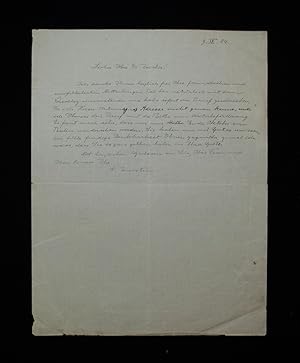
Berlin: 1924. Full Description: EINSTEIN, Albert. Autograph Letter Signed. [Berlin]: 9. IX [September] 1924. Autograph letter signed ("A. Einstein"), to Mr. Zeisler. One quarto page (11 x 8 1/2 inches; 280 x 217 mm). Manuscript letter on recto, verso blank. With one horizontal center crease and one vertical center crease as expected in a letter. A few other light creases. Some minor chipping along edges. A closed split along horizontal crease, not affecting manuscript. Overall very good. This letter with text in German is addressed to "Herr Dr. Zeisler" (Sigmund Zeisler), an German-Jewish U.S. attorney, born in Austria. He was known for his defense of radicals in Chicago in the 1880s, also known as the Haymarket Affair. His wife was the famous concert pianist Fannie Bloomfield Zeisler. Some unproven sources have said that Zeisler was Einstein's lawyer, but regardless it is known that he and Einstein were good friends and had much correspondence over the years. According to "The Collected Papers of Albert Einstein" published by Princeton University, Einstein was in correspondence during the 1920s with Zeisler regarding various American investments. According to a letter from Zeisler to Einstein on October 15, 1921 "Zeisler had invested $4,300 in American shares on Einstein's behalf in October 1921. He subsequently informed Einstein of the accumulated interest." Einstein wrote another letter in April of 1924 asking Zeisler to transfer American investments to his daughter and soon to be son-in-law as a dowery. Zeisler was to ensure the interest was paid on an annual basis to his daughter. In this present letter just six months later, Einstein is thanking Zeisler for doing "many good things" and stating that he looks forward to seeing him again in Berlin. Translated by an outside party: "9. IX. 24. Dear Dr, Zeisler, Many thanks for your friendly and clearly stateed letter. Of course I agree with the offer. I immediately wrote the letter. Since I don;t know the exact address, I an sending you the letter and ask that you forward it. It pleases me that we shall see each other again in Berlin. You have done many good things, for which I thank you. I know that you have done these things gladly since you are a good person. Regards to you, your wife and to your sons. A. Einstein." HBS 68960. $7,500. Signed.
-
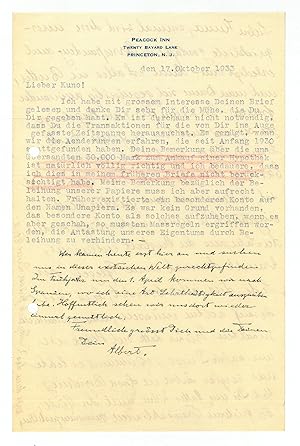
Typescript letter with six autograph lines signed ("Albert").
Published by Peacock Inn, Princeton, NJ, 17. X. 1933., 1933
Seller: Antiquariat INLIBRIS Gilhofer Nfg. GmbH, Vienna, A, Austria
Association Member: ILAB PADA VDA VDAO
Seller rating 5 out of 5 stars
Manuscript / Paper Collectible Signed
8vo. 1 p. With an autograph letter signed by Elsa on the reverse. - Includes: 3 autograph letters signed by his wife Elsa Einstein (folio and 8vo; Caputh, 21 August 1932 and no date), one with a 6-line autograph postscript signed by Albert Einstein, and a slip of paper (ca. 40 x 80 mm) with autograph note, date (Princeton, 9 May 1934), and signature in full. Intimate correspondence with Einstein's cousin Kuno Kocherthaler, director of a mining company in Spain and also an art collector. - Typing on hotel stationery on the day of his arrival in the USA as a stateless refugee, having escaped from ever-increasing persecution in Nazi Germany, Einstein thanks Kuno for a letter of his about financial matters, adding below in his own hand: "Wir kamen heute erst hier an und suchen uns in dieser exotischen Welt zurechtzufinden. Im Frühjahr um den 1. April kommen wir nach Spanien, wo ich eine Art Lehrtätigkeit auszuüben habe. Hoffentlich sehen wir uns dort wieder einmal gemütlich [.]". - In an earlier letter of Elsa's, also regarding family investments administered by Kuno (undated but written aboard the "Oakland", probably in the port of Bremen on 10 December 1932, about to depart for a winter cruise to Pasadena via Middle America), Einstein adds a poignant note about his younger son Eduard, who suffered from schizophrenia and had recently been committed to a mental asylum in Switzerland: "Nimm bitte diese schleichende Sorge von uns; das Leben hat in letzter Zeit Schweres gebracht, da mein liebster Sohn, der Jüngere, in einer Anstalt hat untergebracht werden müssen (Geisteskrankheit) [.]". - In the final missive, possibly another postscript torn from a longer letter, Einstein gives his consent in a single word ("Einverstanden"), signing and dating: "Princeton, 9. Mai 1934 / Albert Einstein". Elsa's own letters discuss travel, finances, Albert Einstein's stay in Spa, etc. - Each sheet with marginal binder holes affecting a few letters, otherwise flawless.
-
Autograph Letter Signed [ALS] Denouncing Racial Segregation
Published by np, Princeton, NJ, 1943
Seller: Manhattan Rare Book Company, ABAA, ILAB, New York, NY, U.S.A.
Seller rating 5 out of 5 stars
Manuscript / Paper Collectible First Edition Signed
nb. Condition: Fine. First edition. EINSTEIN OFFERS STRONG AND PRESCIENT WORDS OF ENCOURAGEMENT TO THE LEADER OF THE NAACP IN THE FIGHT AGAINST RACIAL SEGREGATION AND DISCRIMINATION IN THE UNITED STATES. Background: Einstein's fight against racial discrimination in the United States: The imperative "to protect the rights of the individual. was Einstein's most fundamental political tenet. Individualism and freedom were necessary for creative art and science to flourish. Personally, politically, and professionally, he was repulsed by any restraints. "That is why he remained outspoken about racial discrimination in America. As a Jew who had grown up in Germany, Einstein was acutely sensitive to such discrimination. 'The more I feel an American, the more this situation pains me,' he wrote in an essay called 'The Negro Question' for the January 1946 issue of Pageant magazine. 'I can escape the feeling of complicity in it only by speaking out.'" (Isaacson, Albert Einstein, 505). Even more directly, in his 1946 commencement speech to Lincoln University, the first degree-granting Historically Black College and University (HBCU) in the United States, Einstein strongly denounced segregation as "an American tradition which is uncritically handed down from one generation to the next" noting that "There is separation of colored people from white people in the United States. That separation is not a disease of colored people. It is a disease of white people. I do not intend to be quiet about it." This remarkable letter - from 1943 -is one of the earliest examples of his interest in condemning racism in the United States. The letter: Dated 22 September 1943 and handwritten on his embossed Mercer Street, Princeton letterhead, Einstein writes in English to Walter F. White, the enormously influential African-American civil rights leader who led the NAACP from 1929-1955, praising him for his work and revealing his own awareness of and frustrations with racism and prejudice in America. â The text reads in full: Dear Mr. White: I have been quite impressed by the address you delivered some years ago at a meeting of the Princeton Branch of the National Association for the Advancement of Colored People. I know how hard it is to awaken the conscience even of good-hearted and well-meaning people when deep rooted prejudices are in the way. It is a great work indeed which you are doing relentlessly for the betterment of the living conditions of our Colored fellow-citizens, for justice and for the accomplishment of national unity of the American people. With sincere respect and kind wishes, Yours, Albert Einstein ------------- On April 28, 1940, White was the keynote speaker at "an inter-racial meeting sponsored by the Princeton branch of the National Association for the Advancement of Colored People" where his topic was "What Happens to Democracy When It Encounters the Color Line." (Princeton Herald, April 26, 1940). At the time, Princeton did not admit African Americans and the community was debating the question of whether or not to end segregation at the university. (Princeton, in fact, did not admit its first African-American student until the fall of 1947). Einstein -writing in 1943 -notes that he heard White speak "some years ago". Something clearly must have deeply impressed Einstein about White's speech for him to write this thoughtful letter to White over three years after the event. Note: In addition to its content, this apparently unpublished letter is also remarkable for being one of the very few letters Einstein hand-wrote in English during this period, as German was still very much his preferred tongue. Princeton: September 22, 1943. One page on Einstein's embossed Mercer Street, Princeton letterhead (7.25x10 in visible), handsomely matted and framed with a photograph of Einstein. Fine condition.
-
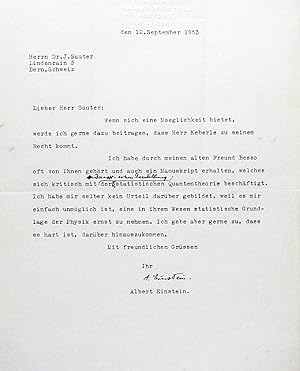
Typed Letter Signed with Autograph Annotation
Published by np, Princeton, NJ, 1953
Seller: Manhattan Rare Book Company, ABAA, ILAB, New York, NY, U.S.A.
Seller rating 5 out of 5 stars
Manuscript / Paper Collectible First Edition Signed
custom folder. Condition: Very Good. First edition. TOWARDS THE END OF HIS LIFE, EINSTEIN WRITES TO ONE OF HIS FRIENDS FROM THE PATENT OFFICE CONCERNING ONE OF THE CENTRAL STRUGGLES OF HIS SCIENTIFIC LIFE. COMMENTING ON THE WORK OF DIRAC, EINSTEIN ADMITS THAT ALTHOUGH HE "CAN'T TAKE A STATISTICAL FOUNDATION OF PHYSICS SERIOUSLY" HE FINDS IT "DIFFICULT TO MOVE BEYOND IT". Background: Einstein's struggle with accepting a strictly statistical quantum theory has been one of the most discussed and debated topics of twentieth-century physics. When introduced to the statistically-based quantum mechanics of Heisenberg, Born, and Jordan in 1926, Einstein famously wrote to Max Born that "Quantum mechanics is certainly imposing. But an inner voice tells me that it is not yet the real thing. The theory says a lot, but does not really bring us any closer to the secret of the 'old one.' I, at any rare, am convinced that He is not playing at dice." (Einstein letter to Born from 4 December 1926.) From the onset, "Einstein regarded the quantum theory as descriptively incomplete. What he meant was that, in typical cases, the probabilistic assertions provided by the theory for an individual quantum system do not exhaust all the relevant and true physical assertions about the system. Put briefly, according to Einstein, the typical statistical story told by quantum theory is not the whole story." (Arthur Fine, "What is Einstein's Statistical Interpretation, or, Is It Einstein for Whom Bell's Theorem Tolls?"). Einstein's discomfort with the new theory haunted him for the next three decades and his challenges to the theory were the cause of some of the most fertile and defining moments of modern science, notably the celebrated "Bohr-Einstein debates" begun at the Fifth Solvay Conference (1927) and his monumentally influential "EPR" paper of 1935 ("Can Quantum-Mechanical Description of Physical Reality Be Considered Complete?", written with Boris Podolsky and Nathan Rosen). As late as 1949, in his "Reply to Criticisms" (published in Albert Einstein: Philosopher-Scientist), Einstein notes that Born and Wolfgang Pauli, in their contributions to the volume "deprecate the fact that I reject the basic idea of contemporary statistical quantum theory, insofar as I do not believe that this fundamental concept will provide a useful basis for the whole of physics" and spends the majority of the essay explaining his position (and distinguishing between his acceptance of the model for "ensembles of systems" while still rejecting it for an "individual physical system"). The letter: Dated September 12, 1953, and written to his old colleague at the patent office in Bern, Joseph Sauter, the letter (translated from the original German) reads in full: Dear Mr. Sauter, If I am able to, I will gladly assist Mr. Keberle. I have heard of you often from my old friend Besso and I have also received a manuscript which deals critically with [handwritten] Dirac's presentation of the statistical approach to quantum theory. I have not been able to judge it myself because it is simply impossible for me to take a statistical foundation of physics seriously. But I have to admit that it is difficult to move beyond it. Yours sincerely, [signed] A. Einstein. Albert Einstein. The recipient, Joseph Sauter, worked with Einstein at the Bern Patent office during the years he was developing the ideas for his revolutionary papers of 1905. "Among his colleagues at the Patent Office Einstein discovered one with similar scientific interests-Dr. Josef Sauter, a French-Swiss, who had also studied at the Polytechnic and who had been Professor Weber's chief assistant for a while. Sauter, like Einstein, tried to fill the gaps in the Polytechnic's syllabus by private study, so that Einstein was able to discuss with him Maxwell's thermodynamics and Helmholtz's and Hertz's theoretical concepts. The two also discussed Einstein's publications on thermodynamics with the result that Sauter discovered a mistake in them, which Einstein accepted 'without being.
-

Albert Einstein Autograph
Seller: Markus Brandes Autographs GmbH, Kesswil, TG, Switzerland
Association Member: PADA
Seller rating 3 out of 5 stars

Manuscript / Paper Collectible Signed
US$ 17,609.21
US$ 34.43 shipping
Ships from Switzerland to U.S.A.Quantity: 1 available
Add to basketAutograph letter signed, one page, 7 x 9 inch, Cromer (England), 1.10.1933, in German, to Sir W.D. Ross (Provost of Oriel College, Oxford, from 1929 to 1947 and Vice-Chancellor of Oxford University from 1941 to 1944) - concerning an invitation for Prof. Stenzel as a guest lecturer, written and signed in dark ink "A. Einstein", attractively mounted (removable) for fine display with a photograph, shows Albert Einstein in a chest-up portrait (altogether 16,5 x 11,75 inch), with intersecting letter folds, and a few mild stains - in fine condition. "Herrn Prof. Ross, University Oxford. Sehr geehrter Herr Kollege! Herr Prof. Zangger, Prof der gerichtlichen Medizin an der Universität Zürich, veranlasst mich, Sie auf Prof. Stenzel in Kiel aufmerksam zu machen, der seine Stellung an der Universität Kiel verloren hat. Er beschäftigt sich mit der Geschichte der Wissenschaft des alten Griechenland, und ist selber nicht in der Lage, Ihnen von Deutschland aus zu schreiben. Die Frage ist, ob eine Möglichkeit dafür besteht, dass dieser Mann nach England oder Amerika eingeladen werden könnte, um Gastvorlesungen zu halten. Prof. Zangger schreibt mir, dass Sie über die Forsehungen des erwähnten Kollegen genau Bescheid wüssten. Einer Antwort an mich bedarf es nicht, da ich in dieser Angelegenheit nur Vermittler sein kann. Wenn irgendeine Möglichkeit besteht, so lassen Sie am besten eine Nachricht an Prof. Zangger gelangen, zumal ich dieser Tage nach Amerika (Princeton) fahre. Freundlich grüsst Sie Ihr - A. Einstein"Translated:"Prof. Ross, University of Oxford. Dear colleague, Prof. Zangger, Professor of forensic medicine at the University of Zurich, asked me to make you aware of Prof. Stenzel in Kiel, who lost his position at the University of Kiel. He researches the history of science of ancient Greece, and is not in the psoition to contact you from Germany. The question is if there is a possibility to invite this gentleman to England or America to deliver guest lectures. Prof. Zangger writes that you are aware of the the research of the noted researcher. There is no need to answer me as I can only act as a messenger in this matter. If there is any possibility, it is best to send a message to Prof. Zangger, especially since I am traveling to America (Princeton) these days. Kind regards - Your A. Einstein" Einstein fled from his native Germany when Adolf Hitler came to power. The scientist, who was Jewish, arrived in England while a bounty had been put on his head by the Nazis who named him an enemy of the regime. Commander Oliver Locker-Lampson, an MP and naval officer, had become politically anti-fascist in the lead up to the Second World War. Hearing that the world-famous scientist had received death threats from Nazi sympathisers in Belgium, Commander Locker-Lampson reached out to Einstein and offered him refuge at a camp on Roughton Heath near his home, Newhaven Court, in Cromer, North Norfolk. On October 17, 1933 Albert Einstein and his wife Elsa moved to the US and Albert took up a position at the Institute for Advanced Study at Princeton, New Jersey.Professor Julius Stenzel was a German classical philologist and philosopher. He l was a member of a disciplinary committee that expelled some Nazi students from the university in 1930 who had disturbed the service of the liberal theologian Otto Baumgarten . After the seizure of power of the National Socialists, Stenzel was denounced by a student and given a temporary leave of absence. Despite political rehabilitation, he was transferred to the University of Halle on November 1, 1933, on the basis of Section 5 of the Law for the Restoration of the Professional Civil Service . Here he died two years later after a short, serious illness.
-
Autograph letter signed
Publication Date: 1921
Seller: Bauman Rare Books, Philadelphia, PA, U.S.A.
Association Member: ABAA ILAB PBFA
Seller rating 4 out of 5 stars
Signed
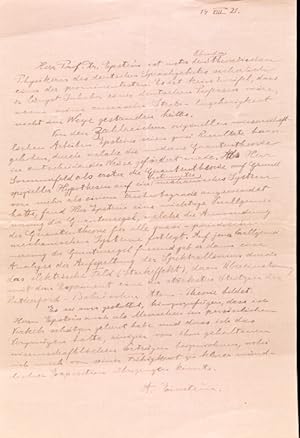
EINSTEIN, Albert. Autograph letter signed. No place, August 14, 1921. Single sheet of cream lined paper, measuring 7-1/2 by 11 inches; p. 1. $35,000.Rare heartfelt autograph letter of recommendation written and signed by Einstein in German, enthusiastically recommending his friend and colleague, physicist Prof. Dr. Paul Epstein, for an academic position.The autograph letter, dated "14 VIII 21," written entirely in Einstein's hand reads (translated from the original German): "Prof. Dr. Epstein is certainly one of the most prominent living theoretical physicists of the German-speaking world. Without a doubt, he would have been appointed to a German professorship a long time ago, had his Russian nationality not stood in the way. Among Epstein's numerous original scientific papers, two findings, which advanced the modern quantum theory in crucial ways, should be noted. After Mr. Sommerfeld, as the first physicist who, on the basis of special hypotheses, had applied the quantum theory to a certain mechanical system of more than one degree of freedom, Mr. Epstein discovered an important generalization of the quantum principle, which established the application of the quantum theory for all quasi-periodic mechanical systems. Based on that general application of the quantum principle, he then provided an analysis of the splitting of spectral lines in the electrical field (Stark effect), the accordance of which with the experiment provides one of the strongest supports for the Rutherford-Bohr atomic theory. I would like to add that I have also come to appreciate Mr. Epstein in personal interactions as a human being, and that I had the pleasure of attending several scientific lectures given by him, which enabled me to convince myself of his competence in delivering clearly understandable oral exposition. / A. Einstein."Einstein and Epstein were friends and longtime correspondents who shared an interest in physics, Judaism, and the founding of Israel. Paul Epstein was a Russian-American mathematical physicist. He remains best known for his contributions to the development of quantum mechanics. Indeed, he was one of a select group that included Lorentz, Einstein, Minkowski, Thomson, Rutherford, Sommerfeld, Röntgen, von Laue, Bohr, de Broglie, Ehrenfest, and Schwarzschild. Born in Warsaw, then part of Imperial Russia, Epstein was brought up solidly middle class. He later stated that his mother recognized his potential at the age of four and predicted his future as a mathematician. Epstein studied mathematics and physics for his entire university career, eventually earning a degree from the Imperial University of Moscow. He then went on to earn a Ph.D. at the Technical University of Munich in 1914, concentrating on a problem in the theory of diffraction of electromagnetic waves. However, the outbreak of World War I rendered Epstein an enemy alien in Germany. Sommerfeld intervened on his behalf and he was allowed to stay as a private citizen and continue his research. In 1916, Epstein published an important paper explaining the Stark Effect using the Bohr-Sommerfeld quantum theory. After the war, Epstein went to Leiden and worked as an assistant for Lorentz and Ehrenfest. In 1921the year this letter was writtenEpstein was recruited by Robert Millikan to join the physicists at the California Institute of Technology. Epstein accepted the position and stayed there for the rest of his career, publishing extensively on quantum theory. Epstein was something of polymath and worked in numerous areas outside of quantum theory including work on air resistance, the settling of gasses, the theory of vibration, and the absorption of sound. He was an avid supported of Freudian psychoanalysis (including as one of the founding members of the Psychoanalytic Study Group that later merged with the Los Angeles Institute for Psychoanalysis). Epstein was also notably anti-communist and worried about the threat of nationalism.The areas of study mentioned in Eins. Signed.

![Seller image for ALBERT EINSTEIN AUTOGRAPH LETTER SIGNED [with] LETTER ON ECONOMICS for sale by Second Story Books, ABAA](https://pictures.abebooks.com/inventory/md/md32297725145.jpg)

![Seller image for Autograph Letter Signed [ALS] Denouncing Racial Segregation for sale by Manhattan Rare Book Company, ABAA, ILAB](https://pictures.abebooks.com/inventory/md/md30742309183.jpg)