Order Total (1 Item Items):
Shipping Destination:

Behavior Organisms, First Edition (12 results)
Skip to main search results
Search filters
Product Type
- All Product Types
- Books (12)
- Magazines & Periodicals (No further results match this refinement)
- Comics (No further results match this refinement)
- Sheet Music (No further results match this refinement)
- Art, Prints & Posters (No further results match this refinement)
- Photographs (No further results match this refinement)
- Maps (No further results match this refinement)
- Manuscripts & Paper Collectibles (No further results match this refinement)
Condition Learn more
- New (2)
- As New, Fine or Near Fine (3)
- Very Good or Good (7)
- Fair or Poor (No further results match this refinement)
- As Described (No further results match this refinement)
Binding
Collectible Attributes
Language (2)
Free Shipping
Seller Location
Seller Rating
-
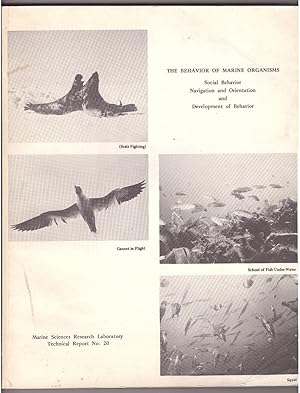
The Behavior of Marine Organisms
Published by Memorial University, St. John's NFLD, 1977
Seller: Ainsworth Books ( IOBA), Chilliwack, BC, Canada
Association Member: IOBA
Seller rating 5 out of 5 stars

First Edition
Paperback. Condition: Very Good. First Edition. Light soiling to card covers, bottom fore corners creased.; Tight solid book, text unmarked.; Trade PB; Marine Sciences Research Laboratory Technical Report # 20; B&W Illustrations; Small 4to 9" - 11" tall; 286 pages; This is a scholarly text taken from the Plenary papers of the above mentioned meeting. Subtitled Social Behavior, Navigation and Orientation & Development of Behavior.
-

Behavior of the Lower Organisms
Language: English
Published by New York: Columbia University Press, 1923
First Edition
Hardcover. Condition: Good. 1st Edition. Third printing by information on copyright page, bound in black cloth with gilt lettering and decorations, ex-library wioth usual treatments, previous owner name stamp and bookplates, still Good clean and serviceable copy.
-
The Behavior of Marine Organisms MSC 360 - Selected Readings
Published by Published By the Author, University of Miami, 1995
First Edition
Plastic Comb and Stiff Wraps. Condition: VG. Dust Jacket Condition: No Jacket as Issued. Revised in 1995. Much on sharks and bio acoustics. Prepared for a class. Over 500 pages by various authors. Size: Thick 4to - over 9¾" - 12" Tall.
-
Light and the Behavior of Organisms
Published by John Wiley & Sons, New York, 1911
Seller: Uncommon Books, Glastonbury, CT, U.S.A.
Association Member: SNEAB
Seller rating 5 out of 5 stars
First Edition
Original Cloth. Condition: VG-. No Jacket. First Edition. Book has cover wear. Book.
-
Hardcover. Condition: Very Good. Dust Jacket Condition: Facsimile Dust Jacket. 1st Edition. First Printing. Bound in black cloth with black lettering and 1st printing indicator for Appleton. Very good copy, hinges sound though has some scratching on front cover, ink stain on front of text block, previous owner's stamp on front endpapers, and ruled ink underling to parts of the book. Otherwise the book has square, stiff boards with minimal wear, a tight spine and pointed tips. In a facsimile dust jacket, which is new, that was taken from a first printing. Looks handsome in a new plastic removable cover. Shipping box is suitable for wrapping with a non-price listed purchase order inside along with biodegradable packing.
-
Hardcover. Condition: Fine. Dust Jacket Condition: Near Fine. 1st Edition. First edition, first printing, first state binding in rare dust jacket of Skinner's first book, a landmark in the field of behavior analysis. Full black cloth with bright gilt lettered spine, the title de-embosed in blind to front cover, publisher's [I] to last text page indicating a first printing. One of 500 copies in this first issue black binding. A fine clean tight copy, tiny stamped previous owner's name to base of front free endpage, no other markings. Original dust jacket is unclipped showing the original price of $5.00, a few small chips and tears, the largest chip is less than 1/2 x 1/4 of an inch to top of spine, some hair-line splitting where the spine meets the panels, old tape to verso along top and bottom edges, usual toning to spine, light soiling to rear pane, presents nicely. A beautiful example of an important and rare work. Scarce in dust jacket.
-

The Behavior of Organisms - An Experimental Analysis: The Century Psychology Series
Published by D. Appleton-Century Company Incorporated, New York, 1938
Seller: RareNonFiction, IOBA, Ladysmith, BC, Canada
Association Member: IOBA
Seller rating 5 out of 5 stars
First Edition
Hardcover. Condition: Good. First Edition. In this, Skinner's first book, he "launched a new science based on selection by consequences as the mechanism through which behavior changes during the lifetime of the individual. The book summarizes nearly ten years of research, spanning the years of Skinner's graduate school days at Harvard through his three years as a member of the Society of Fellows. Here he defines his basic unit of behavior, the operant, proposes rate as the basic datum, and describes his research program-to identify the variables of which behavior is a function." - B.F. Skinner Foundation. ix, [1], 457 pages. References. Index. Name of Arthur Gladstone stamped atop front free endpaper is presumably that of the Swarthmore College professor who edited the 'Bulletin of the Research Exchange on the Prevention of War' in the 1950s. Ink marginal lines and/or marginalia on approximately 23 pages appear recent. Dust jacket not included. Moderate wear to original black cloth. Bright gilt lettering upon backstrip. Binding tight.; 8vo - over 7¾" - 9¾" tall; The Behavior of Organisms - An Experimental Analysis: The Century Psychology Series Skinner B.F. Behavioral Theory Reflex Operant Conditioning EAB Experimental Analysis of Behavior.
-
Behavior of Organisms
Published by Appleton-Century-Crofts
Seller: Wonder Book, Frederick, MD, U.S.A.
Seller rating 5 out of 5 stars
First Edition
Condition: Very Good. NY: Appleton Century 1938. 1st printing, black cloth, '1' on last pg. Hardcover 8vo 457 pgs. Very good in a fair dust jacket. Spine ends and corners lightly bumped. Hinge shaken. Owner's name in ink to front pastedown. Contents clean and binding sound. Jacket is edgeworn, chipped and has edge tears. Jacket torn into 2 pieces at spine. Jacket spine toned. 5.00 orig price to flap. Inquire if you need further information.
-

Behavior of Organisms: An Experimental Analysis. (First issue in black cloth.)
Published by New York: D. Appleton-Century Co. Inc., 1938., 1938
Seller: Ted Kottler, Bookseller, Redondo Beach, CA, U.S.A.
Seller rating 3 out of 5 stars

First Edition
Hardcover. Condition: Near Fine. No Jacket. 1st Edition. FIRST EDITION, first issue. ix, 457 pp. Original black cloth. Very Good+. The Century Psychology Series. 800 copies of the first edition were printed in the summer of 1938 and published in September, of which 500 were bound in black cloth. The remaining 300 were bound in light green cloth and issued in the mid-1940s.
-
The Behavior of Organisms: An Experimental Analysis
Published by D. Appleton-Century Company, New York, 1938
Seller: Burnside Rare Books, ABAA, Portland, OR, U.S.A.
Association Member: ABAA CBA ILAB
Seller rating 5 out of 5 stars
First Edition Signed
Condition: Near Fine. Dust Jacket Condition: Near Fine. First Edition. First edition, first printing denoted by "I" on last page of text. Signed by B.F. Skinner on the title page. Bound in publisher's original black cloth with titles blocked in blind on the upper board and stamped in gilt on the spine. Near Fine with light rubbing to cloth at edges, three small stains to rear cover, spine gilt slightly dulled. Pages toned and lower corners of early pages bumped. Former owner name Mungo Miller to front free endpaper, most likely the research scientist who published a paper entitled "Observation of Initial Visual Experience in Rats" in a 1948 issue of The Journal of Psychology. In a Near Fine unclipped dust jacket with light edge wear, spine toned and lightly worn at the crown. The psychologist's first book, a milestone in the experimental analysis of behavior. Signed copies are incredibly scarce.
-

Gravity and the Behavior of Unicellular Organisms (Hardcover)
Language: English
Published by Cambridge University Press, Cambridge, 2005
ISBN 10: 0521820529 ISBN 13: 9780521820523
First Edition Print on Demand
Hardcover. Condition: new. Hardcover. Unicellular organisms use gravity as an environmental guide to reach and stay in regions optimal for their growth and reproduction. These single cells play a significant role in food webs and these factors together make the effects of gravity on unicellular organisms a fascinating and important subject for scientific study. In addition, they present valuable model systems for studying the mechanisms of gravity perception, a topic of increasing interest in these days of experimentation in space. This book reveals how single cells achieve the same sensoric capacity as multicellular organisms like plants or animals. It reviews the field, discussing the historical background, ecological significance and related physiology of unicellular organisms, as well as various experimental techniques and models with which to study them. Those working on the biology of unicellular organisms, as well as in related areas of gravitational and space science will find this book of value. How do single cells know where is up and down? What is their ecological benefit? How can they be used to study the mechanisms of gravity perception? Historical and current approaches are summarised in order to answer these basic questions of interest to biologists as well as space and gravitational scientists. This item is printed on demand. Shipping may be from multiple locations in the US or from the UK, depending on stock availability.
-
Gravity and the Behavior of Unicellular Organisms (Hardcover)
Language: English
Published by Cambridge University Press, Cambridge, 2005
ISBN 10: 0521820529 ISBN 13: 9780521820523
First Edition Print on Demand
US$ 137.14
US$ 49.76 shipping
Ships from United Kingdom to U.S.A.Quantity: 1 available
Add to basketHardcover. Condition: new. Hardcover. Unicellular organisms use gravity as an environmental guide to reach and stay in regions optimal for their growth and reproduction. These single cells play a significant role in food webs and these factors together make the effects of gravity on unicellular organisms a fascinating and important subject for scientific study. In addition, they present valuable model systems for studying the mechanisms of gravity perception, a topic of increasing interest in these days of experimentation in space. This book reveals how single cells achieve the same sensoric capacity as multicellular organisms like plants or animals. It reviews the field, discussing the historical background, ecological significance and related physiology of unicellular organisms, as well as various experimental techniques and models with which to study them. Those working on the biology of unicellular organisms, as well as in related areas of gravitational and space science will find this book of value. How do single cells know where is up and down? What is their ecological benefit? How can they be used to study the mechanisms of gravity perception? Historical and current approaches are summarised in order to answer these basic questions of interest to biologists as well as space and gravitational scientists. This item is printed on demand. Shipping may be from our UK warehouse or from our Australian or US warehouses, depending on stock availability.