Order Total (1 Item Items):
Shipping Destination:

Boy Will by Frost Robert, Signed (37 results)
Skip to main search results
Search filters
Product Type
- All Product Types
- Books (37)
- Magazines & Periodicals (No further results match this refinement)
- Comics (No further results match this refinement)
- Sheet Music (No further results match this refinement)
- Art, Prints & Posters (No further results match this refinement)
- Photographs (No further results match this refinement)
- Maps (No further results match this refinement)
- Manuscripts & Paper Collectibles (No further results match this refinement)
Condition Learn more
- New (No further results match this refinement)
- As New, Fine or Near Fine (9)
- Very Good or Good (10)
- Fair or Poor (No further results match this refinement)
- As Described (18)
Binding
Collectible Attributes
Language (2)
Free Shipping
Seller Location
Seller Rating
-
Hardcover. Condition: Very Good. No Jacket. 1st Edition. First American edition, second state ('aind' on page 14 has been corrected, while 'wich-hazel' on page 62 has not) of Robert Frost's first collection, signed by Frost with the handwritten complete poem, 'Triple Bronze' on the flyleaf, 'to Paul Engle, with friendliest exchange.' Engle was, of course, the longtime director of the Iowa Writer's Workshop and co-founder of the UI's International Writing Program, as well as a prominent poet in his own right. Frost visited Iowa on April 13, 1959 during National Library Week. Also included, laid in, (Engle's part of the 'exchange') is the poem 'Robert Frost' by Paul Engle, printed by Iowa's Typographic Laboratory on the occasion of Frost's visit in an edition of 3000. This book was purchased from Paul Engle's estate. No dust jacket. Boards have edge wear, minor scratches, minor scuffs, rubbed/slightly frayed corners/spine. No writing in the text. Inscribed by Author(s).
-
A Boy's Will
Language: English
Published by Henry Holt and Company, 1915
Seller: Yesterday's Muse, ABAA, ILAB, IOBA, Webster, NY, U.S.A.
Association Member: ABAA ILAB IOBA
Seller rating 5 out of 5 stars

Signed
Hard Cover. Condition: Very Good. No Jacket. First American Edition. First American edition, second state ('Aind' corrected to 'And' on page 14, 'wich-hazel' uncorrected on p. 62). Signed and dated by author without inscription on title page ('Robert Frost, Fitchburg 1938'). Lacks jacket. Spine and edges faded, newspaper clippings laid in with associated toning of pages. 1915 Hard Cover. ix, 63, [1] pp. The first published book by the famous American poet best known for his introspective depictions of rural life as seen in The Road Not Taken and Mending Wall. Frost was a popular public figure, and remains the only poet to win four Pulitzer Prizes for Poetry. He was poet laureate of Vermont, and received the Congressional Gold Medal for his work. Signed by author.
-
A BOY'S WILL. First American edition. Signed and inscribed by Robert Frost.
Language: English
Published by Henry Holt, New York, NY, 1915
Seller: Kurt Gippert Bookseller (ABAA), Chicago, IL, U.S.A.
Association Member: ABAA ILAB MWABA
Seller rating 5 out of 5 stars
First Edition Signed
Hardcover. Condition: Very good- condition. First American edition. 63 pages. One of only 750 copies of the first state of the first American edition. Original blue linen hardcover cloth binding is moderately shelfworn, with minor fraying to the spine extremities and minor browning/sunning to the spine; protected in fitted archival mylar. No dustjacket. White wove paper, with the endpapers of a heavier white wove paper, somewhat toned. Top edge trimmed, other edges uncut, as issued. With the typographical error "Aind" present and uncorrected in the last line on page 14. On page 62 line 16 the word "wich-hazel" remains uncorrected. Signed and inscribed on the front endpaper "For my friends Mr & Mrs M. E. Gates [signed] Robert Frost." The inner front hinge at the half-title page is weakened. Merrill Edwards Gates (1848-1922) became president of Amherst College in 1891. Frost first visited the Amherst campus to give a reading of his poetry in April 1916 while working on his third book of poetry, Mountain Interval. Later that year, he was invited to join the faculty with the rank of full Professor beginning in January 1917. First American edition. Signed by Author(s).
-
Hardcover. Condition: Fine. Dust Jacket Condition: Fine. 1st Edition. First Edition, First Printing SIGNED by Robert Frost on a laid in signature. A magnificent dustjacket with only slight wear to the edges. This original First Printing dustjacket is seldom seen in this nice condition. Most copies are restored or worn but this copy has NO restoration. The book is in excellent condition. The binding is tight, and the boards are crisp with minor wear to the edges. The pages are clean with no writing, marks or bookplates in the book. Overall, a stunning copy of this FIRST EDITION SIGNED by the author. We buy SIGNED Frost First Editions. Signed by Author(s).
-
Hardcover. Condition: Near Fine. 1st Edition. First Edition, second issue SIGNED by Robert Frost on the front end paper. The book is solid, with some fading to the spine. The binding is tight, and the pages are clean with no marks or bookplates. An attractive copy SIGNED by the author. Signed by Author(s).
-

A Boy's Will
Published by Henry Holt and Company (no date), N. Y.
Seller: James S. Jaffe Rare Books, LLC, ABAA, Deep River, CT, U.S.A.
Seller rating 5 out of 5 stars
Signed
8vo, original blue cloth. Bookplate on front endsheet, otherwise a fine copy. Bookplate on front endsheet, otherwise a fine copy Later printing. Signed on the front free endpaper by the poet, "Robert Frost,Amherst 1930".
-
A Boy's Will
Published by Henry Holt, 1934
Seller: Koster's Collectible Books, Farmingville, NY, U.S.A.
Seller rating 5 out of 5 stars
First Edition Signed
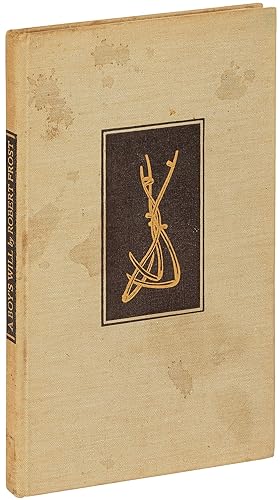
Hardcover. Condition: Very Good-. Dust Jacket Condition: No Dust Jacket. 2nd American Ed. Hardcover; Hardcover. SIGNED by author Robert Frost on first endpaper. This is the 2 nd American Edition, designated First 1934 Edition on the copyright page. Tan cloth boards with gold illustration boxed in brown on front boards. Boards are noticeably soiled, foxed and tanned. Fore edge soil. Front hinge lightly cracked. Endpapers noticeably tanned as well. Faint water mark at outer margin edges of text pages. Text completely unaffected. Thomas Nason woodcut on title page. Always carefully wrapped and shipped in cardboard boxes to protect your purchase.; B/w Illus; 8VO.
-
A Boy's Will (Signed)
Published by Collectors Reprints, NY, 1992
Seller: Michael J. Toth, Bookseller, ABAA, Springtown, PA, U.S.A.
Seller rating 5 out of 5 stars
Signed
Hard Cover. Condition: Fine. First Thus. This is a facsimile edition of this early work by Frost, published by Collector's Reprints. Tipped in is a signed sheet by Robert Frost which reads "To Fred and Peggy ? from Robert Frost, Breadloaf, 1961". The autograph is genuine and NOT a facsimile. The original edition was published by Henry Holt in 1915. 63 pp. Signed by Author.
-
A Boy's Will, inscribed by Frost with a full, untitled manuscript evolving draft of the poem that would be published in 1928's A West-Running Brook as "A Minor Bird"
Published by Henry Holt and Company, New York, 1915
Seller: Churchill Book Collector ABAA/ILAB/IOBA, San Diego, CA, U.S.A.
Association Member: ABAA ILAB IOBA
Seller rating 5 out of 5 stars
First Edition Signed
Hardcover. Robert Frost inscribed this U.S. first edition of his first published book on the front free endpaper in 10 lines with the full text of an evolving draft of an untitled poem that would be published in 1928's West-Running Brook as "A Minor Bird". The inscription reads: "I have wished a bird would fly away | And not sing by my house all day, | Have clapped my hands at him from the door | When it seemed as if I could bear no more. | The fault may partly have been in me. | The bird was not to blame for his key. | And of course there must be something wrong | In wanting to silence any song. | Robert Frost | For Elizabeth & Ten Eyck Perry". First American edition, second state is confirmed by "And" (correcting "Aind") on the final line of p.14. First state binding is confirmed by fine linen cloth. (Crane A2.1) Condition is very good. The binding is clean and tight with sharp corners, modest spine toning, dulled but still legible spine print, slight fraying to the spine ends, trivial wear to the corners, and a slight forward lean. The contents are clean with a crisp feel despite modest overall age-toning. We find no spotting or previous ownership marks. The author's signature and dedication transferred slightly to the facing front pastedown, likely the result of the book being closed swiftly upon conclusion of the inscription. The book is housed in a full brown Morocco goatskin Solander with hubbed spine, blue spine labels, and marbled paper interior.Significantly, this untitled manuscript version of "A Minor Bird" is an evolving draft, following the poem's first publication in Inlander magazine in 1926, but preceding the first volume publication in 1928. When published in Inlander, the poem read "may" instead of "must" at line 5, "I own" instead of "of course" in line 7, and in the final, 8th line "ever wanting to silence song" instead of "wanting to silence any song." This manuscript copy reflects the changes to lines 7 & 8, but does not yet incorporate the change to line 5. The difference between "must" and "may" is substantive, at both the physical and literary center of the poem. Consonant with the evolving draft, this copy was likely inscribed in November 1927, placing it squarely between the original, 1926 publication in Inlander and publication in West-Running Brook (19 November 1928). Henry Ten Eyck Perry (1890-1973), a native of Albany, New York, was a writer and professor of English. Ten Eyck Perry graduated from Yale in 1912, received his doctorate from Harvard in 1918, published a number of books, and taught English at the University of Buffalo. There he apparently interacted with at least one other major American poet; T.S. Eliot wrote in a letter of 26 December 1932 that he was to visit "Buffallo or is it Buffalo Bufallo Bufaloo to stay with Professor Henry Ten Eyck Perry." The marriage of Elizabeth Ten Eyck Perry (nee Elizabeth McAfee, 1888-1976) led to her involvement with the University of Buffalo, where she was the founding president of the Women's Club in 1946. In the University of Buffalo's archives we find reference to two visits from Robert Frost, once to deliver a lecture in 1921 and for a three day stay in 1927. This inscription was likely made in November of 1927, when he paid a visit to the University of Buffalo as "poet in residence". The school's newspaper notes that during his three-day visit he had office hours and "his time [was] at the service of students, faculty, and to a certain extent of townspeople." Iconic American poet and four-time Pulitzer Prize winner Robert Lee Frost (1874-1963) completed the manuscript of A Boy's Will in England, where it was published by David Nutt in 1913. By 1914, "Frost's reputation as a leading poet had been firmly established in England, and Henry Holt of New York had agreed to publish his books in America." This first American edition of A Boy's Will saw a first printing of 750 copies in April 1915.References: Crane A2.1; Tuten and Zubizarreta; ANB First U.S. editio.
-
A Boy's Will, signed by Frost in Albany, New York
Published by Henry Holt and Company, New York, 1934
Seller: Churchill Book Collector ABAA/ILAB/IOBA, San Diego, CA, U.S.A.
Association Member: ABAA ILAB IOBA
Seller rating 5 out of 5 stars
Signed
Hardcover. Second American Edition. This second American edition of the author's first published book was signed by the author in Albany, New York. The inscription is inked in two lines on the upper front free endpaper recto: "Robert Frost | Albany".Published in 1934, this edition was bound in tan linen cloth with a gilt-stamped brown front cover illustration panel (intertwined scythes) and brown spine title panel. The tan dust jacket features an ivy-covered fence post illustration repeated from the title page. Condition is very good in a very good dust jacket. The binding is square and tight with sharp corners and minimal soiling; two small instances on the lower spine and a few faint instances on the blank rear cover. The contents are clean, with no spotting or previous ownership marks. Age-toning is mild. The endpapers show some perimeter browning from the pastedown glue and there is a short, 1.5 inch split to the front endpapers at the lower gutter, slightly exposing the intact mull beneath and not affecting binding integrity. The dust jacket is unclipped and substantially complete, with trivial loss confined to extremities. The jacket shows spine toning and modest soiling, particularly to the lower right front face. The jacket is protected beneath a clear, removable, archival cover.Iconic American poet and four-time Pulitzer Prize winner Robert Lee Frost (1874-1963), the quintessential poetic voice of New England, was actually born in San Francisco and first published in England. When Frost was eleven, his newly widowed mother moved east to Salem, New Hampshire, to resume a teaching career. There Frost swiftly found his poetic voice, infused by New England scenes and sensibilities. Promising as both a student and writer, Frost nonetheless dropped out of both Dartmouth and Harvard, supporting himself and a young family by teaching and farming. Ironically, it was a 1912 move to England with his wife and children "the place to be poor and to write poems" that finally catalyzed his recognition as a noteworthy American poet. The manuscript of A Boy's Will was completed in England and accepted for publication by David Nutt on 1 April 1913. "Yeats pronounced the poetry "the best written in America for some time" and Frost received "two extraordinary tributes in the Nation and the Chicago Dial and a superb review in the Academy." (ANB) A convocation of critical recognition, introduction to other writers, and creative energy supported the English publication of Frost's second book, North of Boston, in 1914, after which "Frost's reputation as a leading poet had been firmly established in England, and Henry Holt of New York had agreed to publish his books in America." Accolades met his return to America at the end of 1914 and by 1917 a move to Amherst "launched him on the twofold career he would lead for the rest of his life: teaching whatever "subjects" he pleased at a congenial college and "barding around," his term for "saying" poems in a conversational performance." (ANB) By 1924 he had won the first of his eventual four Pulitzer Prizes for poetry (1931, 1937, and 1943). Frost spent the final decade and a half of his life as "the most highly esteemed American poet of the twentieth century" with a host of academic and civic honors to his credit. Two years before his death he became the first poet to read in the program of a U.S. Presidential inauguration (Kennedy, January 1961). When Holt first published Frost's first two books, Holt reversed the order of British publication, publishing the U.S. first edition of North of Boston in late March 1915, followed swiftly thereafter by the U.S. first edition of A Boy's Will in April 1915. Holt did not publish this second U.S. edition of A Boy's Will until 1934, by which time Frost's reputation had grown considerably. Fittingly, this second U.S. edition is a considerably larger and more handsomely produced book than the first edition.Reference: Crane A2.2; ANB.
-
A Boy's Will, copy "54" of the final 135 first edition copies, which were signed and numbered by Frost in 1943
Published by David Nutt, London, 1913
Seller: Churchill Book Collector ABAA/ILAB/IOBA, San Diego, CA, U.S.A.
Association Member: ABAA ILAB IOBA
Seller rating 5 out of 5 stars
First Edition Signed
Wraps. This first edition, final binding variant of Robert Frost's first published book is copy number 54 of the final 135 copies signed and numbered by the author in 1943. Despite its fragile wraps binding, this copy approaches near fine condition. The binding is square, complete, tight, and sharp-cornered, appearing unread, with no vertical spine creases. We note only trivial wear to extremities and mild soiling and toning. The contents are immaculate, with no spotting or previous ownership marks. Frost signed and numbered this copy "Robert Frost | 54" just below his printed name on the title page. First published in England in 1913, the publication history of A Boy's Will is complicated by the fact that the reported 1,000 first edition sheets saw two issues in four variant bindings, owing in part to the bankruptcy of the original publisher (Nutt) and sale of remaining first edition sheets during the subsequent liquidation. This copy is the fourth and final binding designated binding "D" one of the last 135 copies signed and numbered by Frost in 1943. When the original publisher went out of business, the remaining stock of unbound sheets passed in ownership from Simpkin Marshall (who had some bound, known as Binding "C") to Dunster House. "In 1943 Herman Cohen of the Chiswick Book Shop, New York, bought the stock of Dunster House when that shop went out of business. In the stock he found 135 copies of A Boy's Will, second issue, binding D. Cohen consulted Captain Louis Henry Cohn of The House of Books, Ltd., New York, whom he knew to be a close personal friend of Robert Frost. Captain Cohn asked Frost to sign and number the 135 copies, and Frost agreed to do so." Frost wrote of the arrangement "It's an irony of time that they should come round to me in the way they have." (Crane, A2, p.9)Louis Henry Cohn (1889-1953) was a colorful figure who merits further mention. Cohn was born in Brooklyn and grew up in Cleveland but, taking a cue from his French mother, served with the French Foreign Legion during WWI, rising to the rank of Captain, by which he was known for the rest of his life, rendering him one of the few booksellers to be addressed by rank.Iconic American poet and four-time Pulitzer Prize winner Robert Lee Frost (1874-1963), the quintessential poetic voice of New England, was actually born in San Francisco and first published in England. When Frost was eleven, his newly widowed mother moved east to Salem, New Hampshire, to resume a teaching career. There Frost swiftly found his poetic voice, infused by New England scenes and sensibilities. Promising as both a student and writer, Frost nonetheless dropped out of both Dartmouth and Harvard, supporting himself and a young family by teaching and farming. Ironically, it was a 1912 move to England with his wife and children "the place to be poor and to write poems" that finally catalyzed his recognition as a noteworthy American poet. The manuscript of A Boy's Will was completed in England and accepted for publication by David Nutt on 1 April 1913. "Yeats pronounced the poetry 'the best written in America for some time'" and Frost received "two extraordinary tributes in the Nation and the Chicago Dial and a superb review in the Academy." Accolades met his return to America at the end of 1914 and by 1917 a move to Amherst "launched him on the twofold career he would lead for the rest of his life: teaching whatever "subjects" he pleased at a congenial college and "barding around," his term for "saying" poems in a conversational performance." By 1924 he had won the first of his eventual four Pulitzer Prizes for poetry (1931, 1937, and 1943). Frost spent the final decade and a half of his life as "the most highly esteemed American poet of the twentieth century" with a host of academic and civic honors. Two years before his death he became the first poet to read in the program of a U.S. Presidential inauguration (Kennedy, January 1961). References: Crane A2; ANB First edition,
-
A Boy's Will, signed and dated by Frost in Amherst in 1927
Published by Henry Holt and Company, New York, 1915
Seller: Churchill Book Collector ABAA/ILAB/IOBA, San Diego, CA, U.S.A.
Association Member: ABAA ILAB IOBA
Seller rating 5 out of 5 stars
First Edition Signed
Hardcover. First U.S. edition, first printing. This American first edition, first printing of the author's first published book is inscribed on the front free endpaper in two lines: "Robert Frost | Amherst 1927". We need not wonder for whom Frost signed the book; the facing front pastedown features the only previous ownership mark in the book that of librarian Katherine Brand.This edition saw a first printing of 750 copies in April 1915, one month after the American edition of North of Boston (reversing the publication order of the British first editions). Condition is good plus, sound, clean, and complete, though with some honest signs of age and wear. The blue cloth binding is square and tight with sharp corners, though with a significantly dulled spine and shelf wear manifesting in slight fraying of the cloth at the spine ends and corners. Second state of the first printing is confirmed by absence of the misspelled "Aind" replaced by "And" in the last line on page 14. The contents are clean, free of spotting or soiling, though age-toned and with some transfer browning to the front free endpaper from Katherine Brand's illustrated bookplate. Katherine Edith Brand (1900-1988) became a librarian in the Manuscript Division of the Library of Congress. After graduating from Smith College in 1921 and secretarial school in Boston thereafter, she moved to Amherst in 1925, where she became secretary and research assistant to Ray Stannard Baker. Baker was the authorized biographer of President Woodrow Wilson and editor of his papers. In 1929, Brand accompanied the Wilson papers to the Library of Congress, where she remained until 1956, eventually heading the Manuscripts Section. Brand's papers, spanning diaries to unpublished writings to correspondence, are held by Smith College.Amherst, where Frost inscribed this copy, was home to Frost for the better part of two decades over a span of more than three. He joined the faculty in 1917 and received an honorary M.A. from Amherst the following year. He left Amherst in 1920, but returned in 1923 the year New Hampshire, his first book to win a Pulitzer Prize, was published for another two years. Frost again returned to Amherst College in 1926, remaining until 1938. Following Frost's death in 1963, his public service was held at Amherst's Johnson Chapel.Iconic American poet and four-time Pulitzer Prize winner Robert Lee Frost (1874-1963), the quintessential poetic voice of New England, was actually born in San Francisco and first published in England. When Frost was eleven, his newly widowed mother moved east to Salem, New Hampshire. Frost swiftly found his poetic voice, infused by New England scenes and sensibilities. Promising as both a student and writer, Frost nonetheless dropped out of both Dartmouth and Harvard, supporting himself and a young family by teaching and farming. Ironically, a 1912 move to England with his wife and children finally catalyzed his recognition as a noteworthy American poet. A Boy's Will was completed in England and accepted for publication by David Nutt in 1913. Following English publication of Frost's second book, North of Boston, in 1914, "Frost's reputation as a leading poet had been firmly established in England, and Henry Holt of New York had agreed to publish his books in America." Accolades met Frost's return to America at the end of 1914 and by 1917 a move to Amherst "launched him on the twofold career he would lead for the rest of his life: teaching whatever "subjects" he pleased at a congenial college and "barding around." Frost went on to win a still-unrivaled four Pulitzer Prizes for Poetry and spent the final decade and a half of his life as "the most highly esteemed American poet of the twentieth century." Two years before his death he became the first poet to read in the program of a U.S. Presidential inauguration (Kennedy, January 1961).References: Crane A2.1; American Archivist; ANB.
-
A Boy's Will, inscribed and dated by Frost to his friend, fellow poet, and future governor of Connecticut, Wilbert Snow
Published by Henry Holt and Company, New York, 1934
Seller: Churchill Book Collector ABAA/ILAB/IOBA, San Diego, CA, U.S.A.
Association Member: ABAA ILAB IOBA
Seller rating 5 out of 5 stars
Signed
Hardcover. Second American Edition. This author's presentation copy of the second American edition of the author's first published book was inscribed in two lines on the front free endpaper recto in 1936 to Frost's friend, fellow poet, and future governor of Connecticut Wilbert Snow: "Bill from Robert | Amherst 1936".This second American edition, published in 1934, was bound in tan linen cloth with a gilt-stamped brown front cover illustration panel (intertwined scythes) and brown spine title panel. The tan dust jacket features an ivy-covered fence post illustration repeated from the title page. Condition is very good minus in a very good dust jacket. The binding is square and tight with sharp corners, its chief defect spotting to the linen cloth, primarily proximate to the spine and at the upper edges of the covers. The contents are clean, with no spotting or previous ownership marks, just a bit of perimeter browning to the endpapers from the pastedown. The dust jacket is unclipped and substantially complete, with shallow strip loss at and adjacent to the spine head. The jacket shows mild spine toning and is protected beneath a clear, removable, archival cover.The recipient, Charles Wilbert "Bill" Snow (1884-1977) was, at turns, an Eskimo teacher and reindeer agent in Alaska, a U.S. Army artillery officer, a professor at various prestigious universities, and author of several volumes of poetry. Snow reportedly met and befriended Frost in March 1925, when he was asked to speak at a public dinner for Frost's 50th birthday. In 1944, eight years after Frost inscribed this volume for him, Snow entered politics. In 1946, Snow was Lieutenant Governor of Connecticut and the Democratic Party's candidate for Governor. He lost the race but became governor anyway albeit for just 13 days; the outgoing Governor resigned early to take a seat in the U.S. Senate, leaving Snow to fill in for the short interval before his victorious opponent took office. By the time he was approaching the age of 40 in 1912, not-yet-iconic American poet Robert Lee Frost (1874-1963) had dropped out of Dartmouth and Harvard, tried farming and teaching, and decided to move to England with his wife and children "the place to be poor and to write poems". That finally catalyzed his recognition. The manuscript of A Boy's Will was completed in England and accepted for publication by David Nutt on 1 April 1913. A convocation of critical recognition, introduction to other writers, and creative energy supported the English publication of Frost's second book, North of Boston, in 1914, after which "Frost's reputation as a leading poet had been firmly established in England, and Henry Holt of New York had agreed to publish his books in America." Accolades met his return to America at the end of 1914 and by 1917 a move to Amherst where this copy was inscribed "launched him on the twofold career he would lead for the rest of his life: teaching whatever "subjects" he pleased at a congenial college and "barding around," his term for "saying" poems in a conversational performance." By 1924 he had won the first of his eventual four Pulitzer Prizes for poetry (1931, 1937, and 1943). Frost spent the final decade and a half of his life as "the most highly esteemed American poet of the twentieth century" with a host of academic and civic honors. Two years before his death he became the first poet to read in the program of a U.S. Presidential inauguration (Kennedy, January 1961). When publishing Frost's first two books, Holt reversed the order of British publication, publishing the U.S. first edition of North of Boston in late March 1915, followed swiftly thereafter by the U.S. first edition of A Boy's Will in April 1915. Holt did not publish this second U.S. edition of A Boy's Will until 1934, by which time Frost's reputation had grown considerably. Fittingly, this second U.S. edition is a considerably larger and more handsomely produced book than the first edition.References: ANB; NGA; Crane A2.2.
-
A BOY'S WILL. Inscribed by Frost
Published by David Nutt, London, 1913
Seller: TBCL The Book Collector's Library, Montreal, QC, Canada
Association Member: IOBA
Seller rating 5 out of 5 stars
First Edition Signed
Condition: Near Fine. 1st Edition. 1st Edition. Presentation Copy of the First Edition of the author's first book, preceded only by the legendary Twilight [1894] of which only one copy is known. Neatly and succinctly inscribed in blue-black fountain pen on the half-title to friend abd admirer George Crosbie. "For Crosbie / from / Frost". Most of Crosbie's Frost collection was given to Blair Academy [new Jersey] in 1988. A fine copy in the original cream linen wrappers, a bit dusty but otherwise quite nice. Binding D [with 4-petaled flowers]. 1 of only 686 copies of 1000 printed, with "Printed in Great Britain" rubber-stamped on the copyright page. Clymer and Green p. 20; Crane A2. Signed.
-

First American edition of Frost's first published work. Octavo, original publisher's cloth, gilt titles to the spine and front panel. Boldly signed by the poet on the title page. In near fine condition. Frost's first commercially published book of poems, A Boy's Will was first published in 1913 by David Nutt in London, with a dedication to Frost's wife, Elinor. Its first American edition would come two years later, in 1915, through Henry Holt and Company. Like much of Frost's work, the poems in A Boy's Will thematically associate with rural life, nature, philosophy, and individuality, while also alluding to earlier poets including Emily Dickinson, Thomas Hardy, William Shakespeare, and William Wordsworth.â Despite the first section of poems having a theme of retreating from society, then, Frost does not retreat from his literary precursors and, instead, tries to find his place among them.
-

First American edition of Frost's first published work. Octavo, original publisher's cloth, gilt title to the front panel. Boldly signed and dated by the poet on front free endpaper, "Robert Frost Wesleyan December 1926." Ownership signature on front pastedown of Richard Brooks in pencil. In very good condition. A charming example. Frost's first commercially published book of poems, A Boy's Will was first published in 1913 by David Nutt in London, with a dedication to Frost's wife, Elinor. Its first American edition would come two years later, in 1915, through Henry Holt and Company. Like much of Frost's work, the poems in A Boy's Will thematically associate with rural life, nature, philosophy, and individuality, while also alluding to earlier poets including Emily Dickinson, Thomas Hardy, William Shakespeare, and William Wordsworth.â Despite the first section of poems having a theme of retreating from society, then, Frost does not retreat from his literary precursors and, instead, tries to find his place among them.
-
A Boy's Will, hand-numbered "62" and signed by Frost, one the final 135 first edition copies, which were signed and numbered by Frost in 1943
Published by David Nutt, London, 1913
Seller: Churchill Book Collector ABAA/ILAB/IOBA, San Diego, CA, U.S.A.
Association Member: ABAA ILAB IOBA
Seller rating 5 out of 5 stars
First Edition Signed
Wraps. This first edition, final binding variant of Robert Frost's first published book is copy number 62 of the 135 copies signed and numbered by the author in 1943. Despite its fragile wraps binding, this copy approaches very good condition. The binding is square, complete, firmly attached, and appears unread, with no vertical spine creases. There is light wear to extremities, a .5 inch (1.3 cm) closed tear to the lower front joint, and the wraps show minor soiling and toning. The contents are clean, mildly age-toned, though free of spotting, soiling, or previous ownership marks. Frost signed and numbered this copy "Robert Frost | 62" just below his printed name on the title page. First published in England in 1913, the publication history of A Boy's Will is complicated by the fact that the reported 1,000 first edition sheets saw two issues in four variant bindings, owing in part to the bankruptcy of the original publisher (Nutt) and sale of remaining first edition sheets during the subsequent liquidation. This copy is the fourth and final binding designated binding "D" one of the last 135 copies signed and numbered by Frost in 1943. When the original publisher went out of business, the remaining stock of unbound sheets passed in ownership from Simpkin Marshall (who had some bound, known as Binding "C") to Dunster House. "In 1943 Herman Cohen of the Chiswick Book Shop, New York, bought the stock of Dunster House when that shop went out of business. In the stock he found 135 copies of A Boy's Will, second issue, binding D. Cohen consulted Captain Louis Henry Cohn of The House of Books, Ltd., New York, whom he knew to be a close personal friend of Robert Frost. Captain Cohn asked Frost to sign and number the 135 copies, and Frost agreed to do so." Frost wrote of the arrangement "It's an irony of time that they should come round to me in the way they have." (Crane, A2, p.9)Iconic American poet and four-time Pulitzer Prize winner Robert Lee Frost (1874-1963), the quintessential poetic voice of New England, was actually born in San Francisco and first published in England. When Frost was eleven, his newly widowed mother moved east to Salem, New Hampshire, to resume a teaching career. There Frost swiftly found his poetic voice, infused by New England scenes and sensibilities. Promising as both a student and writer, Frost nonetheless dropped out of both Dartmouth and Harvard, supporting himself and a young family by teaching and farming. Ironically, it was a 1912 move to England with his wife and children "the place to be poor and to write poems" that finally catalyzed his recognition as a noteworthy American poet. The manuscript of A Boy's Will was completed in England and accepted for publication by David Nutt on 1 April 1913. "Yeats pronounced the poetry 'the best written in America for some time'" and Frost received "two extraordinary tributes in the Nation and the Chicago Dial and a superb review in the Academy." Accolades met his return to America at the end of 1914 and by 1917 a move to Amherst "launched him on the twofold career he would lead for the rest of his life: teaching whatever "subjects" he pleased at a congenial college and "barding around," his term for "saying" poems in a conversational performance." By 1924 he had won the first of his eventual four Pulitzer Prizes for poetry (1931, 1937, and 1943). Frost spent the final decade and a half of his life as "the most highly esteemed American poet of the twentieth century" with a host of academic and civic honors to his credit. Two years before his death he became the first poet to read in the program of a U.S. Presidential inauguration (Kennedy, January 1961). References: Crane A2, American National Biography First edition, only printing, final binding variant.
-
A Boy's Will (signed)
Published by Henry Holt, New York, 1934
Seller: MARK POST, BOOKSELLER, San Francisco, CA, U.S.A.
Seller rating 5 out of 5 stars
First Edition Signed
Hard Cover. Second American Edition, first printing. Signed "Robert Frist - Amherst" on the front endpaper. BOOK IS VERY GOOD- WITH SMALL SIGNS OF LABEL OR TAPE REMOVAL ON SPINE AND ENDPAPERS. OTHERWISE BOARDS AND TEXT CLEAN AND TIGHT. UNCOMMON DUST JACKET IS VERY GOOD WITH $1.75 PRICE, SLIGHT EDGE WEAR AND TWO SMALL CHIPS. PANELS VERY CLEAN. OWNER NAME WITH 1937 DATE.
-
A Boy's Will
Published by Henry Holt and Co, 1915
Seller: Bookbid, Beverly Hills, CA, U.S.A.
Seller rating 4 out of 5 stars

Signed
hardcover. Condition: very good. 2nd state. First edition, 2nd state ("And" on p.14 corrected, "which-hazel" on p.62 uncorrected). Book very good, very minor wear, some fading to covers, tear to upper corner of p. 55.
-
A Boy's Will (Signed First Edition)
Published by Henry Holt and Company, New York, 1915
Seller: Brenner's Collectable Books ABAA, IOBA, Manasquan, NJ, U.S.A.
Association Member: ABAA ILAB IOBA
Seller rating 5 out of 5 stars
Signed
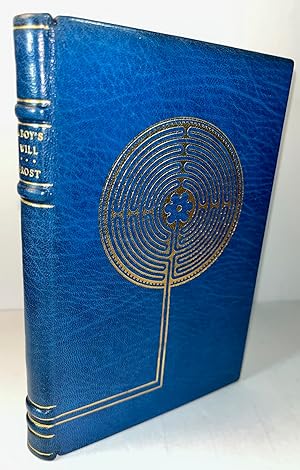
Hardcover. Condition: Very Fine. First U.S. Edition. 8vo., 63pp. Beautiful First American Edition of the iconic poet's first published book. This is the second printing with the spelling correction made on page 14. Rebound in modern blue morocco with four raised spine bands and gilt titles. Abstract spiral design stamped in gilt on both front and rear boards. New marbled end-papers added. Pages trimmed and gilt edges added, A stunningly beautiful production from the Harcourt Bindery of Boston. Square and tight with no discernible wear. A couple of scattered spot to interior pages but trivial. Address label removed from ffep leaving a faint ghost. Bookseller ticket at the bottom of the ffep. Signed and dated on the ffep by Frost from Franconia (NH) in October, 1916. A gorgeous collectable copy. Signed by Author(s).
-
A Boy's Will
Published by David Nutt, London, 1913
Seller: Between the Covers-Rare Books, Inc. ABAA, Gloucester City, NJ, U.S.A.
Association Member: ABAA ESA ILAB IOBA
Seller rating 5 out of 5 stars
First Edition Signed
Softcover. Condition: Fine. First edition, signed issue, second issue, binding D. 12mo. 52pp. Cream-colored linen wrappers printed in black. Frederick Baldwin Adams, Jr.'s copy, with his pencil notation about this printing on the front flyleaf, housed in an envelope, in a custom stiff paper and card chemise, with Adams' Rockwell Kent-designed bookplate inside the front cover of the chemise. This is copy number 123 of 135 numbered copies Signed and numbered by Robert Frost in 1923 on the half-title page. According to *Crane* A2 note: binding D (with rubberstamp "Printed in Great Britain" on verso of title page, as distributed by Dunster House, Cambridge, Mass, 1923. See Crane, p. 7-9, for the complicated publishing history of this title). Adams was an important collector, and friend of Robert Frost.
-
Boy's Will
Published by Henry Holt and Company, New York, 1915
Seller: Heritage Book Shop, ABAA, Beverly Hills, CA, U.S.A.
Seller rating 5 out of 5 stars
First Edition Signed
First Edition. Full Description: FROST, Robert. A Boy's Will. New York: Henry Holt and Company, 1915. First American edition, first issue of Frost's first published book. With "Aind" on page 14. An inscribed partial poem by Frost on front free endpaper reading "With the lyrical I should like to/ have for lyrical/ Robert Frost". Also, on blank page 10, there is the entirety of Frost's poem "Fragmentary Blue" in his hand. It is signed "R.F." The manuscript is very close to the published version of the poem with the exceptions of just 3 word differences. This is an exciting glimpse into an early version of this poem as it was not published until July 1920 with a group of poems in Harper's Magazine. In 1923 it was first published in book form as part of Frost's Pulitzer Prize winning book "New Hampshire." Small octavo (7 1/2 x 5 1/4 inches; 190 x 130 mm). ix, [1, blank], [11]-63, [1] pp. Original blue fine linen cloth decoratively stamped and lettered in gilt on front cover and spine. Top edge stained blue, others uncut. Spine and board edges lightly sunned. Some very minor rubbing to head and tail of spine. Housed in a blue cloth slipcase. Overall, fine. A Boy's Will is commonly regarded as Frost's first book, since only one copy exists of his true first, Twilight (two were printed, one of which was destroyed by Frost himself). "Frost once claimed that he wrote 'Fragmentary Blue' to tease his friends who wanted him to stop writing lyrics (Cramer). The poem first appeared in the July 1920 issue of Harper's Magazine and was later included as the first poem in the "Grace Notes" section of New Hampshire." (Critical Companion to Robert Frost: A Literary Reference to His Life and Work By Deirdre J. Fagan). Crane A2.1. HBS 68873. $6,000. Signed.
-
A Boy's Will, [INSCRIBED WITH POEM, PAGES UNCUT]
Published by Henry Holt & Co., 1915
First Edition Signed
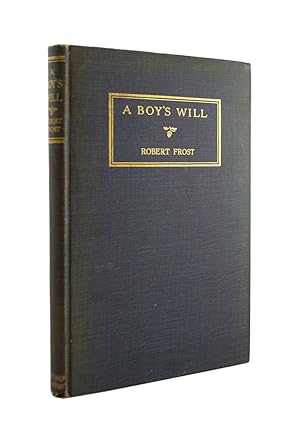
Hardcover. Condition: Good. No Jacket. 1st Edition. Condition: VG-. 64 pp. This is the 1st edition, 2nd state, of Frost's first published book of poetry, with the "Aind" on the final line on pg. 14 corrected, and "wich-hazel" on p. 62 uncorrected. An example of great significance for the serious Frost collector, inasmuch as the book is incribed to Frost's student Don H. Smith, with the final line of Frost's poem "The Strong Are Saying Nothing," published in "A Further Range" in 1936: "The Strong are saying nothing until they see/Robert Frost/To Don H. Smith" On the one hand, the book has never been read in full, as pgs. 21-24, 25-28, and 37-40, have never been cut. On the other, there is some staining and color loss to the spine, the covers are lightly soiled, there is a slight cover offset, very light corner wear, and the title pg. through pg. 14 is detached. An interesting copy with a rare poetic inscription. In uncertain economic times, what better way to invest your money than in artifacts of lasting value you can hold in hand and enjoy? Inscribed by Author(s).
-
A Boy's Will
Published by Henry Holt and Compay, New York, 1934
Seller: Between the Covers-Rare Books, Inc. ABAA, Gloucester City, NJ, U.S.A.
Association Member: ABAA ESA ILAB IOBA
Seller rating 5 out of 5 stars
Signed
Hardcover. Condition: Very Good. Second American edition, with revised text. Illustrated from woodcuts by Thomas W. Nason. Recipient's pictorial bookplate on a front blank. Boards with some light staining, second half of the text block with a stain at the bottom corner not affecting the interior, endpapers with light offsetting and lower hinge with a very short tear, very good and sound, lacking the dust jacket. Inscribed by Frost with 12 lines of verse in his hand, being the first three stanzas of "A Prayer in Spring" (which appears in this collection in four stanzas), with seven textual variants in punctuation. Signed by Frost at the end of the poem and Inscribed below: "For Carol Kendall / Hanover May 1938." Crane A2.2.
-
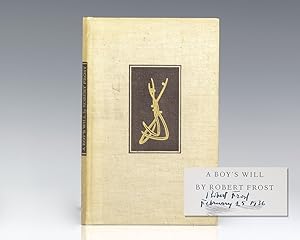
Second American edition of Frost's first published work. Octavo, original beige linen cloth, engraved title page. Signed and dated by the poet on the title page, "Robert Frost February 25 1936." In very good condition. Small ownership name. Frost's first commercially published book of poems, A Boy's Will was first published in 1913 by David Nutt in London, with a dedication to Frost's wife, Elinor. Its first American edition would come two years later, in 1915, through Henry Holt and Company. Like much of Frost's work, the poems in A Boy's Will thematically associate with rural life, nature, philosophy, and individuality, while also alluding to earlier poets including Emily Dickinson, Thomas Hardy, William Shakespeare, and William Wordsworth.â Despite the first section of poems having a theme of retreating from society, then, Frost does not retreat from his literary precursors and, instead, tries to find his place among them.
-
A Boy's Will, inscribed and dated by Robert Frost in April 1935
Published by Henry Holt and Company, New York, 1934
Seller: Churchill Book Collector ABAA/ILAB/IOBA, San Diego, CA, U.S.A.
Association Member: ABAA ILAB IOBA
Seller rating 5 out of 5 stars
Signed
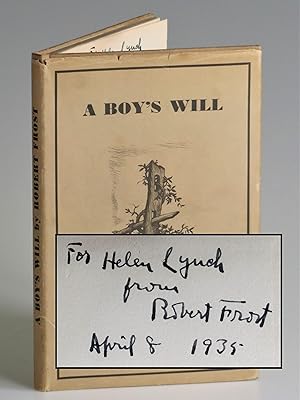
Hardcover. Second American Edition. This second American edition of the author's first published book is inscribed by Frost, apparently to his American publisher's secretary, in four lines on the front free endpaper recto: "For Helen Lynch | from | Robert Frost | April 8 1935".This second American edition, published in 1934, was bound in tan linen cloth with a gilt-stamped brown front cover illustration panel (intertwined scythes) and brown spine title panel. The tan dust jacket features an ivy-covered fence post illustration repeated from the title page. The book is in fine condition, the jacket better than very good. The binding is square, clean, and tight with sharp corners and no discernible wear. The contents are bright and clean. The sole previous ownership mark is the signature of the recipient "Helen D. Lynch" inked on the upper front pastedown opposite the front free endpaper Frost inscribed to her. We are informed, but unable to definitively substantiate, that Helen Lynch worked at the time for Henry Holt and Company. The unclipped dust jacket is quite presentable, showing only fractional loss at the spine head and corners and light general wear to extremities, including a 1.5 inch (3.8 cm) closed tear at the upper rear face. The dust jacket is protected beneath a clear, removable, archival cover. Iconic American poet and four-time Pulitzer Prize winner Robert Lee Frost (1874-1963), the quintessential poetic voice of New England, was actually born in San Francisco and first published in England. When Frost was eleven, his newly widowed mother moved east to Salem, New Hampshire, to resume a teaching career. There Frost swiftly found his poetic voice, infused by New England scenes and sensibilities. Promising as both a student and writer, Frost nonetheless dropped out of both Dartmouth and Harvard, supporting himself and a young family by teaching and farming. Ironically, it was a 1912 move to England with his wife and children "the place to be poor and to write poems" that finally catalyzed his recognition as a noteworthy American poet. The manuscript of A Boy's Will was completed in England and accepted for publication by David Nutt on 1 April 1913. "Yeats pronounced the poetry "the best written in America for some time" and Frost received "two extraordinary tributes in the Nation and the Chicago Dial and a superb review in the Academy." (ANB) A convocation of critical recognition, introduction to other writers, and creative energy supported the English publication of Frost's second book, North of Boston, in 1914, after which "Frost's reputation as a leading poet had been firmly established in England, and Henry Holt of New York had agreed to publish his books in America." Accolades met his return to America at the end of 1914 and by 1917 a move to Amherst "launched him on the twofold career he would lead for the rest of his life: teaching whatever "subjects" he pleased at a congenial college and "barding around," his term for "saying" poems in a conversational performance." (ANB) By 1924 he had won the first of his eventual four Pulitzer Prizes for poetry (1931, 1937, and 1943). Frost spent the final decade and a half of his life as "the most highly esteemed American poet of the twentieth century" with a host of academic and civic honors to his credit. Two years before his death he became the first poet to read in the program of a U.S. Presidential inauguration (Kennedy, January 1961). When Holt first published Frost's first two books, Holt reversed the order of British publication, publishing the U.S. first edition of North of Boston in late March 1915, followed swiftly thereafter by the much smaller U.S. first edition of A Boy's Will in April 1915. Holt did not publish this second U.S. edition of A Boy's Will until 1934, by which time Frost's reputation had grown considerably. Fittingly, this second U.S. edition is a considerably larger and more handsomely produced book than the first edition.Reference: Crane A2.2.
-
A Boy's Will
Published by David Nutt, London, 1913
Seller: Moroccobound Fine Books, IOBA, Lewis Center, OH, U.S.A.
Association Member: IOBA
Seller rating 5 out of 5 stars
First Edition Signed
Soft cover. Condition: Fine. 1st Edition. First edition, second Issue, Binding D, one of 135 copies, signed and numbered by Frost. 50 pp. Softcover, bound in wraps with four-petaled flower motif on the front cover. Unmarked. [Of-C3-S4]. Signed by Author(s).
-
A Boy's Will, the first binding state of the first edition, signed by Frost
Published by David Nutt, London, 1913
Seller: Churchill Book Collector ABAA/ILAB/IOBA, San Diego, CA, U.S.A.
Association Member: ABAA ILAB IOBA
Seller rating 5 out of 5 stars
First Edition Signed
Hardcover. First edition. This is an elusive prize - the first edition, first printing, first binding state of Robert Frost's first published book, signed by the author.First published in England in 1913, the publication history of A Boy's Will is complicated by the fact that the reported 1,000 first edition sheets saw two issues in four variant bindings. These many iterations were bound and sold over a period of three decades, owing in part to the bankruptcy of the original publisher (Nutt) and sale of remaining first edition sheets during the subsequent liquidation. It is estimated that "no more than 350 copies" and plausibly as few as 284 were issued thus, in the publisher's original shiny bronzed brown pebbled cloth "used to bind the first books that appeared." Known to Frost bibliographers and collectors as "binding A", these copies "were bound by the Leighton-Straker Bookbinding Co. before 1 April 1913." Rendering this copy of "binding A" even more compelling than scarcity warrants is Frost's signature "Robert Frost" on the upper right of the half-title page. Ink, nib, and hand all indicate that Frost's signature is contemporaneous.Condition of the book is good plus sound, complete, and unrestored, though showing some befittingly venerable signs of age. The bronzed brown cloth binding is tight, clean, and retains its hue and sheen on the majority of both covers. The spine is sunned, as are the inner edges of both boards adjacent to the hinges. There is lesser toning to a strip of the upper rear cover and the fore edges. The front cover gilt print and decoration remains bright. The cloth shows minor shelf wear to extremities, most notably some fraying at the spine ends. The first issue contents are marked only by the author; we find no previous ownership marks. Spotting is intermittent and light within, more evident on the untrimmed page edges. The signature connecting the half title and title page leaves remains uncut.Iconic American poet and four-time Pulitzer Prize winner Robert Lee Frost (1874-1963), the quintessential poetic voice of New England, was actually born in San Francisco and first published in England. When Frost was eleven, his newly widowed mother moved east to New Hampshire. There Frost swiftly found his poetic voice, infused by New England scenes and sensibilities. Promising as both a student and writer, Frost nonetheless dropped out of both Dartmouth and Harvard, supporting himself and a young family by teaching and farming. Ironically, a 1912 move to England with his wife and children "the place to be poor and to write poems" catalyzed Frost's recognition as a noteworthy American poet. The manuscript of A Boy's Will was completed in England and published by David Nutt in April 1913. "Yeats pronounced the poetry "the best written in America for some time" and Frost received "two extraordinary tributes in the Nation and the Chicago Dial and a superb review in the Academy."" (ANB) A convocation of critical recognition, introduction to other writers, and creative energy supported the English publication of Frost's second book, North of Boston, in 1914, after which "Frost's reputation as a leading poet had been firmly established in England, and Henry Holt of New York had agreed to publish his books in America." Accolades met Frost's return to America at the end of 1914. By 1917 a move to Amherst "launched him on the twofold career he would lead for the rest of his life: teaching whatever "subjects" he pleased at a congenial college and "barding around," his term for "saying" poems in a conversational performance." (ANB) In 1924 he won the first of an eventual four Pulitzer Prizes for poetry (1931, 1937, and 1943). Frost spent his final decades as "the most highly esteemed American poet of the twentieth century" with a host of academic and civic honors to his credit. Two years before his death he became the first poet to read in the program of a U.S. Presidential inauguration (Kennedy, January 1961). Reference: Crane A2.
-
A Boy's Will.
Published by David Nutt, 1913
Seller: Compass Rose Books, ABAA-ILAB, Kensington, CA, U.S.A.
Seller rating 5 out of 5 stars
First Edition Signed
Soft cover. Condition: Fine. 1st Edition. A Fine copy in dull white printed wrappers, with stamp "printed in Great Britain" on the copyright page. Binding D, with four-petaled flower motif on the front cover. SIGNED by Frost under his name on the title page and numbered "99". 50pp. A clean unworn copy. Q14889. Signed by Author(s).
-
A BOY'S WILL
Published by David Nutt, London, 1913
Seller: Charles Agvent, est. 1987, ABAA, ILAB, Fleetwood, PA, U.S.A.
Seller rating 5 out of 5 stars
First Edition Signed
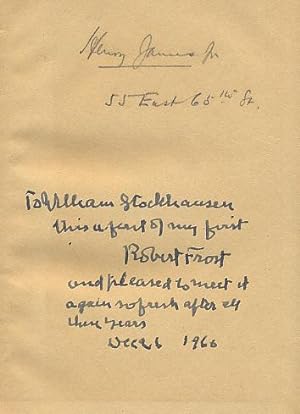
Hardcover. First Edition. Original bronzed brown pebbled cloth, gilt-lettered on the front cover. Crane A2: First Issue, Binding A of Frost's first book. Less than 350 copies of the first issue in the first binding were issued, from a total edition of 1,000. INSCRIBED and SIGNED by the author on the front endpaper: "To William Stockhausen/this a first of my first/Robert Frost/and pleased to meet it/again so fresh after all/these years/Dec 26 1960." In addition on the front endpaper is the pencil ownership signature of Henry James, Jr. with a 55 East 65th St. address. According to the SOTHEBY PARKE BERNET catalog of THE WILLIAM E. STOCKHAUSEN COLLECTION, 1974, "this copy is most certainly from the library of Henry James the novelist. The owner name is in the hand of his nephew Henry James but appears to be an identification of source. The nephew inherited a large part of the novelist's library on the author's death in 1916. He never used either Jr. or Henry James II but his uncle did use the latter. Since this is evidently not his own ownership inscription it appears to be more than likely that he wrote it to identify those books which had come from his uncle's library." A copy of NORTH OF BOSTON also inscribed to Stockhausen had a similar ownership signature. This copy of A BOY'S WILL was last on the market in 1977, and a letter from the well-known bookseller to the buyer is laid in. Housed in a cloth chemise and handsome brown morocco-backed cloth slipcase. A spectacular copy with an exceptional association.



![Seller image for A Boy's Will, [INSCRIBED WITH POEM, PAGES UNCUT] for sale by Aesthete's Eye Books](https://pictures.abebooks.com/inventory/md/md31404284936.jpg)