

Order Total (1 Item Items):
Shipping Destination:

Buchanan James, Signed (18 results)
Skip to main search results
Search filters
Product Type
- All Product Types
- Books (15)
- Magazines & Periodicals (No further results match this refinement)
- Comics (No further results match this refinement)
- Sheet Music (No further results match this refinement)
- Art, Prints & Posters (No further results match this refinement)
- Photographs (No further results match this refinement)
- Maps (No further results match this refinement)
- Manuscripts & Paper Collectibles (3)
Condition Learn more
- New (No further results match this refinement)
- As New, Fine or Near Fine (5)
- Very Good or Good (3)
- Fair or Poor (No further results match this refinement)
- As Described (10)
Binding
Collectible Attributes
Language (2)
Free Shipping
Seller Location
Seller Rating
-

Hard Cover. Condition: Fine. Dust Jacket Condition: Fine. 1st Edition. SIGNED (inscribed) by author on title page. $26.95 price present on DJ flap. Size: 8vo - over 7¾" - 9¾" tall. Signed by Author.
-

Murder and Obsesion - SIGNED by Elizabeth George, Joyce Carol Oates, Anne Perry Edna Buchanan, James W. Hall, Dennis Lehane, Michael Malone
Published by Delacorte, New York, 1999
First Edition Signed
Hardcover. Condition: Near Fine. Dust Jacket Condition: Fine. First Edition - First Printing. Bumped at the bottom corners, else a fine copy, apparently unread, in a fine dust jacket, now in a clear removable protective cover. Bubble wrapped and shipped in a well padded, sturdy box. SIGNED by Joyce Carol Oates, Elizabeth George and Anne Perry on the title page, and by Edna Buchanan, James W. Hall, Dennis Lehane, and Michael Malone at their entries. Obsession at its most insidious. Size: 8vo - over 7¾" - 9¾" tall. Signed by Authors. Book.
-
100 Years on the James at Buchanan, Virginia : James Evans Masonic Lodge #72, A.F. & A. M. 1882-1982
Published by Valley Printers, 1985
Seller: Novel Ideas Books & Gifts, Decatur, IL, U.S.A.
Seller rating 5 out of 5 stars

Signed
Hardcover. Condition: Fine. Copy #6 of 500 limited and signed. ; 8vo 8" - 9" tall; 319 pages; Signed by Author.
-
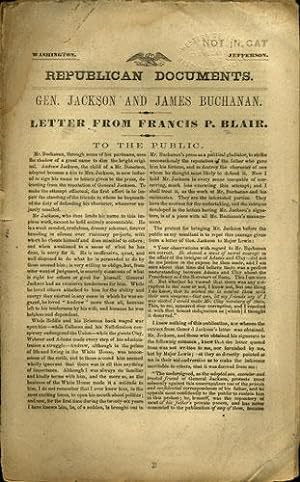
Republican Documents. Gen. Jackson and James Buchanan. Letter from Francis P. Blair. To the Public
Language: English
Published by [Silver Spring, Md.], 1856
Seller: Kaaterskill Books, ABAA/ILAB, East Jewett, NY, U.S.A.
Association Member: ABAA ILAB IOBA
Seller rating 5 out of 5 stars
First Edition Signed
Self wrappers. First edition. 15 pp. Double col. 8vo. Signed and dated in print: Silver Spring, August 15, 1856 (earlier than the other letter with a similar title: "Republican Documents. Letter from Francis P. Blair. To my neighbors." Blair, instrumental in forming the new Republican Party and influential in securing the nomination of John C. Fremont, here wages a vicious attack on Buchanan and his allies for using a relative of Andrew Jackson to attack him. Not in Sabin, Dumond, LCP. OCLC 7458101. Disbound, dampstain along top corner, institutional blind stamp and rubber stamp on first page, lower forecorner of last leaf with a small chip. A good copy.
-
The Religious Convictions and Character of James Buchanan Fifteenth President of the United States - A Citizen of Lancaster County - A Member of the Presbyterian Church
Language: English
Published by Intelligencer Print, Lancaster, PA, 1912
Signed
Stapled. Condition: Fine. No Jacket. W. U. Hensel signed on the front cover. Black lettering on tan wraps. 8vo, 34pp. Signed by Author(s).
-
Tobacco Tycoon: The Story of James Buchanan Duke
Published by Random House, (1942), New York, 1942
First Edition Signed
Hardcover. Condition: Very Good. No Jacket. 1st Edition. 337 pages including index. 8vo. Stated First Printing. Frontispiece portrait. Illustrated. The book itself is not signed, but a note from the author to the original owner of the book is signed and attached to the front free end paper. The front paste down has the name of the original owner of the book with additional related information. No dust jacket. Book is square, tight, and clean. A scarce copy. Signed by Author(s).
-
[Kansas land grant; Abolition; Bleeding Kansas; John Brown] Kansas Land Deed on Parchment for Samuel Gridley Howe, signed by Secretary Albright for President James Buchanan, October 1, 1858
Language: English
Published by Washington, 1858
Manuscript / Paper Collectible Signed
Condition: Good. Printed document on parchment, details filled in by hand in ink, sealed 23x29,5 cm. This fascinating document brings together two great antagonists of antebellum U.S. politics on one vellum sheet. Samuel Gridley Howe was a New England medical doctor, politician and philanthropist, who in his Byronesque youth had joined the Greek independence fight and founded the Perkins School for the Blind in Watertown after his return. During the "Bleeding Kansas" conflicts of the 1850s, he was an important actor in the attempts of New England abolitionists to bring settlers opposed to slavery to Kansas, in order to tip the balance of states towards abolition. Most famously, he was one of the "secret six" who financed John Brown's attempts to stir a slave rebellion. After the ill-fated attempt at Harper's Ferry, which led to John Brown's arrest and hanging, he left the US for Canada for a few weeks so that he could not be forced to appear in a Southern court as a witness. Later, he became a member of the Freedmen's Inquiry Commission. His wife, Julia Ward Howe, who also knew Brown, wrote the Battle Hymn of the Republic based on the soldier's song "John Brown's Body". In his "Letters and Journals" (Vol. 2, page 433), their daughter mentions that Howe considered relocating to Kansas in the late 1850s, but writes: "I doubt that my father ever thought seriously about moving to Kansas; but he bought several parcels of land there, and maintained to the end of his life a keen interest in all the affairs of the Territory." This particular purchase of land came one year before Brown's raid at Harper's Ferry. It is for "a tract of land" of 150 acres in Ozawkie, originally purchased in 1854 by David M. Martin of Atchison County, Kansas Territory, from "the Delaware Tribe of Indians". The deed was signed by Secretary Albright for James Buchanan, the pro-slavery President whose political enemy Howe remained. A fascinating antebellum document linking two major protagonists of both sides of the leadup to the civil war. In worn condition: vertical creases probably due to rolling, ink faded, but legible apart from the signature of the Recorder of the General Land Office. Signed by Author(s).
-
JAMES M. BUCHANAN (James Buchanan,1919-2013) Professor Dr., amerikanischer Wirtschaftswissenschaftler/Nobelpreis 86
Manuscript / Paper Collectible Signed
GROSSES FOTO, EIGENHÄNDIG SIGNIERT (GF,8°) (auch vorhanden : EIGH. MANUSKRIPTSEITE (1 S. 4° in schwarzem Stift, eng beschrieben, unvollständig), übertitelt "Democracy and Constitutional Order", am Kopf eigenhändig signiert, datiert 04.25.89, Euro 145,-).
-

AUTOGRAPH LETTER SIGNED by the future president JAMES BUCHANAN, as Secretary of State to Secretary of the Navy JOHN Y. MASON, regarding the misconduct of Midshipman James B. Yates.
Published by Washington, April 27, 1848., 1848
Seller: Blue Mountain Books & Manuscripts, Ltd., Cadyville, NY, U.S.A.
Seller rating 5 out of 5 stars
Signed
Condition: Fine. - Over 70 words penned on 10 inch high by 8 inch wide embossed Satis paper. Writing as Secretary of State with the annotation "Private" at the head of the letter James Buchanan responds to Secretary of the Navy John Y. Mason regarding the case of Midshipman James B. Yates who has been neglecting his studies despite frequent admonishment and light discipline. "I have not one word to say in his defence nor any request to make. I would merely suggest, that should you determine to dismiss him, you would suffer him to remain until I could write his father, Dr. Yates, so that he might come on & take him home, if he thought proper." Signed in full "James Buchanan". Folded vertically and horizontally for mailing, else near fine. Prior to being elected as President of the United States, James Buchanan (1791-1868) had served as a U.S. Congressman, U.S. Senator, and minister to Russia, subsequently being appointed as President James K. Polk's Secretary of State. As president, Buchanan supported the South and Pro-Slavery positions, intervening to assure that the Supreme Court would rule in favor of slavery in the Dred Scott v. Sandford case. He also supported Southern attempts to have the Kansas Territory's entry into the Union as a Slave State. Buchanan, the only U.S. President to remain a bachelor, had a close relationship with William Rufus De Vane King, sparking many speculations in later days.An attorney, judge and politician from Virginia, John Young Mason (1799-1859) served as a U.S. Congressman and subsequently as a United States District Judge for the Eastern District of Virginia. He served as Secretary of the Navy from 1846 to 1849, and subsequently as Attorney General of the United States and then as U.S. Minister to France.The young Midshipman James B. Yates, failed to respond to subtle pressures from George P. Upshur, the superintendent of the U.S. Naval Academy, who had determined that the young Midshipman had been neglecting his studies and failed to turn up for half a dozen recitations claiming he was unprepared. Events came to a head when Yates left the navy yard without permission on January 24th, 1848, and disappeared for the day only to clandestinely return late that night. Upshur suspended him from everything but his academic classes and informed the Secretary of the Navy, reporting that sadly Yates was "learning nothing, literally nothing valuable at this School" and expected him to fail. Upshur considered him "altogether unfit for the navy.".
-
The Collected Works of James M. Buchanan.
Published by Liberty Fund 1999-2002, Indianapolis, 1999
First Edition Signed
First editions of each of volume that comprise the collected works of Nobel Prize-winning economist James M. Buchanan's papers. Octavo, original half cloth, 20 volumes. Eighteen of the twenty volumes are association copies warmly inscribed in the year of publication by James Buchanan to his assistant of 46 years, Betty H. Tillman, the second person Buchanan phoned on October 16, 1986 (after his wife, Ann) when he learned he had been awarded the Nobel Prize in Economics (see Buchanan, 'Notes on Nobelity,' in Better than Plowing: And Other Personal Essays, University of Chicago Press 1992). Only Volumes 11 and 20 are unsigned. Each are in very good to near fine condition; dust jackets were not issued for these volumes. James M. Buchanan is responsible for the rebirth of political economics as a scholarly pursuit (Boettke, 1998). Buchanan has done more than most to introduce ethics, legal, political, and social thinking into economics. Consequently, he maintains that public policy cannot be considered in terms of distribution, but instead should question rules that engender a pattern of exchange and distribution (Swedberg, 1990). Buchanan distinguishes between politics and policy. Politics is about the rules of the game, while policy is focused on strategies that players adopt within a given set of rules. The Economic Journal noted in 2006 that "Questions about what are good rules of the game are in the domain of social philosophy, whereas questions about the strategies that players will adopt given those rules is the domain of economics, and it is the play between the rules (social philosophy) and the strategies (economics) that constitutes what Buchanan refers to as constitutional political economy.".
-

The Collected Works of James M. Buchanan.
Published by Liberty Fund 1999-2002, Indianapolis, 1999
First Edition Signed
First editions of each of volume that comprise the collected works of Nobel Prize-winning economist James M. Buchanan's papers. Each volume is signed and dated by James M. Buchanan. Octavo, original half cloth, 19 volumes. In fineÂcondition, dust jackets were not issued for these volumes. James M. Buchanan is responsible for the rebirth of political economics as a scholarly pursuit (Boettke, 1998). Buchanan has done more than most to introduce ethics, legal, political, and social thinking into economics. Consequently, he maintains that public policy cannot be considered in terms of distribution, but instead should question rules that engender a pattern of exchange and distribution (Swedberg, 1990). Buchanan distinguishes between politics and policy. Politics is about the rules of the game, while policy is focused on strategies that players adopt within a given set of rules. The Economic Journal noted in 2006 that "Questions about what are good rules of the game are in the domain of social philosophy, whereas questions about the strategies that players will adopt given those rules is the domain of economics, and it is the play between the rules (social philosophy) and the strategies (economics) that constitutes what Buchanan refers to as constitutional political economy.".
-
Etats-Unis, New York, G.P.Putnam's Sons 1996. In-8 cartonnage éditeur, pleine toile de 202 pages au format 14,5 x 22,5 cm. Couverture muette. Dos rond avec titre. Complet de la jaquette illustrée, en superbe état. Photographie des 13 auteurs au 4ème plat. Plats et intérieur frais. Roman sous forme de " Cadavre Exquis " écrit par 13 romanciers et journalistes, tous originaires de Floride : Carl Hiaasen, Dave Barry, Elmore Leonard, Paul Levine, Les Standiford, Tananarive Due, John Dufresne, Edna Buchanan, Brian Antoni, Vicki Hendricks, Carolina Hospital, Evelyn Mayerson et James W. Hall. Texte initialement publié en feuilleton dans le Miami Herald Tropic. Edition originale américaine en superbe état de fraicheur. Précieux exemplaire enrichi de la signature autographe des 13 auteurs et bien complet du carton d'invitation pour la séance de dédicaces.
-
[AUTOGRAPH LETTER, SIGNED, FROM JAMES BUCHANAN TO JAMES A. CALDWELL].
Published by Washington, D.C. May 23, 1842., 1842
Seller: William Reese Company, New York, NY, U.S.A.
Association Member: ABAA ESA ILAB SNEAB
Seller rating 5 out of 5 stars
Signed
An excellent letter from future President James Buchanan to James A. Caldwell, regarding national finance and the diffusion of the "Aroostook War" at the end of the decades-long Maine boundary conflict with Great Britain. Caldwell, a Democratic state senator of Pennsylvania, was a close personal friend and frequent correspondent of Buchanan in the 1830s and 40s. This letter from then-senator Buchanan reads in part: "In regard to Mr. Tyler's measures of nomination; I feel every disposition to support both when I can do so without a violation of principle; but I cannot approve his Exchequer project. Indeed it has but few, - very few friends in either party. As it was originally presented by the Secretary of the Treasury [Walter Forward], I considered it more dangerous if possible than a National Bank.Nothing has yet authentically transpired of the character of Lord Ashburton's negotiations. He is very pacific in his conversation; I have no doubt he sincerely desires to preserve the peace between the two countries, but we cannot yet form any decided opinion at what may be the results.One of the greatest evils under our system is the unreasonable length of the sessions of Congress. We have now been in session nearly six months and the House have not yet begun to consider the tariff question." Tyler's Exchequer Project was a plan presented to Congress in December 1841, which envisioned a public banking institution directed by a non-partisan Board of Control. It failed in the face of intense resistance from Henry Clay; Tyler, for his part, vetoed Clay's bill proposing a National Bank. "Lord Ashburton's negotiations," conducted with Daniel Webster, sought to diffuse rumblings of war between Great Britain and America based on the disputed northern border of Maine. The Webster-Ashburton Treaty was finally signed on August 9, affording Maine the familiar shape it retains today. This marked the end nearly a century of conflict, with its roots as far back as the Peace of Utrecht in 1713. A brief but notable letter from a future president, touching on two of the major political issues of the early 1840s. Old folds, minor tanning. Very good. In a green cloth chemise.
-

James Buchanan: The United States Needs to Be Governed by the Democratic Party (".the perpetuity & prospering of the people of this union depend upon the ascendancy of Democratic principles.".)
Seller: The Raab Collection, Ardmore, PA, U.S.A.
Seller rating 4 out of 5 stars

Signed
Buchanan served as U.S. minister to Russia during Andrew Jackson?s administration, then was U.S. Senator from Pennsylvania from 1834-1845. In 1844, he and Lewis Cass challenged former President Van Buren for the Democratic presidential nomination. When it became clear that the convention was deadlocked, Jackson protege James K. Polk was put forth as a "dark horse" candidate, and he ended up as the party?s nominee. Recognizing Buchanan's support of the ticket and Pennsylvania's contribution to his election, Polk appointed Buchanan Secretary of State.Buchanan remained in office for Polk's full term, and was closely associated with the administration's leading measures, particularly the annexation of Oregon and the Mexican War. It was a foregone conclusion that Buchanan would seek the 1848 nomination.Autograph Letter Signed as Secretary of State, marked "Private," Washington, May 20, 1847, to Philadelphia Democrat George Guier (who was apparently not one of his supporters), discussing his political goals and stating his philosophy that the Democrats are the party that most benefits the nation. ?I ought long ago to have acknowledged the receipt of your favor of the 30th ultimo.The truth is that business of the Department is so incessant & pressing that I am compelled to neglect my private correspondents. Why did you not write to me on the subject of your son-in-law?s appointment as a second lieutenant. I should most cheerfully have sustained his application. Although you and I have not been as good friends as I could desire, yet I have always justly appreciated your services & merits as a Democrat. Of this I could long since have given you proof had I not supposed my motives might have been mistaken. I am now encouraged to drop this hint only by the kind tone of your letter. You subscribed yourself my friend, and as you have never yet been charged with hypocracy, I accept the pledge with all my heart. All I desire of you in this character is that you shall think & speak as kindly of me as I do of you. I have no ambitious aspirations beyond that of a desire to obtain & preserve the good opinion of my fellow citizens. Your friendship for me will not, therefore, cost you much. We shall never quarrel about your Presidential preferences; because I know you will never support any candidate unless he be a good Democrat. A long experience in public life has convinced me that the perpetuity & prospering of the people of this union depend upon the ascendancy of Democratic principles in the administration of their Government. I shall, therefore, be in favor of that man for President, whoever he may be, best calculated to secure this ascendancy. Let us, therefore, shake hands & be good friends hereafter." Failing to receive the presidential nomination in 1848 or 1852, Buchanan was appointed minister to Britain by President Franklin Pierce. This meant that he was out of the country from 1853-1856, and did not have to stake out a position on sectional flare-ups over the Kansas-Nebraska Act, the fugitive slave law, and the organization of the Kansas Territory. Having offended no one North or South, he was admirably situated to capture the Democratic nomination in 1856. So in the end, he obtained the prize he so long sought - the presidency - only to find himself at the center of the gargantuan storm of secession and its prelude, through which he was unable to navigate.
-
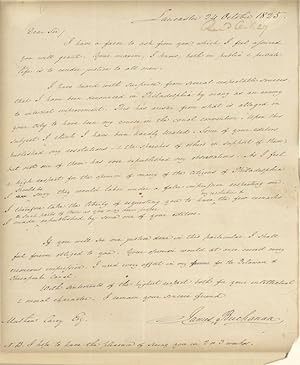
Autograph letter signed entirely in the handÂof the 15th President of the United States, James Buchanan to Philadelphia publisher Mathew Carey. Addressed to Mathew Carey, the letter reads, "Lancaster 24 October 1825. Dear Sir, I have a favor to ask you which I feel assured you will grant. Your maxim, I know, both in public and private life is to render justice to all men. I have heard with surprise from several respectable sources that I have been denounced in Philadelphia by many as an enemy to internal imprisonment. This has arisen from what is alleged in your city to have been my course in the canal convention. Upon this subject I think I have been hardly treated. Some of your editors published my resolutions and the speeches of others in support of them; but not one of them has ever published my observations. As I feel a high respect for the opinion of many of the citizens of Philadelphia I should be sorry they would labor under a false impression respecting me. I therefore take the liberty of requesting you to have my resolution and the few remarks I made or such parts of them that you may deem proper republished by some one of your editors. If you will see one justice done in this particular I shall feel forever obliged to you. Your opinion in this particular I shall feel forever obliged to you. Your opinion would at once correct every erroneous impression, I used every effort in my power for the Delaware and Chesapeake canal. With sentiments of the highest respect both for your intellectual and moral character. I remain your sincere friend, James Buchanan N.B. I hope to have the pleasure of seeing you in 2 or 3 weeks." Accompanied by the original mailing envelope addressed to Carey in Buchanan's hand. Irish-born American publisher Mathew Carey established himself as a publisher in Philadelphia by founding the Pennsylvania Herald in 1785 and Columbian Magazine in 1786. He published the firstÂRoman Catholic version of the Bible printed in the United States, America's first atlases, and frequently wrote on various social topics includingÂdebates in the state legislature. In very good condition with some browning to the page edges. The 15th President of the United States, James Buchanan, served immediately prior to the American Civil War. Buchanan aspired to be a president who would rank in history with George Washington with his tendencies toward neutrality and impartiality. Historians fault him, however, for his failure to address the issue of slavery and the secession of the southern states, bringing the nation to the brink of civil war.
-

President James Buchanan Returns Wilkes Expedition Hero Commander Andrew K. Long to the Active List ()
Seller: The Raab Collection, Ardmore, PA, U.S.A.
Seller rating 4 out of 5 stars
Signed
In 1838, six U.S. Navy vessels set out on a great voyage of exploration. Aboard were several hundred seamen and scientists under the command of Lt. Charles Wilkes. Authorized by Congress, the U.S. Exploring Expedition (also known as the Wilkes Expedition) would explored and mapped the Pacific, Antarctica, and the northwest coast of the United States. A tremendous feat of navigation, the expedition broadened knowledge of uncharted areas of the world and helped expand American commerce, industry, and scientific knowledge. It cemented the nation?s status as a new world economic leader.The USS Relief was part of the Wilkes Expedition. Launched in 1836 as a full-rigged ship of 468 tons and 7 guns, it in the late 1830s and 1840s served as a US Navy store ship. It completed a challenging journey after participating in the Wilkes Expedition, navigating severe storms near Cape Horn, and requiring repairs in Chile. It was also used to carry sick personnel and supplies, ultimately returning from the Pacific, arriving back in New York on March 28, 1840. In 1845, the USS Relief was actively operating as part of the Pacific Squadron, bolstering the fleet's supply capabilities. It played a key role in supporting U.S. naval operations along the South American coast during the 1840s. The captain of the USS Relief was Lieut. Commander Andrew K. Long, who was for meritorious service promoted by President John Tyler to the rank of Commander in 1845.In the 1850s Long went on the Reserve List, which contains all military reservists in active status but not on active duty. He remained part of the naval establishment; however, in time he wanted to return to active service. President James Buchanan obliged him. Document signed, with ornate engravings of an eagle, ships and Neptune, Washington, December 27, 1858, reinstating Andrew K. Long on the active list, and stating ?I have nominated and with the advice and consent of the Senate do appoint him a Captan in the Navy from the 14th of September 1855 on the ?Active List?? This is countersigned by Isaac Toucey, Secretary of the Navy. The reason the appointment was made retroactive for three years may have had something to do with pensions being higher on the active list.
-

President James Polk And Secretary Of State James Buchanan Sign Document During The Last 48 Hours Of Presidency
Seller: Stuart Lutz Historic Documents, Inc., South Orange, NJ, U.S.A.
Association Member: ABAA ESA ILAB
Seller rating 2 out of 5 stars

Signed
JAMES POLK (1795-1849). James Polk was the Eleventh President.JAMES BUCHANAN (1791-1868). Buchanan was the Fifteenth President.DS. 1pg. March 2, 1849. Washington D. C. A partly-printed document signed James K. Polk as President and James Buchanan as Secretary of State. They appointed George W. Clutter as Deputy Postmaster in Wheeling, Virginia. This document is signed by two Presidents, James K. Polk during his last 48 hours as president (he left on March 4, 1849), and James Buchanan, eight years before he served as president. George W. Clutter was a prominent figure in Virginia politics and a captain in the 13th U.S. Infantry during the Mexican-American War. In this document, he is appointed to Deputy Postmaster of Wheeling, Virginia. Fourteen years later, Wheeling would break away from Virginia during the Civil War with other northwestern counties to create West Virginia, with Wheeling being its first capital. The document is in fine condition with folds, a seal, dark signatures and professional framing.
-

US Land Grant Certificate to Milton C. McDaniel, Signed by President James Buchanan
Publication Date: 1857
Manuscript / Paper Collectible Signed
Condition: Very good. No jacket. Land grant certificate No. 17,465, to Milton C. McDaniel of Randolph County, Illinois, signed by President James Buchanan, dated June 1, 1957. Seal on bottom left corner is faded, and there is some soiling, but document is in very good shape.


![Seller image for [Kansas land grant; Abolition; Bleeding Kansas; John Brown] Kansas Land Deed on Parchment for Samuel Gridley Howe, signed by Secretary Albright for President James Buchanan, October 1, 1858 for sale by Silbergaul](https://pictures.abebooks.com/inventory/md/md32391039890.jpg)

